
- 1INAF-Astrophysical Observatory of Arcetri, Florence, Italy (teresa.fornaro@inaf.it)
- *A full list of authors appears at the end of the abstract
A primary objective of the NASA Mars 2020 Perseverance rover mission is the detection of organic matter on Mars, which may provide key insights into the past habitability of Mars and the potential presence of past life. Indeed, molecular biosignatures‒organic molecules diagnostic of biological processes‒may provide more direct evidence of biogenicity than other categories of biosignatures for which biological production is only inferred. However, the degradation of the molecules in the harsh Martian environment over time, along with the limitations of the space flight instruments and the possible transformations induced by the measurements themselves, makes it quite challenging to identify the original material and differentiate between biotic and abiotic organic matter.
The Perseverance rover utilizes a specialized suite of instruments to map minerals and organic distributions at a microscopic scale. Notably, the Scanning Habitable Environments with Raman and Luminescence for Organics and Chemicals (SHERLOC) instrument, a deep UV (DUV) Raman and fluorescence spectrometer, previously identified Raman features in the Quartier abrasion target on the Jezero crater floor that suggest the presence of aromatic organics within sulfate matrices [1].
This study builds upon previous findings by reporting similar Raman features in the Pilot Mountain target, located on the Jezero fan top. To interpret these signals, we carried out a systematic laboratory investigation and compared these SHERLOC observations with laboratory data from reference organo-sulfate samples to evaluate the possible organic sources for the detected spectroscopic features [2]. Specifically, we prepared organo-sulfate analog samples using a variety of aromatic organic compounds easily detectable by SHERLOC (both abiotic and of potential biotic origin), and characterized them with laboratory DUV Raman and fluorescence spectrometers analogous to SHERLOC, i.e. the ACRONM instrument located at NASA’s Johnson Space Center, the Brassboard instrument located at the Jet Propulsion Laboratory, and the Photon Systems RPL200 instrument located at INAF-Astrophysical Observatory of Arcetri, operated to mimic SHERLOC analysis.
Comparison between our laboratory dataset and SHERLOC observations for Quartier and Pilot Mountain shows that different types of aromatic organics in sulfates tested in this work‒naphthalene, 1- and 2-naphthol (HN), 1,3- and 2,6-dihydroxynaphthalene (DHN), 9-methylanthracene (9-MA), uracil and an oxy-PAH polymer synthesized from 1-HN (poly1-HN)‒exhibit intense C-C and C=C ring stretching bands (and C=O stretching bands in the case of compounds like uracil with carbonyl functional groups on the aromatic ring) at a variety of positions within the spectral regions of interest, though none of the tested organo-sulfate analogs exhibit fluorescence resembling the co-located fluorescence doublet at ~303 and 325 nm observed in Quartier and Pilot Mountain (Fig. 1). However, the polycyclic aromatic hydrocarbons (PAHs) 9-MA, 2,6-DHN and 1,3-DHN in magnesium sulfate fluoresce mostly outside the SHERLOC region, which may be consistent with an inorganic origin of the co-located fluorescence doublet, such as luminescence of Ce3+ in anhydrite [1,3], illustrating that similar types of three/two-ring aromatic organic molecules could be present.
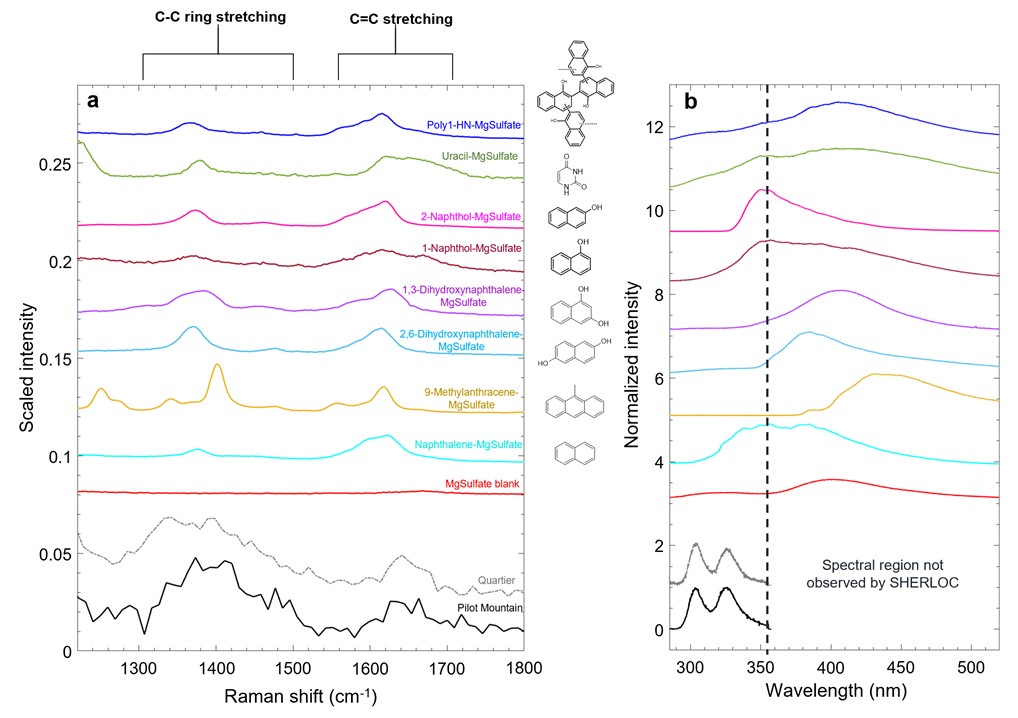
Fig. 1. Cross-comparison of the features of interest in Quartier and Pilot Mountain with spectra of organo-sulfate analogs for Raman (a) and fluorescence (b).
The association with igneous lithologies suggests that PAHs formed endogenously by igneous processes (Fig. 2). Their location in pores of the igneous rocks may be consistent with Fischer-Tropsch-like synthesis from trapped magmatic gases catalyzed by iron oxides. PAHs might have been subsequently preserved by sulfates precipitated in the pores of the igneous rocks as consequence of their aqueous alteration. Such salt-mediated preservation is particularly efficient on Earth, since sulfate minerals can trap organics within intracrystalline inclusions [4], and exhibit photoprotective properties [5,6].
Regional hydrothermal groundwaters associated with Syrtis Major volcanism might also have played a role in sulfate formation and PAH transportation, as well as in dissolving igneous rocks causing mobilization of Ce3+ and its transportation through fractures and precipitation as sulfate veins, which would explain the co-presence of Ce3+ and PAHs in these sulfates (Fig. 2).
The organo-sulfate association is consistent with studies on Martian meteorites [7] and observations from Gale crater [8] and reinforces the hypothesis that sulfates might have been key in the preservation and transport of organic molecules in the Martian environment and, hence, could have played a significant role in the Martian carbon cycle, influencing the availability and cycling of carbon compounds necessary for life.
Although we have not found evidence of biogenicity, we cannot exclude that the organics detected in these rocks might be resistant alteration products from the chemical weathering of ancient biotic compounds, and/or a correlation with the organic carbon of potential biotic origin detected in the Bright Angel formation [9]. With the limitations of Perseverance’s Raman and fluorescence spectroscopy techniques, addressing these various hypotheses would require further laboratory studies to retrace the chemical weathering processes that might have occurred at Jezero crater over time leading to the formation of the observed organics, and returning these samples to Earth for high sensitive analysis in Earth-based laboratories.
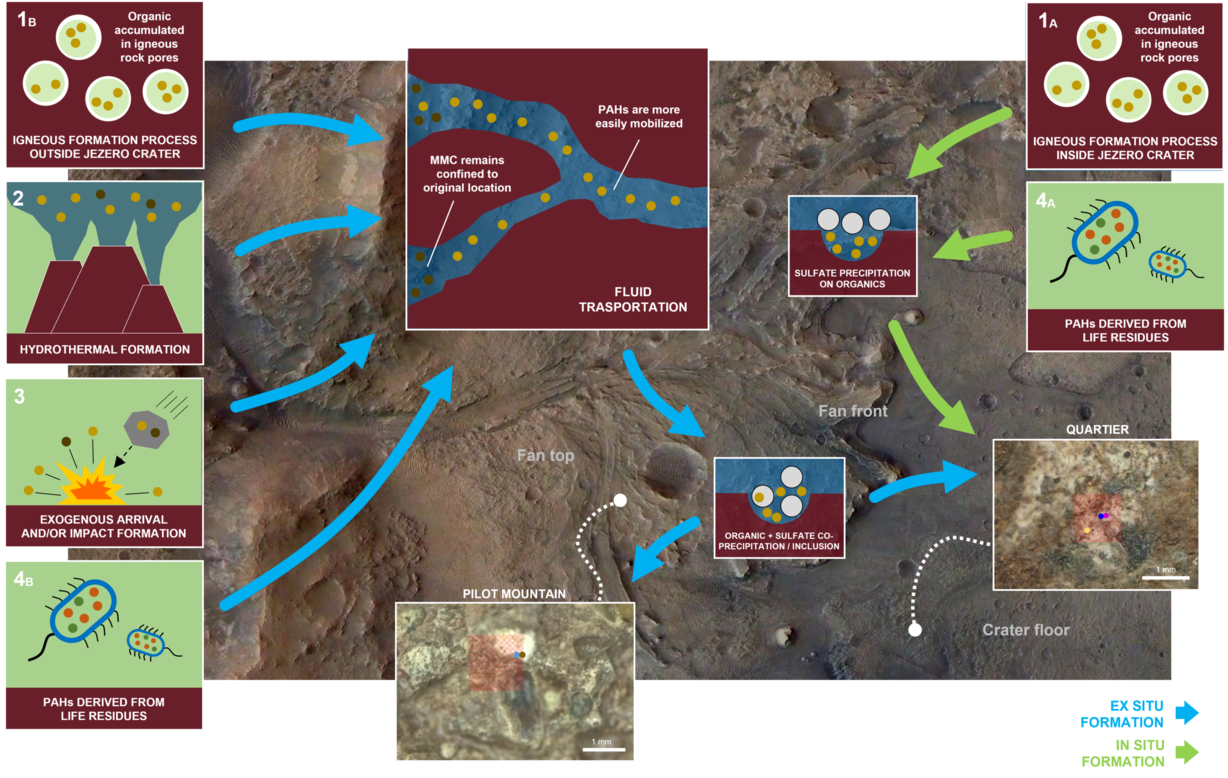
Fig. 2. Potential mechanisms for the presence of PAHs in sulfates in Quartier and Pilot Mountain.
Acknowledgments: This research was supported by the Italian Space Agency (ASI) through the ASI/INAF agreement no. 2025-12-HH.0, and by INAF Large Grant 2024.
References: [1] Sharma S. et al. (2023) Nature, 619, 724–732. [2] Fornaro T. et al. (2025) Nature Astronomy, 9, 1648–1661. [3] Haney N. C. et al. (2026) JGR-Planets, 131(3), e2025JE009385. [4] Sephton M. A. et al. (2023) J Geol Soc London, 180. [5] Alberini, A. et al. (2024) Scientific Reports, 14, 15945. [6] Alberini A. et al. (2025) Scientific Reports, 15(1), 40484. [7] Jaramillo E. A. et al. (2019) Geophys Res Lett, 46, 3090–3098. [8] Eigenbrode J. L. et al. (2018) Science, 360, 1096–1101. [9] Hurowitz, J. A. et al. (2025) Nature, 645(8080), 332–340.
S. Sharma, R. S. Jakubek, G. Poggiali, J. R. Brucato, R. Bhartia, A. Steele, A. E. Murphy, M. M. Tice, M. D. Schulte, K. P. Hand, M. D. Fries, W. J. Abbey, A. Alberini, D. Alvarado-Jiménez, K. C. Benison, E. L. Berger, S. Biancalani, A. J. Brown, A. P. Broz, W. P. Buckley, D. K. Buckner, A. S. Burton, S. V. Bykov, E. L. Cardarelli, E. A. Cloutis, S. A. Connell, C. Garcia-Florentino, F. Gómez, N. C. Haney, C. Lee, V. Lino, P. Manini, F. M. McCubbin, M. E. Minitti, R. V. Morris, Y. Phua, N. Randazzo, J. Razzell Hollis, F. Renzi, S. Siljeström, J. I. Simon, A. Srivastava, N. Tasinato, K. Uckert, R. C. Wiens and A. J. Williams
How to cite: Fornaro, T. and the Organo-Sulfate Analog Study Working Group: Aromatic Organic Compounds Associated with Sulfates at Jezero Crater: Insights from SHERLOC and Laboratory Analogs, Europlanet Science Congress 2026, The Hague, The Netherlands, 7–11 Sep 2026, EPSC2026-194, https://doi.org/10.5194/epsc2026-194, 2026.


