
 1,2,3
1,2,3- 1Department of Earth and Planetary Sciences, ETH Zurich, Zurich, Switzerland (xi.yang@eaps.ethz.ch)
- 2Geosciences Department, University of Freiburg, Freiburg, Germany
- 3Center for Space and Habitability, University of Bern, Bern, Switzerland
Extensional rift systems on Venus are widely distributed and provide important insights into Venus's past and current tectonic activities [1]. Outstanding questions for Venusian rifts relate to their driving forces and lithospheric properties, which have been explored by a few studies. Previous 2D geodynamic models [2] explored Venus rifting with limited tectonic extension rates (1 cm/yr) and very thin lithosphere, and indicated strong crustal rheology needed for rift localization and rift morphologies being strongly affected by crustal thickness. More recent 3D models of Venus rifting [3] showed different types of rifting morphologies with a 2 cm/yr extension rate that depend on crustal rheology, crustal thickness, and lithosphere thermal structure. Both of these geodynamic studies explored Venus rifting with visco-plastic incompressible rock rheologies.
Here, we use a state-of-the-art thermomechanical model I3ELVIS [4] that accounts for visco-elasto-plastic compressible rock rheology and plastic strain-induced weakening to investigate the rifting process on Venus. In particular, we test models with three different crustal rheologies [5]: plagioclase, dry diabase, and mafic granulite. The mantle material uses dry olivine [6], which accounts for grain size evolution (Zener pinning) [7]. We model the rifting with slow, moderate, and fast extension rates of 1, 3, and 10 cm/yr, respectively. To initialize spontaneously localizing rifting, we prescribe a 150-km-thick thermal lithosphere ( ~1650 K isotherm) that is slightly thinned in the middle. Of particular interest, we track the width of the rift flank uplift, which is defined as extending from the peak topography outward to where the flank uplift is indistinguishable from the surrounding terrain. For all modeled and observed rifts, this feature is extracted with a lateral resolution of 16 km, consistent with the global resolution of the Magellan measurements.
We find that the crustal rheology and the tectonic extension rate particularly influence fault formation during rifting. The diabase crust models subjected to small/moderate extension rates produce a rift valley characterized by several small-scale normal faults. When subjected to a fast extension rate, the diabase crust forms a rift valley with a set of conjugate normal faults and a dominant normal fault at the edge of the rift valley (Fig.1a). The stronger granulite crust subjected to a moderate (Fig.1b) or fast extension rate generates dominant detachment fault or a pair of conjugate normal faults, repsectively, and it only generates several sets of normal faults without a dominant normal fault when subjected to a slow extension rate. The weakest plagioclase crustal rheology generates a rift valley with fault-like topography only when subjected to a moderate or fast extension rate. We repeated all models with the extension rate of 10 cm/yr for a 100-km-thick lithosphere (~1625 K isotherm); none could generate a rift valley, demonstrating the need for a relatively thick thermal lithosphere.
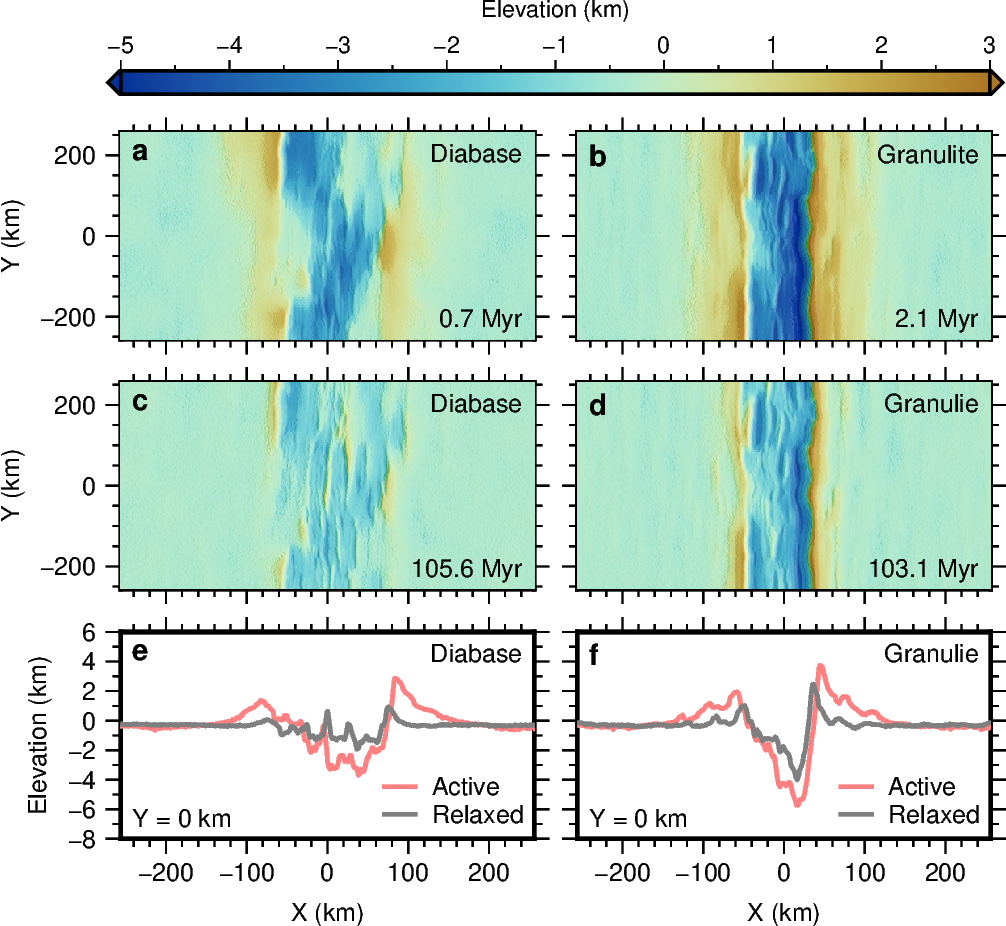
Fig.1 (a,b) Active and (c,d) relaxed topography and (e,f) their topographic profiles at Y = 0 km that are derived from the models of (a,c) the diabase crust subjected to an extension rate of 10 cm/yr and (b,d) the granulite crust subjected to an extension rate of 3 cm/yr. The (c,d) relaxation starts from the models (a,b) active models active models.
All rifts formed in our models generate wide rift flank uplifts with a median width >60 km. In particular, the strong mafic granulite crust with moderate to fast extension rates and the dry diabase crust rheology with fast extension rates show a median flank uplift width exceeding 120 km (e.g., Fig.1a,b). To investigate whether the wide uplifted rift flanks can serve as evidence for active rifting, we investigate the isostatic relaxation of rifts by continuing the same numerical models with zero extension rate. After about 100 Myr of relaxation, the median widths of rift flank uplift in the diabase and granulite crust decrease to <30 (Fig.1c) and 50 km (Fig.1d), respectively, demonstrating that wide rift flank uplifts (>100 km) are indeed a signature of currently or recently active rifting (Fig.1e,f).
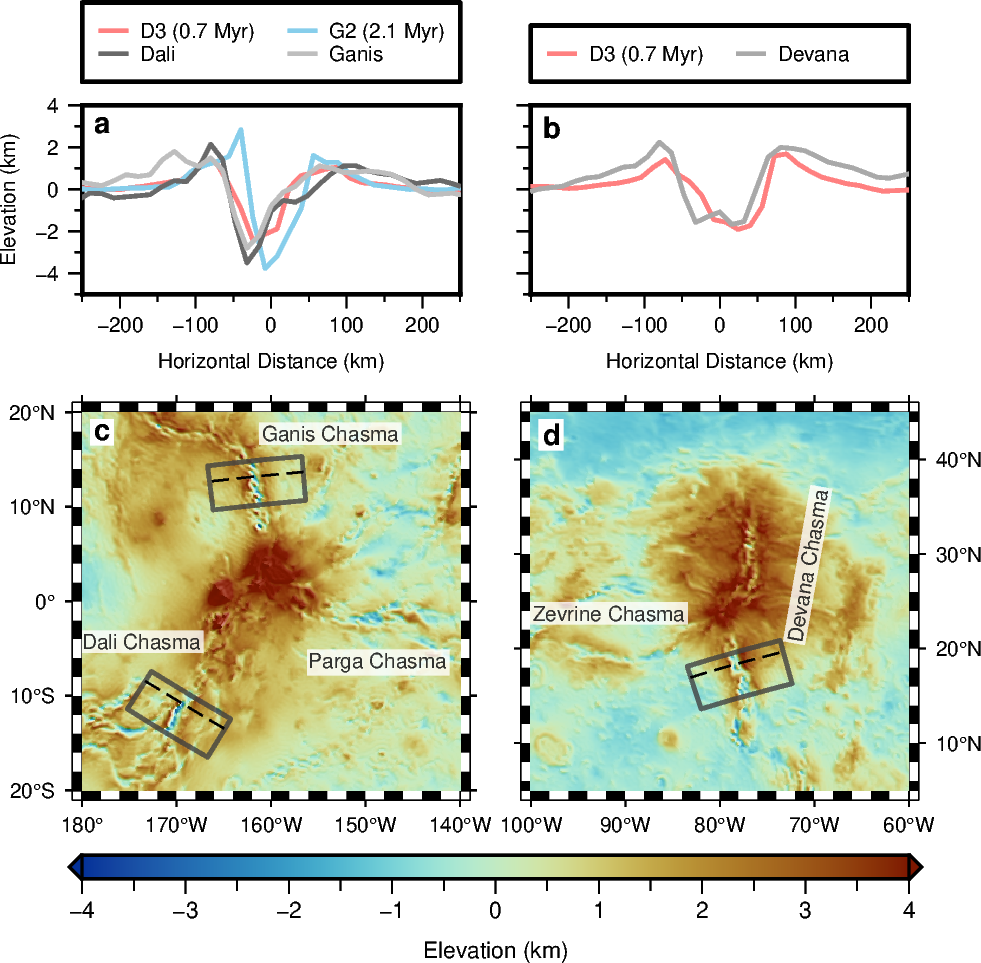
Fig.2 (a,b) The topographic profiles and (c,d) regional topographic maps of (a,c) Alta and (b,d) Beta Regiones. The profiles are oriented from West to East, and their location are denoted by dashed black lines. (a,b) Down-sampled (16 km) topographic profiles from models of the diabase crust subjected to a 10 cm/yr extension rate (D3) and the granulite crust subjected to a 3 cm/yr extension rate (G2), respectively. (c,d) The gray boxes denote the regions used to extract the median width of rift flank uplifts.
We analyze the topography of rift valleys from Ganis, Dali, and Devana chasmata; their median width of rift flank uplifts is about 110, 160, and 180 km, respectively (Fig.2c,d). Comparing these profiles to our results suggests that the rift valleys of these chasmata are presently or recently (within a few tens of Myr) active. Furthermore, our models favor a dry diabase crust with a high extension rate or a mafic granulite crust with a moderate extension rate, which generates a similar topography of rift valleys (Fig.2a,b). These are aligned with previous studies suggesting that the Venusian crust should be basaltic with mafic rheology [8-10] and previous rifting models [2,3]. The preferred rapid extension rate might be associated with plume-lithosphere interactions in the studied regions, which needs future testing.
Reference:
[1] Price, M. & Suppe, J., EM&P (1995). [2] Regorda, A. et al., JGR-Planets (2023). [3] Gülcher, A. et al., EPSL (2025). [4] Gerya, T. (2019) [5] Ranalli, G. (1995). [6] Hirth, G. et al., Geophys. Monogr. Ser (2004). [7] Bercovici, D. & Ricard, Y., Phys. Earth Planet. Inter. (2012). [8] Foster, A. & Nimmo, F., EPSL (1996). [9] Mackwell, S. et al., JGR-Solid Earth (1998). [10] Nimmo, F. & Mackwell, S., PNAS (2023).
How to cite: Yang, X., Gerya, T., and Gülcher, A.: Wide rift flank uplifts suggest active rifting on Venus, Europlanet Science Congress 2026, The Hague, The Netherlands, 7–11 Sep 2026, EPSC2026-201, https://doi.org/10.5194/epsc2026-201, 2026.


