
 1,2,4,1
- 1Observatoire de la Côte d’Azur, Université Côte d’Azur, Nice, France (hagrusa@oca.eu)
- 2Centre national d’études spatiales (CNES), Paris, France
- 3Department of Physics, University of Helsinki, Helsinki, Finland
- 4Department of Astrophysics, University of Zurich, Zurich, Switzerland
Contact binaries are common among small bodies throughout the Solar System. Based on radar images, ~10-30% of all NEAs larger than ~200 m are thought to be contact binaries [1,2], though their origin remains poorly explained. NASA’s Lucy mission recently encountered the main-belt asteroid 52246 Donaldjohanson (DJ), revealing its bilobate shape. DJ’s cratering age and YORP spin-down timescale are both consistent with the age of its collisional family (Erigone, ~150 Myr) [3,4], suggesting that its bilobate shape could be a direct product of catastrophic disruption and reaccumulation.
We perform smoothed-particle hydrodynamics (SPH) simulations of the collisional disruption of a 100 km asteroid followed by the subsequent gravitational reaccumulation of fragments using a N-body code with the soft-sphere discrete element method (SSDEM) for interparticle friction forces. With recent algorithmic improvements and GPU acceleration, we can simulate asteroid family formation using ~108 particles, roughly ~3 orders of magnitude beyond previous studies, resolving the spins and shapes of km-sized fragments. A preliminary low-resolution simulation is shown in Fig. 1, where we find roughly ~20% of the reaccumulated fragments form bilobate shapes as a result of hierarchical growth of debris, leading to frequent low-speed mergers of similarly sized objects. In addition to explaining the formation of asteroid Donaldjohanson, this high contact-binary fraction suggests that catastrophic disruptions may be the dominant formation mechanism for contact binaries observed among NEAs. We will present what are, to our knowledge, the highest-resolution simulations of asteroid catastrophic disruptions to date, and explore how contact-binary properties depend on material properties and impact conditions (friction, impact energy, target rotation, etc.).
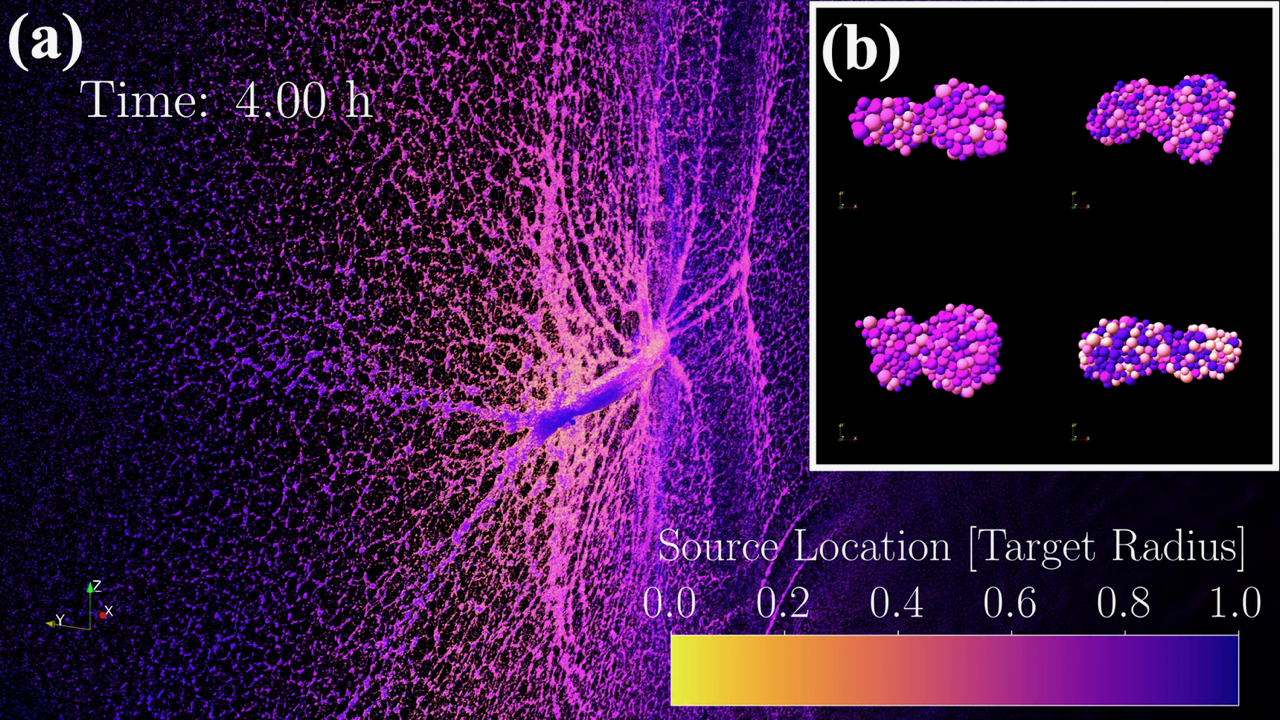
Figure 1: (a) A snapshot showing the gravitational reaccumulation of particles 4 hours after a collision between a 25 km projectile and a 100 km target at an impact speed of 5 km/s and angle of 45°. (b) Renderings of four km-scale contact binaries ~50 hours after the collision. Particle colors indicate their source location within the parent body.
References
1. Benner, et al., in Asteroids IV, Radar observations of Near-Earth and Main-Belt Asteroids, 2015, 165-182.
2. Virkki, et al., PSJ, Arecibo Planetary Radar Observations of Near-Earth Asteroids: 2017 December–2019, 2022, 3:222, 36.
3. Marchi et al., PSJ, A Pre-flyby View on the Origin of Asteroid Donaldjohanson, a Target of the NASA Lucy Mission, 2025, 6:59, 19.
4. Bierhaus et al., EPSC-DPS Joint Meeting 2025, An overview of the geology on the C-type Main Belt asteroid (52246) Donaldjohanson from NASA's Lucy flyby.
How to cite: Agrusa, H., DeMartini, J., Meier, T., and Michel, P.: Catastrophic disruptions as the origin of contact-binary asteroids, Europlanet Science Congress 2026, The Hague, The Netherlands, 7–11 Sep 2026, EPSC2026-202, https://doi.org/10.5194/epsc2026-202, 2026.


