

- Charles University, Faculty of Mathematics and Physics, Department of Geophysics, Praha 2, Czechia
Introduction
Missions Galileo and Juno have significantly advanced our understanding of Jovian moons. Through their measurements, these missions unveiled the possible presence of subsurface water oceans. Building on these discoveries, upcoming missions, JUICE and Europa Clipper, hold the potential to further enhance characterisation of the internal structure by delivering new and/or improved data, including tidal deformation and magnetic induction measurements ([1], [2], [3]).
Our study aims to characterise the internal structure of Europa. We employed a combination of known material properties ([4], [5], [6], [7]) alongside measured satellite data to assess Europa’s plausible internal structures. Among data we included total mass (M), radius (Rsurf), moment of inertia (MOI) [8], as well as amplitude of magnetic induction measured at synodic period (Asyn), obtained from Gallileo [9], new measurement of the ice shell thickness (DIh), measured by Juno [10], as well as anticipated tidal Love number k2 into our statistical analysis, aiming to enhance our understanding of the moons' structural characteristics.
Model
We numerically evaluate the internal density, pressure, and temperature profiles, assuming known structural parameters, which represent our a priori information about possible structures: the total radius, core and mantle radii, densities of mantle and core, salinity Cw, and surface heat flux. From these, we derive data values predicted for each assumed structure.
For the thermal profile, we assume conductive heat transfer in the ice shell, and an adiabatic profile in the liquid ocean. Equations of state (EOS) and parameters describing the hydrosphere’s material properties are adopted from [4], [5], [6],[7], while the core and mantle properties are simplified.
For each model, we also evaluate tidal deformation, using a library based on [11], as well as magnetic induction response, using code based on [12].
To determine the interior structures, that are consistent with measured data, such as measured values for M, MOI and Rsurf, along with Asyn [9], DIh [10], and anticipated k2, along with their uncertainties, we apply a statistical approach by coupling our model with emcee sampler [13], that uses the Markov chain Monte Carlo method, which samples posterior distributions of internal structure parameters. We test several combinations of measured data and analyse how the used dataset impacts statistical distribution of the parameters.
Results
We assumed models, where Europa is either fully differentiated into the hydrosphere, mantle, and core, or a model with only the hydrosphere and a silicate-iron inner layer, to assess the structure. We analysed the internal structure for two different salts present in the ocean: MgSO4 and NaCl.
We compared the resulting internal structures as additional data information was gradually incorporated. The most significant change was the variation in surface ice shell thickness among tested dataset configurations. Models that incorporated information about Asyn preferred very thin ice shell thicknesses, compared to other models.
We then studied resulting structures for models, where the inner layer was not fully differentiated for both salts. Our results showed that their structures preferred thicker hydrospheres, when compared with models where we had differentiated mantle and core.
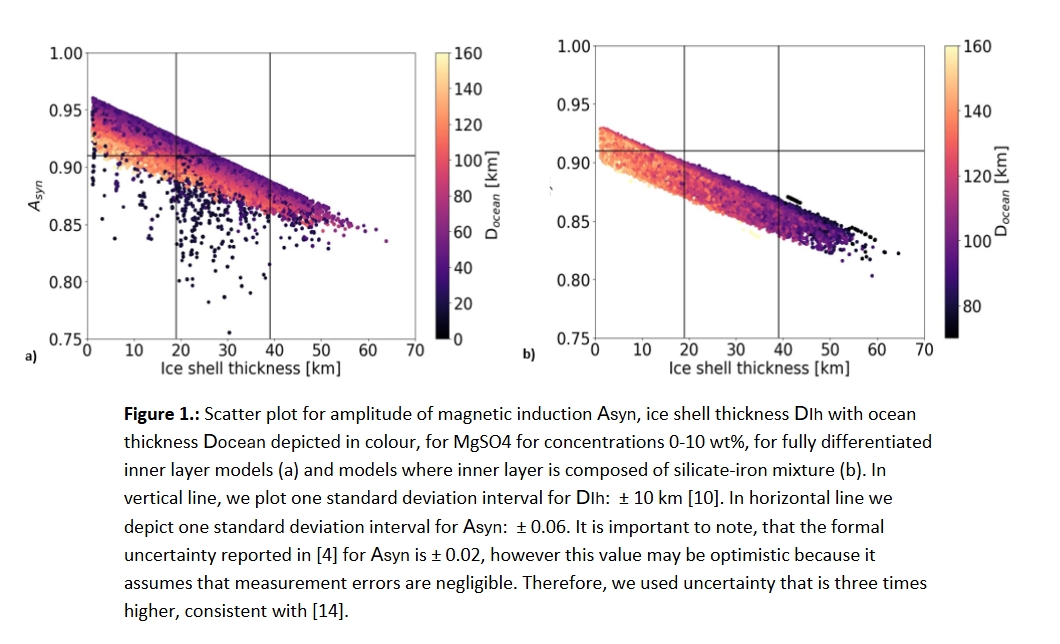
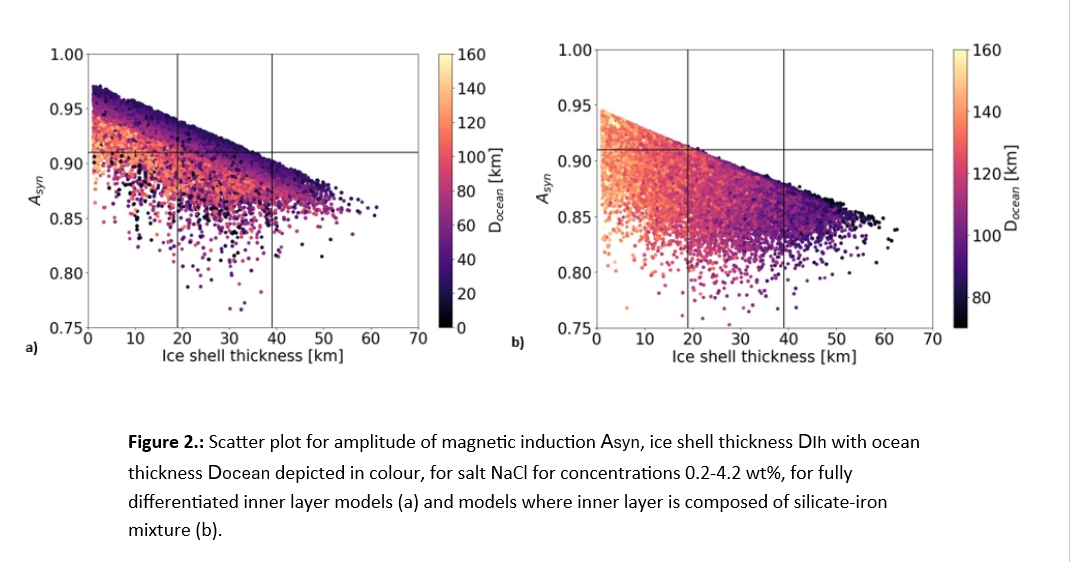
We then plotted the resulting structures as functions of DIh with respect to Asyn, marking the regions where both the measured values of DIh and Asyn fall within one-sigma standard deviation range. The results are depicted in Figure 1, for MgSO4, and Figure 2, for NaCl.
Our results showed that, across all models, most of the resulting structures do not fall within the one-sigma interval for DIh and Asyn. For the models where 0-10wt% MgSO4 was present, to be consistent with both measured data, Europa must have at least a partially differentiated core and mantle. In the case of 0.2-4.2wt% NaCl, we found structures that fall within one-sigma range of both measurements, with or without differentiated mantle and core, due to the higher conductivity of NaCl compared to MgSO4. It is important to note that, in the presence of NaCl, we worked with a narrower range of concentrations than for MgSO4, so it is plausible that if higher concentrations had been allowed, it could yield a larger number of compatible models for NaCl.
Summary
We modelled the internal structure of Europa, considering the existence of both mantle core, as well as only layer composed of iron-silicate mixture, for compositions of MgSO4 and NaCl. We employed Markov chain Monte Carlo, using emcee library. In the dataset we also included information about magnetic induction and ice shell thickness. We found if MgSO4 is present, for models to be compatible with both measurements, Europa’s deep interior must be at least partially differentiated.
Acknowledgement
This research was supported by Charles University through project No. 142125 and by the Czech Science Foundation (project No. 26-21877S).
References
[1] Cappuccio et al. (2020). https://doi.org/10.1016/j.pss.2020.104902
[2] Cappuccio et al. (2022). https://doi.org/10.3847/PSJ/ac83c4
[3] Mazarico et al. (2023). https://doi.org/10.1007/s11214-023-00972-0
[4] Vance and Brown (2013). https://doi.org/10.1016/j.gca.2013.01.040.
[5] McDougall and Barker (2011). ISBN: 978-0-646-55621-5.
[6] Pan, Yong and Secco (2020). https://doi.org/10.1029/2020GL090192
[7] Journaux et al. (2020). https://doi.org/10.1029/2019JE006176
[8] Gomez Casajus et al. (2022). https://doi.org/10.1029/2022GL099475.
[9] Schilling, Khurana and Kivelson (2004). https://doi.org/10.1029/2003JE002166
[10] Levin et al. (2026). https://doi.org/10.1038/s41550-025-02718-0
[11] Sabadini and Vermeersen (2004). ISBN: 978-1-4020-2285-8
[12] Pěč et al. (1991). https://doi.org/10.5636/jgg.43.295.
[13] Foreman-Mackey et al. (2013). https://doi.org/10.1086/670067
[14] Petricca et al. (2023). https://doi.org/10.1029/2023GL104016
How to cite: Košíková, T. and Běhounková, M.: The Impact of the Geophysical Constraints on the Internal Structure of Europa , Europlanet Science Congress 2026, The Hague, The Netherlands, 7–11 Sep 2026, EPSC2026-206, https://doi.org/10.5194/epsc2026-206, 2026.


