OPS6 | Exploring the Jupiter system through unique Juice and Europa Clipper synergies

OPS6

Exploring the Jupiter system through unique Juice and Europa Clipper synergies
Conveners: Sam Fayolle, Audrey Vorburger, Corey Cochrane, Hao Cao, Lorenz Roth
Orals WED3
| Wed, 09 Sep, 14:00–15:30 (CEST)|Room Jupiter (Jazz 1 & 2)
Orals WED4
| Wed, 09 Sep, 16:00–17:30 (CEST)|Room Jupiter (Jazz 1 & 2)
Posters THU-POS
| Attendance Thu, 10 Sep, 18:00–19:30 (CEST) | Display Thu, 10 Sep, 08:30–19:30|Foyer 3, F3.15–34
Wed, 14:00
Wed, 16:00
Thu, 18:00
Jupiter’s icy moons - Europa, Ganymede, and Callisto - are at the center of planetary science curiosity, particularly in the search for habitability in the solar system. In this context, ESA’s Jupiter Icy moons Explorer (Juice) is on its way to the Jovian system after its successful Venus gravity assist in August 2025 and is joined by NASA’s Europa Clipper following its launch in October 2024 and its Mars flyby in March 2025.

This session invites contributions from the science community related to these two missions’ objectives. This includes, but is not limited to, better understanding of Jupiter icy moons’ surface properties, internal structures and dynamics, as well as implications for habitability. The session will also cover the moons’ complex interactions with the space environment and their dynamical evolution within the Jovian system. Finally, abstracts related to observations and future science opportunities during cruise are also welcome.

As we reflect on this unique opportunity of having two spacecrafts in the Jovian system at the same time, the session will highlight the scientific opportunities offered by each mission as well as by the dual-spacecraft configuration, emphasizing the synergistic potential of Europa Clipper and Juice.

Orals WED3: Wed, 9 Sep, 14:00–15:30 | Room Jupiter (Jazz 1 & 2)

Chairperson: Sam Fayolle
Missions updates, instruments & planning
14:00–14:15
|
EPSC2026-72
|
solicited
|
On-site presentation
Olivier Witasse, Claire Vallat, Nicolas Altobelli, and Angela Dietz

The JUpiter ICy Moons Explorer (JUICE) is the first large-class mission in ESA’s Cosmic Vision programme. Launched on 14 April 2023 from Kourou, the spacecraft is en route towards Jupiter. After arrival in July 2031, JUICE will spend approximately four years studying the Jupiter system, performing multiple flybys of three of its Galilean icy moons before entering orbit around Ganymede for its final year. The mission will investigate conditions that may support habitable environments within the satellites, all of which are thought to contain subsurface liquid water oceans. JUICE will also conduct a global investigation of the Jupiter system as the archetype for giant planet systems throughout our Universe. Interactions between the moons and the magnetosphere, as well as tidal and gravitational evolution within the Galilean system, will also be assessed. Additional targets include the innermost Galilean moon, Io and its plasma torus, the minor and irregular moons, and the ring systems.

To fulfil its scientific goals, JUICE is equipped with ten advanced scientific instruments dedicated to geophysical, in-situ, and remote-sensing investigations, and a radiation monitor, and includes one experiment using the spacecraft’s telecommunications system to connect with ground‑based radio telescopes.

This presentation will provide a brief status update as of the time of the conference (September 2026), present an overview of observations performed so far during the cruise phase, in particular during the 3I/ATLAS campaign, and outline the prospects for the second Earth gravity‑assist flyby. Ongoing areas of collaboration between JUICE and Europa Clipper will also be discussed.


How to cite: Witasse, O., Vallat, C., Altobelli, N., and Dietz, A.: The ESA Jupiter Icy moons Explorer (JUICE) mission: September 2026 status report, Europlanet Science Congress 2026, The Hague, The Netherlands, 7–11 Sep 2026, EPSC2026-72, https://doi.org/10.5194/epsc2026-72, 2026.

14:15–14:30
|
EPSC2026-284
|
solicited
|
On-site presentation
Haje Korth, Robert Pappalardo, and Bonnie Buratti

NASA’s Europa Clipper mission is on course to begin its investigation of the Jovian system in 2030, where it will assess Europa’s potential habitability through a coordinated suite of remote-sensing and in-situ measurements. While the mission’s primary science campaign lies ahead, the cruise phase provides opportunities to commission flight hardware, refine operational concepts, and conduct initial calibrations and performance tests under conditions that cannot be fully reproduced on the ground. The Mars-Earth gravity-assist trajectory therefore serves both as a means of reaching Jupiter, and as an important step in preparing the observatory for the demanding environment and tightly coordinated operations required at Europa.

Europa Clipper launched on 14 October 2024 and completed its Mars gravity assist on 1 March 2025. That encounter enabled early in-flight validation across several investigations: The Europa THermal EMission Imaging System (E-THEMIS) acquired Mars observations to support validation of a nonlinearity correction for one thermal band, the Radar for Europa Assessment and Sounding: Ocean to Near-surface (REASON) performed its first complete end-to-end radar test through closest approach, and the Gravity and Radio Science (G/RS) team exercised flyby gravity science tracking procedures with open-loop receivers from NASA’s Deep Space Network. Then in November 2025, the Europa Ultraviolet Spectrograph (Europa-UVS) observed interstellar comet C/2025 N1 ATLAS near the comet’s closest approach to Earth, obtaining data useful ultraviolet data for calibration and compositional assessment. Finally, the Europa Clipper Magnetometer (ECM) and the Plasma Instrument for Magnetic Sounding (PIMS) have been operating regularly in cruise to mitigate technical risk and to facilitate frequent solar wind calibrations. These activities demonstrate how cruise operations can reduce risk, improve instrument characterization, and produce scientifically useful measurements prior to Jupiter arrival.

The mission’s Earth flyby on 3 December 2026, will provide a more comprehensive rehearsal of Europa Clipper’s payload and spacecraft capabilities. Earth’s well-characterized magnetic, plasma, atmospheric, thermal, optical, and radiation environments offer a uniquely valuable calibration and operational target. The encounter will support absolute calibration of ECM using Earth’s magnetic field and crosscalibration of the PIMS Faraday cup measurements against plasma observations from other near-Earth spacecraft.

Additional calibrations and characterizations are being considered for implementation. REASON could use terrestrial lightning over the Amazon and/or Africa to characterize the radar beam pattern and could test receiver performance using transmissions from Owens Valley Radio Observatory. Within the Van Allen radiation belts, the Europa Imagin System (EIS) could acquire visible camera observations despite its cover being closed, to evaluate susceptibility to a radiation environment that is a precursor to future operations at Jupiter. E-THEMIS could use Earth and Moon observations, coordinated with Europa-UVS whenever possible, to calibrate its extended thermal range and to validate radiometric performance using the cold lunar nightside, the only pre-arrival target approaching Europa-relevant low temperatures. Europa-UVS could test stellar occultations of UV-bright stars by Earth and the Moon to prepare for probing Europa’s atmosphere and could observe terrestrial airglow near closest approach as an analog for future Europa measurements. Europa-UVS, E-THEMIS, EIS, and the Mapping Imaging Spectrometer for Europa (MISE) infra-red spectrometer could conduct a joint-scan demonstration of coordinated multi-instrument pointing, despite the EIS and MISE covers being closed.

Additional spacecraft and payload activities could broaden the encounter’s value as an operational test. Star-tracker imaging of Earth could test whether engineering sensors can provide scientifically useful data products. Check-outs of the SUrface Dust Analyzer (SUDA) dust analyzer and the MAss Spectrometer for Planetary Exploration (MASPEX) neutral gas mass spectrometer could assess instrument compatibility and operational behavior in the modest radiation environment near Earth. G/RS Doppler tracking could test telecommunications modes and antenna switching, while RadMon radiation monitor and the Canary Box MOSFET transistor monitor will characterize the performance of these engineering subsystems in the Earth’s Van Allen belts.

Together, the Mars and Earth gravity-assist activities, opportunistic cruise observations, and coordinated calibration campaigns form an end-to-end preparation program for Europa Clipper. By validating instrument performance, testing coordinated operations, and exposing spacecraft systems to relevant natural environments before Jupiter arrival, these cruise-phase activities increase confidence that the observatory will be ready to execute its Europa science campaign and address the mission’s central objective: determining whether Europa has conditions suitable for life.

How to cite: Korth, H., Pappalardo, R., and Buratti, B.: Earth Encounter: Advancing Europa Clipper Readiness Through Cruise-Phase Flyby Operations, Europlanet Science Congress 2026, The Hague, The Netherlands, 7–11 Sep 2026, EPSC2026-284, https://doi.org/10.5194/epsc2026-284, 2026.

14:30–14:42
|
EPSC2026-553
|
ECP
|
On-site presentation
Adel Malatinszky, Stavros Kotsiaros, Olivier Witasse, Claire Vallat, Nicolas Altobelli, Lucas Liuzzo, Elias Roussos, Marco Pinto, Angelica Sicard, Quentin Nenon, Angela Dietz, Arnaud Boutonnet, and Hugh Evans

Planetary missions to Jupiter face extreme challenges due to its intense radiation environment, one of the harshest in the Solar System. High-energy particles trapped in Jupiter’s magnetosphere can severely impact spacecraft systems and scientific instruments, requiring careful mitigation in trajectory planning and operations. The ESA JUICE (JUpiter ICy moons Explorer) mission addresses these hazards through optimized shielding, radiation-aware trajectory selection, and adaptive payload operations. A dedicated Radiation Working Group supports the mission through a variety of analyses aimed at assessing the harsh Jovian radiation environment and ensuring mission success. The activities of the working group can be divided into categories of modelling advancements and analysis which aims to support the mission operations to make the best possible decisions regarding the trajectory of JUICE by the end of 2026. We highlight in this presentation three of its activities: 1) refinement of the Jovian radiation environment estimations 2) Re‑evaluation of Ganymede’s magnetospheric shielding and its possible influence on the total ionizing dose experienced by JUICE across different trajectory and orbital configurations, and 3) radiation environment monitoring.

The “high latitude” phase up to 35 degrees inclination above the Jupiter equator during the Jupiter tour requires an update of the radiation model. In this context, the JOvian Specification Environment (JOSE) radiation model [SPENVIS] is being updated by ONERA. The Radiation Working Group is responsible for assessing the performance of existing radiation models and for testing the updated model (JOSE‑2) once it becomes available.

The Ganymede phase of JUICE’s mission is the largest contributor 58% of the total ionizing dose (TID) during the mission due to its extensive residence and position in Jupiter’s radiation belt. Ganymede possesses its own magnetosphere which is of high scientific interest and can act as a partial shield by deflecting energetic particles, potentially reducing the flux of incident Jovian particles at lower altitudes. at lower altitudes. Therefore, the estimation of shielding effect is crucial to calculate the TID JUICE will experience. Different models have been developed to compute the reduction in TID due to shielding. The Ganymede Radiation Environment Engineering Tool (GREET) developed by Kallisto Consultancy Ltd, which calculates electron flux spectra at different orbits depending on relative position to Ganymede, was originally used to generate environmental specification data. However, ongoing work by Liuzzo et al. [e.g. Liuzzo et al. 2020] since 2016 has introduced new advanced approach to shielding by as an example considering the plasma interaction with the current sheet of Jupiter. The results will show how the different approaches modified the flux predictions for the JUICE trajectory.

To monitor the harsh Jovian environment, JUICE carries an advanced radiation monitoring system, RADEM [Hajdas et al 2025], capable of measuring high-energy electrons, protons and ions. The mission also has a Juice Monitoring Unit (JMU) inside its electronics vault which will be used to compare the flux measured outside the spacecraft with RADEM with the TID inside the vault. In addition, instrument background (e. g. CCD noise) and radiation effects such as Single Event Upsets to on-board memories, will be correlated with various sources of energetic particles, providing unique information about the radiation environment.

References:

[SPENVIS] European Space Agency. (n.d.). TREP/JOREM model. SPENVIS. Retrieved May 11, 2026, from SPENVIS TREP/JOREM page

[Liuzzo et al. 2020] Liuzzo, L., Poppe, A. R., Paranicas, C., Nénon, Q., Fatemi, S., & Simon, S. (2020). Variability in the energetic electron bombardment of Ganymede. Journal of Geophysical Research: Space Physics, 125, e2020JA028347. https://doi.org/10.1029/2020JA028347

[Hajdas et al, (2025)]  Hajdas, W., Gonçalves, P., Pinto, M. et al. The JUICE Radiation Environment Monitor, RADEM. Space Sci Rev 221, 43 (2025). https://doi.org/10.1007/s11214-025-01163-9

How to cite: Malatinszky, A., Kotsiaros, S., Witasse, O., Vallat, C., Altobelli, N., Liuzzo, L., Roussos, E., Pinto, M., Sicard, A., Nenon, Q., Dietz, A., Boutonnet, A., and Evans, H.: Assessing the Jovian Radiation Environment and its Impact on ESAs JUpiter ICy moons Explorer mission, Europlanet Science Congress 2026, The Hague, The Netherlands, 7–11 Sep 2026, EPSC2026-553, https://doi.org/10.5194/epsc2026-553, 2026.

14:42–14:54
|
EPSC2026-1166
|
On-site presentation
Thibault Cavalié, Ladislav Rezac, Raphael Moreno, Eva Wirström, Paul Hartogh, Miriam Rengel, Hideo Sagawa, Camille Lefour, Thierry Fouchet, Christopher Jarchow, Emmanuel Lellouch, Samuel Goodyear, Borys Dabrowski, and Pierre Mancini

The Jupiter Icy Moons Explorer (JUICE) is the first L-class mission of the Cosmic Vision 2015-2025 program of the European Space Agency. JUICE was launched in April 2023 and embarked on an 8-year interplanetary transfer to reach Jupiter and its system. It will perform its Jupiter orbit insertion in July 2031 and start its nominal science phase. JUICE will orbit the planet about 60 times until its Ganymede orbit insertion (GOI) at the end of 2034. This Jupiter tour will comprise 2 close flybys of Europa, and many more flybys of Ganymede and Callisto. After starting the Jupiter tour in the equatorial plane of the planet, JUICE will spend many months in inclined orbits reaching inclinations of up to ~ 35 degrees before going back to the equatorial plane in preparation of GOI.

The payload of JUICE comprises 10 science instruments. One of the remote sensing instruments is the Submillimetre Wave Instrument (SWI), which was designed to study the composition, chemistry and dynamics of the atmospheres of Jupiter and the Galilean Moons. It will also investigate the surface properties of the moon surfaces. SWI is an off-axis single dish telescope with 29 cm diameter equipped with two perpendicular pointing mechanisms that allow to point ±72° along track and ±4.3° cross track from the nadir direction of the JUICE platform during the Jupiter tour. It is a heterodyne spectrometer and radiometer that can be tuned independently and simultaneously in two submillimetre bands (530-638 GHz and 1066-1286 GHz). The highest spectral resolution is achieved with the Chirp Transform Spectrometers that cover 1 GHz bandwidth with 10000 channels. SWI is thus a miniaturized observatory with all the inherent complexity implied for observation planning.

The JUICE Science Operation Center (JSOC) is conducting planning exercises every year before JOI. These exercises serve the purpose of developing the science observation implementation procedures and the relevant software tools (both at the ESA and instrument team levels) that will ensure smooth operations during the science phase. In parallel, the four JUICE science working groups are continuously consolidating and extending the JUICE science objectives. They also identify multi-instrument synergies and propose coordinated observation campaigns.

The latest planning exercise occurred in the first semester of 2026 and focused on two equatorial orbits, namely orbits 37 and 38, that include a close Ganymede flyby. It spans from 23 November to 20 December 2033, with the flyby occurring on 27 November 2033. The flyby inbound is mostly on the nightside and the outbound on the dayside, with a closest approach at ~900 km altitude. The orbits also provide opportunities for Io, Europa and Callisto observations with apparent sizes sufficiently large so that enable to map them.

The implementation of the JUICE observing plan follows a multi-step approach (observation plan, pointing timeline, instrument timeline) coordinated by JSOC. A significant effort by JSOC and the instrument teams concerned the identification and implementation of common/complementary observations in the design the spacecraft pointing profile to maximize the science return of the mission in these orbits and flyby. Following the latest JUICE science synergy workshop (ESAC, January 2026), several coordinated campaigns have been implemented in the 2026 planning exercise and helped making the implementation of the timeline more efficient. Of particular interest for SWI are the following coordinated campaigns: zonal winds, distant monitoring and auroral monitoring for Jupiter, and a coordinated mapping of the Ganymede dayside on the flyby outbound leg.

For what concerns SWI, the observation sequences pre-defined are complemented with other SWI observations, that can be either prime or ride-along observations. For Jupiter, those include: (i) temperature and winds observations with Jupiter limb scans, (ii) searches for isotopes and new species with limb stares and scans, (iii) temperature and composition measurements by means of regional mapping observations (including the auroral regions). During the flyby Ganymede, SWI will perform surface and exosphere regional mapping observations from the largest distances during the flyby and a series of limb stares and scans to investigate the composition, temperature and winds of its exosphere a few hours from closest approach. Moreover, SWI aims to conduct a monitoring of the Galilean Moons surfaces and exospheres on a daily basis, dedicating about 1 hour per day of operations, to investigate the various processes acting as sources and sinks for the exospheres. Finally, SWI will support observation campaigns initiated and led by other instruments and the latest planning exercise proposed several examples of those, like: (i) stellar and Earth radio occultations for which SWI will observe the temperature, composition and winds of the target at the latitudes/longitudes of the ingress/egress, and (ii) Io and Europa closest distance observations.

How to cite: Cavalié, T., Rezac, L., Moreno, R., Wirström, E., Hartogh, P., Rengel, M., Sagawa, H., Lefour, C., Fouchet, T., Jarchow, C., Lellouch, E., Goodyear, S., Dabrowski, B., and Mancini, P.: SWI observation strategy for the Jupiter Tour of the JUICE nominal science phase as exemplified by the latest ESA planning exercise, Europlanet Science Congress 2026, The Hague, The Netherlands, 7–11 Sep 2026, EPSC2026-1166, https://doi.org/10.5194/epsc2026-1166, 2026.

14:54–15:06
|
EPSC2026-1224
|
On-site presentation
Stas Barabash, Pontus Brandt, Peter Wurz, Martin Wieser, Gabriella Stenberg Wieser, Manabu Shimoyama, Norbert Krupp, Markus Fraenz, Elias Roussos, Audrey Vorburger, George Clark, Donald Mitchell, Peter Kollmann, and Leonardo Regoli and the PEP Team

Particle Environment Package (PEP) is a suite of six sensors, four of which are dedicated to ion and electron measurements covering an energy range spanning more than nine orders of magnitude, from 1 eV to 5 MeV. All four charged-particle PEP sensors operated during the JUICE Lunar–Earth Gravity Assist (LEGA) maneuver for 8 days in August 2024 and sampled all major domains and boundaries of the terrestrial magnetosphere, including the ring current, radiation belts, plasmasphere, magnetosheath, magnetopause, bow shock, foreshock, and solar wind.

We present a unique combined snapshot of the entire magnetosphere and identify specific particle populations observed across different energy ranges, including cold plasmaspheric ions, freshly injected ring-current ions, auroral-accelerated electrons, and trapped radiation-belt populations. This overview clearly demonstrates the power of the multi-sensor PEP suite for magnetospheric studies.

We also extrapolate these observations to the anticipated measurements when JUICE will be flying through the Jovian magnetosphere.

How to cite: Barabash, S., Brandt, P., Wurz, P., Wieser, M., Stenberg Wieser, G., Shimoyama, M., Krupp, N., Fraenz, M., Roussos, E., Vorburger, A., Clark, G., Mitchell, D., Kollmann, P., and Regoli, L. and the PEP Team: Demonstrating the Power of the PEP Suite: From Earth’s Magnetosphere to Jupiter’s, Europlanet Science Congress 2026, The Hague, The Netherlands, 7–11 Sep 2026, EPSC2026-1224, https://doi.org/10.5194/epsc2026-1224, 2026.

15:06–15:18
|
EPSC2026-965
|
On-site presentation
Beatriz Sanchez-Cano, Marco Pinto, Olivier Witasse, Rami Vainio, Elias Roussos, Laura Rodriguez‑Garcia, André Rodrigues, Go Murakami, Mathis Mewes, Adel Malatinszky, Stavros Kotsiaros, Gaku Kinoshita, Emilia Kilpua, Geraint Jones, Daniel Heyner, António Gomes, Emma Bunce, and Luísa Arruda

The ESA JUICE and the ESA/JAXA BepiColombo missions, currently in cruise to the Jovian and Hermean systems, respectively, provide a unique opportunity to characterise interplanetary space weather conditions during their extended cruise phases, particularly Solar Energetic Particles (SEPs). BepiColombo’s cruise spans eight years (2018–2026), while JUICE is cruising over a similarly long period (2023–2031). During these long trajectories, both missions sample diverse regions of the heliosphere measuring quasi-continuously solar energetic particles and, in the case of BepiColombo, also interplanetary magnetic fields that are modulated by solar activity, shaping the radiation environment experienced by spacecraft and influencing planetary space weather conditions. In particular, BepiColombo offers a rare opportunity to sample SEPs in the inner heliosphere systematically, while JUICE provides unique interplanetary SEP measurements at heliocentric distances greater than 1 AU.

BepiColombo carries a comprehensive suite of plasma and radiation instruments that operate regularly during cruise, including the Solar Intensity X‑ray and Particle Spectrometer (SIXS), the BepiColombo Environmental Radiation Monitor (BERM), the Solar Particle Monitor (SPM), and the Mercury Planetary Orbiter Magnetometer (MPO‑MAG), complemented by dedicated solar‑wind campaigns. JUICE provides continuous energetic particle measurements via the RADiation-hard Electron Monitor (RADEM), with additional instrument operating during health checks, planetary flybys, and later cruise phases.

Here we present an overview of SEP observations recorded by JUICE (RADEM) and BepiColombo (BERM, SIXS, SPM) during their cruise periods, together with interplanetary magnetic field measurements from BepiColombo (MPO-MAG). We discuss how these cruise phase datasets complement observations from heliophysics missions such as Parker Solar Probe and Solar Orbiter, and how both missions can act as upstream solar wind and radiation monitors for other planets, including Venus, Earth, Mars, and Jupiter. In particular, we characterise the propagation of SEPs through the heliosphere. By combining measurements from both missions with observations from other heliophysics missions (e.g., Parker Solar Probe, Solar Orbiter, and near‑Earth spacecraft), we constrain SEP onset times, angular extent, and longitudinal spread. This approach provides insight into SEP transport processes, magnetic connectivity, and the influence of interplanetary structures on particle propagation between the Sun and planetary environments, as well as help us to characterise the environment that both missions will fate in their corresponding orbits.

JUICE and BepiColombo cruise observations demonstrate the significant and often under exploited potential of planetary cruise phases to advance both heliophysics and planetary space weather studies across the inner Solar System.

How to cite: Sanchez-Cano, B., Pinto, M., Witasse, O., Vainio, R., Roussos, E., Rodriguez‑Garcia, L., Rodrigues, A., Murakami, G., Mewes, M., Malatinszky, A., Kotsiaros, S., Kinoshita, G., Kilpua, E., Jones, G., Heyner, D., Gomes, A., Bunce, E., and Arruda, L.: Solar energetic particle monitoring during the cruise phases of JUICE and BepiColombo, Europlanet Science Congress 2026, The Hague, The Netherlands, 7–11 Sep 2026, EPSC2026-965, https://doi.org/10.5194/epsc2026-965, 2026.

15:18–15:30
|
EPSC2026-269
|
On-site presentation
Anezina Solomonidou, Christos Ntinos, Katrin Stephan, Federico Tosi, Michael Malaska, Athena Coustenis, Sebastien Rodriguez, Rosaly Lopes, Alice Lucchetti, Giuseppe Mitri, Klara Kalousova, Martin Valenti, and Olivier Witasse

Ganymede, Jupiter’s largest moon and a confirmed ocean world, is one of the primary targets of the European Space Agency’s European Space Agency JUICE mission, launched in April 2023. A major scientific objective of JUICE is to investigate the geological evolution of Ganymede and assess evidence for past or potentially ongoing cryovolcanic and tectonic activity, as well as material exchange between the surface, subsurface, and internal ocean. Candidate cryovolcanic regions are considered of particular astrobiological interest and have been identified by the JUICE Science Working Team as high-priority observational targets.

Previous studies based on Voyager and Galileo imagery identified approximately twenty candidate paterae and possible cryovolcanic regions on Ganymede (Collins et al., 2013). However, their origin, composition, and geologic context remain poorly constrained due to the limited spatial and spectral resolution of currently available datasets.

Here, we present a comprehensive reassessment of these twenty candidate regions in preparation for upcoming JUICE observations. We combine geomorphological analysis with a systematic compositional investigation using reprocessed Galileo Near-Infrared Mapping Spectrometer (NIMS) data and a consistent linear spectral unmixing methodology. Our approach enables comparative evaluation of spectral variability and compositional trends across all candidate regions using temperature-dependent laboratory spectral endmembers.

The results reveal distinct spectral groups among the candidate paterae, ranging from water-ice-dominated terrains to salt-rich assemblages, with systematic differences observed between model runs under varying thermal conditions. Several regions exhibit coherent morphological and compositional characteristics compatible with cryovolcanic resurfacing and/or brine-related processes. These candidate regions emerge as particularly compelling targets for future high-resolution observations by JUICE instruments, including JANUS and MAJIS.

This work refines the prioritization of candidate cryovolcanic regions on Ganymede and provides an important framework for the interpretation of forthcoming JUICE observations, contributing to the broader investigation of ocean worlds and their astrobiological potential.

How to cite: Solomonidou, A., Ntinos, C., Stephan, K., Tosi, F., Malaska, M., Coustenis, A., Rodriguez, S., Lopes, R., Lucchetti, A., Mitri, G., Kalousova, K., Valenti, M., and Witasse, O.: Identifying Priority Cryovolcanic Targets on Ganymede for ESA’s JUICE Mission, Europlanet Science Congress 2026, The Hague, The Netherlands, 7–11 Sep 2026, EPSC2026-269, https://doi.org/10.5194/epsc2026-269, 2026.

Surfaces & atmospheres

Orals WED4: Wed, 9 Sep, 16:00–17:30 | Room Jupiter (Jazz 1 & 2)

Chairperson: Lorenz Roth
16:00–16:15
|
EPSC2026-937
|
ECP
|
solicited
|
On-site presentation
Louis Rivoire, Maria Smirnova, Eli Galanti, and Yohai Kaspi
Radio occultation measurements provide a direct way to probe the vertical structure of Jupiter’s atmosphere. As a spacecraft radio signal passes through the planetary limb, it is refracted by the atmosphere, allowing profiles of refractivity, pressure, and temperature to be retrieved at high vertical resolution. The measurements are also used to probe Jupiter’s ionosphere, allowing electron density profiles to be retrieved in the upper atmospheric layers. For ESA’s Jupiter Icy Moons Explorer, JUICE, radio occultation experiments are planned to study the thermal structure and variability of Jupiter’s upper troposphere and lower stratosphere, the structure of the ionosphere, and their connection to broader questions of atmospheric circulation and dynamics.
 
The 3GM radio science experiment on JUICE will enable a new set of radio occultation measurements of Jupiter’s atmosphere using highly stable radio links. Around 100 occultation opportunities are expected during the mission, providing a broad sampling of latitudes and longitude. For the highest-resolution radio occultation experiments, we have developed an accurate varying spacecraft pointing technique during each observation. This approach is expected to allow the radio occultation experiments to penetrate to deep atmospheric levels, down to approximately 1.5 bar. In addition, the presence of an Ultra Stable Oscillator will enable one-way occultation measurements, which are especially valuable for retrieving high-resolution atmospheric profiles. 
 
At present, NASA's Juno mission provides the most extended radio occultation dataset of Jupiter's neutral atmosphere. Since July 2023, Juno has obtained the first new measurements of this kind since the Voyager era, sounding the atmosphere down to approximately 0.5 bar. These two-way coherent observations require ray tracing of both the uplink and downlink signals through Jupiter's oblate atmosphere, and have produced pressure-temperature profiles over a growing range of latitudes and longitudes. The analysis now includes measurements in the northern polar region, showing profiles that define the cold northern stratospheric vortex above 65 degrees north. The Juno results have already provided new constraints on Jupiter’s present day thermal structure, meridional variability, and polar dynamics.
 
In this presentation, we use the recent Juno radio occultation results as a foundation for preparing the atmospheric science of JUICE. Juno has already provided a new view of Jupiter’s upper troposphere and lower stratosphere, revealing vertical structure and variability that can guide the next stage of radio occultation studies. Building on these results, JUICE will extend the investigation with improved accuracy, higher vertical resolution, and the potential to sound deeper into the atmosphere than before. Together, these observations will provide a major step toward a more complete three-dimensional view of Jupiter’s thermal structure and atmospheric dynamics.

How to cite: Rivoire, L., Smirnova, M., Galanti, E., and Kaspi, Y.: Jupiter's Atmosphere Through Radio Occultations: From Current Measurements to JUICE, Europlanet Science Congress 2026, The Hague, The Netherlands, 7–11 Sep 2026, EPSC2026-937, https://doi.org/10.5194/epsc2026-937, 2026.

16:15–16:27
|
EPSC2026-266
|
ECP
|
On-site presentation
Gianluca Chiarolanza, Randolph L. Kirk, Michael T. Bland, and Giuseppe Mitri

INTRODUCTION

Stereo photogrammetry has been extensively applied to reconstruct the topography of various planetary bodies. Its application yields a digital representation of surface topography, typically referred to as a Digital Elevation Model (DEM), whose quality determines how reliably it can be employed for subsequent geophysical and geological investigations. The successful application of stereogrammetry primarily depends on appropriate viewing conditions from the cameras and, secondarily, on the geometric and illumination characteristics of the images [1]. Aside from the perspective-related differences required to generate sufficient parallax, images should ideally be as similar as possible, since most stereo algorithms rely on feature matching between two images. Such ideal conditions, however, are not always met, especially for outer Solar System bodies, which often present heterogeneous datasets [2].

In particular, large resolution mismatches between stereo images, common in “serendipitous” observations from multi-flyby missions, constitute one of the main complications in the generation of reliable stereo DEMs, because features resolved in one image may appear blurred or absent in the other. To reduce mismatch and enhance similarity between the two stereo images, a commonly adopted approach is to leave the lower-resolution image as it is and downsample the higher-resolution image. In addition to improved similarity, such an approach also minimises computational effort, which was particularly valuable in the past given the technological limitations. However, downsampling inevitably suppresses high-frequency spatial information, potentially reducing the effective resolution of the resulting stereo DEMs. Conversely, upsampling the lower-resolution image preserves the native detail of the finer image but may increase matching ambiguity and noise-related artefacts. Computational cost is generally higher in this case, though with current technology this is not an important concern for small images such as the Galileo Solid-State Imaging (SSI) data [3] employed here.

The relative performance of these opposite strategies for stereopairs with substantial resolution mismatch remains poorly constrained. Here we present results from an ongoing investigation of how image resampling strategies and stereo-processing parameters affect DEM quality using Galileo SSI data of Conamara Chaos on Europa. The study is motivated by the need to identify optimal settings for the future generation of reliable and high-quality DEMs, maximise our topographic knowledge of the Jovian moons using existing image datasets, and provide useful constraints for stereo-planning activities relevant to the JUICE (ESA) and Europa Clipper (NASA) missions.

METHODS

Topographic reconstruction was performed using the Ames Stereo Pipeline (ASP) [4] on Galileo SSI image pairs covering Conamara Chaos. Two categories of stereopairs were analysed: (1) high-resolution pairs, used to generate reference DEMs, and (2) mismatched pairs, combining one high-resolution image with a lower-resolution frame.

Two opposite resampling approaches were systematically explored, one involving upsampling of the lower-resolution image and the other involving downsampling of the higher-resolution image. Additionally, stereo-processing parameters were systematically explored through hierarchical testing of different parameter combinations, consistent with methodologies adopted in previous studies [5-6].

DEM quality was evaluated quantitatively through a smoothing-based approach adapted from previous studies on Martian DEMs [6], using RMS deviation analyses to estimate the horizontal resolution and vertical precision of the target DEMs. Additional qualitative inspection of hillshaded DEMs, error maps, and topographic profiles was also performed.

RESULTS

The analysis indicates that significantly different stereo DEMs can be generated from the same set of images depending on how the images are pre-processed and how the stereo software is configured. Some parameters appear to exert a stronger control than others on the balance between spatial detail, DEM smoothness, and relative vertical precision.

Systematic differences in DEM quality are primarily associated with the adopted resampling strategy and the image ordering within the stereo pair (because the matching process does not treat the two images symmetrically) and, secondarily, with the stereo-processing parameters, particularly the size of the matching kernels. Under appropriate tuning, fine-sampling approaches appear capable of preserving geomorphological detail more effectively without excessively penalising vertical precision, particularly in rough-textured terrains and across narrow morphologic features. In contrast, coarse-sampling configurations generally produce smoother but less detailed topography.

These results suggest that preserving the native detail of higher-resolution images through fine-sampling approaches may be advantageous even in the presence of substantial resolution mismatches, provided that appropriate stereo configurations are adopted. Future work will further quantify these relationships, establish practical guidelines for optimising stereo photogrammetry under limited and heterogeneous imaging conditions, and provide additional constraints for planning the acquisition of image pairs suitable for stereogrammetry during the JUICE and Europa Clipper missions.

ACKNOWLEDGMENTS

G.C. and G.M. acknowledge support from the Italian Space Agency (2023-6-HH.0).

REFERENCES

[1] Becker, K. J. et al. (2015) 46th LPSC, 2703.

[2] Schenk, P. M. (2008) ISPRS Archives, XXXVII.

[3] Belton, M. J. S. (1992) Space Sci. Rev., 60, 413-455.

[4] Beyer, R. A. et al. (2018) Earth Space Sci., 5, 537-548.

[5] Bland, M. T. et al. (2021) Remote Sens., 13, 5097.

[6] Kirk, R. L. et al. (2021) Remote Sens., 13, 3511.

How to cite: Chiarolanza, G., Kirk, R. L., Bland, M. T., and Mitri, G.: Assessing Stereo DEM Quality under Large Resolution Mismatch: Results from Galileo Europa Imagery, Europlanet Science Congress 2026, The Hague, The Netherlands, 7–11 Sep 2026, EPSC2026-266, https://doi.org/10.5194/epsc2026-266, 2026.

16:27–16:39
|
EPSC2026-326
|
On-site presentation
Bernd Abel, Ales Charvat, Jan Zabka, and Anatolii Spesyvyi

The exploration of Jupiter’s icy moons — Europa, Ganymede, and Callisto — has entered a transformative era with the ongoing journeys of ESA’s JUICE and NASA’s Europa Clipper toward the Jovian system. The planetary science community is presented with an unprecedented dual-spacecraft opportunity to investigate the habitability, composition, and evolution of the Jovian moons. In this context, laboratory analogue experiments become essential for the interpretation of in situ spacecraft observations and for the calibration and validation of advanced space MS instrumentation.
Within the Prague laboratory, we have developed SELINA (Selected Ice Nanoparticle Accelerator), a unique hypervelocity ice accelerator designed specifically for the calibration and performance verification of spaceborne mass spectrometers under realistic impact conditions. SELINA enables the controlled acceleration of nanometer-sized ice particles (100-800nm) to velocities representative of dust and plume particles encountered in the Jovian environment. The facility is capable of generating reproducible impact events on detector targets and mass spectrometers, thereby providing a highly relevant analogue for icy moon surface ejecta and plume sampling.
A particular focus of this contribution is the application of SELINA to investigations relevant for the SUrface Dust Analyzer (SUDA) aboard Europa Clipper and possibly for the neutral gas mass spectrometry instrumentation carried by JUICE. Using hypervelocity ice particles containing simple and complex organic compounds, as well as supramolecular molecular assemblies, we report studies of the velocity-dependent fragmentation behavior produced during impact ionization events. The resulting mass spectra reveal how impact velocity, molecular complexity, and ice matrix composition influence the detectability and preservation of molecular signatures potentially linked to prebiotic chemistry or habitability indicators.
Our experiments demonstrate that fragmentation pathways strongly depend on impact energy and target conditions, producing characteristic spectral fingerprints that can directly support the interpretation of forthcoming spacecraft measurements. In particular, we investigate the survivability of larger organic structures and the formation of diagnostic fragment ions under Jovian-like encounter velocities. These laboratory results provide essential reference datasets for distinguishing instrumental effects from intrinsic compositional signatures in future in situ observations. A database in this direction is in progrss at the moment.
The synergistic operation of JUICE and Europa Clipper offers an exceptional opportunity to compare complementary measurements across multiple icy moons and varying space environment conditions. SELINA contributes to this scientific framework by bridging spacecraft instrumentation with controlled laboratory analogue studies, enabling improved interpretation of mass spectrometric data acquired within the Jovian system. The presented work highlights the crucial role of hypervelocity laboratory experiments in preparing for the scientific exploitation of one of the most ambitious planetary exploration campaigns of the coming decade.

How to cite: Abel, B., Charvat, A., Zabka, J., and Spesyvyi, A.: Exploring the Jupiter System Employing Mass Spectrometry: Hypervelocity Ice Accelerator SELINA as the Ultimate Laboratory Analogue Experiment, Europlanet Science Congress 2026, The Hague, The Netherlands, 7–11 Sep 2026, EPSC2026-326, https://doi.org/10.5194/epsc2026-326, 2026.

16:39–16:51
|
EPSC2026-961
|
ECP
|
On-site presentation
Rozenn Robidel, Apurva Oza, François Leblanc, Jean-Yves Chaufray, Sébastien Verkercke, Emily Costello, Nicolas Altobelli, and Claire Vallat

Ganymede and Callisto will be soon visited by ESA’s JUICE spacecraft along with complementary flybys by NASA’s Europa Clipper. Ganymede, with its intrinsic magnetic field, and Callisto, located outside the Laplace Resonance and peak plasma torus environment, exhibit complex exospheric environments that differ markedly from Europa’s. Callisto, due to its lack of an intrinsic magnetic field, is a natural laboratory for disentangling endogenic and exogenic contributions to the surface-bounded water exospheres on icy moons. Both moons exhibit pronounced leading/trailing hemispheric dichotomies in surface composition, albedo, and plasma irradiation, yet the relative weight of sublimation, sputtering, radiolysis, and outgassing in shaping their tenuous atmospheres is not yet fully understood. A major unknown, particularly for the darker terrains of Ganymede and Callisto – potentially linked to dust contamination or non-pure ice compositions – is the role of micrometeoroid impact vaporization in shaping their tenuous atmospheres. The JWST/NIRSpec detection of a patchy CO₂ exosphere at Ganymede [1], together with HST/STIS detections of H, O, and O₂ auroral emissions [2,3] and Juno/JADE constraints on the ionosphere [4], have reopened questions that pre-mission models focused on solar UV and Jovian plasma sources [5–9] cannot fully address. The observed variability of O₂ at Europa, also seen at Ganymede [10], further implies an active thermal release from the surface [11] balanced by plasma destruction. These coupled processes are further complicated by micrometeoroid gardening, making it difficult to disentangle their respective contributions.


To address this, building on the framework introduced by Robidel et al. [12], incorporating micrometeoroid impact vaporization into a 3D rotation-dependent Monte Carlo Exospheric Global Model (EGM) for Ganymede, we extend the analysis to Callisto with a focus on hemispheric asymmetry. The EGM treats each test particle's ballistic trajectory, photo- and electron-impact destruction, sticking, and re-ejection, allowing direct comparison of the steady-state column densities produced by sublimation, sputtering, radiolysis, and impact vaporization across both hemispheres of both moons.

Using the Bond albedo and surface temperatures of Ganymede’s trailing and leading hemispheres [10], we can quantitatively show that micrometeoroid vaporization provides a nearly symmetric source of neutrals. This process becomes the dominant non-thermal driver on Callisto’s leading hemisphere, where Jovian plasma sputtering is suppressed and darker surface regions enhance thermal contrast. Further simulations are needed to quantify the role of meteoroid impacts in supplying carbon-bearing material and contributing to CO₂ production at the surfaces and in the exospheres of Ganymede and Callisto.


Lastly, the trailing-to-leading column-density ratio provides a diagnostic observable to disentangle the relative contributions of source processes. These predictions are directly testable by JUICE (during Ganymede flybys and orbital phase, as well as Callisto flybys) and Europa Clipper, thereby linking Solar System exosphere studies to the broader question of how impacts affect the volatile budgets of irradiated icy moons.


References: [1] Bockelée-Morvan et al. 2024, A&A 690; [2] Hall et al. 1998, ApJ 499; [3] Feldman et al. 2000, ApJ 535; [4] Waite et al. 2024, JGR: Planets 129; [5] Marconi 2007, Icarus 190; [6] Turc et al. 2014, Icarus 229; [7] Plainaki et al. 2015; [8] Leblanc et al. 2017, Icarus 293; [9] Leblanc et al. 2023, Icarus 399; [10] Oza et al. 2026, Astrobiology; [11] Oza et al. 2019, PSS 167; [12] Robidel et al. 2024, EPSC17-129

How to cite: Robidel, R., Oza, A., Leblanc, F., Chaufray, J.-Y., Verkercke, S., Costello, E., Altobelli, N., and Vallat, C.: Atmospheric Variability and Influence of Micrometeorite Vaporization on Ganymede and Callisto’s Leading and Trailing Hemispheres, Europlanet Science Congress 2026, The Hague, The Netherlands, 7–11 Sep 2026, EPSC2026-961, https://doi.org/10.5194/epsc2026-961, 2026.

Interiors & dynamics
16:51–17:06
|
EPSC2026-487
|
solicited
|
On-site presentation
Alessandra Marzolini, Marc Rovira-Navarro, Wouter van der Wal, and Valerio Filice

Ganymede is the primary target of ESA's JUpiter ICy moons Explorer (Juice), which will measure, among other quantities, the moon's gravity field, tidal response, and induced magnetic field with unprecedented precision [1]. These observations will substantially refine models of Ganymede's internal structure, with direct implications for the habitability of its subsurface ocean. However, individual geophysical observables suffer from inherent parameter degeneracies that no single measurement can resolve [2] [3]. We present a Bayesian framework that combines multiple geophysical datasets to constrain Ganymede's interior structure. First, we use currently available observations to retrieve an interior model consistent with existing measurements. Second, we incorporate the expected observations from Juice to investigate their contribution to improving these constraints.

We model Ganymede’s interior as a five-layer spherically symmetric body, consisting of a metallic core, a silicate mantle, a high-pressure ice layer, a liquid salty ocean and an ice shell, consistent with the moon’s total mass and radius. Ocean density and electrical conductivity are computed from phase diagrams as a function of MgSO4 concentration (wt%). To constrain the interior parameters, we consider multiple geophysical observables with complementary sensitivities: the moment of inertia (MoI), the magnetic induction amplitude, and the tidal Love numbers at diurnal frequency. We explore the posterior distributions of interior parameters using a Markov Chain Monte Carlo approach.

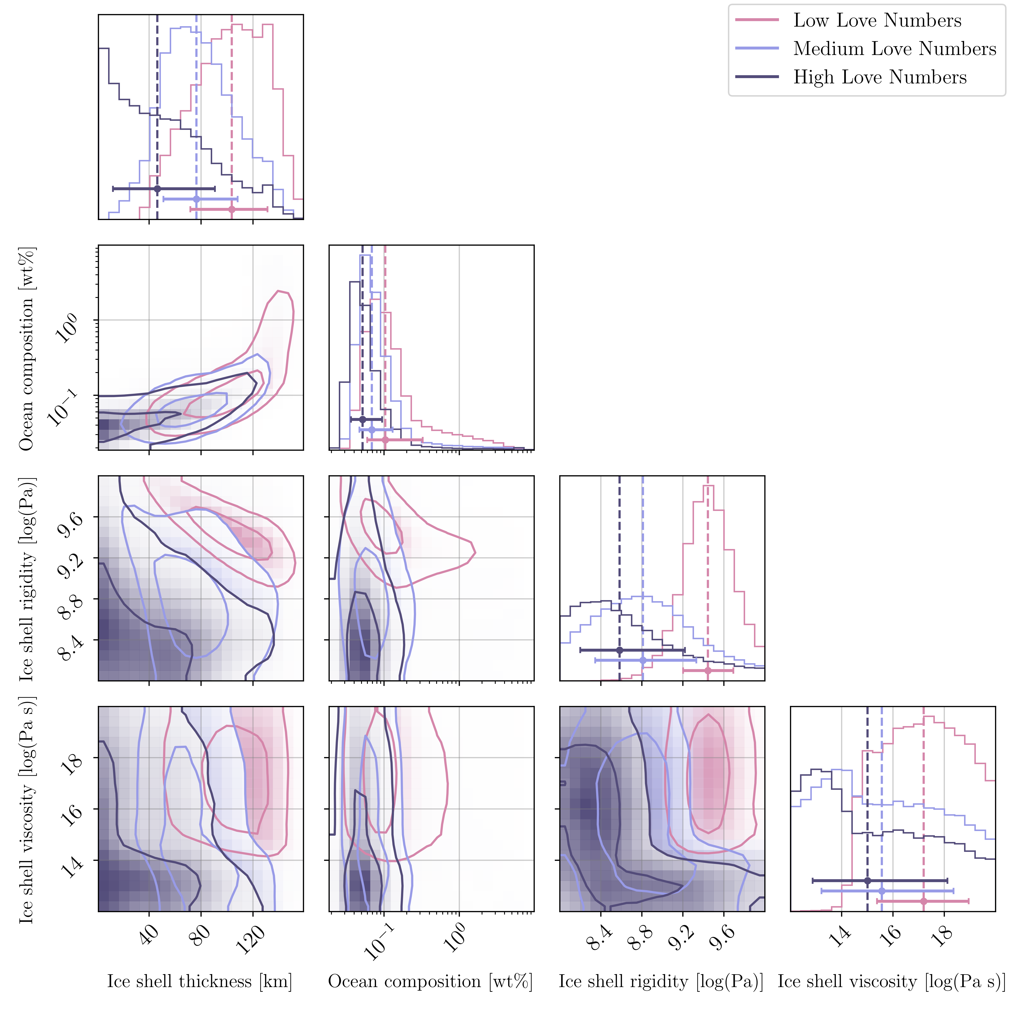
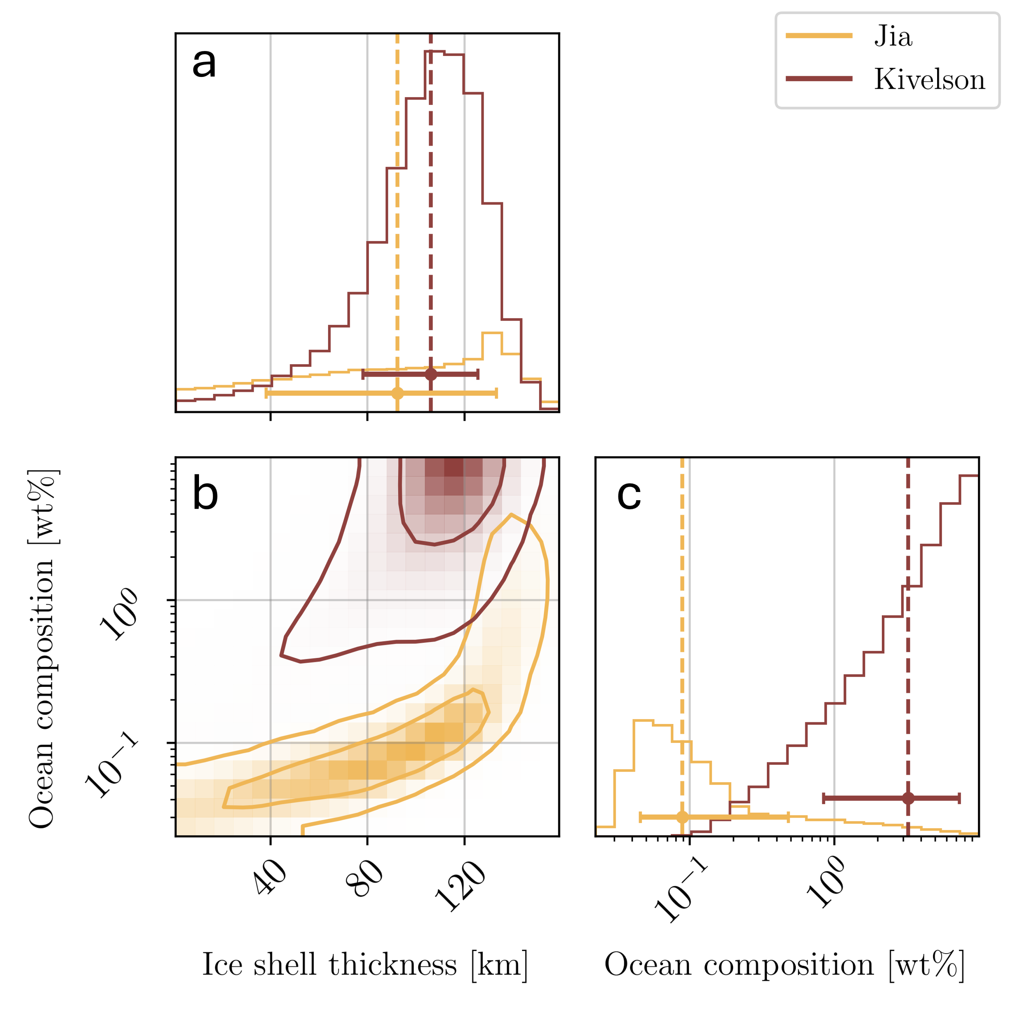
Figure 1: Posterior probability distributions of the hydrosphere parameters retrieved from two inversions with different estimates of the magnetic induction amplitude from [4] (Jia) and [5] (Kivelson). The vertical dashed lines indicate the 50th percentile, while the horizontal bars show the 1σ credible regions, defined from the 16th and 84th percentiles. The contour lines in (b) mark the 1σ and 2σ credible regions.

We first constrain the interior using currently available observations from the Galileo and Juno missions, namely the MoI and magnetic induction amplitude. For the latter, we consider both the estimate of 0.84±0.018 reported by [5] and the more recent estimate of 0.72±0.03 from [4]. The higher magnetic induction amplitude is consistent with high salinity oceans, while the more recent estimate favors low salinity oceans. In both cases, shell thickness and ocean salinity are strongly correlated, with the posterior distribution showing two families of high probability (Figure 1b): low-salinity oceans spanning a wide range of ice shell thicknesses, and thicker ice shells compatible with a broader range of ocean compositions. These results demonstrate that the inferred interior structure is sensitive to the adopted magnetic induction estimate.

Figure 2: Posterior probability distributions of the hydrosphere parameters and mechanical properties for three inversions with different synthetic values of the real tidal Love number. Details are as in Figure 1.

We then assess the improvement of adding synthetic tidal Love number measurements to simulate future Juice observations. The Love number values span the range of tidal responses predicted by interior models that are consistent with the moon’s MoI and observed magnetic induction amplitude. The inclusion of k2 and h2 reduces the uncertainty in both ice shell thickness and ocean composition (Figure 2). The tidal response values strongly influence the preferred region of parameter space: lower real Love number values shift the posterior distributions toward thicker ice shells and more saline oceans. Measuring Ganymede’s tidal response will therefore help discriminate between models compatible with current observations. However, including tidal observations introduces new trade-offs between ice shell thickness and rigidity, which cannot be resolved by the real parts of Love numbers alone. Adding the imaginary part of k2, which is sensitive to the dissipative properties of the ice shell, was found to further constrain mechanical parameters and partially resolve these degeneracies.

These results demonstrate that a joint inversion is essential to fully exploit existing observations and the future Juice dataset. The Bayesian framework presented here is directly applicable to the analysis of future Juice measurements and can be extended to incorporate additional observables such as multi-frequency magnetic induction responses, libration amplitudes, and tidal tomography. More broadly, the methodology is transferable to other icy moons, such as Europa, targeted by Europa Clipper, providing a unified approach to interior characterization.

Bibliography

[1] T. Van Hoolst, et al. 2024. Space Sci. Rev., 10.1007/s11214-024-01085-y

[2] S. Kamata, et al. 2016. J. Geophys. Res. Planets, 10.1002/2016JE005071

[3] F. Petricca, et al. 2023. Geophys. Res. Lett., 10.1029/2023GL104016

[4] X. Jia, et al. 2024. J. Geophys. Res. Planets, 10.1029/2024JE008309

[5] M. G. Kivelson, et al. 2002. Icarus, 10.1006/icar.2002.6834

How to cite: Marzolini, A., Rovira-Navarro, M., van der Wal, W., and Filice, V.: Probing Ganymede's Interior Through Combined Geophysical Observations, Europlanet Science Congress 2026, The Hague, The Netherlands, 7–11 Sep 2026, EPSC2026-487, https://doi.org/10.5194/epsc2026-487, 2026.

17:06–17:18
|
EPSC2026-830
|
ECP
|
On-site presentation
Julia Maia, Pietro Matteoni, Ana-Catalina Plesa, Tina Rückriemen-Bez, Frank Postberg, and Hauke Hussmann

Many surface tectonic features on Europa have been hypothesized to form in response to liquid and brine reservoirs within the ice shell [e.g., Schmidt et al., 2011; Steinbrugge et al., 2020; Matteoni et al., 2023]. Because these reservoirs have higher densities than the surrounding ice, they cause stresses that deflect the surface, generating topographic and gravity anomalies. Although the existence of such signatures has been proposed [e.g., Schmidt et al., 2011; Michaut and Manga, 2017; Lesage et al., 2025], their expected characteristics have not been systematically quantified.

Here we investigate the topographic and gravitational signals produced by subsurface high-density deposits within Europa’s ice shell.Using both viscous and visco-elastic loading models [e.g., Richards and Hager, 1984; James et al., 2013; Maia et al., 2023], we predict the observable signatures generated by such reservoirs. We explore four key reservoir properties: (i) diameters of 10–100 km, (ii) thicknesses of 100–1000 m, (iii) density contrasts of 80–680 kg/m³ relative to water ice, and (iv) depths ranging from 1 km to 80% of the total ice-shell thickness. In addition, we perform the investigation for conductive and convective ice shells with thicknesses ranging from 10 to 40 km and test the effect on adding an elastic layer of 0.5 to 5 km thickness on the upper part of the shell.  A schematic view of the model is shown in the figure below. 

The second figure illustrates how each reservoir parameter influences the predicted topography and gravity for a 20-km-thick ice shell with a viscous, conductive viscosity profile. We also find that variations in ice shell thickness and viscosity structure produce only minor changes in the amplitudes and shapes of the modeled signatures. On the other hand, the addition of an elastic layer can strongly reduce the deformation of the shell, particularly for shallow reservoirs.

Overall, the models suggest that salty subsurface reservoirs can produce surface displacements of several hundred meters. For pure liquid water, surface displacements are in the range of tens of meters. These signals are potentially detectable by stereo topography and radar sounding from Europa Clipper and JUICE, as well as by GALA, the laser altimeter onboard JUICE. On the other hand, the associated gravity anomalies are on the order of a few milligals, and the expected horizontal scales of the features (~100 km) fall below the ∼500 km resolution limit of Europa Clipper’s global gravity field recovery [Mazarico et al., 2023]. Such small-amplitude signals will also be difficult to detect using line-of-sight acceleration from individual flybys, though detectability depends strongly on spacecraft altitude [e.g., James, 2016; Mazarico et al., 2023].

How to cite: Maia, J., Matteoni, P., Plesa, A.-C., Rückriemen-Bez, T., Postberg, F., and Hussmann, H.: Signatures of ice shell heterogeneities on Europa from gravity and topography, Europlanet Science Congress 2026, The Hague, The Netherlands, 7–11 Sep 2026, EPSC2026-830, https://doi.org/10.5194/epsc2026-830, 2026.

17:18–17:30
|
EPSC2026-58
|
On-site presentation
Giacomo Lari and Mattia Rossi

Introduction

The orbital configuration of the Galilean moons of Jupiter is the result of billions of years of evolution. Despite the extensive studies on this system, many orbital features are still unexplained or debated. A prominent example is the formation age of the Laplace resonance between Io, Europa and Ganymede, which could be either primordial (Peale and Lee 2002) or the product of tidal orbital migration of the moons (Yoder and Peale 1981). Callisto is currently not involved in any resonance, but it is very close to the 7:3 commensurability with Ganymede (De Haerdtl 1892, Noyelles and Vienne 2007).

Other orbital features that still need to be explained are the free eccentricities of Ganymede and Callisto (Malhotra 1991, Downey et al. 2020). Furthermore, the amplitude of the free libration of the Laplace resonance angle is 0.066° (Lieske 1980). Since this amplitude decreases with time because of tidal dissipation, its current value was used to date the formation of the Laplace resonance (Yoder and Peale 1981, Henrard 1983), assuming a smooth damping from an initial value of 360°.

The dynamical evolution of the Galilean moon system is mainly driven by the tides acting between Jupiter and Io (Peale et al. 1979), which cause a secular change in the satellite's semi-major axis. The Laplace resonance allows the exchange of angular momentum between the three inner moons, so that Ganymede results to be the moon that migrates faster. From astrometric and Juno data (Lainey et al. 2009, Park et al. 2025), it was possible to estimate the tidal parameters of Jupiter and Io, and the consequent migration rates of the satellites. In particular, Ganymede moves away from Jupiter at a rate of about 10 cm/yr. Such a value implies that Ganymede encountered the 7:3 resonance with Callisto about two million years ago.


Methods

In order to investigate the effects caused by the encounter with the 7:3 resonance, we ran dedicated numerical simulations of the orbital evolution of the satellites. We considered a pre-resonance orbital configuration of the moons almost identical to the current one, with the three inner satellites slightly closer to Jupiter and locked in the Laplace resonance. We took different initial values of the eccentricities of Ganymede and Callisto, considering both the case their free eccentricities were smaller or slightly larger than today's.
 
Setting tidal parameters close to the estimated ones (Lainey et al. 2009), we propagated the system starting just before the encounter with the 7:3 resonance and ending at J2000 epoch. We ran hundreds of numerical simulations and we compared the resulting orbital elements in order to determine the dynamical pathway that best matches the current configuration of the Galilean moon system.


Results

Starting from eccentricities of Ganymede and Callisto slightly larger than today's, we obtained that the most probable outcome is that the two moons crossed the resonance without being captured. At the resonance crossing, their eccentricities experienced a downward kick that decreased their values of about 15% (Ganymede) and 6% (Callisto). By tuning the pre-resonance values of the eccentricities, it was possible to perfectly match their current values at the end of the integration. This kind of evolution is the one that best reproduces the current orbital elements of the Galilean moons.

Although the probability of capture into the 7:3 resonance was significant, the consequent evolution is generally not compatible with the current orbital configuration of the system. In fact, in almost all simulations for which there was capture, the 7:3 resonance persisted for many millions of years, forcing the eccentricities of Ganymede and Callisto to increase well above their current values. Once the resonance eventually broke down, there was not enough time for tidal dissipation to damp these values.

From our simulations, we found that in the case the initial free eccentricity of Ganymede had been null, the capture into the 7:3 resonance would have been extremely probable. Since this kind of evolution must be avoided, it is necessary that Ganymede conserved part of its free eccentricity before the 7:3 resonance crossing. This requires a low tidal dissipation within Ganymede, so that the damping timescale in eccentricity is at least a few hundreds of millions of years.

One of the effect of the the passage through the 7:3 resonance was to excite the amplitude of the free libration of the Laplace resonance angle. In our simulations, we started with an amplitude much smaller than today's, and we observed a jump of its value right at the resonance crossing. In many simulations, we obtained a final amplitude close to the current value of 0.066°. Therefore, the observed libration amplitude of the Laplace resonance angle is the result of the recent encounter with the 7:3 resonance, and the estimates of the age of the Laplace resonance based on its value are not valid.

Finally, the numerical simulations revealed the effect of an extremely recent dynamical excitation occurred just 20 thousand years ago. This was due to the crossing of a three-body resonance between the three outer Galilean moons, and its main effect was to increase the oscillation amplitude of the eccentricity of Europa.

This study provides an accurate reconstruction of the orbital evolution of the Galilean moons over the last millions of years. Although this is a relatively short period of time, the dynamical evolution of the moon system was very rich and could have taken different pathways, including the formation of a four-body resonant chain. The results presented in this work could be useful for future studies of the evolution of the system over larger timescales.


Acknowledgments:

This research was developed under the ASI/CRAS agreement no. 2022-16-HH.0.


References:

De Haerdtl (1892). Bull. Astron. 9, 212–215.
Downey et al. (2020). Mon. Not. R. Astron. Soc. 499, 40–51.
Henrard (1983). Icarus 53, 55–67.
Lainey et al. (2009). Nature 459, 957–959.
Lieske (1980). Astron. Astrophys. 82, 340–348.
Malhotra (1991). Icarus 94, 399–412.
Noyelles and Vienne (2007). Icarus 190, 594–607.
Park et al. (2025). Nature 638, 69–73.
Peale et al. (1979). Science 203, 892–894.
Peale and Lee (2002). Science 298, 593–597.
Yoder and Peale (1981). Icarus 47, 1–35.

How to cite: Lari, G. and Rossi, M.: Surprises in the recent orbital evolution of the Galilean moons, Europlanet Science Congress 2026, The Hague, The Netherlands, 7–11 Sep 2026, EPSC2026-58, https://doi.org/10.5194/epsc2026-58, 2026.

Posters: Thu, 10 Sep, 18:00–19:30 | Foyer 3

Display time: Thu, 10 Sep, 08:30–19:30
Chairpersons: Sam Fayolle, Lorenz Roth
F3.15
|
EPSC2026-94
|
ECP
|
On-site presentation
Valentin André, Marie Běhounková, Gabriel Tobie, Gaël Choblet, and Mathilde Kervazo

Abstract

Europa is a primary candidate for habitability due to the presence of a liquid subsurface ocean in direct contact with its rocky mantle [1]. Chemical exchanges favored by hydrothermal activity associated to magmatic phenomena could bring compounds suitable for the ocean’s habitability [2]. The occurrence and timescale of magmatic activity at the seafloor of Europa, however remains debated. Some studies suggested a hot scenario, where partial melting in Europa’s mantle occur during most of the moon’s history, with melt generation triggered and sustained by radioactive heating and tidal dissipation alongside limited heat removal by thermal convection [3]. Other studies proposed that Europa had a colder thermal evolution [4], implying delayed magmatism and much more modest amounts of melt. Even if magmatism is significant at depth, it might not result in seafloor volcanism [5]. However, the feedback of melting on mantle rheology as well as the different modes of extraction or retention of the melt were not entirely investigated. Such effects might have considerable implications on the dynamics of convection and thermal evolution of Europa’s mantle.

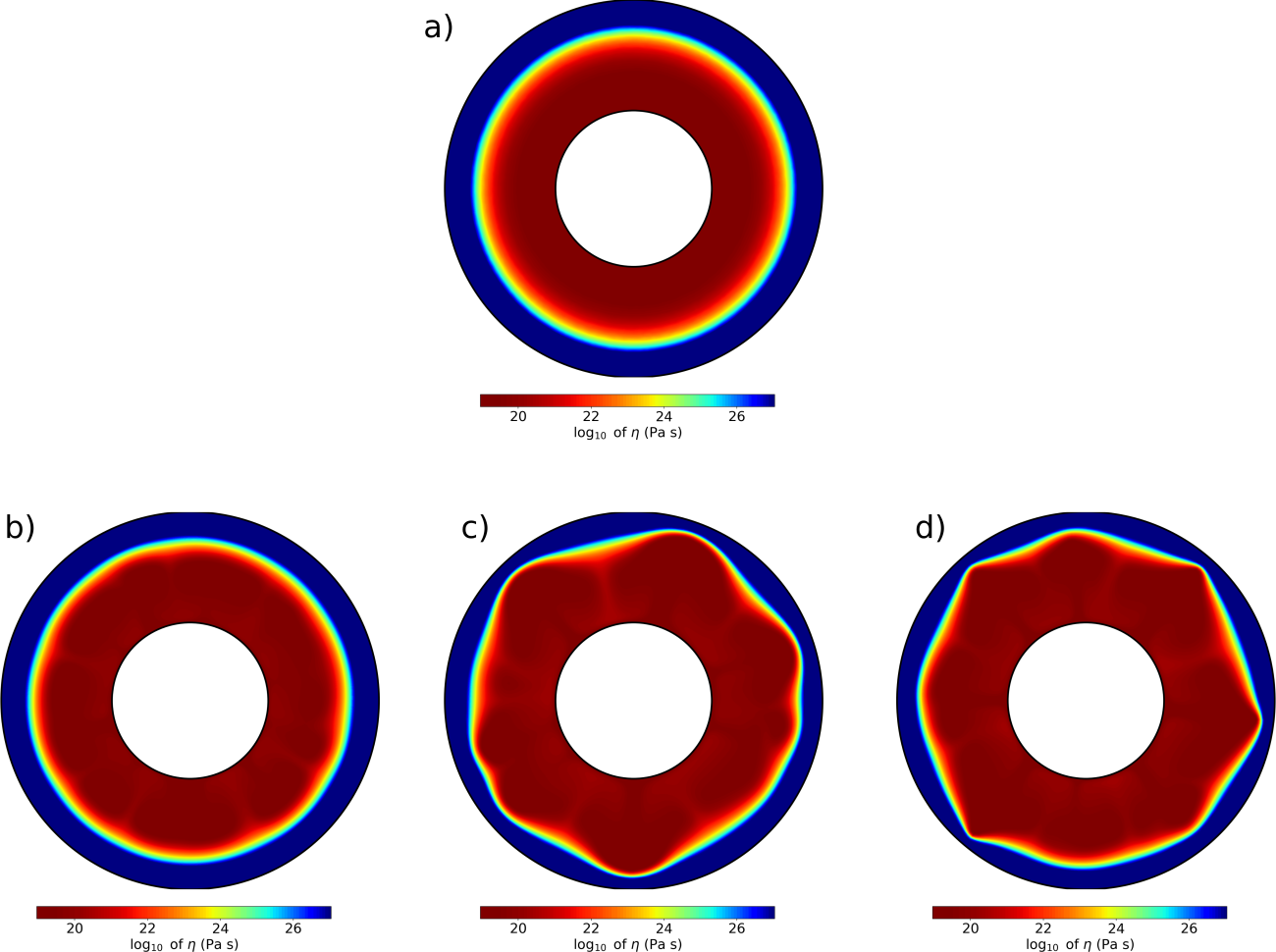
In this study, the thermal evolution and melt production in Europa’s silicate mantle is investigated using a three-dimensional (3D) numerical model that solves for thermal convection considering radiogenic and tidal heating [6], [7]. The timescale and location of melt production in the mantle is analyzed by considering several melt treatments as well as the feedback of melting on mantle rheology and solidus temperatures [8]. Melt treatments involve (1) instantaneous melt extraction once the temperature is above the solidus with removal of excess thermal energy; (2) melt retention where melt is advected with the solid matrix and can crystallise once the temperature drops below the solidus; (3) an intermediate melt extraction where melt migrates upward and can heat its surroundings within one convection time step. Our results show that melt generation and production rates in Europa’s mantle strongly depend on the considered melt treatment and the subsequent effect on mantle rheology. In the instantaneous melt extraction case, melting predominantly occurs at great depths below a thick lithosphere with relatively low melting rates. If the melt stays with the solid matrix, the average melting rate can be ten times higher, with local partial melting up to 20% under favorable conditions. The retention of melt, even in small fractions, impacts the vigor of convection as local buoyancy and viscosity are respectively increased and decreased. As such, upwelling plumes develop more quickly and can significantly affect the thermal structure of the stagnant lid (Figure 1). We show that these hot plumes could be able to erode the cold lithosphere, thus considerably reducing the local thickness of the stagnant lid and allowing melt to be generated closer to the seafloor. This effect is even more prominent in the reactive melt extraction treatment, which may suggest that melt could be generated at shallower depths than previously anticipated. Tidal dissipation, amplified in partially molten regions, could further enhance this effect. The weakening of the stagnant lid rheology due to the penetrating plumes could potentially favor dyke development and the transport of melt at the seafloor of Europa.

Figure 1: Vertical cross-sections of Europa’s mantle viscosity. a) Initial state. b) Instantaneous melt extraction case. c) Case where melt remains and is advected with the solid matrix. d) Melt percolation case. 


References

[1] W. B. Moore, H. Hussmann (2009). Thermal evolution of Europa's silicate interior, in: R. T. Pappalardo , W. B. McKinnon, K. K. Khurana (Eds.). Europa, University of Arizona Press, Tucson,, pp. 369–380. doi: https://doi.org/10.2307/j.ctt1xp3wdw.21

[2] Vance, S. D. et al. (2016). Geophysical controls of chemical disequilibria in Europa. Geophysical Research Letters 43 4871–4879. doi: https://doi.org/10.1002/2016GL068547

[3] Běhounková, M. et al (2021). Tidally induced magmatic pulses on the oceanic floor of Jupiter's moon Europa. Geophysical Research Letters, 48, e2020GL090077. https://doi.org/10.1029/2020GL090077

[4] Petricca, F. et al. (2025). Partial differentiation of Europa and implications for the origin of materials in the Jupiter system. Nature Astronomy, pages 1–11. doi:  https://doi.org/10.1038/s41550-024-02469-4

[5] Green, A. P et al.. (2025). No magmatic driving force for Europan sea-floor volcanism.  Nature Astronomy 9 (2025) 640–649. doi: https://doi.org/10.1038/s41550-025-02508-8

[6] G. Choblet (2005). Modelling thermal convection with large viscosity gradients in one block of the ‘cubed sphere’. Journal of Computational Physics 205 269–291. doi:  https://doi.org/10.1016/j.jcp.2004.11.005

[7] Choblet, G. et al. (2007). ŒDIPUS: a new tool to study the dynamics of planetary interiors, Geophysical Journal International 170 9–30. doi:  https://doi.org/10.1111/j.1365-246X.2007.03419.x

[8] Běhounková, M. et al (2010). Coupling mantle convection and tidal dissipation: Applications to Enceladus and Earth-like planets, Journal of Geophysical Research: Planets 115 2009JE003564. doi:https://doi.org/10.1029/2009JE003564.


Acknowledgments

This work was supported by the Agence Nationale de la Recherche (ANR, project OSSO-BUCO, ANR-23-CE49-0003 to BR). This research utilized the resources of the GLiCID Computing Facility (Ligerien Group for Intensive Distributed Computing, www.glicid.fr, Pays de la Loire, France). The work of M.B. was supported by the Czech Science Foundation (project No. 26-21877S). 

How to cite: André, V., Běhounková, M., Tobie, G., Choblet, G., and Kervazo, M.: Europa’s seafloor may not be silent, Europlanet Science Congress 2026, The Hague, The Netherlands, 7–11 Sep 2026, EPSC2026-94, https://doi.org/10.5194/epsc2026-94, 2026.

F3.16
|
EPSC2026-186
|
On-site presentation
Yasumasa Kasaba, Fuminori Tsuchiya, Hiroaki Misawa, Brieuc Collet, Rikuto Yasuda, Rentaro Sugawara, Haruto Yamanaka, Takeru Kato, Ayuto Kawakami, Yuto Katoh, Atsushi Kumamoto, Hajime Kita, Tomoki Kimura, Baptiste Cecconi, Lucas Grosset, Corentin Louis, James Waters, Antonio Vecchio, and Jan-Erik Wahlund

This paper provides the preparation activities for radio observations of Jupiter by Radio and Plasma Wave Investigation (RPWI) aboard ESA JUpiter ICy moons Explorer (JUICE), from the view for its high frequency radio observation capability in 20k –40MHz.

This part enables the characterization of Jovian radio emissions (including gonio-polarimetry), passive radio sounding of the ionospheric densities of icy moons, and passive sub-surface radar measurements. It has an enough capability to detect Jovian radio emissions from magnetosphere (aurora etc.), atmosphere (lightning), and icy moons. Direction and polarization capabilities are first enabled in the Jovian system, to identify their source locations and characteristics.

(1) Initial flux calibration was executed using solar type III radio bursts during the August 2024 Lunar-Earth Gravity Assist, using the measurements with Wind and PSP, and the sensitivity in 0.4-2 and 10-15 MHz were estimated (Vecchio et al., in printing). Caliblation of direction and polarization with antenna pattern is also now in preparation based on Cassini RPWS logics (Waters Collet et al.).
(2) Distribution and occurrence characteristics of terrestrial Auroral Kilometric Radiation (AKR) and Jovian radiations are investigated for the detection capability in Earth flyby and Jovian observations (Yamanaka et al.; Sugawara et al.).
(3) Evaluation of the sounding capability of the icy moons' ion density profiles were studied using Jovian auroral radiations, with ray tracing studies (Yasuda et al., 2024). This technique is also applied for Titan ionosphere (Yasuda et al, submitted; T. Katoh et al.).
(4) Feasibility studies of the passive radar capability for the icy moons' surface and subsurface were studied with numerical and ray tracing studies, compared with Lunar AKR reflection detected by Kaguya (Kawakami et al.).

We also summarize the radio observation plans for Jupiter and icy moons in 2030s.

How to cite: Kasaba, Y., Tsuchiya, F., Misawa, H., Collet, B., Yasuda, R., Sugawara, R., Yamanaka, H., Kato, T., Kawakami, A., Katoh, Y., Kumamoto, A., Kita, H., Kimura, T., Cecconi, B., Grosset, L., Louis, C., Waters, J., Vecchio, A., and Wahlund, J.-E.: Preparation for radio observations of Jupiter by Radio and Plasma Wave Investigation (RPWI) aboard ESA JUICE, Europlanet Science Congress 2026, The Hague, The Netherlands, 7–11 Sep 2026, EPSC2026-186, https://doi.org/10.5194/epsc2026-186, 2026.

F3.17
|
EPSC2026-282
|
On-site presentation
Sam Fayolle, Dominic Dirkx, Marc Rovira Navarro, Olivier Witasse, and Valerio Filice

1. Motivation

Tides are a key driver of planetary system evolution: they govern the intensity of tidal heating in the moons' interiors, drive their rotations towards equilibrium states, and set the migration and circularisation rates of their orbits. A detailed characterisation of the satellites' current response to tidal forcing offers invaluable insight into their interior structure and properties, as well as into the present-day evolution of the system's orbital configuration. This is, in turn, essential for placing constraints on the long-term thermal-orbital evolution of the system and, for icy moons in particular, on the history of their internal oceans.

In the context of the upcoming Juice and Europa Clipper missions, radio-science tracking of both spacecraft during their close encounters with the Galilean moons (flybys and orbital phase) will be critical in this regard. Such measurements will constrain the moons' dynamics, and in particular the dynamical signatures of tidal effects, at an unprecedented level of detail and precision [1,2]. At the accuracy levels anticipated post-missions, however, the limiting factor for the inferred solution might no longer be the precision of the radio-science tracking, but instead the physical fidelity and self-consistency of the dynamical models that underpin the data analysis.

More specifically, tidal effects manifest themselves both in the spacecraft's trajectory and in the satellites' own dynamics. Reliably extracting these signatures from radio-science data therefore requires that tidal contributions be incorporated into the dynamical models of the spacecraft and moons in a fully consistent way. For synchronous satellites, the intricate coupling between tide, orbit, and rotation makes this particularly challenging: any mismodelling of these interactions leads to an erroneous dissipation signature and ultimately affects the recovered estimates [3]. Achieving such consistency in the Galilean system is further complicated by the Laplace resonance, which requires Io, Europa, and Ganymede to be modelled as a single, unified dynamical system to ensure that the strong gravitational couplings between them are properly captured. 

2. Approach

To address this challenge, we proposed a unified dynamical framework [4] in which each satellite's gravitational deformation is propagated through an ordinary differential equation derived from a prescribed rheology, along with the orbital and rotational dynamics (building on previous works focussing on exosystems [5,6]). Embedding the internal response directly within the integrated dynamics guarantees that all orbit-rotation-tide couplings are accounted for, at all forcing frequencies. Critically, the proposed model establishes a direct and physically motivated connection between interior properties (e.g., viscosity, rigidity) and tidal dissipation signatures in the moons’ dynamics, and ensures full consistency between the orbits, rotations and tidal deformation of all moons. We expanded our original two-dimensional proof-of-concept [4] into a complete N-body implementation that includes higher-order effects, such as moon-moon interactions, and three-dimensional effects in the moons’ orbits and rotations (non-zero inclination and obliquity).

3. Results and outlook

Applied to the Galilean system, the model successfully reproduces expected dynamical features: it maintains the Laplace resonance, yields realistic spin-orbit resonant rotations in a Cassini state, and recovers the orbit expansion and circularisation rates predicted by tidal theory [7]. Crucially, the propagated dynamics also captures coupling signatures that fall outside the reach of conventional formulations. Multi-frequency and indirect forcing and response of both tides and rotation emerge naturally from the concurrent integration of the coupled equations of motion, with additional forcings at the frequencies of the other Galilean moons appearing directly in each satellite's rotational and deformational response. This is particularly promising for Ganymede, whose gravitational deformation will be characterised with unprecedented detail, including sampling of the moon’s response at different frequencies [8]. More generally, these results demonstrate the potential of a fully coupled modelling approach for future analyses of Juice and Europa Clipper data, where the Galilean satellites’ orbits, rotations, and tidal interactions are self-consistently modelled as an integrated dynamical system.

References

[1] Magnanini, A. et al. Astronomy & Astrophysics 687 (2024): A132.

[2] Fayolle, S. Dissertation (2025)

[3] Magnanini, A., Zannoni, M., and Lainey, V. Astronomy & Astrophysics 707 (2026): A96.

[4] Fayolle, S., et al. Astronomy & Astrophysics 707 (2026): A224.

[5] Correia, A. et al. Astronomy & Astrophysics 571 (2014): A50.

[6] Boué, G., Correia, A., and Laskar, J. Celestial Mechanics and Dynamical Astronomy 126.1 (2016): 31-60.

[7] Goldreich, P., and Soter, S. Icarus 5.1-6 (1966): 375-389

[8] De Marchi, F., et al. Icarus 386 (2022): 115150

How to cite: Fayolle, S., Dirkx, D., Rovira Navarro, M., Witasse, O., and Filice, V.: Self-consistent modelling of tide-orbit-rotation couplings in the Galilean system , Europlanet Science Congress 2026, The Hague, The Netherlands, 7–11 Sep 2026, EPSC2026-282, https://doi.org/10.5194/epsc2026-282, 2026.

F3.18
|
EPSC2026-332
|
ECP
|
On-site presentation
Ryan Dahoumane, Kevin Baillié, and Valery Lainey

Metis and Adrastea are Jupiter’s two innermost satellites and are notable for having semi-major axes that are very close to one another: approximately 1,000 km separate their quasi-circular orbits. Both are located below Jupiter’s synchronous radius, below the fluid Roche limit, and slightly above the rigid Roche limit. The origin of this pair remains poorly constrained. Burns et al. (2004), however, suggested that the proximity of their orbits could be an argument in favor of a formation through the fragmentation of a common progenitor. In addition to the aforementioned elements, the tidal migration of Metis and Adrastea following the fragmentation of a common progenitor may have shaped the satellites’ present-day orbits. 
In the present work, we use N-body integrations to simulate the dynamics following this potential fragmentation, considering Jupiter's J2 and J4 gravitational harmonics, while including tidal forces. By varying the initial separation, fragment masses, and tidal parameters, we assess the dynamical survival of two-body outcomes and the conditions under which the fragments can evolve toward orbits comparable to those observed today.

How to cite: Dahoumane, R., Baillié, K., and Lainey, V.: A Common-Progenitor for Metis and Adrastea?, Europlanet Science Congress 2026, The Hague, The Netherlands, 7–11 Sep 2026, EPSC2026-332, https://doi.org/10.5194/epsc2026-332, 2026.

F3.19
|
EPSC2026-348
|
ECP
|
On-site presentation
Betty Pei-Chun Tsai, Elias Roussos, Daniel Heyner, Kristin Pump, Norbert Krupp, and Yasuhito Narita

To prepare for the arrival of the JUICE (JUpiter ICy moons Explorer) mission, developing a comprehensive and physically grounded magnetic field model is essential to understand the interactions with charged particles and the complicated plasma dynamics. Existing models range from simplified representations, such as the model only include dipole field and induced ocean, to computationally intensive magnetohydrodynamic (MHD) or hybrid simulation codes, yet a critical gap remains for a model balancing physical fidelity with computational efficiency. We aim to present the development of a semi-empirical magnetic field model of Ganymede, based on the frameworks used for Mercury and Earth. Our superposition model integrates observational constraints with theoretical insights to accurately represent the Jovian background field and Alfvén wing, Ganymede’s internal field, the ocean-induced field, and the field generated from different currents in Ganymede’s magnetosphere. The model enables rapid, scalable simulations of particle access across the magnetosphere. It will support mission planning, enhance the interpretation of JUICE data, and provide key predictions for particle-driven surface processes on magnetized icy moons. Ultimately, this work enhances our understanding of moon-magnetosphere interactions and the dynamic interplay between internal fields, induced currents, and external plasma environments.

How to cite: Tsai, B. P.-C., Roussos, E., Heyner, D., Pump, K., Krupp, N., and Narita, Y.: A New Semi-Empirical Model of Ganymede’s Magnetosphere, Europlanet Science Congress 2026, The Hague, The Netherlands, 7–11 Sep 2026, EPSC2026-348, https://doi.org/10.5194/epsc2026-348, 2026.

F3.20
|
EPSC2026-415
|
On-site presentation
Markus Fränz, Norbert Krupp, Elias Roussos, Philipp Wittmann, Robert Labudda, and Stas Barabash

The plasma spectrometer JEI is an ion and electron spectrometer designed to observe the thermal and medium energy charged particle environement of Jupiter. It is part of the PEP instrument onboard JUICE. Meanwhile the instrument was switched on several times while JUICE was in the solar wind. The flyby through the Earth-Moon system in August 2024 was the first test of the instrument in a magnetospheric plasma and under higher radiation. We report on the instrument performance and on observations of charged particles in the solar wind, the lunar environment and during the crossing of the Earth magnetosphere.  Specifically the solar wind observations and the crossing of the Earth plasmasphere provided excellent opportunities to test the performance of the instrument and provide calibration parameters in prospect of the further cruise phase of JUICE and expected observations at Jupiter. The Earth plasmasphere crossings allowed some rare measurements of the plasmaspheric ion composition.

How to cite: Fränz, M., Krupp, N., Roussos, E., Wittmann, P., Labudda, R., and Barabash, S.: Inflight Calibration of the PEP JEI ion and electron spectrometer on the JUICE spacecraft, Europlanet Science Congress 2026, The Hague, The Netherlands, 7–11 Sep 2026, EPSC2026-415, https://doi.org/10.5194/epsc2026-415, 2026.

F3.21
|
EPSC2026-459
|
ECP
|
On-site presentation
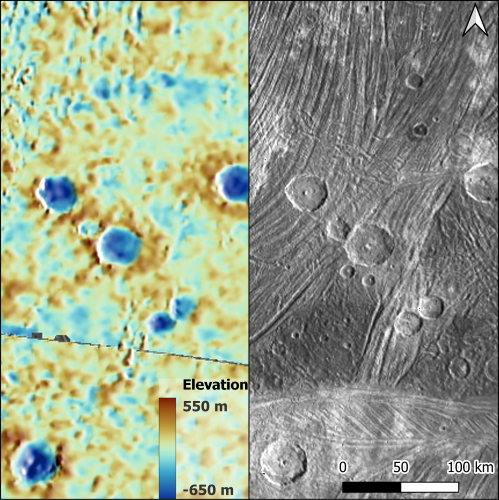
Gianluca Chiarolanza and Giuseppe Mitri

INTRODUCTION

Accurate topographic information will play an important role in the geophysical investigation of Ganymede during ESA’s JUICE mission. Surface topography is particularly relevant for the interpretation of radar sounding observations acquired by the RIME [1] instrument, where Digital Elevation Models (DEMs) can support clutter assessment and subsurface signal interpretation. Topographic information is also expected to support gravity and geodetic investigations performed by the 3GM experiment, including shape characterization at regional scale [2].

Topographic information during the JUICE mission will be provided through the combined contribution of GALA laser altimetry [3] and JANUS stereo imaging [4]. GALA will provide accurate absolute elevation measurements and support global shape and geodetic investigations together with 3GM radio-science measurements. However, applications requiring higher spatial resolution and broader areal coverage, including RIME surface clutter assessment, are more likely to benefit from image-based topographic reconstruction, since the spatial distribution of GALA ground tracks during the flyby phase may be insufficient to provide continuous regional coverage.

DEM generation through stereo imaging from JANUS is therefore expected to play a fundamental role in supporting geophysical investigations. At the same time, the systematic acquisition of suitable JANUS stereopairs during the Ganymede flyby phase may require observation conditions that are complex to satisfy simultaneously with the pointing requirements of other geophysical instruments, particularly for repeated observations needed for stereo reconstruction. As a result, the availability of optimal stereopairs during the flyby phase is still under evaluation.

A possible strategy to mitigate these limitations is the combination of newly acquired JANUS images with legacy datasets from previous missions, including Juno, Galileo, and Voyager imaging systems [5-7]. Such a multi-spacecraft approach nevertheless presents several challenges, since heterogeneous image combinations may present significant differences in spatial resolution, illumination conditions, viewing geometry, and stereo convergence angle. Additional complexity also arises from the different optical characteristics and geometric distortion models of the instruments involved, which may introduce further uncertainties in image co-registration and stereo reconstruction when combining heterogeneous datasets [8]. These factors can affect feature recognition, image matching, stereo triangulation, and ultimately DEM quality.

In a previous preliminary study we proposed evaluating a multi-spacecraft approach for DEM generation on Ganymede by comparing DEMs generated from heterogeneous stereopairs with those derived from conventional single-spacecraft image combinations [9]. Here we present the first progress of that study.


PROGRESS UPDATE AND METHODOLOGICAL IMPROVEMENTS

We expanded the topographic coverage derived from JunoCam stereopairs acquired during Juno’s 7 June 2021 flyby of Ganymede and implemented an updated stereo processing workflow using the Ames Stereo Pipeline [10]. The updated workflow includes refined image pre-processing and the testing of an alternative JunoCam distortion model aimed at improving image co-registration and stereo matching performance. The resulting DEM products provide an improved and more extended single-spacecraft reference dataset, which is undergoing a further expansion through the processing of the remaining JunoCam stereopairs (a sub-area of this DEM is shown in Figure 1). Once completed, this dataset will provide a reference framework for future multi-spacecraft DEM comparisons using overlapping heterogeneous datasets.

In addition to the Enki Catena region investigated in the previous study, the expanded DEM coverage will enable the identification of additional candidate areas suitable for testing heterogeneous stereopairs. These datasets will include combinations characterized by varying ground sampling distances, illumination conditions, and stereo geometries, allowing a systematic assessment of the feasibility, quality, and limitations of multi-spacecraft stereo reconstruction on Ganymede.

This work therefore provides both an updated topographic dataset for geophysical investigations, and a source for evaluating future multi-mission topographic reconstruction strategies during the JUICE flyby phase. The proposed framework may also support future synergistic investigations between JUICE and Europa Clipper at Europa [11], where overlapping flybys could enable similar multi-mission stereo reconstruction approaches for geophysical applications.


ACKNOWLEDGMENTS

G.C. and G.M. acknowledge support from the Italian Space Agency (2023-6-HH.0).


REFERENCES

[1] Bruzzone, L. et al. (2013) IEEE IGARSS, 3907-3910.

[2] De Marchi, F. et al. (2021) Icarus, 354, 114003.

[3] Enya, K. et al. (2022) Adv. Space Res., 69, 2283-2304.

[4] Palumbo, P. et al. (2025) Space Sci. Rev., 221, 32.

[5] Hansen, C. J. et al. (2017) Space Sci. Rev., 213, 475-506.

[6] Belton, M. J. S. (1992) Space Sci. Rev., 60, 413-455.

[7] Smith, B. A. et al. (1977), Space Sci. Rev., 21, 103-127.

[8] Schenk, P. M. and McKinnon, W. B. (2026) 57th LPSC, 1720.

[9] Chiarolanza, G. and Mitri, G. (2025) EPSC-DPS2025-996.

[10] Beyer, R. A. et al. (2018) Earth Space Sci., 5, 537-548.

[11] Pappalardo, R. T. et al. (2024) Space Sci. Rev., 220, 40.


Figure 1: Stereo DEM (left) and orthoimages (right) of a region of Ganymede (22°N, 335°E) imaged by the JunoCam.

How to cite: Chiarolanza, G. and Mitri, G.: Advancing Multi-Spacecraft Topographic Reconstruction on Ganymede for JUICE Geophysical Investigations, Europlanet Science Congress 2026, The Hague, The Netherlands, 7–11 Sep 2026, EPSC2026-459, https://doi.org/10.5194/epsc2026-459, 2026.

F3.22
|
EPSC2026-475
|
On-site presentation
Rose-Marie Baland and Marie Yseboodt

The orientation and rotation of synchronous satellites can be described using two different sets of angles: the Euler angles defined relative to a fixed reference plane (typically the Laplace) and the right ascension, declination, and prime meridian location angles with respect to the J2000 Inertial Celestial Reference Frame, following the convention adopted by the International Astronomical Union (IAU; Archinal et al. 2018).

Yseboodt and Baland (2026) recently derived an analytical transformation between these two angle systems, correct up to the second order in small parameters as orbital inclination and obliquity. Their method was successfully applied to the Galilean satellites (Io, Europa, Ganymede, and Callisto) to produce rotation models intended to supersede the currently adopted IAU models.

In this work, we extend the methodology of Yseboodt and Baland (2026) to Jupiter’s small inner moons: Metis, Adrastea, Amalthea, and Thebe. These satellites are small bodies, with diameters up to ~260 km, orbiting close to Jupiter and rotating synchronously with periods shorter than 0.7 day. Little is currently known about their physical and dynamical properties. In the present study, they are modelled as rigid solid bodies. We perform a frequency decomposition of their ephemerides in order to express the orientation of their orbit as quasi-periodic series. Applying the classical Cassini state model (e.g. Baland et al 2012) term by term then yields a quasi-periodic representation of the spin-axis orientation, initially expressed through Euler angles, then transformed into IAU angles.

Although no dedicated close flybys are currently planned, the JANUS camera system onboard Jupiter Icy Moons Explorer (JUICE) will contribute to constraining the orbital orientation of these inner moons and improving the mapping of their surfaces (Denk et al. 2025). In the context of mission preparation, an updated rotational model for the inner moons may already be valuable as a replacement for the current IAU standard solution. Following future observations, the proposed methodology could also be used to further refine the IAU rotational models.

[1]  M. Yseboodt and R.-M. Baland (2026). Transformation of orientation and rotation angles of synchronous satellites: Application to the Galilean moons. Icarus, 450, 116977.  https://doi.org/10.1016/j.icarus.2026.116977

[2]  B. Archinal et al. (2018). Report of the IAU Working Group on Cartographic Coordinates and Rotational Elements: 2015. Celestial Mechanics and Dynamical Astronomy, 130, 22. https://doi.org/10.1007/s10569-017-9805-5

[3]  T. Denk et al. (2026). Io and the Minor Jovian Moons – Prospects for JUICE. Space Science Reviews, 222, 27. https://doi.org/10.1007/s11214-025-01263-6

[4]  R.-M. Baland, M. Yseboodt, and T. Van Hoolst (2012). Obliquity of the Galilean satellites: The influence of a global internal liquid layer. Icarus, 220, 435–448. http://dx.doi.org/10.1016/j.icarus.2012.05.020

How to cite: Baland, R.-M. and Yseboodt, M.: Orientation and rotation model of the small inner moons of Jupiter, Europlanet Science Congress 2026, The Hague, The Netherlands, 7–11 Sep 2026, EPSC2026-475, https://doi.org/10.5194/epsc2026-475, 2026.

F3.23
|
EPSC2026-804
|
On-site presentation
Tim Van Hoolst, Rose-Marie Baland, Alexis Coyette, and Marie Yseboodt

The rotation rate of Ganymede, the largest satellite of Jupiter, is equal on average to its orbital mean motion due to synchronous rotation. It cannot, however, remain strictly constant because the gravitational torque exerted by Jupiter varies along the orbit. For a purely Keplerian orbit, the torque variations, and the associated librations, occur at the orbital period. Additional perturbations arise from the mutual gravitational interactions between the Galilean satellites, the perturbation from the Sun, and the oblateness of Jupiter, producing departures from Keplerian motion and therefore additional rotational variations.

The ESA JUICE mission will measure Ganymede’s rotation with unprecedented accuracy during the orbital phase around the satellite beginning on  31 October 2034. Here, we compute the libration series of Ganymede with respect to a uniform rotation and evaluate the potential of rotational variations as probes of the satellite’s interior structure.

We use the libration equations developed by Coyette et al. (2026), correct up to second order in small quantities for satellites with or without a subsurface ocean, and including the possible effects of tidal deformations (see Van Hoolst et al. 2013). Orbital perturbations are first derived from the L1 analytical theory of the Galilean satellites (Lainey et al. 2006), and subsequently reassessed using more recent ephemerides.

The truncation threshold adopted for the libration series is 0.1 arcsec in the solid rigid case. This threshold is chosen to investigate the influence of subsurface oceans and tidal deformations and to enable identifying potentially amplified terms. The libration amplitudes obtained for a solid elastic model remain close to those of the rigid case. Similarly, the ocean-elastic solutions generally differ only slightly, except when resonant amplification occurs, notably for periods near 250 and 470 days. A non-hydrostatic equilibrium shape can have a substantial effect on the librations.

The libration solution obtained for a solid rigid Ganymede constitutes an updated version of the series presented by Rambaux et al. (2011). It provides a robust baseline for the construction of updated rotation and orientation models, such as those developed by Yseboodt et al. (this conference).


Coyette, A., Baland, R.-M., Van Hoolst, T., 2026. Second-order modeling of the Cassini states of large satellites: I. Influence of triaxiality and a subsurface ocean. Celestial Mechanics and Dynamical Astronomy 138:3, https://doi.org/10.1007/s10569-025-10269-9

Rambaux, N., Van Hoolst, T., Karatekin, O., 2011. Librational response of Europa, Ganymede, and Callisto with an ocean for a non-Keplerian orbit. Astron. Astrophys. 527, A118. http://dx.doi.org/10.1051/0004-6361/201015304.

Van Hoolst, T., Baland, R.-M., Trinh, A., 2013. On the librations and tides of large icy satellites. Icarus 226(1), 299–315, https://doi.org/10.1016/j.icarus.2013.05.036

Lainey, V., Duriez, L., Vienne, A.: Synthetic representation of the Galilean satellites’ orbital motions from L1 ephemerides. Astron. Astrophys. 456(2), 783–788 (2006). https://doi.org/10.1051/0004-6361:20064941

Yseboodt et al. 2026 this conference

How to cite: Van Hoolst, T., Baland, R.-M., Coyette, A., and Yseboodt, M.:  A libration series for Ganymede  , Europlanet Science Congress 2026, The Hague, The Netherlands, 7–11 Sep 2026, EPSC2026-804, https://doi.org/10.5194/epsc2026-804, 2026.

F3.24
|
EPSC2026-836
|
ECP
|
On-site presentation
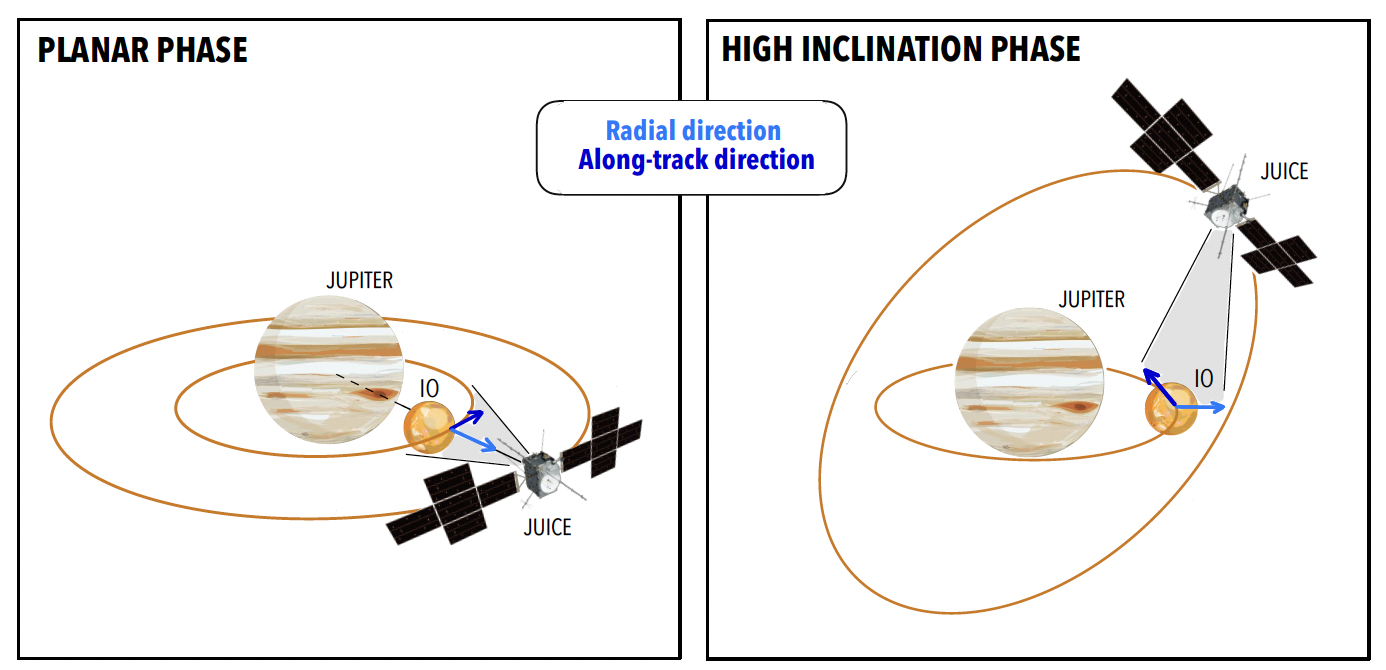
Michela Valsecchi, Sam Fayolle, and Olivier Witasse

1. Introduction

In the coming decade, ESA’s Juice and NASA’s Europa Clipper missions will extensively  study Jupiter's icy moons, with the primary goal of characterizing their habitability potential. A key question at the core of this investigation is to understand how subsurface oceans could have formed within Europa, Ganymede and Callisto and how they survived until present day.

As part of this investigation an important scientific objective of these missions is to improve the determination of the moon’s orbits, providing essential constraints on the long-term evolution of the Jovian System through a better characterization of the present orbital configuration, tidal interactions and subsequent tidal heating rate of the moon’s interiors. 

Within this framework, Io plays a central role: as the innermost Galilean moon, it experiences intense tidal dissipation and, via the Laplace resonance with Europa and Ganymede, acts as a key energy transfer driver in the system. As a result of this dynamical coupling, tidal dissipation within Io influences  the stability and the long-term evolution of the Laplace resonance, ultimately  shaping the evolution of the entire Jovian system. 

The combined flybys of JUICE and Europa Clipper, together with JUICE’s orbital phase, will    tightly constrain the orbits of Europa, Ganymede and Callisto using high precision radio-science data [1,2].  Io, however, lies deep within Jupiter's harsh radiation belt and dense plasma torus. Because of this extreme environment, no close flybys are planned for Io. Its dynamic will be indeed constrained indirectly, primarily through its gravitational perturbations on Europa and Ganymede.  This lack of direct radiometric measurements will result in an imbalanced data set, with a significant observational gap for Io. This will strongly affect the accuracy and robustness of the orbital solution outside the mission bounds [3]. Moreover, this instability will limit our ability to translate the present-day solution accuracy into strong constraints on the (recent) dynamical history of the system.  

To mitigate this, we investigate the option of performing astrometry from the Juice spacecraft to complement the radio-science data set, specifically looking at possible opportunities offered by the Navigation Camera (NavCam) and JANUS high-resolution camera [4]. We assess how direct measurements of Io can bridge this measurement gap and improve the  orbital solution with respect to a radio-science-only analysis. 


2. Methodology

To quantify the potential achievable  improvement, we map how uncertainties of potential optical measurements propagate through the dynamical models of the Jovian system. To this end, we perform a covariance analysis using Tudat [5], an open source high-fidelity orbit and parameter estimation software. 

First, we directly extract the uncertainties on the moons’ orbits for a radio-science-based dynamical solution from recent Juice and Europa Clipper simulation analyses [2], representing the currently expected limits of the ephemerides solution attainable post-missions. We then simulate potential astrometric observations of Io from the Juice spacecraft, and quantify the relative improvement they bring with respect to the baseline radio-science solution.  

Building on a previous Juice astrometry analysis [6] , we look at feasible observation windows by evaluating three main angular constraints. First,  the solar phase angle must  guarantee sufficient surface  illumination. Secondly, a minimum angular distance from Jupiter’s limb must be ensured to prevent the planet’s glare and scattered light from saturating the detector. Thirdly, a minimum Sun- spacecraft-Io angle must be maintained to comply with spacecraft pointing constraints, preventing direct sunlight from entering the optical system. Furthermore, to allow an accurate limb detection, Io must cover a significant fraction of the camera’s FOV. This requirement translates into a constraint on JUICE-Io distance  to ensure sufficient spatial resolution (km/pixel).

For each of the simulated observations, particular attention is paid to the expected error budget. Three major contributions are accounted for to the overall uncertainty: pointing correction errors, spacecraft position uncertainty and uncertainties related to determining the centre of figure.  The former contribution is negligible; the second one is also small and can be directly accounted for by extracting the uncertainty in the spacecraft trajectory from the radioscience analyses mentioned above [1,2]. The last term is the dominating contribution to the total error budget and is evaluated as a function of the target within the camera FOV and illumination conditions. 

We aim to identify optimal observation windows in which Io’s state vector can be best constrained, accounting for both operational limitations (e.g., data volume, camera availability) and for the feasibility conditions above. Preliminary results indicate that the most favorable conditions to constrain Io’s along-track position occur during JUICE’s high-inclination phase, when the spacecraft inclination will increase up to about 35° for magnetospheric studies. The ideal observation geometry to maximise sensitivity to Io’s along-track position requires the moon’s velocity vector (along its orbit) to be orthogonal to the spacecraft-Io line direction. However, during the planar phase, this corresponds to configurations where Jupiter is behind Io as seen from Juice, violating the minimum distance to Jupiter constraint and translating to unfeasible observations. Opportunities for Io astrometry during the high-inclination will thus be critical to constrain Io’s position along its orbit. 

Image credits for Jupiter, Io, and Juice: ©ESA/ATG medialab


The results of this analysis will ultimately be fed back into mission operations planning.  We will assess the operational feasibility of the observations, taking into account operational constraints and mission priorities. Our analysis will provide an integrated setup that will facilitate the integration of Io astrometry in the mission plan by allowing us to identify promising astrometry observations and weigh their relative contribution to the mission’ science objectives against the operational overhead.


References

[1] Magnanini, Andrea, et al. Astronomy & Astrophysics 687 (2024): A132.

[2] Fayolle, M.S., et al. Icarus 416 (2024): 116101.

[3] Fayolle, M.S., et al. Astronomy & Astrophysics 677 (2023): A42.

[4] Palumbo, P., Roatsch, T., Lara, L.M. et al. Space Sci Rev 221, 32 (2025). 

[5] Dirkx, Dominic, et al. EPSC-DPS2025EPSC-DPS2025-673 (2025).

[6] Zenk, Kai, Dominic Dirkx, and Sam Fayolle. Planetary and Space Science 261 (2025): 106112.


How to cite: Valsecchi, M., Fayolle, S., and Witasse, O.: Prospects of constraining Io's dynamics with JUICE astrometry , Europlanet Science Congress 2026, The Hague, The Netherlands, 7–11 Sep 2026, EPSC2026-836, https://doi.org/10.5194/epsc2026-836, 2026.

F3.25
|
EPSC2026-850
|
ECP
|
On-site presentation
Tim Mosimann, Leander Schlarmann, Brian Magee, Alizée Amsler Moulanier, Caspar Schucan, and Audrey Vorburger

We present preliminary results of Direct Simulation Monte Carlo (DSMC) [1] simulations of plumes through icy moon crevasses. The subsurface liquid oceans of icy moons are some of the most fascinating places in the Solar System to search for habitable worlds (beyond Earth), and plumes venting from such crevasses present an opportunity to access fresh material from the subsurface reservoir, be that a water inclusion or a global subsurface ocean. The most promising targets are Jupiter’s icy moon Europa and Saturn’s icy moon Enceladus. For Europa, many studies have argued for the presence of plumes, though some recent developments revised the most prominent localized water plumes evidence [2]. For Enceladus, plumes were directly observed and characterized by many complementary instruments of the Cassini mission. In-situ sampling of the plume material by Cassini’s Ion and Neutral Mass spectrometer (INMS) and Cosmic Dust Analyzer (CDA) has been used to infer the presence of different species [3,4].


In the coming decade, ESA’s JUpiter Icy Moons Explorer (JUICE) [5] and NASA’s Europa Clipper [6] missions will conduct flybys of Europa and Jupiter’s other icy moons. Each spacecraft carries a mass spectrometer instrument (NIM on JUICE and MASPEX on Europa Clipper) which will analyze the chemical composition from gas samples of Europa’s exosphere. Plumes encountered directly by spacecraft can use the sampled composition to infer subsurface reservoir properties. If plumes are not directly encountered, exospheric simulations both with and without included plume modeules may help to support or dispel their presence via indirect evidence attributable to plume sources. ESA’s L4 mission plan for Enceladus further emphasizes the need to properly understand how plumes and plume compositions reflect on different subsurface water reservoir conditions.


To this end, we model the flow of gaseous plumes through the crevasse of icy moons with the DSMC method. We utilize the state-of-the-art open-source Stochastic PArallel Rarefied-gas Time-accurate Analyzer (SPARTA) code [7,8]. Our aim is a simulation with multiple species, with chemical composition inputs from chemical equilibrium models of the subsurface ocean [9] and with outputs being fed into an exosphere model. But first, we must focus on the fundamental parameters shaping the reactions of the different species and the crevasse walls. For example, in literature, a variety of Variable Soft Sphere (VSS) parametrizations for the collision cross section are encountered, even for the same species. But there exist general approaches to estimate VSS parameters, yielding collision property databases for a large number of species pairs (240 × 240) [10].


We compare SPARTA and the ultra-fast Statistical PARTicle Simulation (ultraSPARTS) [11] by running these two DSMC codes under consistent geometrical and physical initial conditions and comparing their outputs. Furthermore, we compare the impact of different collisional cross sections in both codes. In addition, we develop a Computational Fluid Dynamics (CFD) MacCormack solver for a version of the Navier-Stokes equations specifically for nozzled crevasses with a subsonic/supersonic flow transition, based on the approach by [12]. Using multiple types of simulations allows us to compare their results under simple, identical setups, as well as investigate the changes induced by complexities that can only be captured by one of the simulation types. For validation, we may compare our simulations to laboratory setups modelling plumes physically, e.g. the Crevasse Laboratory Analogues for Moons in the Plumes and Ices Simulation Chamber for Enceladus and other moonS (PISCES/CLAM) [13]. Our ultimate goal is to subject the modelled plumes and coupled codes to a reversal algorithm, to be able to constrain subsurface reservoirs from above-surface measurements.


Acknowledgement:

The authors acknowledge the financial support of the SNSF under SNSF starting grant 218336.


References:

[1] Graeme Bird. (1994). Molecular gas dynamics and the direct simulation of gas flows.

[2] Lorenz Roth, et al. (2026). Astronomy & Astrophysics, 709, A59. https://doi.org/10.1051/0004-6361/202659406 

[3] Brian Magee and J. Hunter Waite. (2017). Lunar and Planetary Science XLVIII, 2974. https://scixplorer.org/abs/2017LPI....48.2974M 

[4] Frank Postberg, et al. (2018). Nature 558, 564–568. https://doi.org/10.1038/s41586-018-0246-4

[5] Olivier Grasset, et al. (2013). Planetary and Space Science 78, 1-21. https://doi.org/10.1016/j.pss.2012.12.002

[6] Cynthia Phillips and Robert Pappalardo. (2014). Eos, Transactions AGU, 95(20), 165-167. https://doi.org/10.1002/2014EO200002

[7] Steve Plimpton, et al. (2019). Physics of Fluids 31, 086101. https://doi.org/10.1063/1.5108534

[8] http://sparta.github.io/

[9] Alizée Amsler Moulanier, et al. (2025). The Planetary Science Journal 6, 1. https://doi.org/10.3847/PSJ/ad9925

[10] Mitchell Gosma, et al. (2025) Physics of Fluids 37, 036156. https://doi.org/10.1063/5.0252567

[11] http://www.plasmati.com.tw/

[12] Nick van der Hijden, et al. (2024). Icarus 417, 116114. https://doi.org/10.1016/j.icarus.2024.116114

[13] Yaël Bourgeois and Stéphanie Cazaux. (2025). Planetary and Space Science 269, 106206. https://doi.org/10.1016/j.pss.2025.106206

How to cite: Mosimann, T., Schlarmann, L., Magee, B., Amsler Moulanier, A., Schucan, C., and Vorburger, A.: Simulating Vapour Plumes through Icy Moon Crevasses with DSMC, Europlanet Science Congress 2026, The Hague, The Netherlands, 7–11 Sep 2026, EPSC2026-850, https://doi.org/10.5194/epsc2026-850, 2026.

F3.26
|
EPSC2026-877
|
On-site presentation
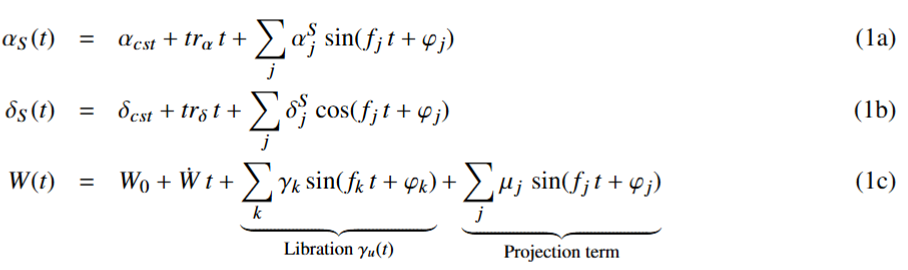
Marie Yseboodt, Rose-Marie Baland, and Tim Van Hoolst
Accurate orientation and rotation models for the Galilean satellites are essential to correctly interpret data from instruments GALA, 3GM, and JANUS onboard the Juice mission. We describe here an orientation/rotation model for Ganymede intended to assist in interior property inference by identifying the parameters to be estimated. 
Our present model aims for a precision of approximately 0.001° (roughly 46 meters on the surface) during the 2035 Ganymede Circular Orbit (GCO) phase of 6 months.  
 
Orientation and Libration Modeling:
We model the spin axis orientation and prime meridian location using the classical angles relative to the International Celestial Reference Frame (ICRF): the right ascension α, declination δ, and the rotation angle W. The W angle includes the physical libration γu defined relative to uniform rotation. For more information regarding the libration, see the poster Van Hoolst et al. (2026), this conference.
The expressions for the α, δ, W angles of the spin axis are sums of a linear polynomials and of a trigonometric series :
The numerical values of the model are given in Table 1 for the orientation angles and Table 2 for the librations. 
 
Table 1: Orientation parameters for a rigid, solid Ganymede. Based on the NOE orbital theory, nine periodic terms are identified. Amplitudes sensitive to the presence of a liquid elastic layer are highlighted in yellow.
 
Table 2: Libration table for a rigid and solid satellite (k2 = 0) and range (k2 ≠ 0) if there is a liquid layer. We have a series of 20 libration frequencies. The truncation threshold of 0.1 as chosen here is below the aimed precision of 0.001°, but allows to see the diurnal libration in the series. Amplitudes sensitive to the presence of a liquid layer are highlighted.
 
Different SPICE kernels are provided for a solid and rigid satellite in planetary Physical Constants Kernels (PCK), available at https://lara.oma.be/GalileanSat.
 
Recommended Parameters for Orientation Model Inversion:
This study identifies the orientation parameters most sensitive to Ganymede's interior structure, specifically the presence of a subsurface liquid ocean, as highlighted in Table 1. However, to ensure robust inversion given a limited number of observations, the set of estimated parameters must be minimized.
We recommend fixing the lines that are independent of the interior to reduce correlations. For the spin orientation, four specific lines (lines 1, 2, 6, and 9) were identified as being interior-dependent. Given their long periods (∼30-560 years) relative to the 6-month duration of the GCO phase, we suggest modeling the combined effect of these four frequencies as a linear trend in right ascension and declination, rather than as a series of periodic oscillations.
Furthermore, we establish a relationship between the orientation angles α, δ and two obliquity amplitudes ε1 and ε3, which provide a more effective basis for constraining interior models.
 
Recommended Parameters for Libration Model Inversion:
For the libration model, to minimize the number of fitted parameters and because separating all individual frequencies over a 6-month duration is likely unfeasible, we again recommend fixing the terms that are independent of the interior. We suggest merging groups of close small frequencies into single periodic terms. This applies to groups with periods of 462–485 days (lines 2, 3, and 4) and 249–254 days (lines 10 and 11).
Three lines have a diurnal/quasi-diurnal period close to 7.1 days (lines 16, 18, and 19). Merging them into a unique diurnal frequency may introduce some error (because the beating term is ignored), depending on the interior model. Note that their amplitude is rather small (less than 1 as), and it may not be possible to estimate them given the expected measurement accuracy. The same applies to the 50-day libration period.
 
References:
M. Yseboodt and R.-M. Baland. Transformation of orientation and rotation angles of synchronous satellites: Application to the Galilean moons. Icarus, 450:116977, 2026. doi:10.1016/j.icarus.2026.116977

How to cite: Yseboodt, M., Baland, R.-M., and Van Hoolst, T.: Orientation and rotation model of Ganymede: Which parameters to fit?, Europlanet Science Congress 2026, The Hague, The Netherlands, 7–11 Sep 2026, EPSC2026-877, https://doi.org/10.5194/epsc2026-877, 2026.

F3.27
|
EPSC2026-887
|
On-site presentation
Alexis Coyette, Rose-Marie Baland, Marie Yseboodt, and Tim Van Hoolst

The oblateness of Jupiter, the perturbations induced by the Sun, and the mutual perturbations between the Galilean satellites, cause their orbital motion to deviate from a purely Keplerian orbit. In particular, the inclination, eccentricity, node and pericenter precession rates of each moon vary with time. These non-uniform orbital motions can be represented through periodic series expansions. From these series, corresponding periodic terms in the rotational response of the satellites can be derived. In the case of orbital node precession, the spin axis response consists of a dominant precessional motion accompanied by smaller nutation terms.

In this work, we extend the rotation model presented by Coyette et al. (2026), in which we assumed osculating orbits, to account for these orbital perturbations. Our dynamical model, based on an angular momentum formalism, couples the polar motion to the precession and nutation of the spin axis. Solving the equations up to second order in small quantities for osculating orbits allowed us to identify two polar motions: one at the diurnal frequency and another associated with the frequency of the precession of the pericenter longitude.

Using periodic series expansions for the orbital elements, we further identify additional polar motion terms superimposed on the two previously identified contributions. Some of these newly identified terms can reach amplitudes comparable to, or even larger than, those of the original polar motions.

References:

Coyette, A., Baland, R.-M., Van Hoolst, T., 2026. Second-order modeling of the Cassini states of large satellites: I. Influence of triaxiality and a subsurface ocean. Celestial Mechanics and Dynamical Astronomy 138:3, https://doi.org/10.1007/s10569-025-10269-9

How to cite: Coyette, A., Baland, R.-M., Yseboodt, M., and Van Hoolst, T.: Influence of orbital perturbations on the Polar Motion of the Galilean satellites, Europlanet Science Congress 2026, The Hague, The Netherlands, 7–11 Sep 2026, EPSC2026-887, https://doi.org/10.5194/epsc2026-887, 2026.

F3.28
|
EPSC2026-930
|
ECP
|
On-site presentation
Brian Magee, Audrey Vorburger, Leander Schlarmann, and Tim Mosimann

We present preliminary results of modelling Europa’s exosphere and how this work will aid preparation of the science teams for the mass spectrometer instruments currently on their way to investigate the icy moon.

Jupiter’s icy moon Europa is one of the most intriguing bodies in the Solar System due to its astrobiological potential and will be explored in the 2030’s by both ESA’s Jupiter Icy Moons Explorer (JUICE) and NASA’s Europa Clipper missions.  Europa’s tenuous atmosphere will be sampled in-situ by the Neutral gas and Ion Mass spectrometer (NIM) [1] onboard JUICE and the MAss Spectrometer for Planetary EXploration (MASPEX) [2] onboard Europa Clipper, providing high mass resolution measurements of the observed chemical composition.  These observations will allow deduction of Europa’s surface composition and processes as well as inferences about its subsurface ocean. 

Previous models of Europa show the dominance of O2 near the surface with extended populations of H2 and H2O at higher altitudes [3,4].  Others have focused on potential plumes, contrasting between different source mechanisms [5], and demonstrating the localized and global effects of an Enceladus-like plume source on the otherwise sputtered exosphere [4].

Our model focuses on the primary source and loss processes of Europa’s exosphere including sublimation and sputtering of the surface ice, photochemistry and ionization.  For our model we utilize the open-source Stochastic PArallel Rarefied-gas Time-accurate Analyzer (SPARTA) code [6].  This code employs the Direct Simulation Monte Carlo (DSMC) method [7] to model the behaviour of gas particle interactions, allowing an investigation of the extent of the collisional atmosphere and comparisons to fully collision-less models [3].

Finally, we show how our model, including future enhancements such as coupling with DSMC plume models in the same code framework [8], can tie directly to expected observational data via instrument data models of the mass spectrometers.   We thus highlight the role that models may play in both interpreting mission data and informing instrument science operations during the JUICE and Europa Clipper mission lifetimes.


Acknowledgement:
The authors acknowledge the financial support of the SNSF under SNSF starting grant 218336.


References:
[1] Föhn, M., et al. (2021), IEEE Aerospace Conference (50100). IEEE, 1-14.
[2] Waite Jr, J. H., et al. (2024). Space Science Reviews, 220.3, 30. https://doi.org/10.1007/s11214-024-01061-6
[3] Vorburger, A., and Wurz, P. (2018). Icarus, 311, 135-145. https://doi.org/10.1016/j.icarus.2018.03.022
[4] Teolis, B. D., et al. (2017). Icarus, 284, 18-29. http://dx.doi.org/10.1016/j.icarus.2016.10.027
[5] Vorburger, A., and Wurz, P. (2021). J. Geophys. Res. Space Phys., 126(9).  https://doi.org/10.1029/2021JA029690
[6] S. J. Plimpton, et al. (2019). Physics of Fluids 31, 086101. https://doi.org/10.1063/1.5108534
[7] Bird, G. A. (1994). Molecular gas dynamics and the direct simulation of gas flows.
[8] Mosimann, T., et al. (2025). EPSC-DPS Joint Meeting 2025. https://doi.org/10.5194/epsc-dps2025-899

How to cite: Magee, B., Vorburger, A., Schlarmann, L., and Mosimann, T.: Europa’s exosphere - preparation for mass spectrometry investigation at Jupiter’s icy moon, Europlanet Science Congress 2026, The Hague, The Netherlands, 7–11 Sep 2026, EPSC2026-930, https://doi.org/10.5194/epsc2026-930, 2026.

F3.29
|
EPSC2026-944
|
On-site presentation
John Carter, Severine Robert, Nicolas Ligier, Francois Poulet, Emiliano D’Aversa, Thibault Cavalié, Davide Grassi, Vincent Hue, Alessandro Moirano, Giuseppe Piccioni, Sebastien Rodriguez, Clement Royer, Benoit Seignovert, Roberto Sordini, Ines Belgacem, and Paula Betriu

The Jupiter Icy Moons Explorer (JUICE) mission will perform an extensive exploration of the Jovian system, combining regular investigations of Jupiter’s atmosphere with multiple flybys of the Galilean moons during the tour phase (2031-2034) and a Ganymede orbital phase until end of 2035 [1]. Among the JUICE payload, Moons and Jupiter Imaging Spectrometer (MAJIS) is an imaging spectrometer designed to characterize the composition, cloud structure, aerosols, and auroral emissions of Jupiter, while also investigating the surfaces and exospheres of the icy moons through visible and infrared hyperspectral imaging observations [2].

To prepare the nominal science phase of the mission, JUICE planning exercises are regularly conducted in coordination with the ESA Science Operations Centre. These exercises aim to consolidate science observations, test operational procedures and planning tools, and evaluate coordinated multi-instrument observation strategies. The latest exercise, performed in 2026, simulated a representative segment of the nominal tour including two perijoves and one Ganymede flyby, providing a framework to test coordinated Jupiter and Galilean moon observation strategies under realistic operational constraints. 

Geometry of the perijoves and Ganymede flyby:

The latest planning exercise "TR03" focuses on a representative segment of the JUICE nominal tour extending from 23 November to 20 December 2033, encompassing the ORB37 and ORB38 perijoves together with the Ganymede flyby 27G6 on November 27th. The selected configuration provides a favorable context to test coordinated observation strategies because it combines two consecutive perijove passages with a low-altitude (900 km) flyby of Ganymede on the trailing hemisphere, although under night-side inbound conditions. The geometry also includes Jupiter eclipse conditions offering opportunities for high-phase observations of Jupiter’s rings, as well as monitoring of Io, the Io plasma torus, and volcanic hot spots. The succession of two closely spaced perijoves enables the exercise to compare different observation strategies or to evaluate the implementation of a more generic and reusable perijove observation template within a multi-instrument framework.

MAJIS Jupiter planning and investigations:

The MAJIS Jupiter observation strategy aims to address several key Level-1 science objectives through the combination of high-resolution perijove observations and pre-/post-perijove monitoring segments. Perijove measurements provide access to cloud microphysics, atmospheric chemistry, and auroral emissions at high spatial resolution, while longer-term monitoring observations provide the temporal and longitudinal context required to investigate atmospheric variability and large-scale dynamics. The exercise started with the implementation of 3 coordinated Jupiter campaigns: a distant monitoring campaign, an auroral monitoring campaign, and a zonal wind campaign. For MAJIS, the exercise included the implementation of several observation types at Jupiter, such as global monitoring sequences, auroral observations, limb scans, and high-resolution perijove measurements, while simultaneously accommodating observations related to Ganymede and other satellite targets. 

Auroral observations included nightside and dayside measurements of the northern and southern auroral ovals at spatial resolutions of 150–250 km/pixel, together with a long-distance auroral monitoring campaign at intermediate phase angle (130°) at 300–350 km/pixel. The monitoring strategy additionally included 13 disk scan observations (250–350 km/pixel), high-resolution perijove mosaics, half-disk observations, and a rapid-revisit sequence consisting of two disk scans separated by 40 minutes (150 km/pixel). Limb observations included north and south polar scans at 160–180 km/pixel together with a global limb campaign composed of 12 acquisitions distributed around Jupiter’s disk at phase angles close to 90°, sampling both dayside and nightside conditions. A few stellar occultations were also implemented. 

MAJIS satellite planning and investigations:

The operational strategy and science return of Galilean moons flybys depends primarily on the geometry of the flyby: 1) if it is a high vs low altitude flyby (altitudes ranging 200-1000km vs >1000 km), 2) how much of the closest approach is during day vs night side, 3) the S/C velocity to a lesser extent. The latest training exercise featured a low velocity, medium altitude (900 km) and mostly nightside trajectory at low altitude. As a result, the main science focus of MAJIS observations was the exosphere of Ganymede. This is achieved by observing the disk and limb with both forward and back scattering geometries (low and high solar phase angles). A typical exospheric observation scans the first 100 to 200 km vertical profile of the exosphere with spatial resolution ranging 1 - 15 km/pixel. Whenever possible, the MAJIS slit is placed tangent to the limb and the instrument scans outwards. Several latitudinal positions are investigated both on the day and night sides. Other pointings have been designed including using a S/C slew motion or scanning in the north-south direction, in an effort to harmonize pointing requirements with other instruments. Partial coverage of the sunlit surface is achieved on the dayside for spatial resolutions ranging 1-15 km/pix, with limited coverage at high resolution given the geometry of the flyby. The search for Ganymede’s mid-latitude auroral emission is achieved by scanning the surface of the moon on its nightside. The final plan for Ganymede has MAJIS observing Ganymede over 20 observing slots: 6 dedicated to dayside surface mapping, 12 of the exosphere (full range of latitudes and solar phase angles) and 2 nightside surface observations dedicated to the search for aurora. 

Substantial effort was dedicated to finding commonalities in the pointing design between MAJIS and the other remote sensing instruments SWI, UVS and JANUS. The plan shows that each MAJIS observing block of Ganymede also has between one and all of these other instruments observing at the same time, demonstrating the strong pointing and science synergy that is possible with these instruments, despite very different pointing requirements and operational modes. 

In addition to Ganymede observations, long distance observations of Io and Europa are planned at low resolution (150-250 km/pix) on their day/night sides, and high solar phase angle observations of the Jupiter rings are implemented in coordination with JANUS. 

This contribution summarizes the main lessons learned from the MAJIS participation, including both scientific and operational aspects of coordinated observation planning within the JUICE mission.

References: [1] Boutonnet et al., 10.1007/s11214-024-01093-y (2024), [2] Poulet et al., 10.1007/s11214-024-01057-2 (2024)

Acknowledgements: JUICE is a mission under ESA leadership with contributions from its Member States, NASA, JAXA and the Israel Space Agency. This work was supported by CNES. This work has been developed under the ASI-INAF agreement no. 2023-6-HH.0.

How to cite: Carter, J., Robert, S., Ligier, N., Poulet, F., D’Aversa, E., Cavalié, T., Grassi, D., Hue, V., Moirano, A., Piccioni, G., Rodriguez, S., Royer, C., Seignovert, B., Sordini, R., Belgacem, I., and Betriu, P.: MAJIS observation strategies during the JUICE science nominal phase: coordinated perijoves and moon flyby, Europlanet Science Congress 2026, The Hague, The Netherlands, 7–11 Sep 2026, EPSC2026-944, https://doi.org/10.5194/epsc2026-944, 2026.

F3.30
|
EPSC2026-1023
|
On-site presentation
Ronny Hahnel, Dirk Plettemeier, and Lorenzo Bruzzone

The JUICE (Jupiter ICy Moon Explorer) mission aims to explore Jupiter and three of its Galilean moons. The spacecraft is set to arrive in the Jovian system in 2031, utilizing its onboard instruments, including the Radar for Icy Moons Exploration (RIME), to study these celestial bodies. RIME operates as a subsurface radar at a center frequency of 9 MHz. The chirp signal has a bandwidth of 2.8 MHz, allowing it to penetrate icy surfaces up to a depth of approximately 9 km with a vertical resolution of about 30 m. The radar sounder uses a 16.6 m dipole consisting of two 8.3 m rods, which are made of a carbon fiber reinforced plastic structure.

To replicate the properties of the radar sounder on Earth, an antenna simulator (AS) was developed. This simulator mimics the behavior of the RIME antenna system in space and is essential for calibrating the radar by estimating and minimizing distortions in the instrument’s performance. The calibration process involves calculating the instrument transfer function (ITF) across the entire transmission path, including the transmitter and receiver paths.

Since the low operating frequency limits direct antenna measurements, simulations are used to approximate the antenna's behavior with negligible discrepancies. However, measurements were made for other components such as the central matching network (CMN), terminal matching network (TMN), dummy loads (DL), and combiner (CMB), across the full frequency range. Therefore, it is possible to accurately reproduce the behavior of the AS.

The transmission characteristics of the TX and RX paths were determined using the radar system's original flight electronics and the AS. Calibration requires de-embedding the AS within the respective path to account for load-dependent behaviors, enabling simulations to incorporate frequency-dependent factors of the antenna system. For these simulations, an ideal chirp signal is assumed as input. Using this assumption, transfer functions are calculated for the power amplifier and the Receiver and Digital Subsystem.

Combining the individual transmission functions results in the ITF. In addition, an average reflection factor can be assumed to approximate the impact of the surface. This makes it possible to estimate the losses occurring along the entire transmission path.

How to cite: Hahnel, R., Plettemeier, D., and Bruzzone, L.: Performance Characterization of RIME aboard JUICE with Instrument Transfer Function, Europlanet Science Congress 2026, The Hague, The Netherlands, 7–11 Sep 2026, EPSC2026-1023, https://doi.org/10.5194/epsc2026-1023, 2026.

F3.31
|
EPSC2026-1206
|
On-site presentation
Giuseppe Cimò, Dominic Dirkx, Guifré Molera Calvés, Vidhya Pallichadath, Leonid Gurvits, Luigi Gisolfi, Alfonso Sanchez Rodriguez, Sandor Frey, Judit Fogasy, Máté Krezinger, Krisztina Perger, Jasper Edwards, Oliver White, Sam Fayolle, and Mas Said

Ground-based radio astronomy and space science get together in the Planetary Radio Interferometry and Doppler Experiment (PRIDE), which provides the precise determination of the lateral position of spacecraft on the celestial sphere using phase referencing near-field Very Long Baseline Interferometry (VLBI).

As part of the ESA Jupiter Icy Moons Explorer (JUICE) mission, PRIDE is complementary to on-board radio science experiments. The technique consists of radio astronomical observations of the JUICE radio signal alongside calibrating quasars to deliver high-resolution lateral position measurements within the International Celestial Reference Frame. PRIDE requires no extra onboard instruments and relies on the spacecraft's existing telecommunications system and ground-based telescope arrays, like the European VLBI Network or the Australian Long Baseline Array.

Since JUICE launch, PRIDE observations have tracked the spacecraft on several occasions. During the Lunar-Earth Gravity Assist (LEGA), multiple radio telescopes observed JUICE to independently validate the spacecraft trajectory to verify PRIDE internal pipelines. In August 2025, the European VLBI Network ran an observing campaign during the Venus gravity assist manoeuvres. In this presentation, the status and the results of the PRIDE-JUICE cruise phase activities will be presented.

How to cite: Cimò, G., Dirkx, D., Molera Calvés, G., Pallichadath, V., Gurvits, L., Gisolfi, L., Sanchez Rodriguez, A., Frey, S., Fogasy, J., Krezinger, M., Perger, K., Edwards, J., White, O., Fayolle, S., and Said, M.: Two years of Planetary Radio Interferometry and Doppler Experiment for the ESA’s JUICE mission, Europlanet Science Congress 2026, The Hague, The Netherlands, 7–11 Sep 2026, EPSC2026-1206, https://doi.org/10.5194/epsc2026-1206, 2026.

F3.32
|
EPSC2026-206
|
ECP
|
On-site presentation
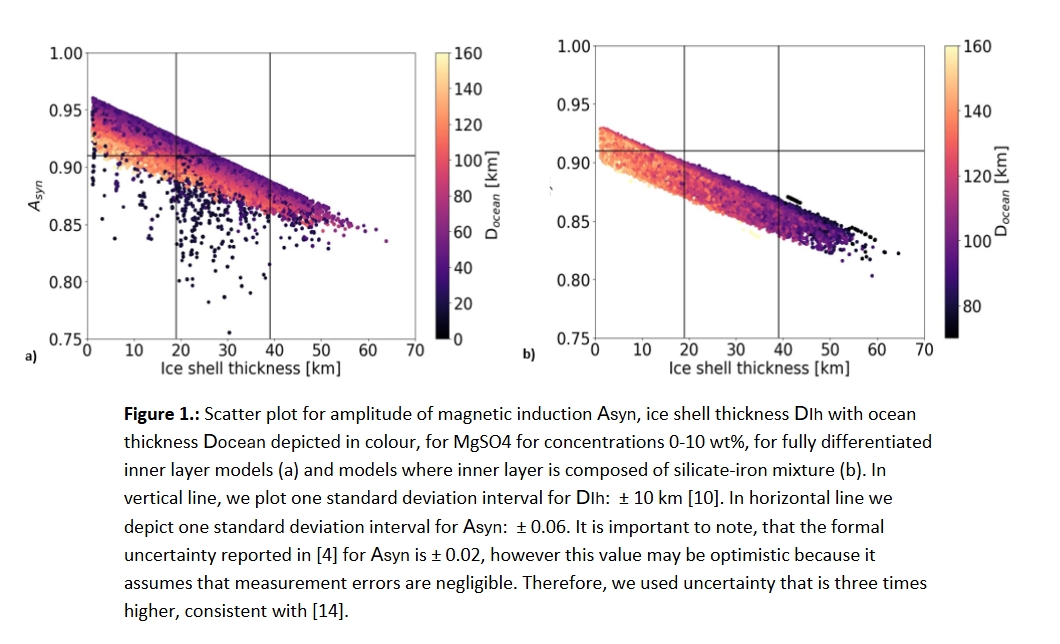
Terézia Košíková and Marie Běhounková

Introduction 

Missions Galileo and Juno have significantly advanced our understanding of Jovian moons.  Through their measurements, these missions unveiled the possible presence of subsurface water oceans. Building on these discoveries, upcoming missions, JUICE and Europa Clipper, hold the potential to further enhance characterisation of the internal structure by delivering new and/or improved data, including tidal deformation and magnetic induction measurements ([1], [2], [3]).  

Our study aims to characterise the internal structure of Europa. We employed a combination of known material properties ([4], [5], [6], [7]) alongside measured satellite data to assess Europa’s plausible internal structures. Among data we included total mass (M), radius (Rsurf), moment of inertia (MOI) [8], as well as amplitude of magnetic induction measured at synodic period (Asyn), obtained from Gallileo [9], new measurement of the ice shell thickness (DIh), measured by Juno [10], as well as anticipated tidal Love number k2 into our statistical analysis, aiming to enhance our understanding of the moons' structural characteristics. 


Model 

We numerically evaluate the internal density, pressure, and temperature profiles, assuming known structural parameters, which represent our a priori information about possible structures: the total radius, core and mantle radii, densities of mantle and core, salinity Cw, and surface heat flux.  From these, we derive data values predicted for each assumed structure. 

For the thermal profile, we assume conductive heat transfer in the ice shell, and an adiabatic profile in the liquid ocean. Equations of state (EOS) and parameters describing the hydrosphere’s material properties are adopted from [4], [5], [6],[7], while the core and mantle properties are simplified. 

For each model, we also evaluate tidal deformation, using a library based on [11], as well as magnetic induction response, using code based on [12].  

To determine the interior structures, that are consistent with measured data, such as measured values for M, MOI and Rsurf, along with Asyn [9], DIh [10], and anticipated k2, along with their uncertainties, we apply a statistical approach by coupling our model with emcee sampler [13], that uses the Markov chain Monte Carlo method, which samples posterior distributions of internal structure parameters. We test several combinations of measured data and analyse how the used dataset impacts statistical distribution of the parameters. 


Results 

We assumed models, where Europa is either fully differentiated into the hydrosphere, mantle, and core, or a model with only the hydrosphere and a silicate-iron inner layer, to assess the structure. We analysed the internal structure for two different salts present in the ocean: MgSO4 and NaCl.  

We compared the resulting internal structures as additional data information was gradually incorporated. The most significant change was the variation in surface ice shell thickness among tested dataset configurations. Models that incorporated information about Asyn preferred very thin ice shell thicknesses, compared to other models.  

We then studied resulting structures for models, where the inner layer was not fully differentiated for both salts. Our results showed that their structures preferred thicker hydrospheres, when compared with models where we had differentiated mantle and core.  

We then plotted the resulting structures as functions of DIh with respect to Asyn, marking the regions where both the measured values of DIh and Asyn fall within one-sigma standard deviation range.  The results are depicted in Figure 1, for MgSO4, and Figure 2, for NaCl. 

Our results showed that, across all models, most of the resulting structures do not fall within the one-sigma interval for DIh and Asyn.  For the models where 0-10wt% MgSO4 was present, to be consistent with both measured data, Europa must have at least a partially differentiated core and mantle. In the case of 0.2-4.2wt% NaCl, we found structures that fall within one-sigma range of both measurements, with or without differentiated mantle and core, due to the higher conductivity of NaCl compared to MgSO4. It is important to note that, in the presence of NaCl, we worked with a narrower range of concentrations than for MgSO4, so it is plausible that if higher concentrations had been allowed, it could yield a larger number of compatible models for NaCl. 

Summary 

We modelled the internal structure of Europa, considering the existence of both mantle core, as well as only layer composed of iron-silicate mixture, for compositions of MgSO4 and NaCl. We employed Markov chain Monte Carlo, using emcee library. In the dataset we also included information about magnetic induction and ice shell thickness. We found if MgSO4 is present, for models to be compatible with both measurements, Europa’s deep interior must be at least partially differentiated.   

Acknowledgement 

This research was supported by Charles University through project No. 142125 and by the Czech Science Foundation (project No. 26-21877S).  

References 

[1] Cappuccio et al. (2020). https://doi.org/10.1016/j.pss.2020.104902 

[2] Cappuccio et al. (2022). https://doi.org/10.3847/PSJ/ac83c4 

[3] Mazarico et al. (2023). https://doi.org/10.1007/s11214-023-00972-0 

[4] Vance and Brown (2013). https://doi.org/10.1016/j.gca.2013.01.040. 

[5] McDougall and Barker (2011). ISBN: 978-0-646-55621-5.  

[6] Pan, Yong and Secco (2020). https://doi.org/10.1029/2020GL090192 

[7] Journaux et al. (2020). https://doi.org/10.1029/2019JE006176 

[8] Gomez Casajus et al. (2022). https://doi.org/10.1029/2022GL099475. 

[9] Schilling, Khurana and Kivelson (2004). https://doi.org/10.1029/2003JE002166 

[10] Levin et al. (2026). https://doi.org/10.1038/s41550-025-02718-0 

[11] Sabadini and Vermeersen (2004). ISBN: 978-1-4020-2285-8 

[12] Pěč et al. (1991). https://doi.org/10.5636/jgg.43.295. 

[13] Foreman-Mackey et al. (2013). https://doi.org/10.1086/670067 

[14] Petricca et al. (2023). https://doi.org/10.1029/2023GL104016 


How to cite: Košíková, T. and Běhounková, M.: The Impact of the Geophysical Constraints on the Internal Structure of Europa , Europlanet Science Congress 2026, The Hague, The Netherlands, 7–11 Sep 2026, EPSC2026-206, https://doi.org/10.5194/epsc2026-206, 2026.

F3.33
|
EPSC2026-952
|
ECP
|
On-site presentation
Laura Barone, Giuseppe Antonio Baratta, Carlotta Sciré, Riccardo Giovanni Urso, Daniele Fulvio, Placido Giuseppe Mineo, and Maria Elisabetta Palumbo

JUpiter ICy moons Explorer (JUICE) is a space mission that aims to make detailed observations of the planet Jupiter and its icy satellites Ganymede, Europa, and Callisto, also known as Galilean moons.

These three moons are continuously exposed to high-energy charged particles and thermal cycling, leading to complex physico-chemical modifications of their icy surface. Carbon dioxide has been widely detected on the surface of Galilean icy moons and represents a key species for understanding surface evolution processes. Recent observations by the James Webb Space Telescope (JWST) resolved for the first time the CO2 ν1+ν3 combination mode near 2.7 µm on Europa [1], highlighting the importance of laboratory investigations of CO2 spectral features in icy environments.

In this work, we present a preliminary laboratory study of the infrared spectral behaviour of CO2 in H2O ice mixtures at temperatures relevant for icy moons. Experiments were performed between 50 and 150 K with pure CO2 ice and H2O:CO2 mixtures with ratios of 20:1, 4:1, and 1:1. Pure CO2 ice exhibits two characteristic features in the 2.7 µm spectral region, with components centred near 2.70 µm and 2.78 µm corresponding to the ν13 and 2ν23 combination bands, respectively [2]. We study how band profiles and the evolution of these bands vary with temperature and mixture composition.

Our results show that CO2 segregation strongly depends on the H2O:CO2 mixing ratio and thermal evolution. In general, segregation processes begin around 60-70 K, producing significant variations in the band profiles. However, the highly diluted 20:1 mixture does not exhibit clear segregation signatures within the investigated temperature range, suggesting a stronger trapping of CO2 molecules within the water ice matrix. We also observe distinct differences in the sublimation behaviour of pure and mixed CO2 ice. Pure CO2 sublimates at approximately 80 K, while in H2O-rich mixtures, the sublimation occurs at significantly higher temperatures due to the interaction with the water ice matrix. These effects are reflected in the evolution of the infrared band shapes and relative intensities.

This work provides new laboratory constraints for the interpretation of infrared observations of icy moons and contributes to the spectroscopic characterization of CO2-bearing icy surfaces relevant for current (e.g., JWST) and future (e.g., JUICE) observations of the Jovian system.

The Italian participation to JUICE mission is founded by the Italian Space Agency (ASI). This work has been developed under the ASI-INAF agreement n. 2023-6-HH.0


[1] Goldberg, C., Trumbo, S., Brown, M., Davis, R., and Loeffler, M.: Investigating the Origin and State of Europa’s CO2 with Global Observations from JWST, EPSC-DPS Joint Meeting 2025, Helsinki, Finland, 7–12 Sep 2025, EPSC-DPS2025-434, https://doi.org/10.5194/epsc-dps2025-434, 2025.

[2] Sandford, S. A., and L. J. Allamandola. "The physical and infrared spectral properties of CO2 in astrophysical ice analogs." Astrophysical Journal, Part 1 (ISSN 0004-637X), vol. 355, May 20, 1990, p. 357-372. 355 (1990): 357-372.

How to cite: Barone, L., Baratta, G. A., Sciré, C., Urso, R. G., Fulvio, D., Mineo, P. G., and Palumbo, M. E.: IR band profile of CO2 combination modes in H2O ice mixtures, Europlanet Science Congress 2026, The Hague, The Netherlands, 7–11 Sep 2026, EPSC2026-952, https://doi.org/10.5194/epsc2026-952, 2026.

F3.34
|
EPSC2026-1032
|
On-site presentation
Johannes Wicht and Ilse De Langen

Because of Jupiter’s rotation and the orbital motion, the subsurface oceans of the Galilean moons experience a time varying background magnetic field. This gives rise to induction and the detection of the related magnetic fields lead to the discovery of the subsurface oceans. We numerically study the induction, concentrating on a background field that consist of Jupiter’s potential field and the field of the current disc but ignores the interaction of the moon with the surrounding plasma.

The complex orbital motions yield magnetic field variations of different frequencies, with different amplitudes and phases that change over time. Analyzing the orbital evolution, we provide a catalogue of these important parameters, which are crucial for interpreting the measured induced magnetic. The most important parameter for the induction problem is the magnetic Reynolds number, Rm. Rm is the ratio of the magnetic dissipation time, which scales with the electrical conductivity, and the induction period. The second parameter, which the system is less sensitive to, is the relative ocean depth. We compare different methods of calculating induction, ranging from classical methods to full 3d dynamical simulations. The Matlab code PlanetInd, which is freely available on GitHub, allows choosing the most appropriate method for the induction problem of interest. We find that the classical analytical solutions based on Bessel functions become problematic for larger Rm values.  PlanetInd therefore uses a pseudo-spectral numerical method in radius for these cases.

Using PlanetInd, we explore the dependence of induction effects on Rm and the relative ocean depth for Europa and Ganymede and predict the expected measurements at different space craft altitudes. PlanetInd allows including radial profiles in electric conductivity and calculates the effects of zonal ocean flows. Assuming a conductivity profile caused by salinity variations in Europa’s ocean, we show that this will be very difficult to detect. The magnetic signal from zonal flows will likely be tiny at Europa but could just be detectable at Ganymede because of the presence of an inner dynamo.

How to cite: Wicht, J. and De Langen, I.: Induction in the Subsurface Oceans of Europa and Ganymede, Europlanet Science Congress 2026, The Hague, The Netherlands, 7–11 Sep 2026, EPSC2026-1032, https://doi.org/10.5194/epsc2026-1032, 2026.