
 1
1- 1Leiden Universiteit, Leiden Observatory, Netherlands (zsmith@strw.leidenuniv.nl)
- *A full list of authors appears at the end of the abstract
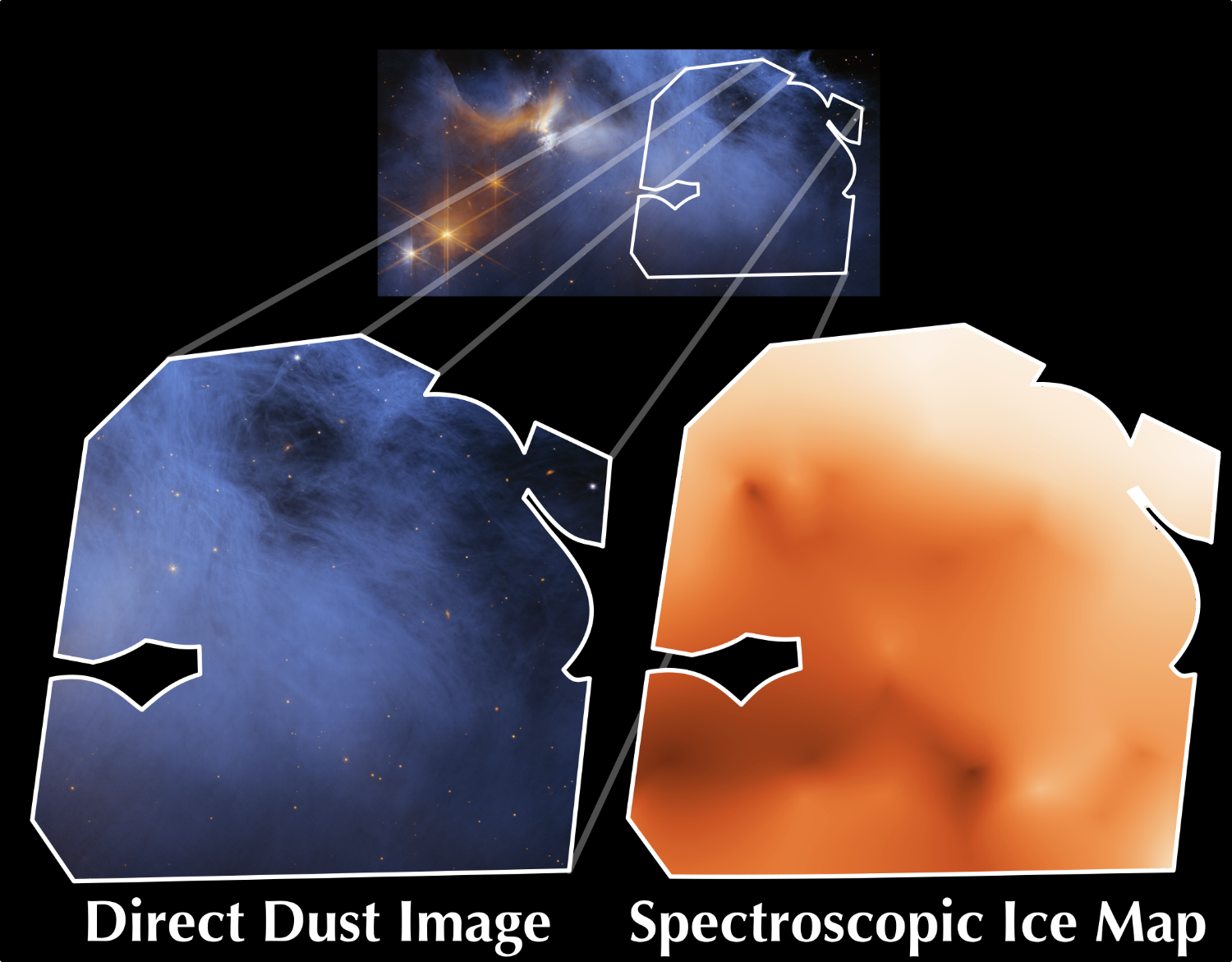
In the coldest regions of molecular clouds, carbon and oxygen freeze onto dust grains and react to form icy mantles that play a fundamental role in star and planet formation. These ices establish the initial chemical inventory of emerging protoplanetary disks and seed their chemical complexity. However, the sequential formation pathways of interstellar ices remain poorly constrained. While infrared spectroscopy is a powerful probe of ice chemistry, previous observing facilities lacked both the sensitivity needed to probe ice abundances during the final stages of core collapse and the spatial sampling required to map ice abundances on the same scales (<1000 AU) as gas abundance maps from cloud edge to core.
JWST NIRCam Wide-Field Slitless Spectroscopy (WFSS) now enables such studies. I will present the first cospatial maps of H2O, CO2, and CO ice on scales of hundreds of AU surrounding a Class 0 source within the Chamaeleon I molecular cloud, using 44 sightlines from the JWST ERS programme “IceAge” (PID: 1309). These observations were made possible by a novel data reduction pipeline developed to establish WFSS as a viable and efficient observing mode. Our observations probe ice column densities an order of magnitude higher than previously explored, where correlations between ice species indicate enhanced CO2 formation within CO-rich ice toward the densest sightlines.
I will also present initial results from my JWST Cycle 2 programme “CHEERIO” (PID: 4358), targeting cloud-edge spectra in Cha I. These observations complement the IceAge dataset and extend our view of ice evolution from the diffuse cloud edge to the dense core within a single molecular cloud.
This unprecedented statistical sampling within one cloud represents a major advance in constraining interstellar ice chemistry by removing the need to average over chemically distinct environments. The resulting chemically consistent dataset provides powerful new constraints for pre-stellar astrochemical models and opens the door to probing gas–grain interactions, snowline formation, chemical evolution in dense regions, and the broader astrophysical implications of ice chemistry.
Melissa McClure, Hugh Dickinson, Helen Fraser, Jennifer Noble, Adwin Boogert, Fengwu Sun, Eiichi Egami, Emmanuel Dartois, Jessica Erkal, Takashi Shimonishi, Tracy Beck, Jennifer Bergner, Paula Caselli, Steve Charnley, Laurie Chu, Maria Drozdovskaya, Rob Garrod, Daniel Harsono, Sergio Ioppolo, Izaskun Jimenez-Serra, Jes Jørgensen, Gary Melnick, Karin Öberg, Mariaelisabetta Palumbo, Yvonne Pendleton, Giulia Perotti, Klaus Pontoppidan, Danna Qasim, Will Rocha, Ardjan Sturm, Angèle Taillard, Ricardo Urso, Ewine van Dishoeck
How to cite: Smith, Z. and the IceAge: Tracing the ice architecture of the Cha I cloud: Cospatial ice mapping of H2O, CO2 and CO with JWST NIRCam/WFSS, Europlanet Science Congress 2026, The Hague, The Netherlands, 7–11 Sep 2026, EPSC2026-210, https://doi.org/10.5194/epsc2026-210, 2026.


