
 1,1,1,2,3
- 1INAF - IAPS, Istituto di Astrofisica e Planetologia Spaziali (INAF - IAPS), Rome - Italy
- 2Università di Roma – Tor Vergata, Dipartimento di Biologia, Rome - Italy
- 3Università degli studi di Napoli “Parthenope”, Dipartimento di Scienze e Tecnologie, Naples - Italy
Introduction. The presence of liquid water is a fundamental parameter when discussing the potential habitability of space environments, coupled with the availability of the elements of life, C-H-O-N-P-S, and of an energy source. The interiors of the Jovian icy moons, Callisto, Ganymede and Europa, are of particular exobiological interest specifically due to the presence of liquid water oceans. For some of these icy moons, such as Europa, this liquid water is also in contact with a potentially geothermally active sub-surface, enabling chemical reactions which may be able to sustain life [1-2-3]. The JUICE (Jupiter Icy Moons Explorer) probe (ESA) and the Europa Clipper mission (NASA) [4, 5] will both be exploring the Jovian moons system, with particular focus on Ganymede and Europa respectively. Prior to the probes’ arrival in the system, it is of great importance to investigate if life may be compatible with these environments and which “type” of life and associated bio-signatures could be detectable with the spectroscopic instruments onboard the two spacecrafts (MAJIS [6, 7] for JUICE and MISE [8] for Europa Clipper). The work presented here focuses on testing the survivability of visible and far-red light absorbing cyanobacteria to the cryogenic and low pressure conditions at the surface of icy moons, as well as the eventual detectability of pigments and other relevant spectral features associated with life via visible to near-infrared spectroscopy.
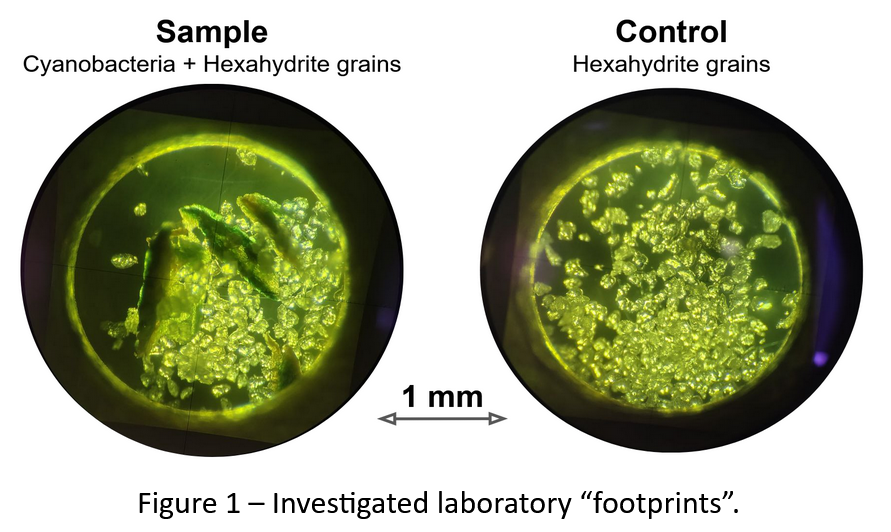
Materials and Methods. Desert Cyanobacteria (Chroococcidiopsis spp.) is an extreme-tolerant bacterium, capable of oxygenic photosynthesis using both visible and far-red light (after acclimatization) [9]. The use of far-red light for photosynthesis would allow this strain to survive where visible light does not reach, for instance at geothermally active ocean floors, using the far-red light emitted by the thermal glow of hydrothermal vents. The survivability of this particular strain has already been tested for space environments, in particular at low-Earth orbit conditions and Mars-like conditions, with other laboratory works testing specific properties such as the limits of its photosynthetic performance and its radioresistance [10-11-12-13]. In this work, we built “laboratory footprints” simulating an inhabited icy moon surface, by “contaminating” magnesium sulfate hexahydrite grains— a hydrated salt relevant for the Jovian icy moon — with cyanobacteria. The mixture is then exposed to vacuum down to 1E⁻³ mbar and to cryogenic temperatures close to 100 K. All the while, the spectral properties of the mixture are being monitored using an infrared microscope via spectral imaging in a range from 0.5 to 12 μm.
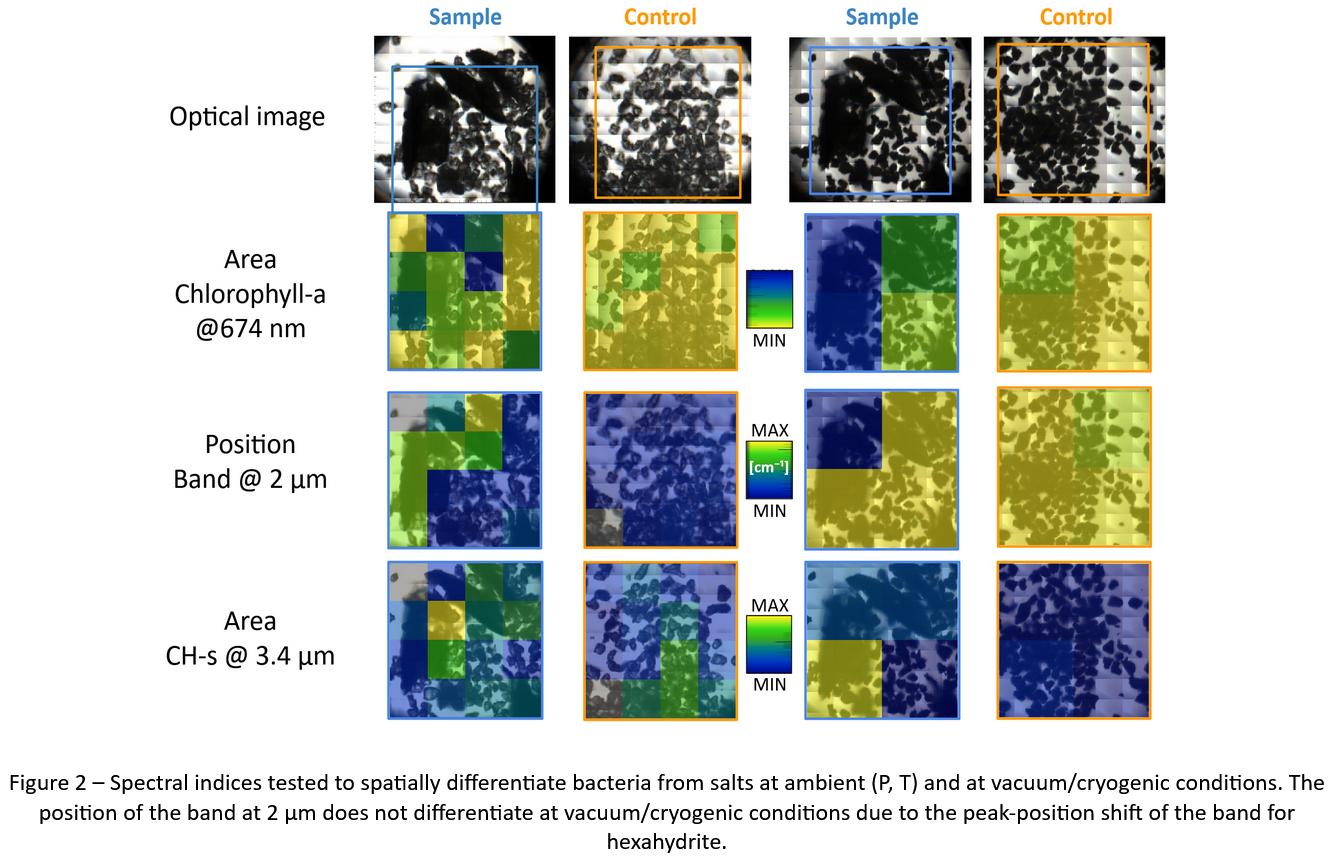
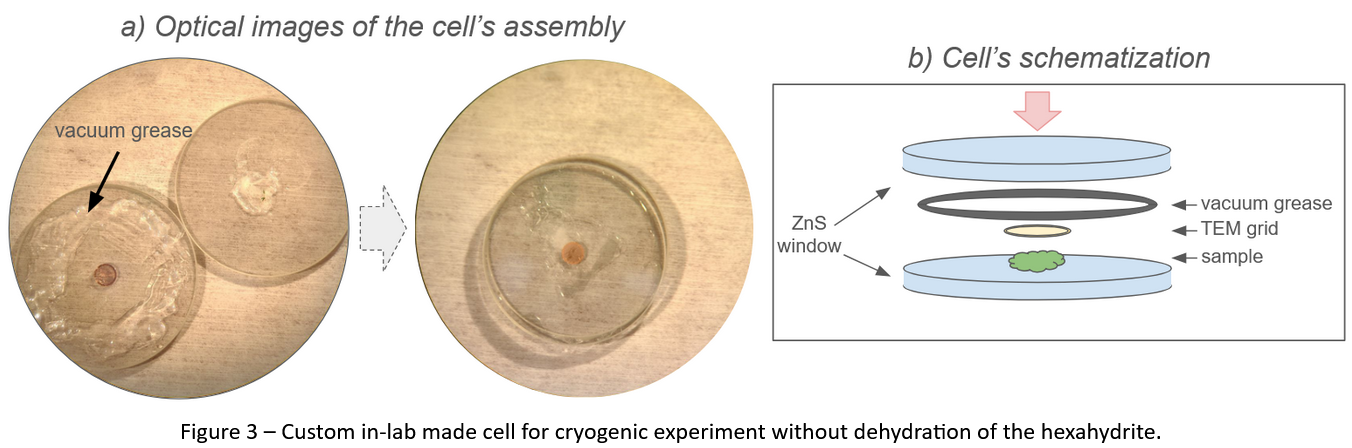
Results and Discussion. The experimental work on the far-red light acclimated strain is still ongoing. The results on the visible light absorbing strain have shown that in the visible spectral range, the spectral features of the cyanobacterium (associated with the Chl-a pigment, cf. Figure 2) and that of hexahydrite are well separated, enabling a direct spatial differentiation at both ambient conditions and cryogenic/vacuum conditions. In the near-IR range, the spectral features of the cyanobacteria get lost in the features of the hydrated salt due to spectral overlap with the water-associated features. Spectral indices such as peak-position, which work for spatial differentiation at ambient (T, P) do not work at cryogenic/vacuum conditions due to changes in the position of the spectral features of hexahydrite (Figure 2). In the mid-IR range, the aliphatic C-H stretching band at 3.4 μm is efficient for spatial differentiation at both ambient and cryogenic conditions (Figure 2), although it is not in itself a biosignature. In this experiment, samples were first put under vacuum and subsequently under cryogenic conditions. The pressure descent resulted in the dehydration of the hexahydrite salt, which is associated with the shift of the peak position of the hydration features [14] and their overlap with the ones of the cyanobacteria. A second experiment has been done where cryogenic conditions were achieved prior to the pressure descent, using a custom-made cell “trapping” water from escaping the system (Figure 3) when decreasing the pressure. The analysis of the spectral monitoring from this second experiment is still ongoing. Meanwhile, all biological samples which have undergone vacuum and cryogenic conditions have been recovered to ascertain their survivability.
References. [1] Belton, M. J. S. et al. Science 274, 377–385 (1996). [2] Smith, B. A. et al. Science 206, 927–950 (1979). [3] Pappalardo, R. T. et al. J. Geophys. Res. 104, 24015–24055 (1999). [4] Phillips, C. B. & Pappalardo, R. T. Eos (Washington DC) 95, 165–167 (2014). [5] Grasset, O. et al. Planet. Space Sci. 78, 1–21 (2013). [6] Poulet F. et al. Space Science Reviews, 2020, 2024. [7] Piccioni G. et al. IEEE pp. 318-323, 2019. [8] Blaney, D. L. et al. Space Science Reviews, 220, 2024. [9] Billi, D., Baqué, M., Verseux, C., Rothschild, L. & de Vera, J.-P., Adaption of Microbial Life to Environmental Extremes 133–146 ( 2017). [10] de Vera, J.-P. et al. Planet. Space Sci. 74, 103–110 (2012). [11] Baqué, M. et al. Orig. Life Evol. Biosph. 43, 377–389 (2013). [12] Di Stefano, G. et al. Life (Basel) 15, 622 (2025). [13] Billi, D. et al. Applied and Environmental Microbiology 66, 1489–1492 (2000). [14] Furnari et al., in preparation.
Acknowledgements. This work is funded through the European Union and Regione Campania’s FESR 2007/2013 O.O.2.1 initiative. SR is supported by the ASI-INAF agreement n.2023-6-HH.0 (Resp.: G. Piccioni).
How to cite: Rubino, S., Furnari, F., Stefani, S., Piccioni, G., Tosi, F., Di Stefano, G., Billi, D., Tonietti, L., and Rotundi, A.: Visible and Far-red light absorbing cyanobacteria settled in salty brines: survivability and detectability on icy moons surfaces, Europlanet Science Congress 2026, The Hague, The Netherlands, 7–11 Sep 2026, EPSC2026-211, https://doi.org/10.5194/epsc2026-211, 2026.


