
 1,6,7,
- 1Lancaster University, Department of Physics, United Kingdom of Great Britain – England, Scotland, Wales (d.naylor@lancaster.ac.uk)
- 2University College London, UK
- 3NASA Jet Propulsion Laboratory, California, USA
- 4John Hopkins Applied Physics Laboratory, Maryland, USA
- 5University of Leicester, UK
- 6University of Warwick, UK
- 7University of Oregon, Oregon, USA
- 8Deep Space Exploration Laboratory / School of Earth and Space Sciences, University of Science and Technology of China, Hefei, China
Soft X-ray emission from a planetary magnetosheath and its associated cusps can be generated by charge exchange between highly charged solar wind ions (such as O7+) and system neutrals. Instruments such as the SXI on the ESA/CAS SMILE mission aim to perform global and dynamic imaging of the terrestrial magnetosheath and explore the driving of the magnetosphere by the solar wind. We investigate the viability of this technique at Uranus where neutral particles sputtered from the icy moons are predicted to form extended tori, although densities are unconstrained. The 98 planetary obliquity and 59 tilt of the dipole axis relative to the spin axis mean the magnetosphere and neutrals have a complex interaction with the solar wind where, for example, the cusps can coincide not only with the exosphere but with the moon-sourced neutrals. We present simulation-derived results that considers the Uranian system at equinox and solstice conditions, estimating the emission generated in the magnetosheath and cusps at different stages of a planetary rotation. Example cases show that around the time of the Voyager 2 flyby, line-of-sight integrated intensity could have been up to ~102 photon cm-2 s-1 on average in the magnetosheath, and up to ~104 photon cm-2 s-1 in the cusps near the planet. This suggests imaging of the magnetosheath and cusps within planetary and solar wind timescales may be possible and that soft X-ray imaging is a potentially valuable tool for studying Uranus’s magnetosphere.
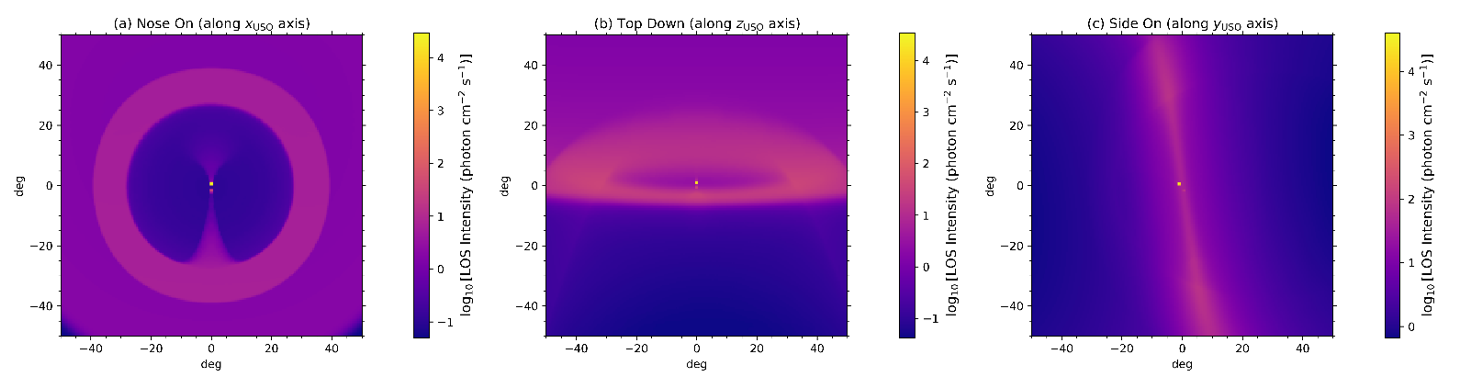
Figure 1: intensity maps for an example case of Uranus’s magnetosheath at solstice, with a large instrument field-of-view being used to show the full dayside magnetosheath region. Intensity is shown for an instrument positioned (a) nose-on to the system, (b) top-down, and (c) side-on to the planet.
How to cite: Naylor, D., Ray, L. C., Dunn, W. R., Jasinski, J. M., Smith, H. T., Wharton, S. J., Desai, R. T., Paty, C. S., and Cao, X.: Soft X-Ray Emission from Uranus's Magnetosheath, Europlanet Science Congress 2026, The Hague, The Netherlands, 7–11 Sep 2026, EPSC2026-253, https://doi.org/10.5194/epsc2026-253, 2026.


