
 1,1,3
1,1,3- 1Università "G. d'Annunzio", Dip. INGEO Chieti-Pescara (alessandra.piscopo001@phd.unich.it) (monica.pondrelli@unich.it)
- 2Università "G. d'Annunzio" Dip. di Scienze Chieti-Pescara (lucia.marinangeli@unich.it)
- 3Università di Bologna, Dip. di Biologia, Geologia e Scienze Ambientali Bologna (barbara.cavalazzi@unibo.it)
Keywords:
Eberswalde crater, aeolian bedforms, atmospheric circulation, environmental changes.
Introduction
Aeolian bedforms on Mars record past atmospheric circulation. Dune turnover times of tens to hundreds of thousands of years (Fenton and Richardson, 2001) mean that individual bedform generations can reflect the obliquity cycles that drove climate transitions during the Late Amazonian (Laskar et al., 2004). Where multiple generations are preserved and their relative ages established through stratigraphic superposition, successive wind regimes can be reconstructed. Eberswalde Crater (23.5°S, 326.5°E, ~65 km; fig. 1) contains a well-preserved Noachian fluvial delta (Malin and Edgett, 2003; Pondrelli et. al, 2008) whose complex topography interacts with atmospheric circulation, producing a diverse aeolian bedform record and making it a particularly informative site for studying regional wind regimes and local topographic effects.
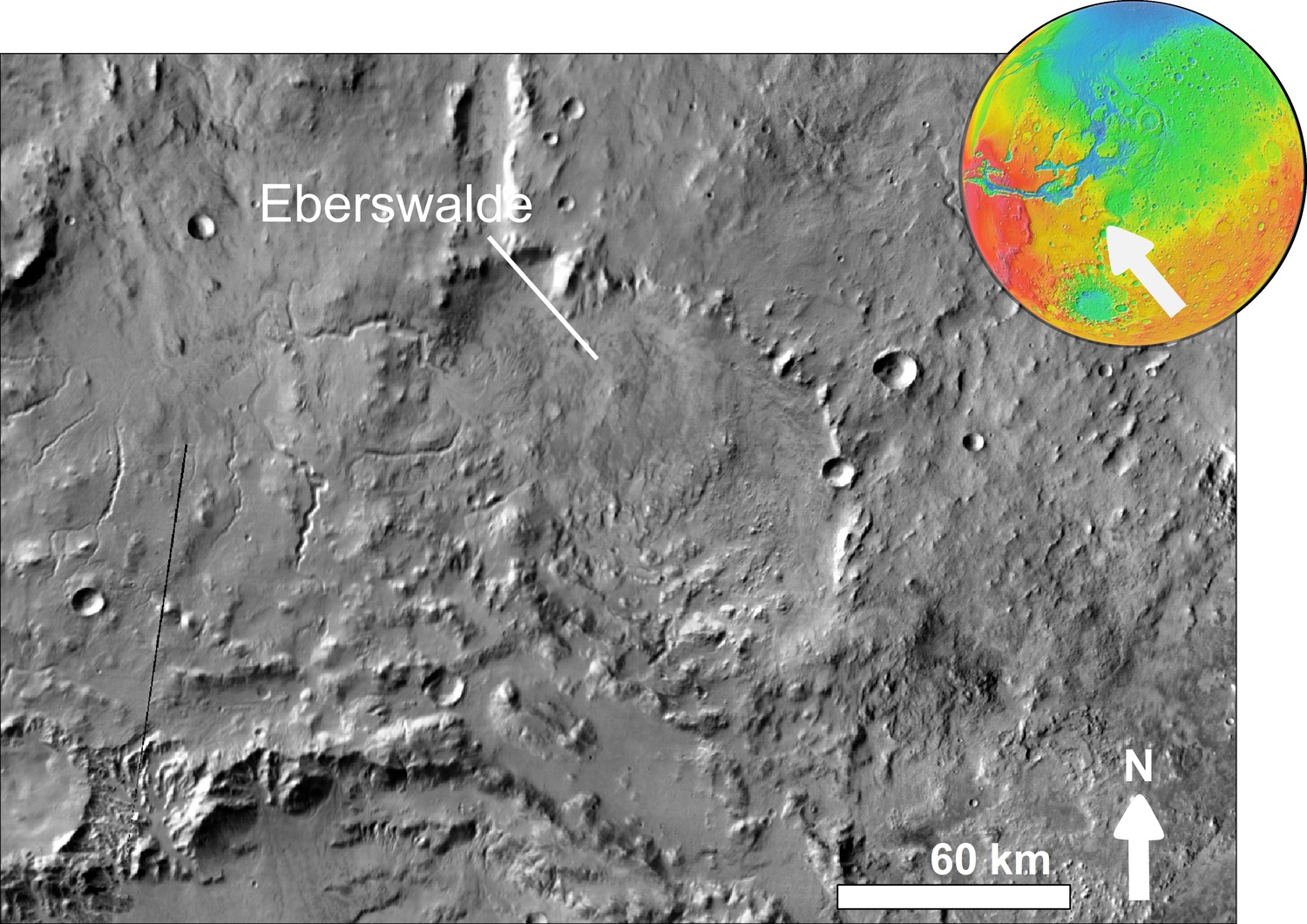
Figure 1. Regional context of Eberswalde Crater (THEMIS infrared mosaic; inset: MOLA topography).
Data and Methods
Mapping was carried out in QGIS v3.40 using HiRISE images (~25 cm/px; McEwen et al., 2007), CTX mosaics (~6 m/px) as basemap (fig. 2), and DEMs from HiRISE stereo pairs (~1 m/px) for 8 areas (A–H); 7 areas (I–Q) used HiRISE 2D only. Each bedform crest was digitized manually; parameters include height, crest length, wavelength, sinuosity, wind direction, topographic influence, type, and generation. Four morphogenetic types (dunes, megaripples, barchan dunes, star dunes) and four generations (G1–G4, oldest to youngest) were identified through crosscutting relationships; 242 bedforms assignable by type but not by generation (ND category), due to absence of crosscutting relationships or multidirectional morphology. Wind directions were reconstructed from stoss–lee side asymmetry (certain) or crest orientation and context (probable); multidirectional bedforms excluded. Present-day winds were extracted from MCD v6.1 (Forget et al., 1999; Millour et al., 2018) at Eberswalde for four solar longitudes.
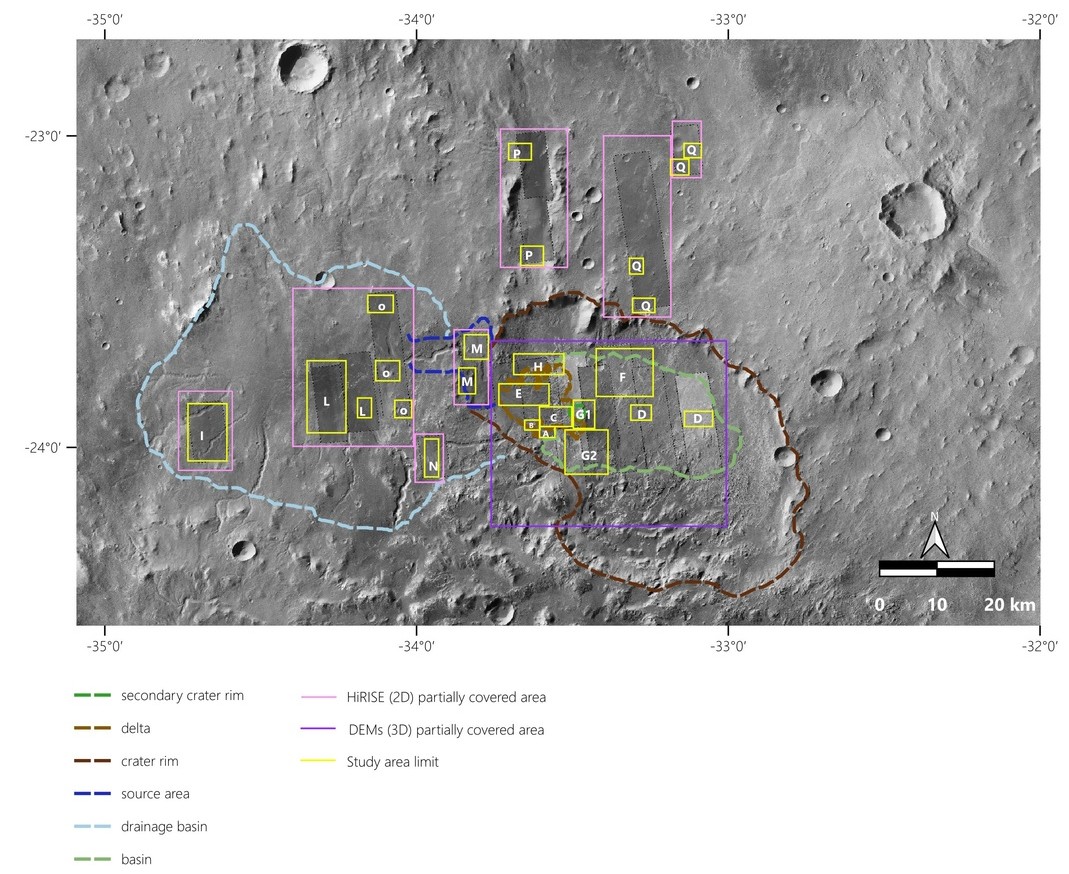
Figure 2. Locations of all 15 study areas on CTX mosaic. Purple: HiRISE stereo DEM images (A–H); pink: HiRISE 2D images (I–Q). Note: the same letters without subscripts correspond to the same area and morphological location (excluding Area G).
Results
1,923 bedforms were mapped across 15 study areas in five morphological depositional settings: delta, basin, drainage basin, source area, and crater plateau. G2 dominates (913, 58%), followed by G1 (618, 40%), G4 (85, 5%), and G3 (36, 2%). Nineteen stratigraphic relationships were identified. The G1→G2 transition is confirmed in 12 of 15 areas (fig. 3), demonstrating a regional atmospheric event. The full G1→G2→G3→G4 sequence is documented in Area F (fig. 3G); G3 also cuts G2 in Area M (fig. 3F); in Area E (fig. 3E), G3 cuts G1 without intervening G2. In Area H (fig. 3H), G4 probably overlies star dunes (ND), implying the multidirectional regime pre-dates the G4 easterly phase.
Inter-area temporal correlation relies on wind direction coherence rather than direct stratigraphic continuity, following standard practice in Martian aeolian stratigraphy (Silvestro et al., 2012). Wind directions reveal a systematic anticlockwise rotation (fig. 4, 5): G1 shows SE–S orientation (mean ~145–163°); G2 is bimodal SW to E (mean ~178°); G3 and G4 are dominated by easterly directions (~90°). The MCD annual mean (161° SSE) matches the G1 regime (fig. 6); the SSE/NW bimodal pattern provides a physical basis for star dune formation, locally amplified by delta lobe and crater rim topography (Edgett and Blumberg, 1994; Courrech du Pont et al., 2024). The G3/G4 easterly direction is absent from all MCD seasons, suggesting local topographic channelling or a circulation shift. Bedform size varies depending on location morphological position: delta areas yield the largest G1 bedforms (~252 m mean crest length), consistent with abundant reworked fluvio-lacustrine sediment; the source area (M) shows anomalously small G2 megaripples (23.2 m), reflecting high sediment flux; and crater plateau areas show reduced sizes consistent with lower sediment availability.
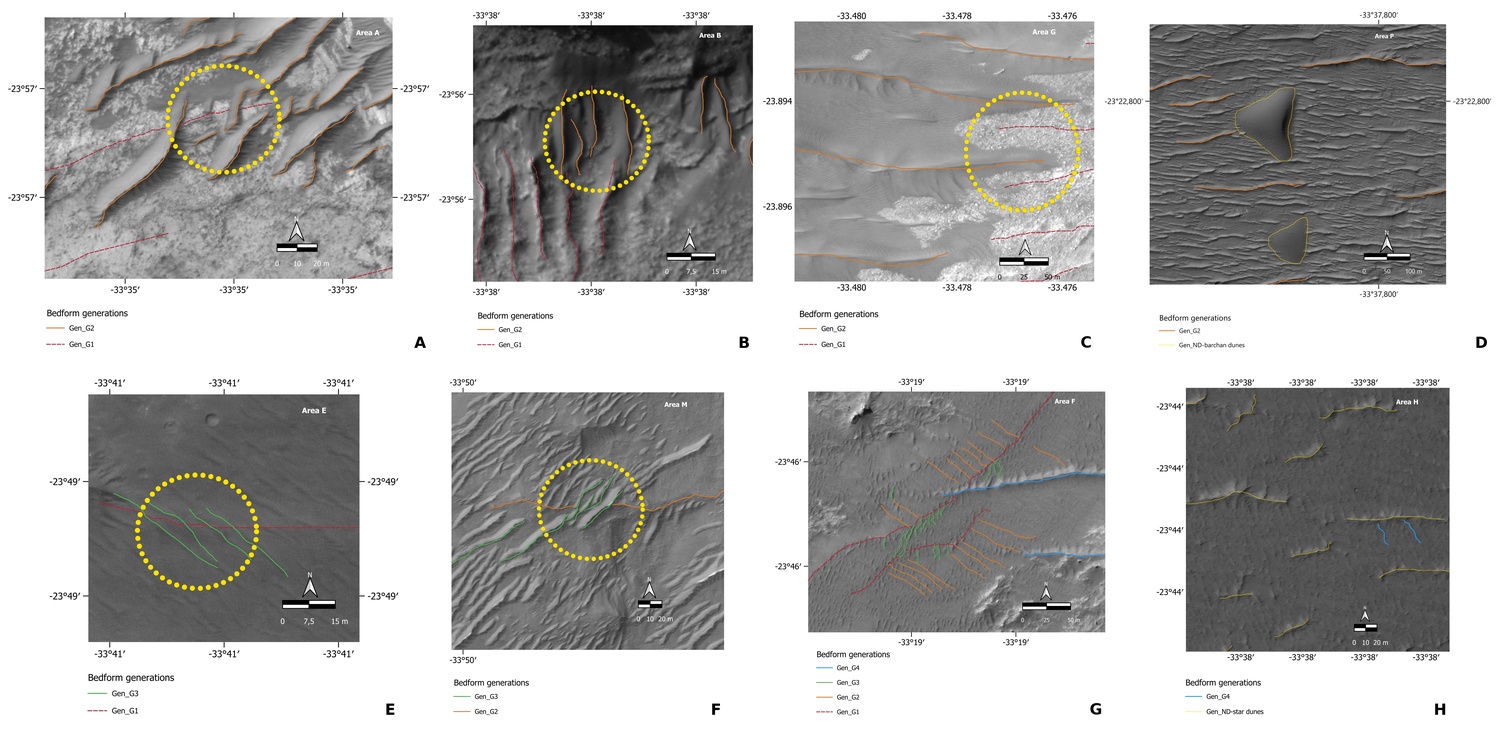
Figure 3. Stratigraphic superposition: A-B-C. G2 cuts G1; D. barchan dunes cut G2; E. G3 cuts G2; F. G3 cuts G1; G. full sequence G1→G2→G3→G4; H. G4 overlies star dunes. Yellow circle: key crosscutting contact..
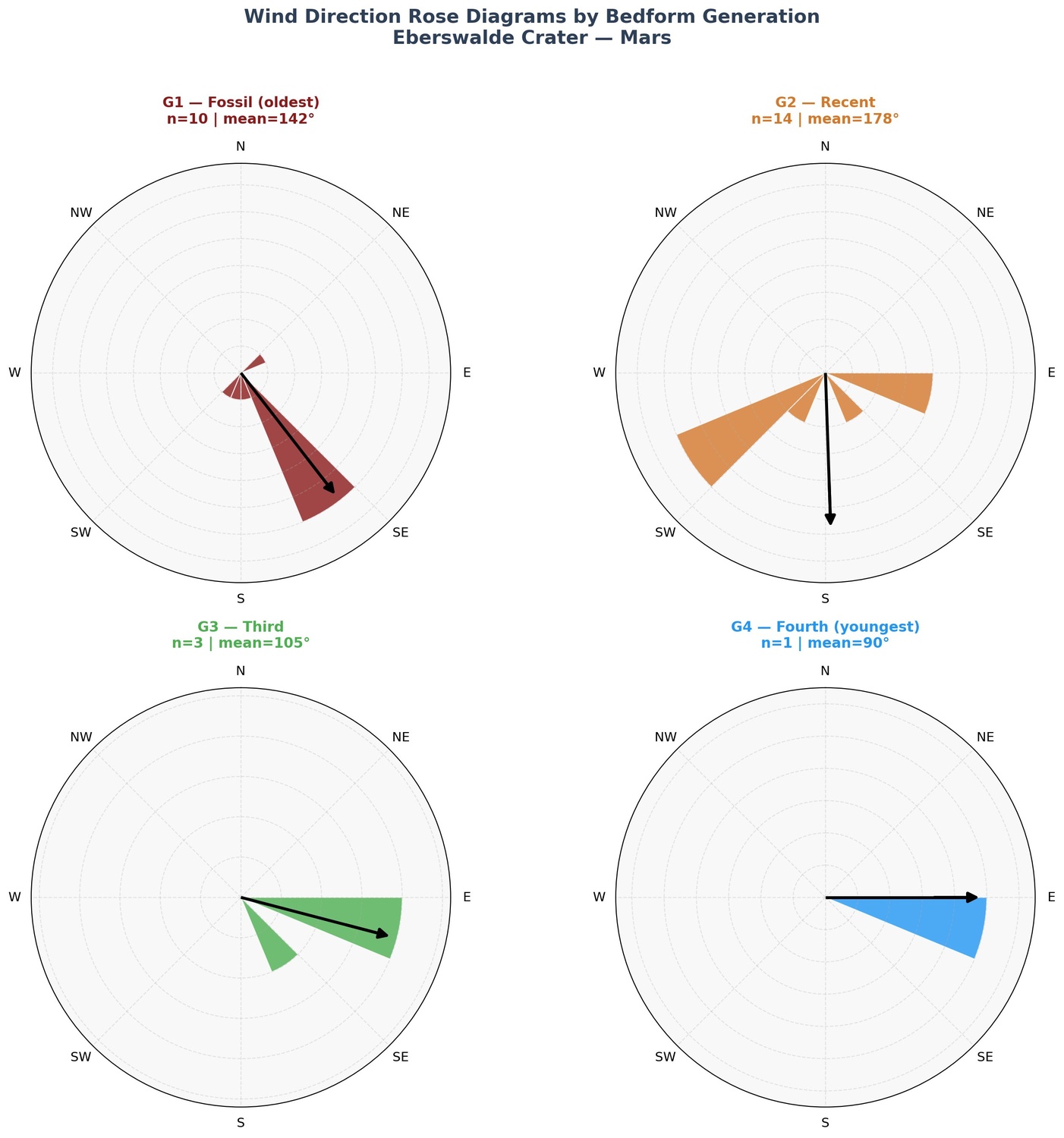
Figure 4. Rose diagrams of transport directions (G1–G4). Anticlockwise rotation from SE/S (G1) through SW/E (G2) to E (G3/G4) is visible.
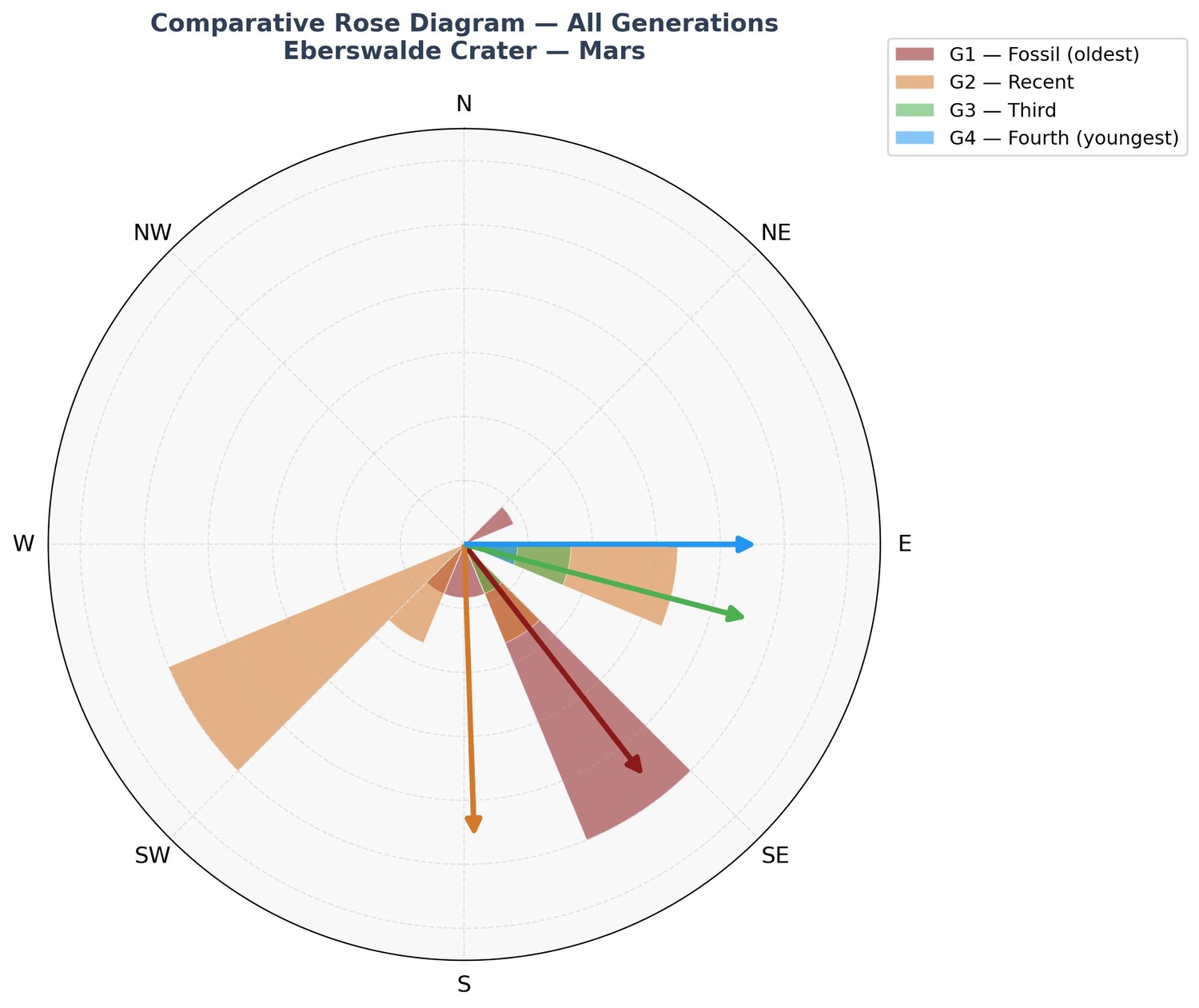
Figure 5. Comparative rose diagram showing the anticlockwise rotation.
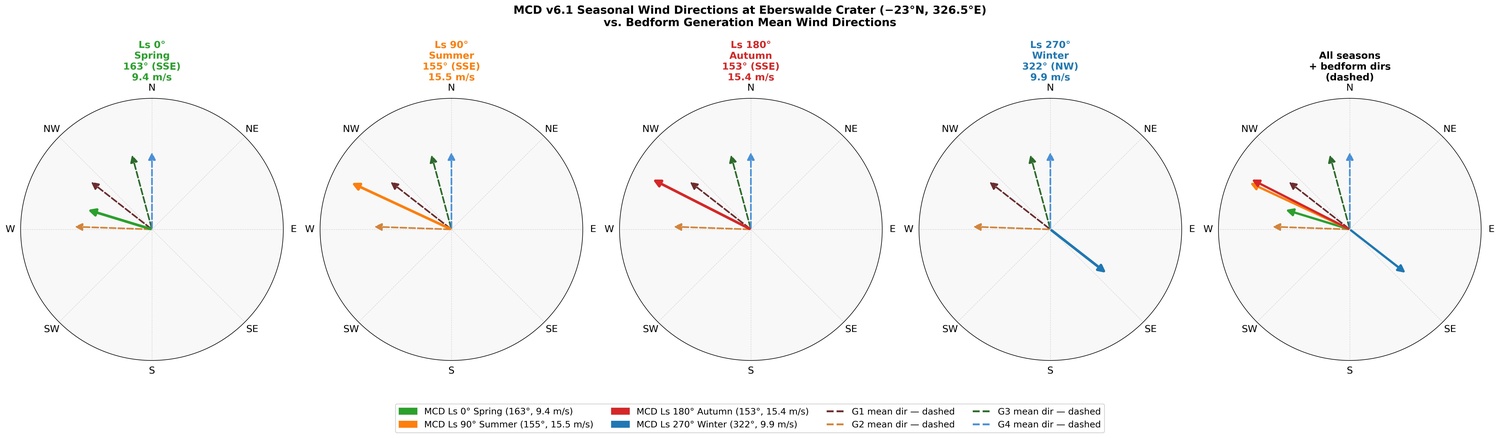
Figure 6. MCD v6.1 seasonal winds (solid) vs. bedform generation means (dashed). G3/G4 easterly direction (~90°) is absent from all seasons.
Discussion and Conclusions
The anticlockwise rotation from SE/S (G1) through SW/E (G2) to E (G3/G4) is consistent with an obliquity-driven weakening of the meridional Hadley circulation and strengthening of the zonal easterly component. We tentatively correlate G1 with the pre-ice-age Late Amazonian (>2.1 Ma), when higher obliquity sustained vigorous meridional winds; G2 with the Martian ice age (~2.1–0.4 Ma), when a transitional wind regime prevailed; and G3/G4 with the post-ice-age interglacial (<0.4 Ma), when declining obliquity weakened the Hadley cell and easterly winds became dominant (Laskar et al., 2004; Head et al., 2003) This interpretation is analogous to aeolian sequences at Utopia Planitia (Liu et al., 2023) and supports obliquity variations as the primary driver of Late Amazonian atmospheric changes. The fossil delta adds topographic complexity and promotes bedform preservation, and Eberswalde preserves a wind record spanning ~2 Ma of Martian atmospheric circulation history.
References
Courrech du Pont et al. (2024), Earth-Sci. Rev. 255.
Edgett & Blumberg (1994), Icarus 112. https://doi.org/10.1006/icar.1994.1197
Fenton & Richardson (2001), JGR 106. https://doi.org/10.1029/2000JE001407
Forget et al. (1999), JGR 104, 24155–24175.
Head et al. (2003), Nature 426. https://doi.org/10.1038/nature02114
Laskar et al. (2004), Icarus 170. https://doi.org/10.1016/j.icarus.2004.04.005
Liu et al. (2023), Nature 620. https://doi.org/10.1038/s41586-023-06206-1.
Malin & Edgett (2003), Science 302. doi:10.1126/science.1090544.
McEwen et al. (2007), JGR 112. doi:10.1029/2005JE002605. E05S02.
Millour et al. (2018), ESAC Workshop.
Pondrelli et al. (2008), Icarus 197, 429-451.
Silvestro et al. (2020), JGR Planets. doi:10.1029/2020JE006446.
Silvestro et al. (2012), E.S.P.L.37, 1424–1436. https://doi.org/10.1002/esp.3286
Acknowledgements
This study was carried out within the Space It Up project funded by the Italian Space Agency, ASI, and the Ministry of University and Research, MUR, under contract n. 2024-5-E.0 - CUP n. I53D24000060005
How to cite: Piscopo, A., Pondrelli, M., Marinangeli, L., and Cavalazzi, B.: Analysis of aeolian bedforms at Eberswalde crater and preserved delta, Mars: a possible record of Late Amazonian wind regimes transition, Europlanet Science Congress 2026, The Hague, The Netherlands, 7–11 Sep 2026, EPSC2026-254, https://doi.org/10.5194/epsc2026-254, 2026.


