
 1,1,2,5,6,
- 1Observatoire de Paris, LIRA, France (bruno.debatz@obspm.fr)
- 2LPG, UMR CNRS 6112, Université de Nantes, Université d’Angers, Nantes, France
- 3Université Côte d’Azur, Observatoire de la Côte d’Azur, CNRS, Nice, France
- 4LEATP, Université de Reims Champagne Ardenne, Reims, France
- 5NASA Ames Research Center, Moffett Field, CA, USA
- 6LMD/IPSL, Sorbonne Université, ENS, PSL Research University, Ecole Polytechnique, IP Paris, CNRS, Paris, France.
The thermal balance and cooling mechanisms of the atmosphere of Pluto have long remained a mystery. Observations of a global haze layer by the New Horizons mission [1,2], together with recent measurements from the James Webb Space Telescope [3], suggest that this haze may play a key role in shaping Pluto’s unusual atmospheric temperature profile. This haze-driven regime establishes Pluto’s atmosphere as a unique case within the Solar System.
Beyond the now well-established role of haze in Pluto’s thermal balance [3,4], its composition and precise radiative impact remain poorly constrained. Several one-dimensional microphysical models, developed based on observations from the New Horizons mission, have attempted to characterize the properties of Pluto’s aerosols. Initially, the haze was interpreted as analogous to that of Titan, dominated by purely photochemical processes [5,6]. However, more recent studies suggest that the aerosols may also include a significant fraction of organic ice [7], formed through direct condensation of major photochemical products in the cold upper atmosphere. Such a condensed component could reduce the efficiency with which haze particles regulate the atmospheric thermal balance. Current microphysical models do not account for a mixed population of both photochemical and icy haze and are not coupled to radiative transfer schemes, preventing a comprehensive assessment of the haze’s impact on Pluto’s atmospheric energy balance. Finally, the seasonal evolution of the haze over a Pluto year, as well as its influence on the annual variability of atmospheric temperature, remains entirely unexplored to date. Constraining the origin, evolution, and composition of Pluto’s haze is therefore essential to quantify its radiative effects and to better understand the planet’s atmospheric behavior and its place among hazy worlds in the Solar System.
To constrain the origin of Pluto’s haze and assess its impact on the climate, we developed the Pluto Planetary Climate Model (Pluto PCM), a global climate model coupled to a microphysical scheme that describes haze and cloud formation and evolution, along with their impact on thermal balance and atmospheric dynamics (see T. Bertrand’s abstract). Here we show that Pluto’s haze is likely composed of a mixture of photochemical aerosols—analogous to those observed on Titan—and organic ices, reconciling observational constraints from both New Horizons (Fig. 1) and the James Webb Space Telescope. We further demonstrate that this haze governs the global thermal balance and is the primary driver of atmospheric cooling. In addition, we identify a seasonal cycle in the haze, providing a first coherent explanation for the opacity variations inferred from stellar occultation measurements. These findings suggest that the haze is not continuously present throughout the Plutonian year, with direct implications for the planet’s climate evolution. Finally, our results indicate that Pluto’s haze is unique within the Solar System, establishing Pluto as a natural laboratory for studying haze processes in tenuous atmospheres.
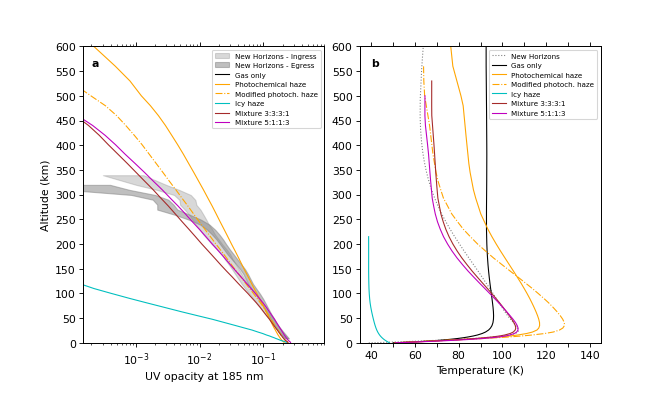
Fig. 1 UV opacity and temperature profiles of Pluto’s atmosphere. a Vertical UV opacity profiles at 185 nm derived from New Horizons solar occultations [1] (grey shaded regions), compared with the ones derived from the 1D Pluto PCM reference simulations for 2015. b Vertical temperature profile measured by New Horizons [1] (black dotted line) compared with the 1D Pluto PCM simulations shown in a.
References
[1] Gladstone, G. R. et al. The atmosphere of Pluto as observed by New Horizons. Science 351, aad8866 (2016).
[2] Cheng, A. F. et al. Haze in Pluto’s atmosphere. Icarus 290, 112–133 (2017).
[3] Bertrand, T. et al. Evidence of haze control of Pluto’s atmospheric heat balance from JWST/MIRI thermal light curves. Nature Astronomy 9, 1300–1308 (2025).
[4] Zhang, X., Strobel, D. F. & Imanaka, H. Haze heats Pluto’s atmosphere yet explains its cold temperature. Nature 551, 352–355 (2017).
[5] Gao, P. et al. Constraints on the microphysics of Pluto’s photochemical haze from New Horizons observations. Icarus 287, 116–123 (2017).
[6] Fan, S. et al. A bimodal distribution of haze in Pluto’s atmosphere. Nature Communications 13, 240 (2022).
[7] Lavvas, P. et al. A major ice component in Pluto’s haze. Nature Astronomy 5, 289–297 (2021).
How to cite: de Batz de Trenquelléon, B., Bertrand, T., Falco, A., Lellouch, E., Lavvas, P., Sciamma-O’Brien, E., Millour, E., and Forget, F.: An icy haze controls Pluto’s atmospheric thermal balance at all seasons, Europlanet Science Congress 2026, The Hague, The Netherlands, 7–11 Sep 2026, EPSC2026-258, https://doi.org/10.5194/epsc2026-258, 2026.


