
 1,2,2
1,2,2- 1LATMOS - CNRS, LATMOS - CNRS, Paris, France (salman.raza@latmos.ipsl.fr)
- 2Université Paris-Saclay, CNRS, GEOPS, 91405, Orsay, France
Introduction and Abstract
The RADAR instrument onboard the Cassini–Huygens spacecraft (2004–2017), operating at a wavelength of 2.2 cm, included both an active and a passive (radiometry) mode. In its active mode (as a Synthetic Aperture Radar), it measured the backscattered signal from the surface through the normalized radar backscatter cross section (σ0). In its passive mode, it recorded the surface microwave thermal emission through the measurements of the surface brightness temperature (Tb).
On November 6, 2011, the E16 flyby of Enceladus by the Cassini–Huygens spacecraft was dedicated to observations with the RADAR subsystem. During this flyby, the Cassini RADAR collected high-resolution observations of the South Polar Terrain (SPT) at its closest approach to Enceladus and medium-to-barely resolved observations of a combination of the moon leading and trailing hemispheres during the inbound/outbound legs of the flyby. Unfortunately, the inbound observations were contaminated by emission from Saturn and its rings, which laid behind Enceladus’ disk during the acquisition. Therefore, this study focuses on two sets of data (1) High-resolution SAR and Tb maps obtained close to the tiger stripes region (2) Four radiometry segments acquired during the E16 outbound leg at mid-latitudes and with a moderate spatial resolution.
Both resolved and unresolved observations of Enceladus have consistently highlighted its extremely high radar-brightness, the highest in the Solar system [1,2]. Radiometry observations along the E16 swath revealed thermal anomalies that had not been detected in the infrared [3]. However, the magnitude of the internal heat flux remained to be constrained.
In this study, we performed the re-analysis of the high-resolution datasets collected over the SPT and obtained constraints on structural, chemico-physical and thermal state of surface and subsurface, including parameters such as grain size, porosity, the presence of water-ice/dust contaminants, and endogenic heat flux [4]. These results have important implications for future missions to Enceladus, in particular for potential lander missions targeting its south polar region.
A portion of the mid-resolution datasets was previously analyzed in a qualitative manner by [5], revealing a large-scale emissivity anomaly in Enceladus’ Leading Hemisphere Terrain (LHT). This region is interpretated to be relatively young, potentially reflecting recent of the resurfacing processes, in agreement with the structural and geological mapping of Enceladus by [6]. The emissivity anomaly is also explained by a scattering anomaly. However, the nature and origin of the observed scattering/emissivity anomalies (such as the characteristic size of the scatterers or the depth of emission) remain unconstrained. The objective of the present re-analysis of the E16 dataset is therefore to better constrain these properties, in order to improve our understanding of the surface phenomena behind such anomalies and, more broadly, the evolutionary history of Enceladus.
Methodology
To predict backscatter (σ0) and thermal emission in the microwave domain we combine two models: (1) a thermal model providing depth profiles of the physical temperature beneath the surface at E16 flyby epoch, (2) a radiative transfer model to simulate both active and passive observations.
Thermal Model: We adapted a multi-layer thermal model called MultIHeaTS [7] to the case of Enceladus. We account for Solar flux and radiative flux equilibrium at surface and a constant temperature or a zero-temperature gradient at the bottom. The subsurface of Enceladus is modeled as mono or bi-layer medium (with an icy porous regolith overlying a denser water ice substrate).
Radiative Transfer Model: We use Snow Microwave Radiative Transfer (SMRT) model, a multi-layer RT model initially designed for snow or sea-ice [8]. Permittivity of water ice is assumed constant with temperature [9], effective permittivity depends on its porosity and includes possible contaminants fraction, assumed as organic dust. The parameters of RT model are thus the dust fraction and water ice grain radius size.
Results
1. SPT observations
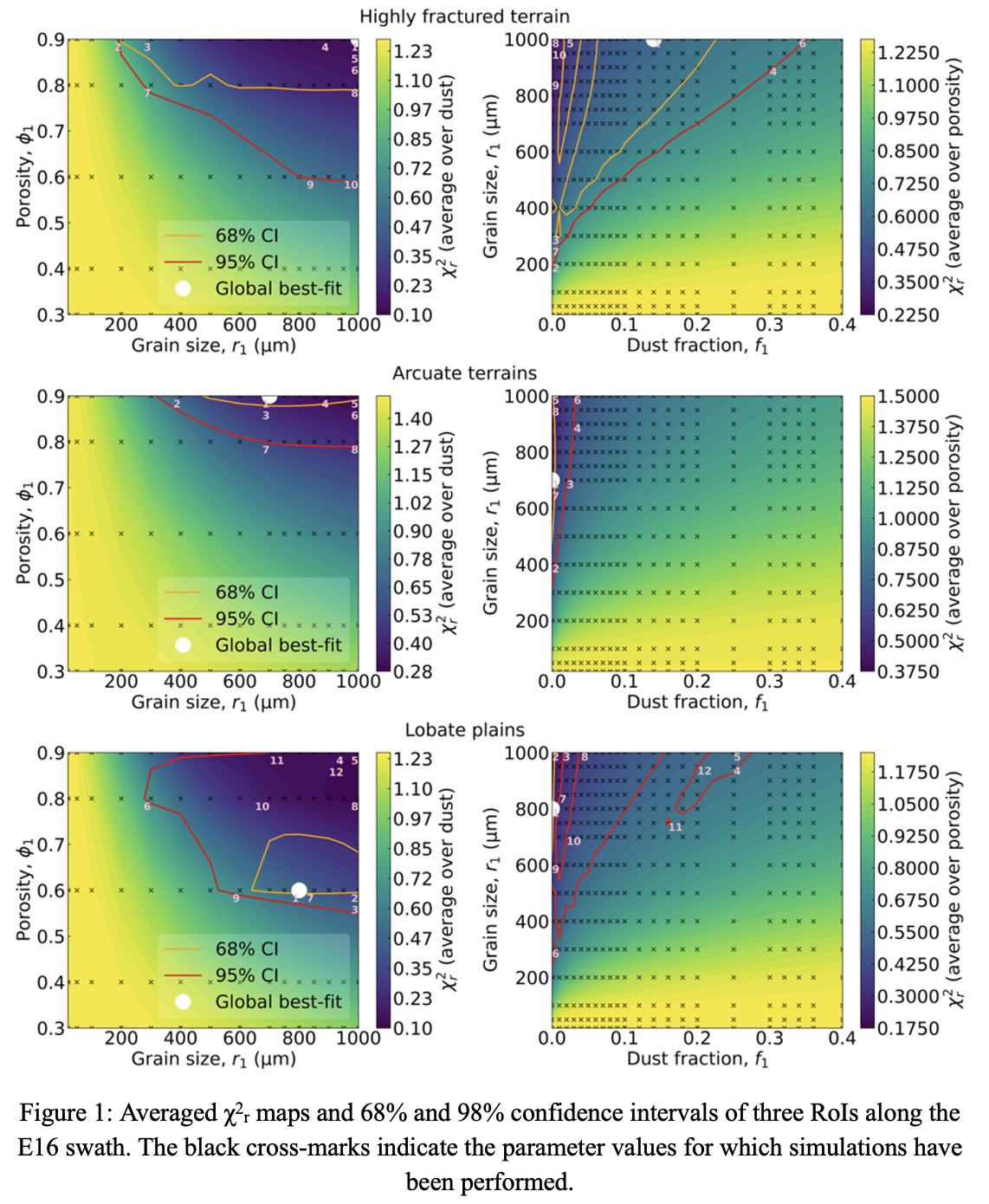
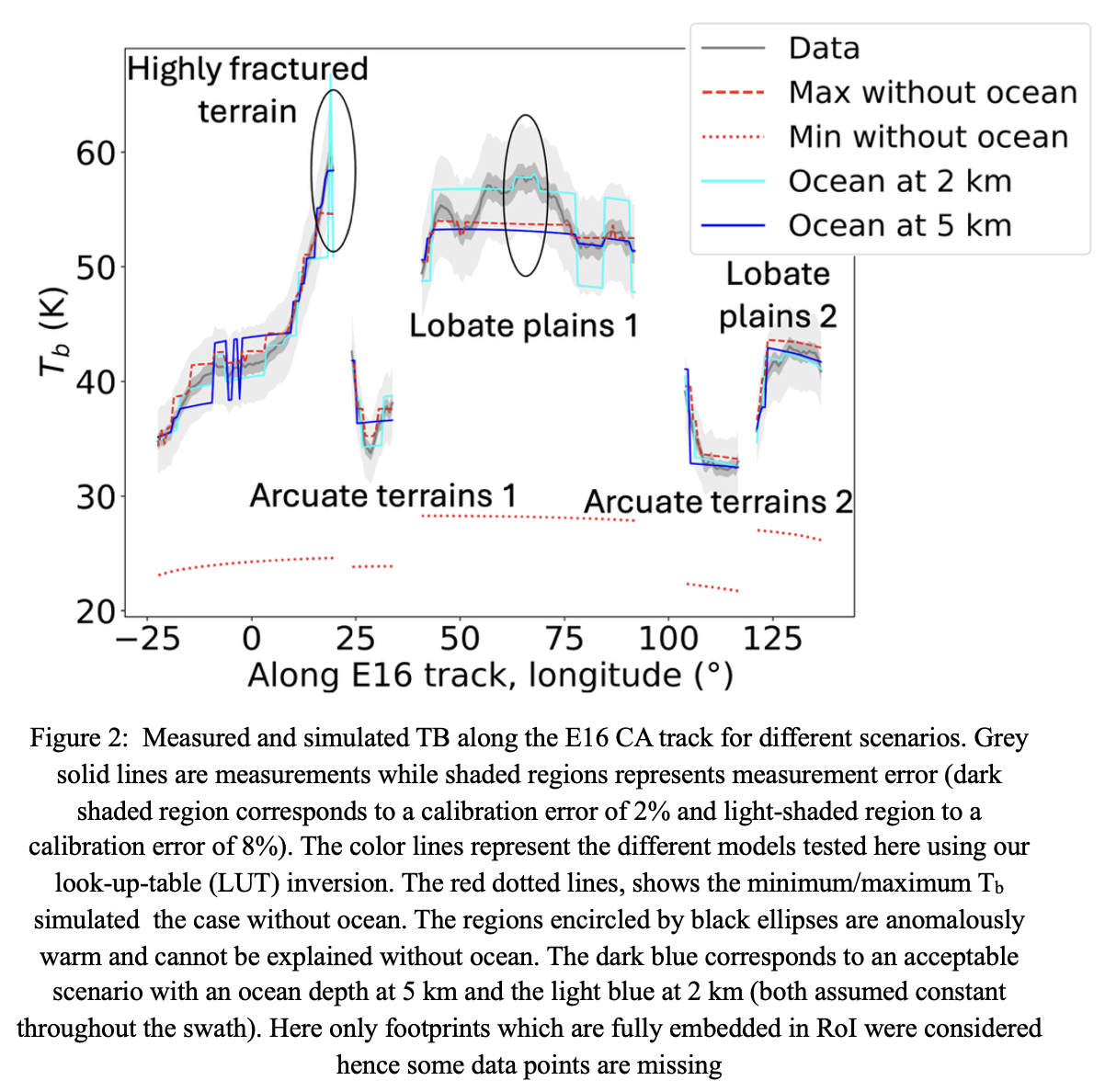
The inversion results suggests that the regolith is characterized by relatively large scattering structures (>500 µm), limiting radar sensitivity to the upper few meters. They also indicate that regolith purity and porosity vary with local geology and between the different identified RoIs (see Figure 1). The anomalously radar bright regions are covered with pure and highly porous water ice. Anomalously high Tb values observed over parts of the swath can only be explained by the presence of an ocean at shallow subsurface (2-5 km deep), associated with enhanced heat loss (up to 900 mW/m2). However, due to degenericies between parameters, the non-anomalous Tb observations can also be explained without invoking a subsurface ocean (see Figure 2). These results are described in details in [4].
2. LHT observations
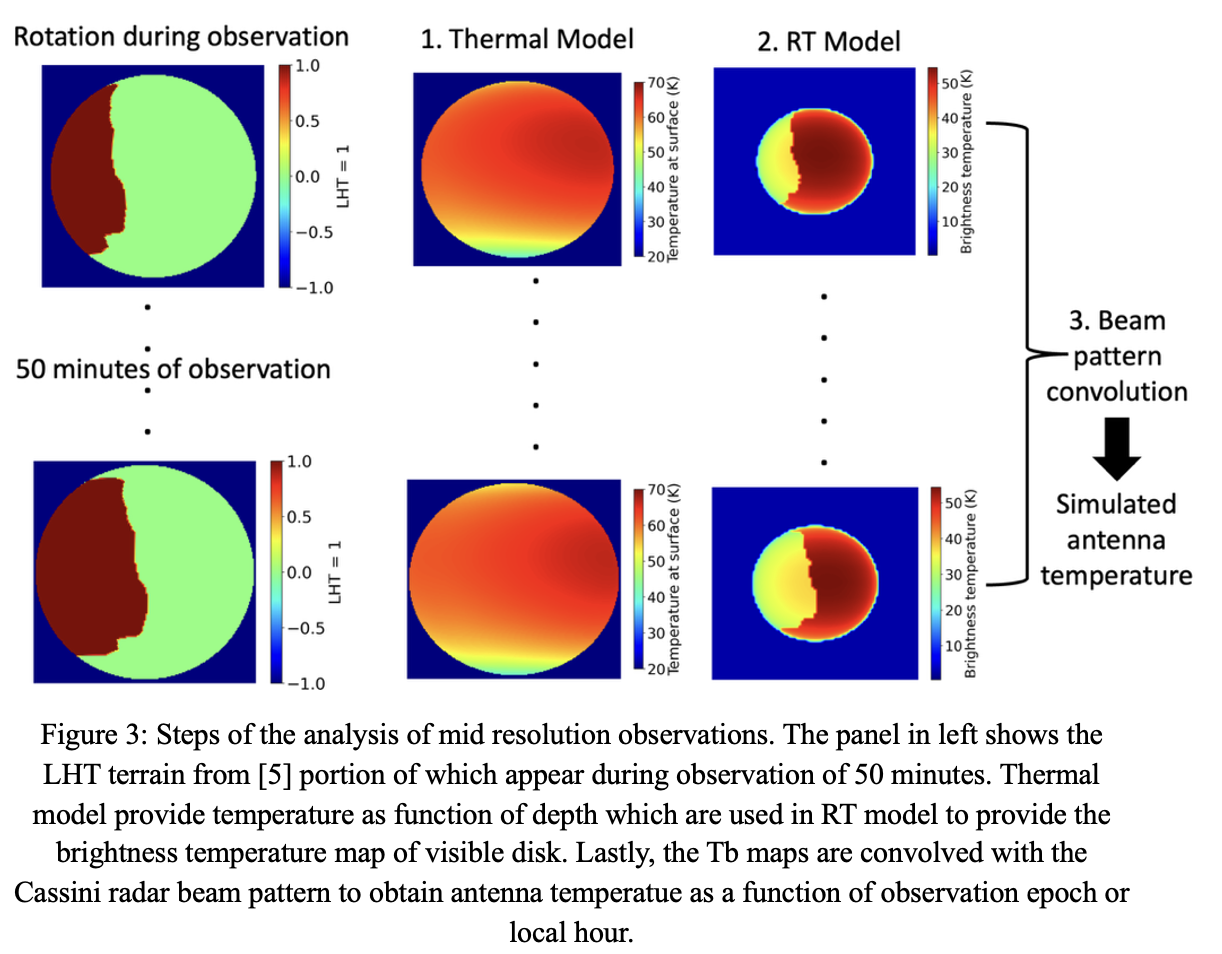
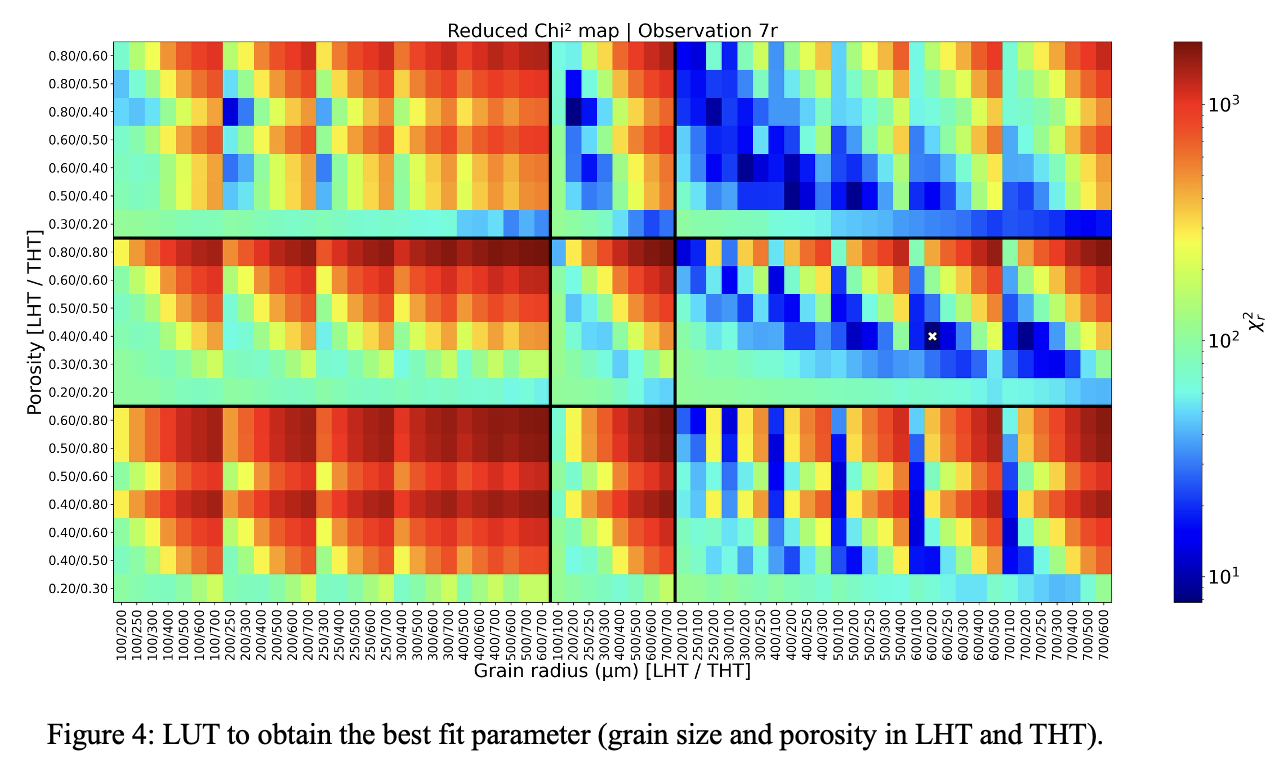
Here we present the ongoing re-analysis of of mid-resolution dataset, building on the work of [4]. Figure 3 displays the schematic of data-to-model comparison workflow. During the outbound leg, as the spacecraft was moving away from the target, the rotation of the moon is taken into account. We first consider a simple mono-layer medium for the subsurface, with no-ocean at bottom and consisting of pure water ice. The properties are varied between the LHT and THT including the cases when both terrains share same properties. Our preliminary inversion results show that: (1) reproducing the emissivity anomaly over the LHT required either higher porosity, or larger grain size (2) there are degeneracies between the parameters - porosity and grain size (see Figure 4). Nevertheless, the best fit solution indicates that the observed anomalies are not related to a change in thermal inertia, but are instead primarily driven by variations in grain size (i.e., scattering and emissivity effects). Finally, results obtained with a bi-layer model (both for the LHT and THT) results will be presented, as this assumption may provide a better explanation of the observations. In addition, the bi-layer approach should put constraints on the depth of emission anomaly.
How to cite: Raza, M. S., Le Gall, A., and Schmidt, F.: Investigation of the South Polar Terrain and Leading Hemisphere of Enceladus using the Cassini RADAR observations, Europlanet Science Congress 2026, The Hague, The Netherlands, 7–11 Sep 2026, EPSC2026-259, https://doi.org/10.5194/epsc2026-259, 2026.


