
 ,
,- Nantes Université, Univ Angers, Le Mans Université, CNRS, Laboratoire de Planétologie et Géosciences, LPG UMR 6112, 44000 Nantes, France ( victor.belissa@univ-nantes.fr, sabrina.carpy@univ-nantes.fr )
Introduction: The 2015 New Horizons flyby revealed Pluto as a geologically diverse and active world, shaped by complex interactions between volatile ices, topography, and a tenuous atmosphere [1,2]. Among its most enigmatic landforms are the Bladed Terrain Deposits (BTDs) of Tartarus Dorsa, methane-rich ridges forming dense, quasi-periodic patterns with kilometer-scale spacing (Fig 1) [3,4]. Since their discovery, their origin has remained debated. Proposed mechanisms include, tectonic origin, atmospheric methane condensation, and penitente-like sublimation erosion driven by solar illumination [3,5]. Here, we investigate the formation of BTDs as large-scale icy sublimation waves. Sublimation waves are periodic bedforms produced by feedbacks between wind-driven atmospheric transport and sublimation of an icy substrate [6,7]. They have been observed in Antarctic blue-ice areas and on the Martian north polar cap [8,9]. Recent theoretical studies established scaling laws linking wavelength, wind velocity, growth timescale, and migration speed to environmental conditions [6,7].
In this study, we combine morphometric analysis of the BTDs, linear stability theory, and Pluto-relevant scaling laws to test whether the blades of Tartarus Dorsa can be interpreted as CH₄ sublimation waves.
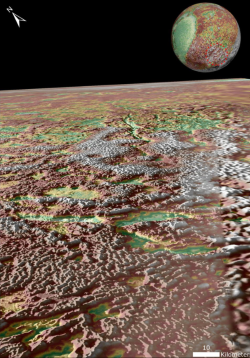
Methods:
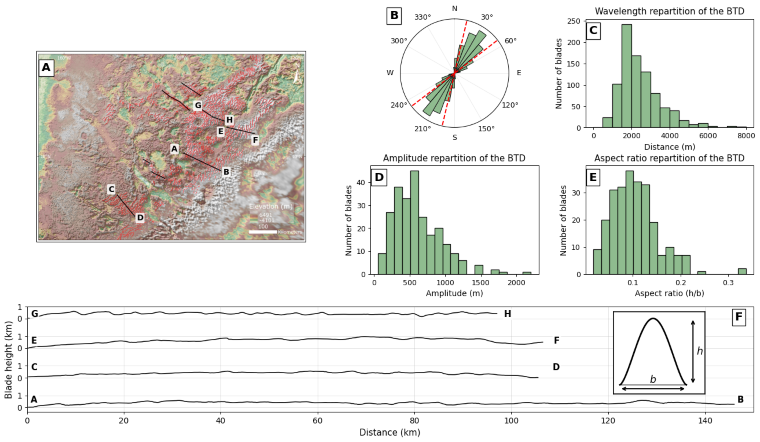
We performed a morphometric analysis of the BTDs using New Horizons mosaics and DEMs (300m/px) [2,10]. Crestlines were manually mapped across the best-resolved part of Tartarus Dorsa to extract orientation, wavelength, amplitude, asymmetry, and aspect ratio from topographic profiles and 250 representative blades. These measurements were used to characterize the morphology of the blades and compare them with known sublimation-driven bedforms.
To test the physical plausibility of sublimation-wave formation on Pluto, we used a model coupling turbulent airflow and sublimation under Pluto conditions [6,7]. Pluto-relevant Schmidt numbers, based on CH₄ diffusivity and N₂ viscosity [11–13], were combined with scaling laws to convert observed wavelengths into wind velocity, growth timescale, and migration speed, and to evaluate whether these conditions are compatible with Pluto’s climate.
Morphometric analysis of Tartarus Dorsa blades:
The BTDs form coherent fields of parallel ridges and troughs, mainly oriented southwest–northeast. Most blades have azimuths of ~32° (Fig. 2). Crest-to-crest spacing is dominated by wavelengths of ~2–3 km. Topographic profiles show broad, asymmetric ridges and a mean aspect ratio of 10%.
These properties differ from penitente-like landforms, which are typically sharp, more symmetrical, and have aspect ratios close to one [5,14–16]. Instead, the low aspect ratio, asymmetry, regular spacing, and coherent orientation of the BTDs are more consistent with sublimation-driven bedforms observed in Antarctic blue-ice areas and proposed on Mars [6–9].
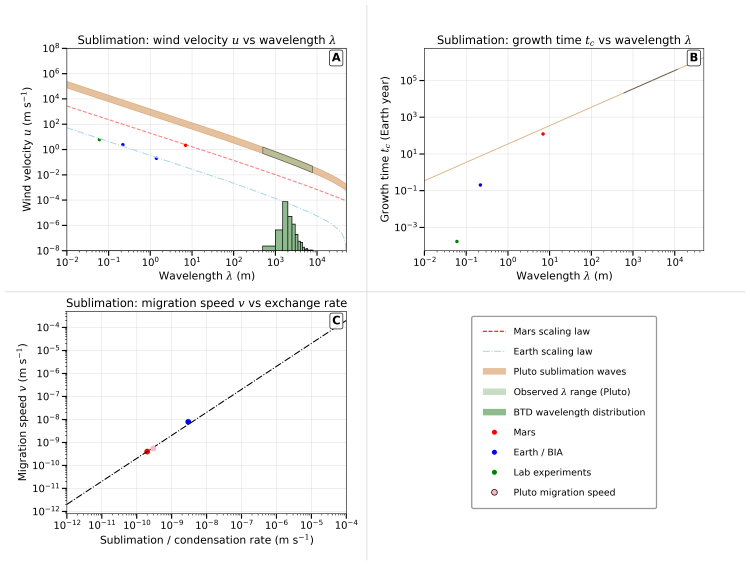
Sublimation-wave emergence under Pluto conditions: Sublimation waves form when spatial variations in sublimation flux become shifted relative to surface topography. If the maximum mass flux occurs at the appropriate position with respect to crests and troughs, relief is amplified rather than smoothed. This feedback depends on the balance between turbulent momentum transport and molecular diffusion [6,7]. For Pluto, expected values of CH₄ diffusivity in N₂ and N₂ kinematic viscosity give Sc ≈ 0.4–1.2 [11–13]. This range lies well within the unstable regime, where growth rates are positive and sublimation waves can spontaneously develop.
This result demonstrates that, despite Pluto’s low atmospheric pressure, the CH₄–N₂ system is physically capable of producing sublimation-driven bedforms under present-day or past Pluto-like conditions.
Scaling laws and implications for Pluto winds: Applying sublimation-wave scaling laws to the observed BTD wavelengths allows us to estimate the wind velocities required to generate kilometer-scale patterns [6,7]. For the measured wavelength of ~2 km, the inferred wind speeds at ~10 m above the surface are on the order of ~1 m s⁻¹. These values are consistent with Pluto global climate model predictions, which show that near-surface winds can locally reach similar magnitudes, particularly in regions affected by topographic gradients and katabatic flows near Tartarus Dorsa [17,18].
The scaling laws also constrain the formation timescales of the BTDs. For λ ≈ 2 km, predicted growth times are approximately 10⁵–10⁶ years, much shorter than the estimated 10–100 Myr age of Pluto’s methane-rich terrains [20]. Predicted migration speeds are low, around 0.03–1 cm yr⁻¹, implying limited lateral displacement over geological timescales. The blades may therefore represent long-lived erosional landforms, formed early and preserved through repeated climatic cycles [21].
Conclusion: Our results support the interpretation of the Tartarus Dorsa BTDs as large-scale CH₄ sublimation waves. Their wavelength, asymmetry, low aspect ratio, and coherent orientation match the expected morphology of sublimation-driven bedforms and differ from penitente-like structures. Linear stability analysis shows that Pluto’s CH₄–N₂ system lies within the unstable regime for sublimation-wave formation, and scaling laws indicate that the required wind speeds are compatible with Pluto climate models.
The BTDs could therefore be interpreted as erosional landforms produced by wind-enhanced sublimation. This interpretation provides a new framework for using Pluto’s icy bedforms as geomorphic markers of surface–atmosphere interactions and opens the possibility of constraining past and present wind regimes on volatile-rich planetary surfaces. More broadly, this work extends sublimation-wave theory from Earth and Mars to the outer Solar System [22].
Acknowledgments: The authors acknowledge the support of the French Agence Nationale de la Recherche (ANR), under grant ANR-23-CE49-0006 (project SHERPAS).
References
[1] Stern. (2015). Science, 350, aad1815.
[2] Moore. (2016). Science, 351, aad7055.
[3] Moore. (2018). Icarus, 300, 129–144.
[4] Singer. (2025). arXiv, 2506.00254.
[5] Moores. (2017). Nature, 541, 188–190.
[6] Bordiec. (2020). Earth-Science Reviews, 211, 103350.
[7] Carpy. (2023). Frontiers in Astronomy and Space Sciences, 10, 1176158.
[8] Bintanja. (2001). Journal of Glaciology, 47, 387–396.
[9] Bintanja. (1999). Reviews of Geophysics, 37, 337–359.
[10] Schenk. (2018). Icarus, 314, 400–433.
[11] Young. (2018). Icarus, 300, 174–199.
[12] Bordiec. (2020). PhD thesis, Nantes.
[13] Gunn. (2022). Nature Astronomy, 6, 923–929.
[14] Claudin. (2015). Physical Review E, 92, 033015.
[15] Matthes. (1934). Transactions of the American Geophysical Union, 15, 380.
[16] Betterton. (2001). Physical Review E, 63, 1–12.
[17] Bertrand. (2020). Journal of Geophysical Research: Planets, 125, e2019JE006120.
[18] Forget. (2017). Icarus, 287, 54–71.
[19] Gladstone. (2016). Science, 351, aad8866.
[20] Howard. (2017). Icarus, 293, 218–230.
[21] Bertrand. (2024). PNAS, 121, e2408226121.
[22] Cavalie L. (2026). This issue
How to cite: Belissa, V., Carpy, S., and Bertrand, T.: Icy sublimation waves as the origin of the bladed shape of the ch₄-rich terrain deposits of tartarus dorsa on pluto , Europlanet Science Congress 2026, The Hague, The Netherlands, 7–11 Sep 2026, EPSC2026-263, https://doi.org/10.5194/epsc2026-263, 2026.


