
 1,
1,- 1British Astronomical Association, Jupiter Section, Cambridge, United Kingdom of Great Britain – England, Scotland, Wales (jrogers11@btinternet.com)
- 2JUPOS team
- 3ALPO-Japan
In the monitoring of Jupiter’s atmospheric features by amateur imagers and recorders, features that seem to be one-off occurrences sometimes turn out to be reproducible phenomena that contribute to a growing understanding of atmospheric dynamics. Here we show three examples from 2025.
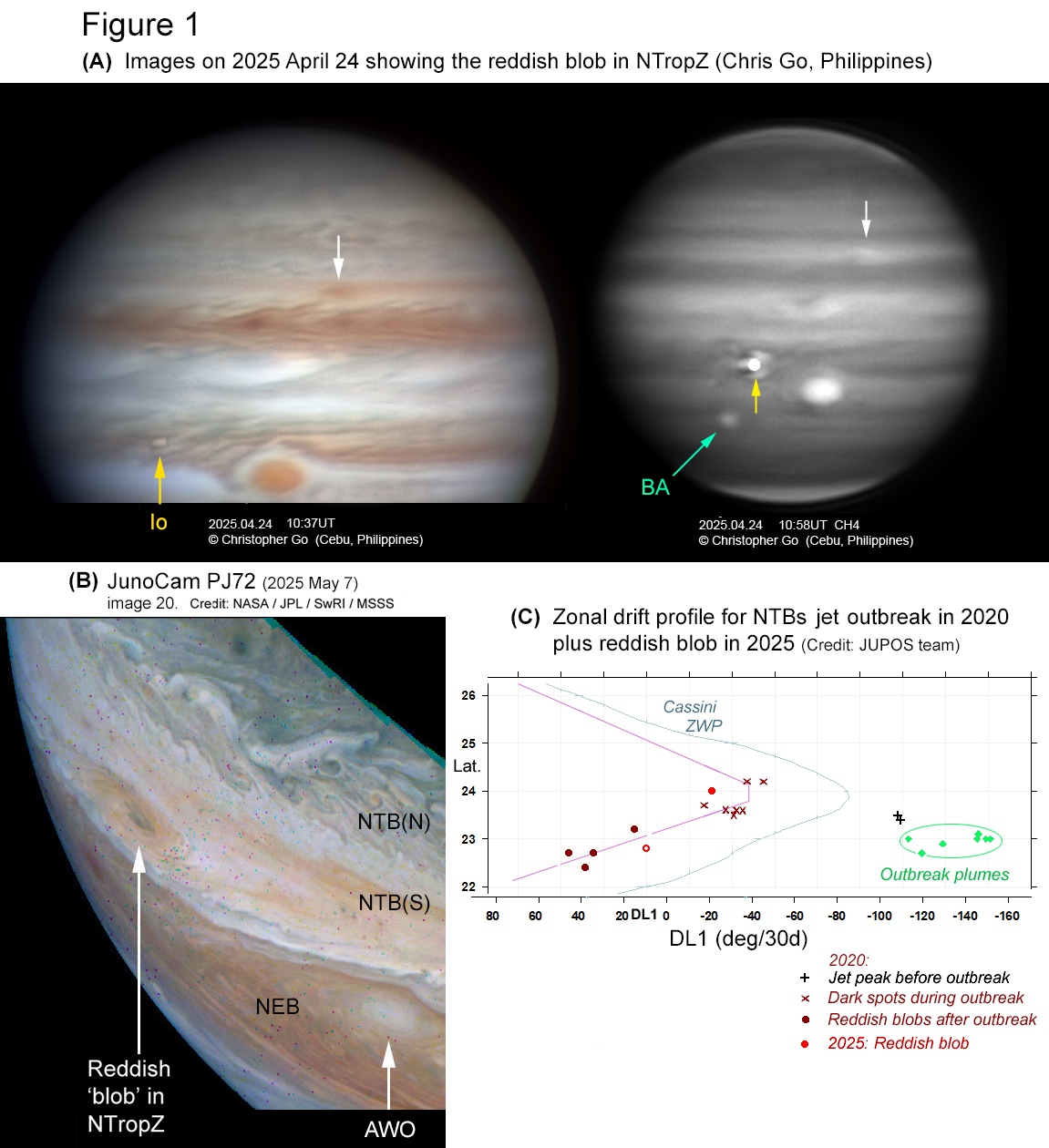
(1) NTBs jet: ‘Reddish blob’ following NTBs jet outbreak
Background: A spectacular outbreak of very bright, very fast-moving convective plumes on the NTBs jet, followed by turbulent dark wakes, occurred in 2025 Jan. and confirmed many aspects of these cyclic upheavals [EPSC-DPS 2025-45 & -51]*.
Observations 2025: Late in the upheaval [BAA Report 2024/25 no.7]*, an orange ‘blob’ developed in mid-March, on the then-reddish NTBs edge at 24ºN, with mean drift rate of DL1 = -21 deg/30d (u3 = 107.4 m/s). It was weakly bright in the methane absorption band (“methane-bright”) [Figure 1A]. In ground-based images it always appeared diffuse or featureless, but JunoCam images at PJ72 (2025 May 7) showed it to be clearly anticyclonic, and it had decelerated and moved south to 22.8ºN. It may have persisted to 2025 Sep., when it faded away.
Conclusions: The ‘blob’ was dynamically similar to the wave-like dark patches in the wake earlier (weakly anticyclonic, in the jet peak latitude but with much slower drift). Similar ‘reddish blobs’ were recorded on orange NTBs in three previous cycles (1964-65, 2012, and 2020), and one of those in 2020 apparently formed as an eddy in the NEBn wave pattern [BAA Report 2020 no.9]. So the turbulence across the NTropZ in these upheavals can form these anticyclonic vortices in various ways, and the resulting reddish oval can drift south on the zonal gradient in the NTropZ [Figure 1C].
(2) South Equatorial Disturbance (SED)
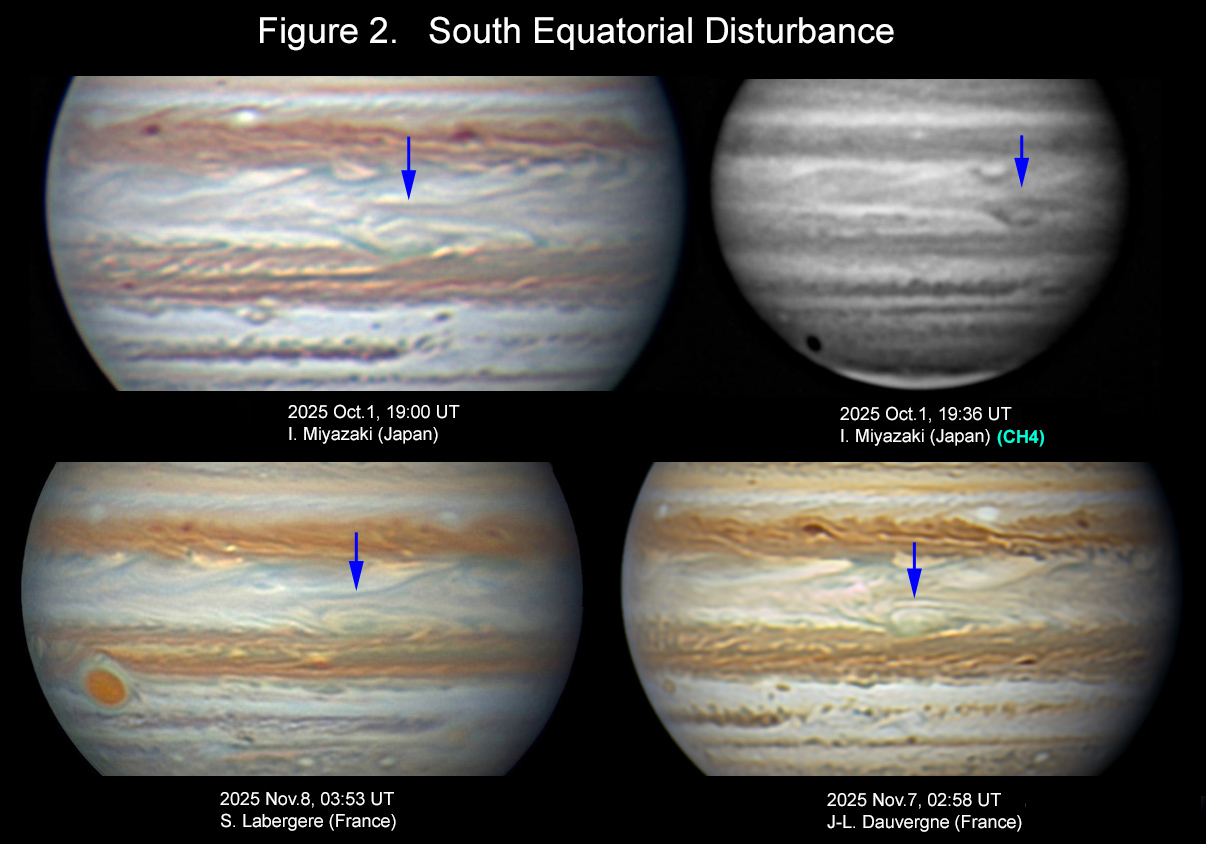
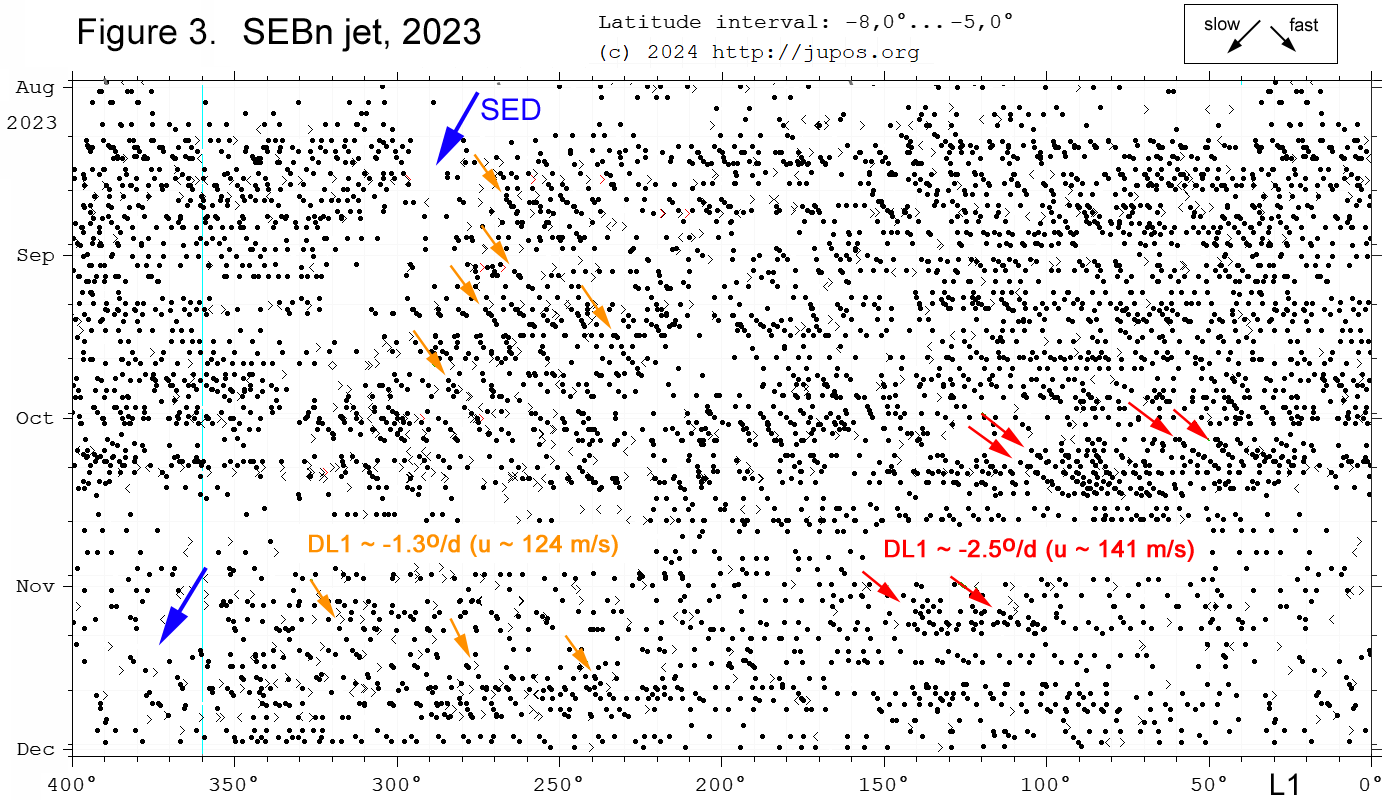
Background: This is a large wave-like feature in the SEBn jet which drifts slowly with DL1 ~ +30 deg/30d (u3 = 91 m/s), thought to be comparable to the NEBs dark formations. Examples existed from 1879-1885, 1976-1989, and 1999-2009 [Refs.1&2], and a new one from 2022 to 2025. The SED is usually marked by a discontinuity or rift in the SEB(N), and is sometimes conspicuous with a bright white oval and dark bluish markings in the EZ(N). But sometimes it is merely a slow-moving gap in the usual array of fast-moving dark spots (‘chevrons’) in the SEBn jet. When visibly prominent, it also modulates the speed of the jet: the chevrons move more slowly preceding the SED.
Observations 2025: The recent SED was tracked since 2022 [BAA Report 2023/24 no.3] but was rarely conspicuous until late 2024. Instead it was usually tracked as a gap in the chevrons. It became visually striking in late 2024 & 2025, but disappeared after 2025 Nov.
Conclusions: The observations of the 2022-2025 SED confirmed our previous results and revealed several variations: (i) In 2025 it often included an exceptionally dark, greenish-blue, very methane-dark patch [Figure 2] – indicating unique disruption of the cloud layers. (ii) The speed of the SEBn jet spots (chevrons) reproduced the longitudinal gradient shown by the previous SED [Figure 3], even before it became visually conspicuous. So its dynamical effect can be dissociated from its visible state. (iii) The peak speed of the SEBn jet, with or without the SED, has been reduced from DL1 ~ -100 to -115 deg/30d (u ~ 150-160 m/s) (1995-2016) to DL1 ~ -70 to -85 (u ~ 139 to 146 m/s) (2021-2025), for unknown reason [BAA Report 2023/24 no.3]. (iv) The JUPOS tracking of chevrons can detect not only an incipient SED, but occasionally similar slow-moving gap(s) (waves?) although they do not become visible nor perturb the SEBn jet speed.
(3) STB & SSTB: Convective outbreaks in cyclonic circulations
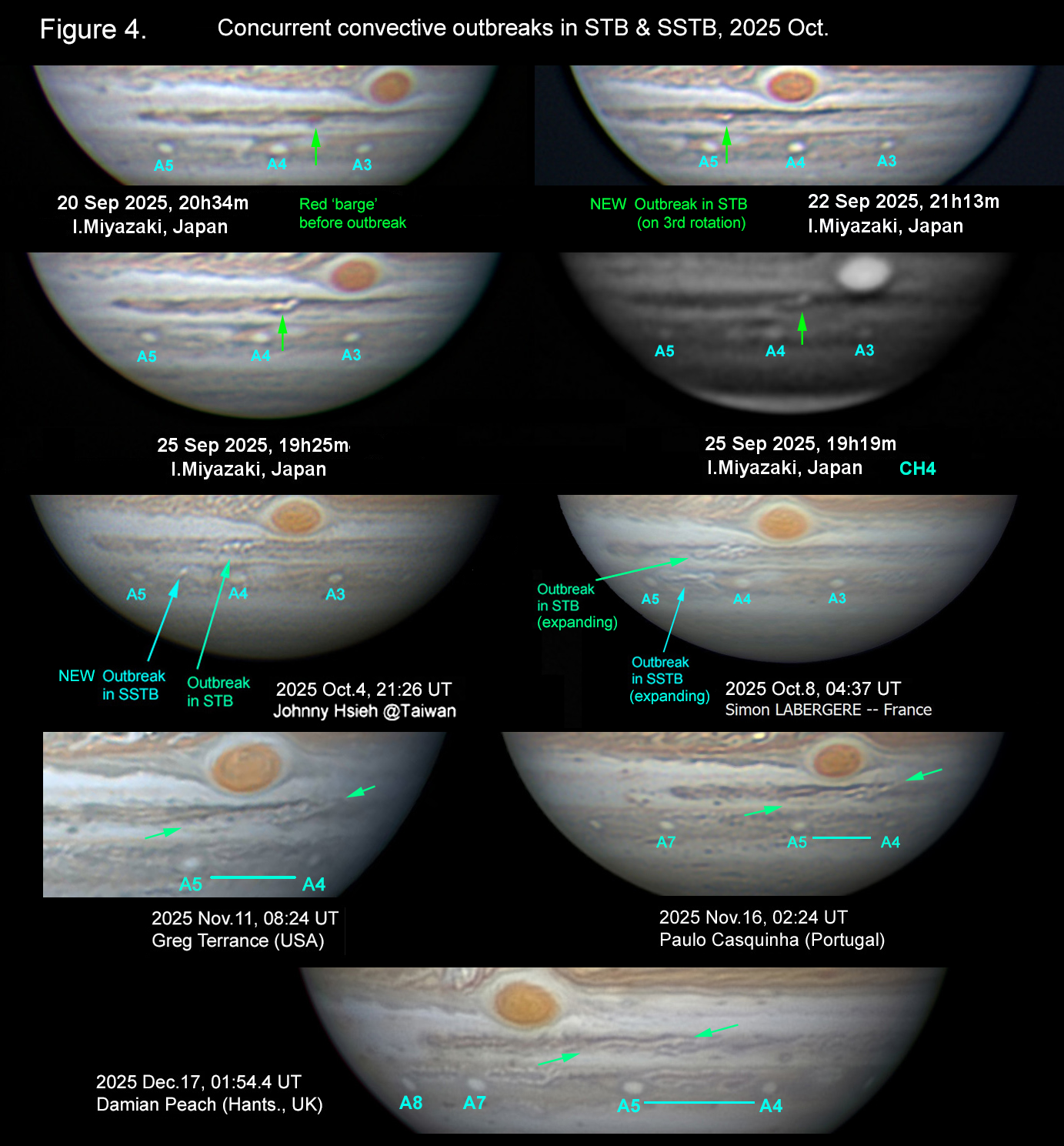
Background: Convective plume outbreaks (seen as very bright small white spots) are increasingly recognised as essential aspects of many jovian phenomena, though they adopt different forms in different belts. In the STB, they are infrequent: four have been recorded, all in cyclonic circulations, which initiated major transitions [Ref.3 & EPSC2024-362]. In the SSTB, only small-scale ones have been recorded [Ref.4 & EPSC2024-378].
Observations 2025 [BAA Reports 2025/26 nos.2 & 4]: In late 2025, two such plumes appeared, one in the STB on Sep.22 and one nearby in the SSTB on Oct.4; they were also very methane-bright initially. Both began in pre-existing cyclonic structures, just as they were approaching the GRS [Figure 4]. The first appeared in the STB in a small red cyclonic oval. This was the first such outbreak observed in the STB to occur without any apparent triggering factor. Then a similar outbreak appeared nearby in the SSTB, in a white oblong. Both outbreaks rapidly expanded to form chaotic regions (FFRs), and the STB one remained turbulent, whereas the SSTB one evolved into a dark segment [Figure 4].
Conclusions: These are the first well-documented examples of outbreaks initiating FFRs in exactly this manner, and they broaden the range of cyclonic transformations which can be produced. Their proximity suggests that one might have triggered the other.
These three examples show how jovian phenomena that are neither obvious nor frequent can nevertheless be recognised and classified by modern amateur imaging and analysis.
References:
*EPSC abstracts and BAA reports cited in text are available at: https://britastro.org/sections/jupiter
- Simon-Miller et al. (2012), Icarus 218, 817–830. [doi:10.1016/j.icarus.2012.01.022]
- Rogers (2012) ‘The life of the South Equatorial Disturbance, 1999-2010’. http://www.britastro.org/jupiter/2012_13/SED-1999-2010_Final-overview-to-post.doc
- Rogers et al. (2025) ‘Jupiter’s South Temperate Domain, 2018-2024’
- Rogers et al. (2025) ‘Jupiter’s S2 (South South Temperate) domain, 2012-2023’ . Refs.3&4 are at: https://britastro.org/section_information_/jupiter-section-overview/long-term-reports-publication
How to cite: Rogers, J., Adamoli, G., Bullen, R., Jacquesson, M., Mettig, H.-J., Vedovato, M., and Mizumoto, S.: Unusual features on Jupiter: new examples confirm dynamical behaviour, Europlanet Science Congress 2026, The Hague, The Netherlands, 7–11 Sep 2026, EPSC2026-268, https://doi.org/10.5194/epsc2026-268, 2026.


