ODAC9 | Professional-Amateur collaborations in astronomy and protection of Astronomical Observatories

ODAC9

Professional-Amateur collaborations in astronomy and protection of Astronomical Observatories
Conveners: Florence Libotte, Marc Delcroix | Co-conveners: Florence Libotte, John Rogers, Sarunas Mikolaitis, Veikko Mäkelä, Giuseppe Cimo, Ricardo Hueso, Gemma Domènech Rams
Orals FRI3
| Fri, 11 Sep, 14:00–15:30 (CEST)|Room Sun (Amare Studio)
Posters THU-POS
| Attendance Thu, 10 Sep, 18:00–19:30 (CEST) | Display Thu, 10 Sep, 08:30–19:30|Foyer 3, F3.79–82
Fri, 14:00
Thu, 18:00
Amateur astronomy has evolved dramatically over recent years. A motivated amateur, with his/her backyard instrument and available software is nowadays capable of getting high-resolution planetary images in different wavelengths (better than many professional observatories could achieve 20 years ago). Topics well covered by amateur astronomers include: high-resolution imaging of solar system planets, high-precision photometry of stellar occultations by minor objects and giant planets' atmospheres, high-precision photometry of exoplanet transits, and observations of radio emissions in our galaxy.
Hundreds of regular observers are sharing their work providing very valuable data to professional astronomers, at a time when professionals face increasing competition accessing observational resources. Some experienced amateurs use advanced methods for analysing their data, facilitating regular collaboration with professionals and often leading to publication in peer-reviewed scientific journals. However, the ability to carry out this work is increasingly threatened by light pollution and radio frequency interference. Existing international guidelines rarely apply to smaller observatories in semi-urban locations, and global satellite constellations pose an urgent additional challenge. This session will showcase results from amateur astronomers working alone or in collaboration with professionals, and present practical case studies on protecting observatories from light pollution and radio interference — covering legal frameworks, dark sky zones, and negotiations with local authorities or commercial operators — with the goal of fostering stronger pro-am partnerships and building shared resources to safeguard the future of astronomical observation.

Orals: Fri, 11 Sep, 14:00–15:30 | Room Sun (Amare Studio)

Chairpersons: Florence Libotte, Marc Delcroix
14:00–14:01
14:01–14:16
|
EPSC2026-852
|
solicited
|
On-site presentation
Glenn Orton, John Rogers, Shawn Brueshaber, Scott Bolton, and Leigh Fletcher

Introduction

The Juno mission continues to expand its science goals beyond those of the prime mission and the first extended mission. Atmospheric studies will continue to be among Juno’s science goals and an area in which the world-wide community of Jupiter observers can provide significant contextual support. A series of radio occultation measurements derive vertical profiles of electron density and the neutral-atmospheric temperature over several atmospheric regions. 

Physical Details of the Mission

Figure 1 shows the sequence of orbits and key investigations of the primary and extended missions.

igure 1. Progression of Juno orbits viewed from above Jupiter’s north pole with respect to local time of day. “PJ” designates a “perijove”, the closest approach to Jupiter on each numbered orbit. Following a Ganymede flyby on PJ34 (green orbit), the orbital period decreased from 53 days to 43-44 days (green + blue orbits). The “Great Blue Spot” (blue) orbits map an isolated patch of intense magnetic field. Following a close Europa flyby on PJ45 (aqua orbit), the period decreased to 38 days (orange orbits). Following close flybys of Io on PJ57 and PJ58 (black orbits) the period decreased to 33 days (red orbits). In reflected sunlight, Jupiter mostly appears as a crescent at perijoves following PJ58, but closer to its original phase angle by P110.

Some characteristics of perijoves of the extended mission for the year starting in September, 2026, are shown in Table 1. We caution that while the day of year for the perijoves is reasonably fixed, the exact times may change.

Role of Amateur Astronomers

We’ve noted at previous EPSC and EPSC-DPS meetings how the amateur community can contribute to the Juno mission via their collective world-wide 24/7 coverage of Jupiter. This applies also to the cadre of professional astronomers supporting the Juno mission. For example, this community has provided the context of different regions over which Juno’s Microwave Radiometer (MWR) has sensed plumes and “hot spots” (Fletcher et al. 2020). They have also alerted observers to strong interactions between the Great Red Spot and smaller anticyclones (Sanchez-Lavega et al. 2021) and the occurrence and evolution of prominent and unusual vortices, such as “Clyde’s spot” (Hueso et al. 2022). The continued tracking of outbreaks in the southern part of the North Equatorial Belt (NEB) also greatly informed the Juno team and supporting astronomers regarding the systematic longitudinal distribution of outbreaks and the range of atmospheric features they generate. A perijove-by-perijove summary of Juno-supporting observations is available at the following web site:  https://www.missionjuno.swri.edu/planned-observations.

After PJ50, Juno’s perijoves migrated to the nightside. From now through the end of the mission, images from this community will be extremely useful to provide a context for several investigations, such as as the MWR measurements of thermal emission from the deep atmosphere that includes mid-to-high latitude coverage. Observations from the amateur community will also provide the visible-wavelength context for anticipated continuation of  JIRAM’s 5-µm maps of much of the southern hemisphere. They will also support the Microwave Radiometer (MWR) observations. Finally, the observations will also provide contextual support for a series of measurements to determine a local temperature profile by tracking the phase shift in Juno’s high-gain antenna signal as the spacecraft goes behind  Jupiter (known as “ingress”) and as it emerges from behind Jupiter (known as “egress”). Figure 2 summarizes graphically all of the successful and planned radio-occultation sequences.

Some of this research was carried out at the Jet Propulsion Laboratory, California Institute of Technology, under a contract with the National Aeronautics and Space Administration (80NM0018D0004).

We dedicate this work to the memory of Dr. Candice Hansen, who was the Juno instrument lead for JunoCam through most of the mission.  She provided operational insight  and guidance for both the public access to Juno observations envisioned for this instrument and for the strong quantitative scientific results it brought to the mission.

Fletcher et al. 2020. J. Geophys. Res. 125, 306399.

Hueso et al. 2022. Icarus 380,114994

Sanchez-Lavega et al. 2021. J. Geophys. Res. 126, e006686.

Table 1. Perijove properties for a portion of Juno’s extended mission for a year, covering PJ87-PJ98. Information for previous perijoves and a summary of observations at large telescopes is listed in: https://www.missionjuno.swri.edu/planned-observations.

PJ

Date

Approx. Spacecraft Event Time

PJ lat. (centric)

PJ long. (System III)

Solar Elongation

87

2026 Sep 9

05:16

72°

324°

31°

88

2026 Oct 11

21:25

73°

  325°

56°

89

2026 Nov 13

12:43

73°

296°

85°

90

2026 Dec 16

04:11

74°

 272°

118°

91

2027 Jan 17

19:31

75°

244°

151°

92

2027 Feb 19

10:43

75°

210°

171°

93

2027 Mar 24

01:57

76°

178°

134°

94

2027 Apr 25

16:50

76°

133 °

103°

95

2027 May 28

08:48

77°

127°

73°

96

2027 Jun 30

00:24

77°

108°

47°

97

2027 Aug 1

17:06

78°

129°

23°

98

2027 Sep 3

09:10

78°

127°


How to cite: Orton, G., Rogers, J., Brueshaber, S., Bolton, S., and Fletcher, L.: The Juno Mission: A Call for Continued Support from Amateur Observers, Europlanet Science Congress 2026, The Hague, The Netherlands, 7–11 Sep 2026, EPSC2026-852, https://doi.org/10.5194/epsc2026-852, 2026.

14:16–14:28
|
EPSC2026-318
|
On-site presentation
Ricardo Hueso, Leigh Fletcher, Olivier Witasse, Vicent Hue, Eli Galanti, Thibault Cavalie, John H. Rogers, Marc Delcroix, and Glenn S. Orton

JUICE (JUpiter ICy moons Explorer) is the first large mission in ESA’s Cosmic Vision 2015-2025 programme. The spacecraft was launched on April 2023 and will arrive at the Jupiter system in July 2031. The primary science goals of the mission are to characterize the Jovian icy satellites, studying their surfaces and interiors to unveil their history and internal structures, and to assess the emergence of habitable environments in their internal oceans [1]. To reach those goals JUICE will perform a complex series of orbits around Jupiter in which it will also run an extensive series of observations of the planet’s atmosphere [2], its magnetosphere and the ring system. All previous Jupiter missions since Galileo have benefited from extensive ground-based campaigns with a variety of telescopes and observational capabilities. A brilliant example of those collaborations comes from NASA’s Juno mission, which has requested collaboration with amateurs for a full decade, enhancing the spatial context and investigations in the time domain of various instruments with a particular strong participation with the Juno camera [3].  In this regard, amateur observations of Jupiter have demonstrated the capability to provide an excellent coverage of atmospheric phenomena that serve as spatial and temporal context to the close observations from spacecraft instruments or space telescopes. Databases of amateur observations such as ALPO Japan (https://alpo-j.sakura.ne.jp/indexE.htm) and PVOL (http://pvol2.ehu.eus/) [4] serve the science community providing access to the amateur data. Open source software tools popular in the amateur community (WinJupos, available at https://jupos.org/) [5] or more python-oriented tools such as PlanetMapper [6] support the analysis of amateur data. In addition, ESA’s Planetary Science Archive (https://archives.esac.esa.int/psa/#/pages/home) releases public data obtained by the two monitoring cameras (JMC; Juice Monitoring Camera 1 and 2) and will soon release also data from the navigation camera (NAVCAM). Data from the science instruments will be released through ESA’s Planetary Science Archive after proprietary time.

In this contribution, we discuss the interest of the mission and its Jupiter Atmosphere Working Group to receive observational support from amateur astronomers. This support is needed during the years before Juno and JUICE to continue understanding temporal changes in the atmosphere of the planet. During the JUICE mission, particular needs will arise over different periods. For example, over the first year of the mission JUICE orbits will be eccentric with larger apojoves implying longer periods of time between close perijoves. Later, orbits will have high-inclinations with reduced views of the equatorial latitudes and in the year before Ganymede orbit insertion orbits will be more regular but constrained by Data Volume. We expect that JUICE collaboration with amateur astronomers will broaden public involvement in the mission and will enhance outreach activities of the mission.

With Jupiter having a negative declination over 2031-2035 when observed from Earth, observations from the southern hemisphere and equatorial latitudes will be favored. Thus, specific outreach activities targeting amateur astronomy in the Global South may improve the amateur collaboration in the mission. Jupiter’s south declination implies that amateur observers in Japan, European countries and the US, where most experienced observers actively participating in collaborations with Jupiter researchers reside, will observe Jupiter under low elevations. Thus, we will actively promote knowledge of the mission in South America and Africa, where amateur astronomy is popular but Jupiter observations are less frequent. We expect to identify JUICE science activities that can be promoted within partners such the Astronomical Society of Southern Africa, the Asociación Argentina Amigos de la Astronomía and Sociedad Astronómica de Valparaiso y Viña del Mar. Such activities can be fostered with the help and participation of international societies promoting astronomy worldwide. Key partners toward that effort are The Europlanet Society and the International Astronomical Union Outreach Group. We will also seek a global collaboration with traditional actors in the amateur planetary astronomy world including the British Astronomical Association Jupiter Section, the Association of Lunar and Planetary Observers and planetary imaging communities on well-known international forums such as Cloudy Nights.

References

[1] Grasset et al. JUpiter ICy moons Explorer (JUICE): An ESA mission to orbit Ganymede and to characterise the Jupiter system. Planetary and Space Science, 78 (2013). [2] Fletcher et al. Jupiter Science Enabled by ESA's Jupiter Icy Moons Explorer. Space Science Reviews, 219 (2023). [3] Hansen, C.J., et al. Junocam: Juno’s Outreach Camera. Space Sci Rev 213, 475–506 (2017). [4] Hueso et al. The Planetary Virtual Observatory and Laboratory (PVOL) and its integration into the Virtual European Solar and Planetary Access (VESPA). Planetary and Space Science, 150 (2018). [5] Jacquesson and Mettig. JUPOS: Amateur analysis of Jupiter images with specialized measurement software. European Planetary Science Congress (2008). [6] King and Fletcher, PlanetMapper: A Python package for visualizing, navigating and mapping Solar System observations. Journal of Open Source Software, 8 (2023).

How to cite: Hueso, R., Fletcher, L., Witasse, O., Hue, V., Galanti, E., Cavalie, T., Rogers, J. H., Delcroix, M., and Orton, G. S.: Amateur Astronomers’ Support for ESA’s JUICE Mission II. Getting ready for 2031-2035, Europlanet Science Congress 2026, The Hague, The Netherlands, 7–11 Sep 2026, EPSC2026-318, https://doi.org/10.5194/epsc2026-318, 2026.

14:28–14:40
|
EPSC2026-1161
|
Virtual presentation
Christopher Go and John Rogers

For 20 years the hstjupiter mailing list has been the venue where amateur planetary imagers collaborate and support Planetary Astronomers in various field of research including space missions.  The hstjupiter group had been the venue where several discoveries were first announced (ie several outbreaks in Jupiter and Saturn, Bird Strike, several impacts on Jupiter).  This is also a venue where planetary astronomers request imagers for support.  We will discuss the contributions of this mailing list and the future plans.

How to cite: Go, C. and Rogers, J.: The HSTJupiter Group: 20 years of Pro-Am Collaboration, Europlanet Science Congress 2026, The Hague, The Netherlands, 7–11 Sep 2026, EPSC2026-1161, https://doi.org/10.5194/epsc2026-1161, 2026.

14:40–14:41
14:41–14:53
|
EPSC2026-661
|
On-site presentation
Marc Delcroix and Ricardo Hueso

After 1994 Shoemaker/Levy 9 comet fragmentation and impacts on Jupiter was predicted and observed by professional astronomers, it was estimated that impacts on Jupiter should be very rarely observed events, maybe once per century. But an Australian amateur observed dark traces of an impact on Jupiter with his backyard telescope in 2009 and observed a flash provoked by another smaller impactor on Jupiter atmosphere in 2010 [1]. This started a series of 13 observations of such events [2],[3], and a long monitoring program supported by software (DeTeCt) aiming at estimating such impacts frequency, through both semi-automatic detection of flashes on amateur videos of Jupiter and logging of all observations period without any events. Despite record participation in the project in 2024 and very good in 2025, no impact was discovered during this period.

Over the years, we could collect a year worth of videos analysis with our software, from 303 different observers (491 000 videos). To refine the rate of Jupiter impacts’ frequency estimation, we analyzed the data per Jupiter apparition, and considering for each apparition the number of impacts discovered, the total duration and period of all negative observations collected through DeTeCt. Focusing on most relevant apparitions with around or more than a month worth of data collected, we find an impact frequency varying from none per year (no impacts detected in 2018, 2022, 2024 and 2025), to ~80/year (4 observed in 2023). Averaging the result for these apparitions (between 2018 and 2026), we estimate now the impact frequency to ~22/y, lowering the precedent (2024) estimation using this methodology of 32~/y [4]


References:

[1] Impact flux on Jupiter: From superbolides to large-scale collisions ", Hueso R., Delcroix M. et al., Astronomy & Astrophysics, September 2013

[2] Small impacts on the Giant planet Jupiter, Hueso R., M. Delcroix et al. Astronomy & Astrophysics 617, A68 pp1-13  2018

[3] Fragmentation modelling of the 2019 August impact on Jupiter, Sankar R. et al. (incl. Delcroix M.), Monthly Notices of the Royal Astronomical Society 2020

[4] 15 years of Jupiter impacts monitoring and observations, Delcroix M., Hueso R., EPSC2024

How to cite: Delcroix, M. and Hueso, R.: Jupiter impacts monitoring till 2026 apparition , Europlanet Science Congress 2026, The Hague, The Netherlands, 7–11 Sep 2026, EPSC2026-661, https://doi.org/10.5194/epsc2026-661, 2026.

14:53–15:05
|
EPSC2026-231
|
On-site presentation
Elisa Maria Alessi, Maria Teresa Artese, Antony Cook, Daniel Banister, and Detlef Koschny

Lunar Impact Flashes (LIFs) are flashes that can be observed on the surface of the Moon, resulting from meteoroid impacts. Their characterization in terms of energy release and temporal and spatial flux is important for many reasons. First, it can help to improve our knowledge on the dynamics and size of the small body’s population. Moreover, the design of a future lunar base and corresponding activities should consider the risk posed by these events. Finally, it should be possible to associate the brighter LIFs with moonquakes generated by impacts and to use this to understand the internal structure of the Moon.

The ESA CubeSat mission LUMIO (Lunar Meteoroid Impact Observer) [1], led by Politecnico di Milano, will observe LIFs on the far side of the Moon from the neighbourhood of the L2 point in the Earth-Moon system. The observations that it will gather will need to be compared to ground-based observations to have an overall understanding of differences in rates of these phenomena between the near and far sides. To train amateur astronomers in this regard, we have organized a series of LIF observing campaigns starting from the Geminid meteoroid stream in December 2025.

The first campaign was supported by two webinars to explain how to observe, to analyse the observations and to estimate the magnitude of the detections. A dedicated web interface was developed to collect the data. It was improved and enriched after the first campaign, thanks to the feedback and suggestions provided by the users (36 people submitting data from 13 countries all over the world). It allows the user to upload images and videos of a suspected LIF, together with technical information regarding the observing instruments. The users are allowed to see what others have uploaded and a specific tool allows them to see whether different users have detected LIFs at the same time.

The final confirmation of the events requires a specific expertise in analysing the images and videos provided. In the case of the Geminids campaign, this was done by firstly looking for close overlaps in time between the reported LIFs. These were called ‘suspected events’. Secondly, these temporally overlapping events were examined to see if they were located at the same location on the Moon. Observations at the same time by at least two observers were called ‘confirmed events’. Thirdly, observers who were observing, but did not report a LIF at these times, were asked to re-check their videos in case they have not noticed the flash. In this way, in the case of the Geminid campaign we have obtained at least 14 confirmed events.

The interest demonstrated by amateurs within about five months is very encouraging and it has shown the importance of the amateur community also for challenging tasks and how a continuous communication between experts and non-experts is really an added value.

References

[1] Cipriano A. M., Dei Tos D. A. and Topputo F. (2018), Front. Astron. Space Sci. 5:29.

Acknowledgements

E.M. Alessi and M.T. Artese acknowledge support by the Italian Space Agency through the agreement n. F43C23000340001 entitled “Supporto scientifico alla missione LUMIO”.

How to cite: Alessi, E. M., Artese, M. T., Cook, A., Banister, D., and Koschny, D.: Lunar Impact Flashes amateurs’ observations: first results of the 2025-2026 campaigns, Europlanet Science Congress 2026, The Hague, The Netherlands, 7–11 Sep 2026, EPSC2026-231, https://doi.org/10.5194/epsc2026-231, 2026.

15:05–15:06
15:06–15:18
|
EPSC2026-1182
|
On-site presentation
Mislav Balokovic

The science of radio astronomy plays a key role in increasing our understanding of the environment and the universe in which we live. As new technology and services utilizing the radio spectrum get introduced at an ever-increasing pace, the consequences for radio astronomy and other scientific radio services can be severe. In recent years, dramatic increase in the utilization of the radio spectrum by services that actively emit radio waves, as opposed to just receiving them, resulted in high pressure on the radio spectrum as an effectively used finite resource. The dominating topic in management of the radio spectrum today is large satellite constellations, which have the potential to massively impact radio astronomy with strong radio emitters practically filling out the whole sky. The Committee on Radio Astronomy Frequencies (CRAF) of the European Science Foundation coordinates activities to keep the frequency bands used by radio astronomy as free as possible from interference. In this talk I will give an overview of its extensive work on protection of radio astronomy and space sciences in Europe in discussions with the major public and private telecommunications agencies and also in discussions within the international bodies that decide on the use of the radio spectrum, where CRAF acts as the expert voice of European radio astronomers.

How to cite: Balokovic, M.: Overview of radio astronomy spectrum protection activities of the Committee on Radio Astronomy Frequencies (CRAF), Europlanet Science Congress 2026, The Hague, The Netherlands, 7–11 Sep 2026, EPSC2026-1182, https://doi.org/10.5194/epsc2026-1182, 2026.

15:18–15:30
|
EPSC2026-1205
|
On-site presentation
Robert Massey and Marieta Valdivia Lefort

There could be more than a million satellites deployed in Low Earth Orbit by the mid 2030s. This is a paradigm shift in our use of space, and represents a thousandfold increase since SpaceX began the construction of the first large constellation in 2019. Such a dramatic change is already having a major impact on the science of astronomy on the ground and in space, with radio and optical interference meaning that facilities like the Rubin Observatory and the Square Kilometer Array could struggle to deliver their goals.

In this paper we will describe the problem, the wider impacts and how we have responded in our roles with the Royal Astronomical Society and European Astronomical Society, organisations representing thousands of European astronomers. Our talk will encompass our efforts to garner technical information, to understand space law, to build broader alliances, successful (and unsuccessful) lobbying efforts, and our work with the media and wider public. We will describe the outcomes of work with the Federal Communications Commission in the US, OfCom in the UK, the European Commission, the UN Committee on the Peaceful Uses of Outer Space, and in the UK the relatively new Earth Space Sustainability Initiative.

Finally, we will offer some thoughts on the next steps in what is certainly a fast-moving landscape and spacescape, and how to find a balance between vocal campaigning and softer engagement with the full range of stakeholders.

How to cite: Massey, R. and Valdivia Lefort, M.: Can we hold on to a dark and quiet sky? The UK and European campaigns to rein in megaconstellations, Europlanet Science Congress 2026, The Hague, The Netherlands, 7–11 Sep 2026, EPSC2026-1205, https://doi.org/10.5194/epsc2026-1205, 2026.

Posters: Thu, 10 Sep, 18:00–19:30 | Foyer 3

Display time: Thu, 10 Sep, 08:30–19:30
Chairpersons: John Rogers, Ricardo Hueso
Jupiter
F3.79
|
EPSC2026-268
|
On-site presentation
John Rogers, Gianluigi Adamoli, Robert Bullen, Michel Jacquesson, Hans-Joerg Mettig, Marco Vedovato, and Shinji Mizumoto

In the monitoring of Jupiter’s atmospheric features by amateur imagers and recorders, features that seem to be one-off occurrences sometimes turn out to be reproducible phenomena that contribute to a growing understanding of atmospheric dynamics.  Here we show three examples from 2025.

(1)  NTBs jet:  ‘Reddish blob’ following NTBs jet outbreak

Background: A spectacular outbreak of very bright, very fast-moving convective plumes on the NTBs jet, followed by turbulent dark wakes, occurred in 2025 Jan. and confirmed many aspects of these cyclic upheavals [EPSC-DPS 2025-45 & -51]*.

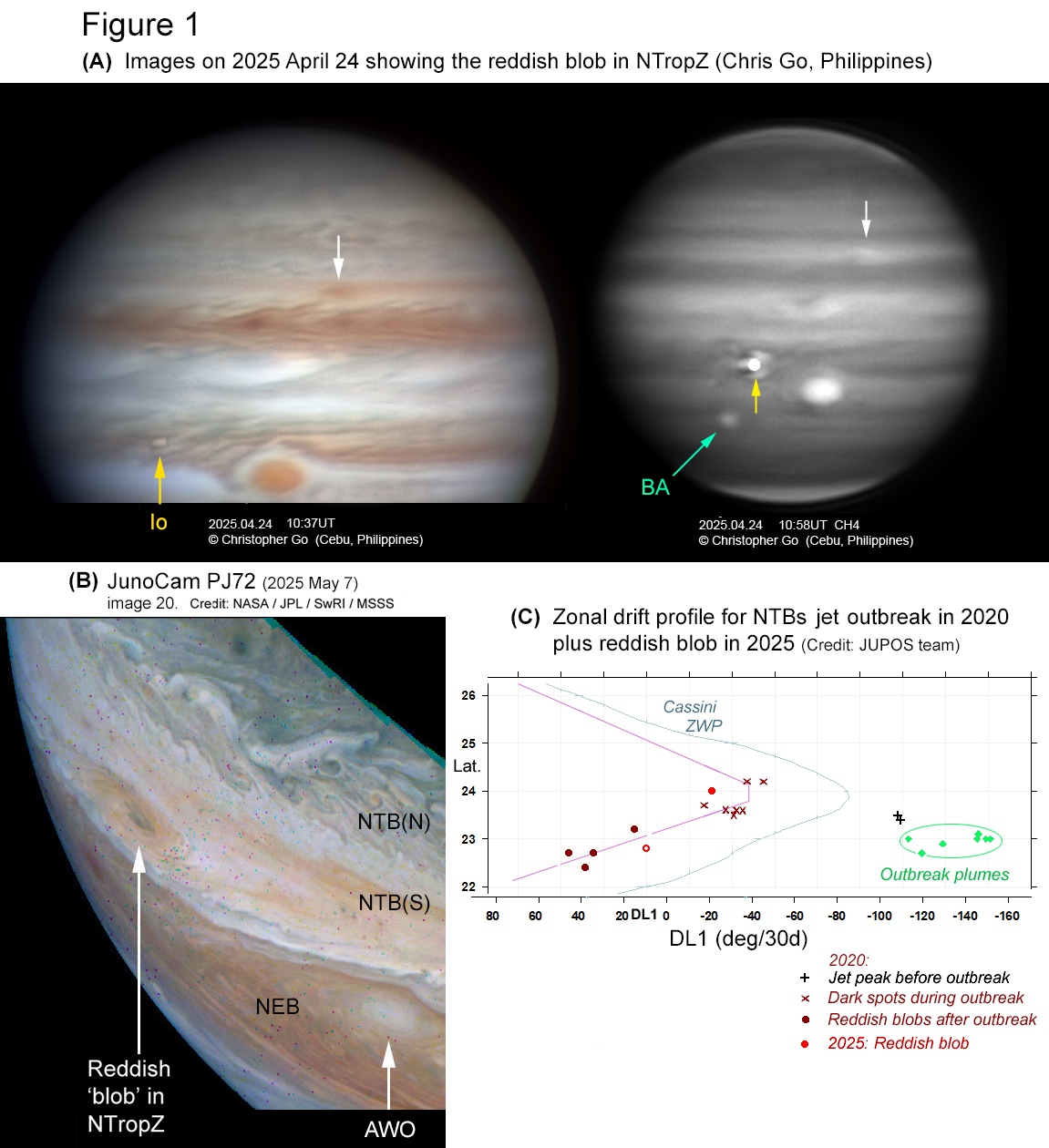
Observations 2025:  Late in the upheaval [BAA Report 2024/25 no.7]*, an orange ‘blob’ developed in mid-March, on the then-reddish NTBs edge at 24ºN, with mean drift rate of DL1 = -21 deg/30d (u3 = 107.4 m/s). It was weakly bright in the methane absorption band (“methane-bright”) [Figure 1A]. In ground-based images it always appeared diffuse or featureless, but JunoCam images at PJ72 (2025 May 7) showed it to be clearly anticyclonic, and it had decelerated and moved south to 22.8ºN. It may have persisted to 2025 Sep., when it faded away.

Conclusions:  The ‘blob’ was dynamically similar to the wave-like dark patches in the wake earlier (weakly anticyclonic, in the jet peak latitude but with much slower drift). Similar ‘reddish blobs’ were recorded on orange NTBs in three previous cycles (1964-65, 2012, and 2020), and one of those in 2020 apparently formed as an eddy in the NEBn wave pattern [BAA Report 2020 no.9]. So the turbulence across the NTropZ in these upheavals can form these anticyclonic vortices in various ways, and the resulting reddish oval can drift south on the zonal gradient in the NTropZ [Figure 1C].

(2)  South Equatorial Disturbance (SED)

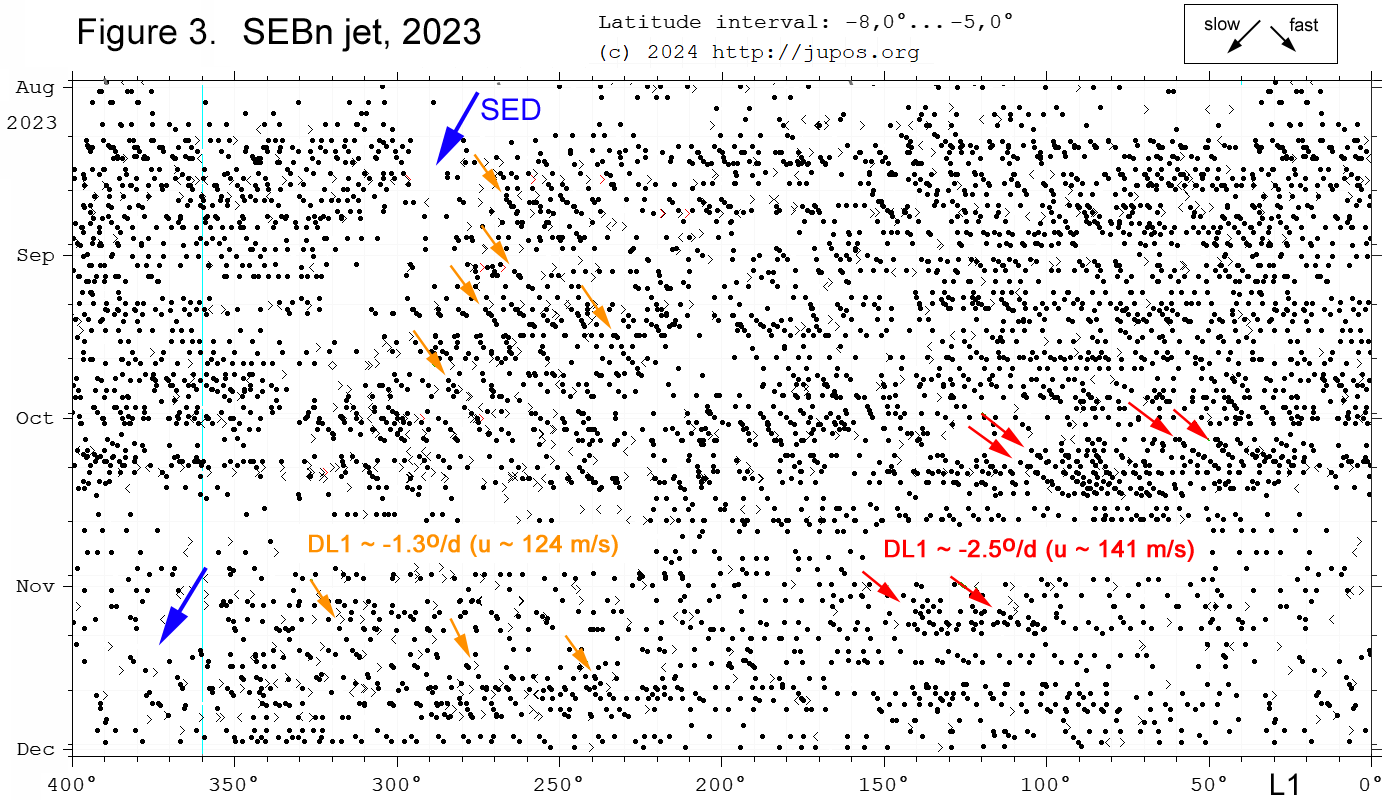
Background: This is a large wave-like feature in the SEBn jet which drifts slowly with DL1 ~ +30 deg/30d (u3 = 91 m/s), thought to be comparable to the NEBs dark formations.  Examples existed from 1879-1885, 1976-1989, and 1999-2009 [Refs.1&2], and a new one from 2022 to 2025. The SED is usually marked by a discontinuity or rift in the SEB(N), and is sometimes conspicuous with a bright white oval and dark bluish markings in the EZ(N).  But sometimes it is merely a slow-moving gap in the usual array of fast-moving dark spots (‘chevrons’) in the SEBn jet. When visibly prominent, it also modulates the speed of the jet: the chevrons move more slowly preceding the SED.

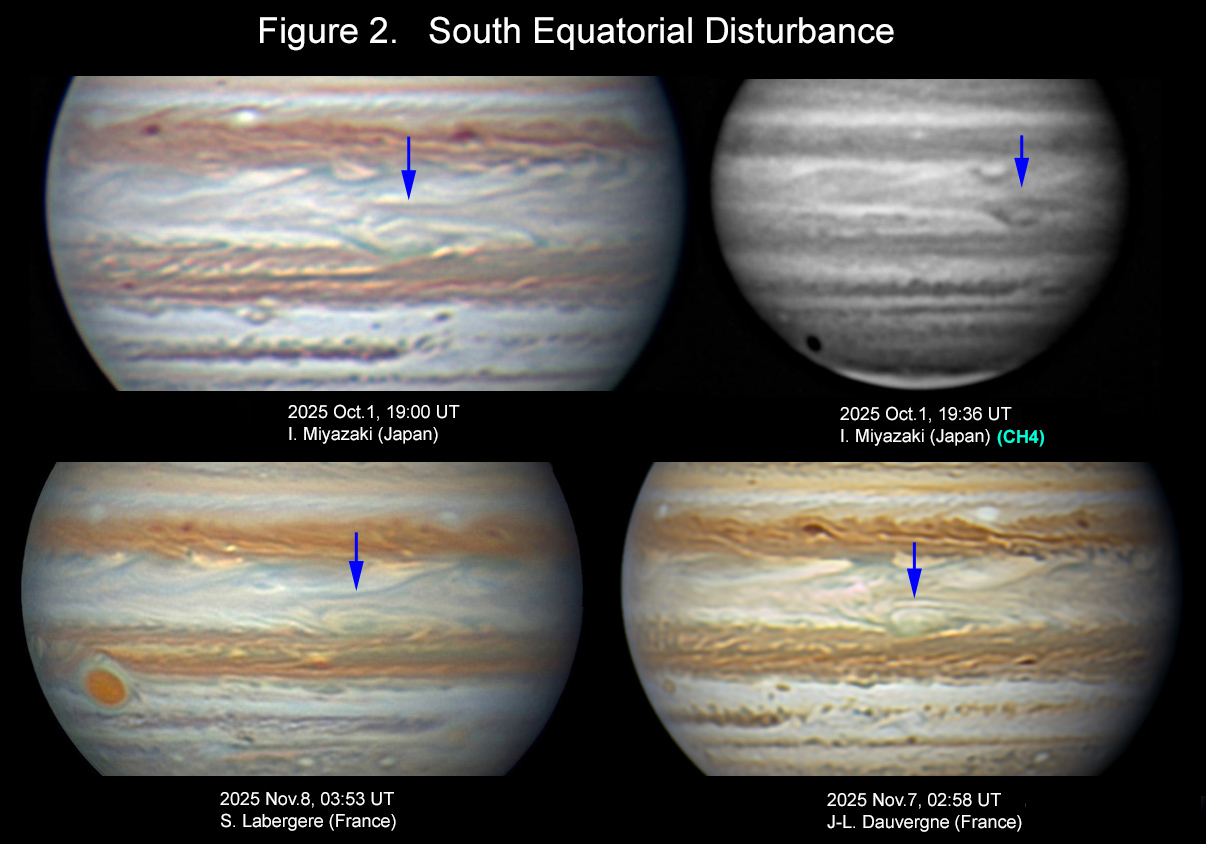
Observations 2025: The recent SED was tracked since 2022 [BAA Report 2023/24 no.3] but was rarely conspicuous until late 2024. Instead it was usually tracked as a gap in the chevrons.  It became visually striking in late 2024 & 2025, but disappeared after 2025 Nov. 

Conclusions:  The observations of the 2022-2025 SED confirmed our previous results and revealed several variations:  (i)  In 2025 it often included an exceptionally dark, greenish-blue, very methane-dark patch [Figure 2] – indicating unique disruption of the cloud layers.  (ii)  The speed of the SEBn jet spots (chevrons) reproduced the longitudinal gradient shown by the previous SED [Figure 3], even before it became visually conspicuous.  So its dynamical effect can be dissociated from its visible state.  (iii)  The peak speed of the SEBn jet, with or without the SED, has been reduced from DL1 ~ -100 to -115 deg/30d (u ~ 150-160 m/s) (1995-2016) to DL1 ~ -70 to -85 (u ~ 139 to 146 m/s) (2021-2025), for unknown reason [BAA Report 2023/24 no.3].  (iv)  The JUPOS tracking of chevrons can detect not only an incipient SED, but occasionally similar slow-moving gap(s) (waves?) although they do not become visible nor perturb the SEBn jet speed.

(3)  STB & SSTB: Convective outbreaks in cyclonic circulations

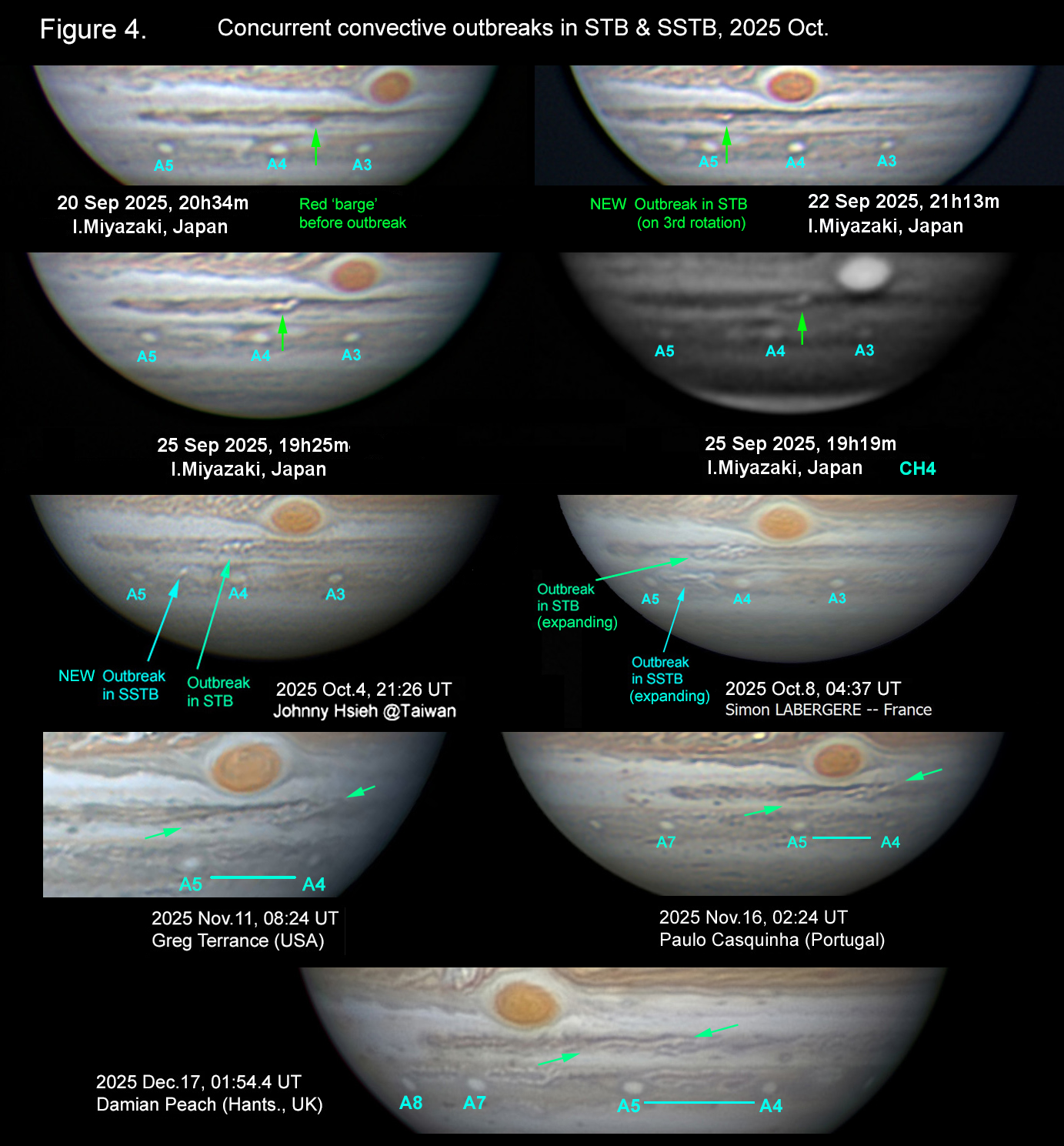
Background: Convective plume outbreaks (seen as very bright small white spots) are increasingly recognised as essential aspects of many jovian phenomena, though they adopt different forms in different belts.  In the STB, they are infrequent: four have been recorded, all in cyclonic circulations, which initiated major transitions [Ref.3 & EPSC2024-362]. In the SSTB, only small-scale ones have been recorded  [Ref.4 & EPSC2024-378].

Observations 2025 [BAA Reports 2025/26 nos.2 & 4]:  In late 2025, two such plumes appeared, one in the STB on Sep.22 and one nearby in the SSTB on Oct.4; they were also very methane-bright initially.  Both began in pre-existing cyclonic structures, just as they were approaching the GRS [Figure 4]. The first appeared in the STB in a small red cyclonic oval.  This was the first such outbreak observed in the STB to occur without any apparent triggering factor.  Then a similar outbreak appeared nearby in the SSTB, in a white oblong. Both outbreaks rapidly expanded to form chaotic regions (FFRs), and the STB one remained turbulent, whereas the SSTB one evolved into a dark segment [Figure 4]. 

Conclusions:  These are the first well-documented examples of outbreaks initiating FFRs in exactly this manner, and they broaden the range of cyclonic transformations which can be produced. Their proximity suggests that one might have triggered the other.

These three examples show how jovian phenomena that are neither obvious nor frequent can nevertheless be recognised and classified by modern amateur imaging and analysis. 


References:

*EPSC abstracts and BAA reports cited in text are available at: https://britastro.org/sections/jupiter

  • Simon-Miller et al. (2012), Icarus 218, 817–830.  [doi:10.1016/j.icarus.2012.01.022]  
  • Rogers (2012) ‘The life of the South Equatorial Disturbance, 1999-2010’.   http://www.britastro.org/jupiter/2012_13/SED-1999-2010_Final-overview-to-post.doc
  • Rogers et al. (2025) ‘Jupiter’s South Temperate Domain, 2018-2024’
  • Rogers et al. (2025) ‘Jupiter’s S2 (South South Temperate) domain, 2012-2023’ .  Refs.3&4 are at:  https://britastro.org/section_information_/jupiter-section-overview/long-term-reports-publication


How to cite: Rogers, J., Adamoli, G., Bullen, R., Jacquesson, M., Mettig, H.-J., Vedovato, M., and Mizumoto, S.: Unusual features on Jupiter: new examples confirm dynamical behaviour, Europlanet Science Congress 2026, The Hague, The Netherlands, 7–11 Sep 2026, EPSC2026-268, https://doi.org/10.5194/epsc2026-268, 2026.

F3.80
|
EPSC2026-6
|
ECP
|
On-site presentation
Raphaël Lallemand, Josselin Desmars, Valéry Lainey, and Arnaud Leroy and the co-authors

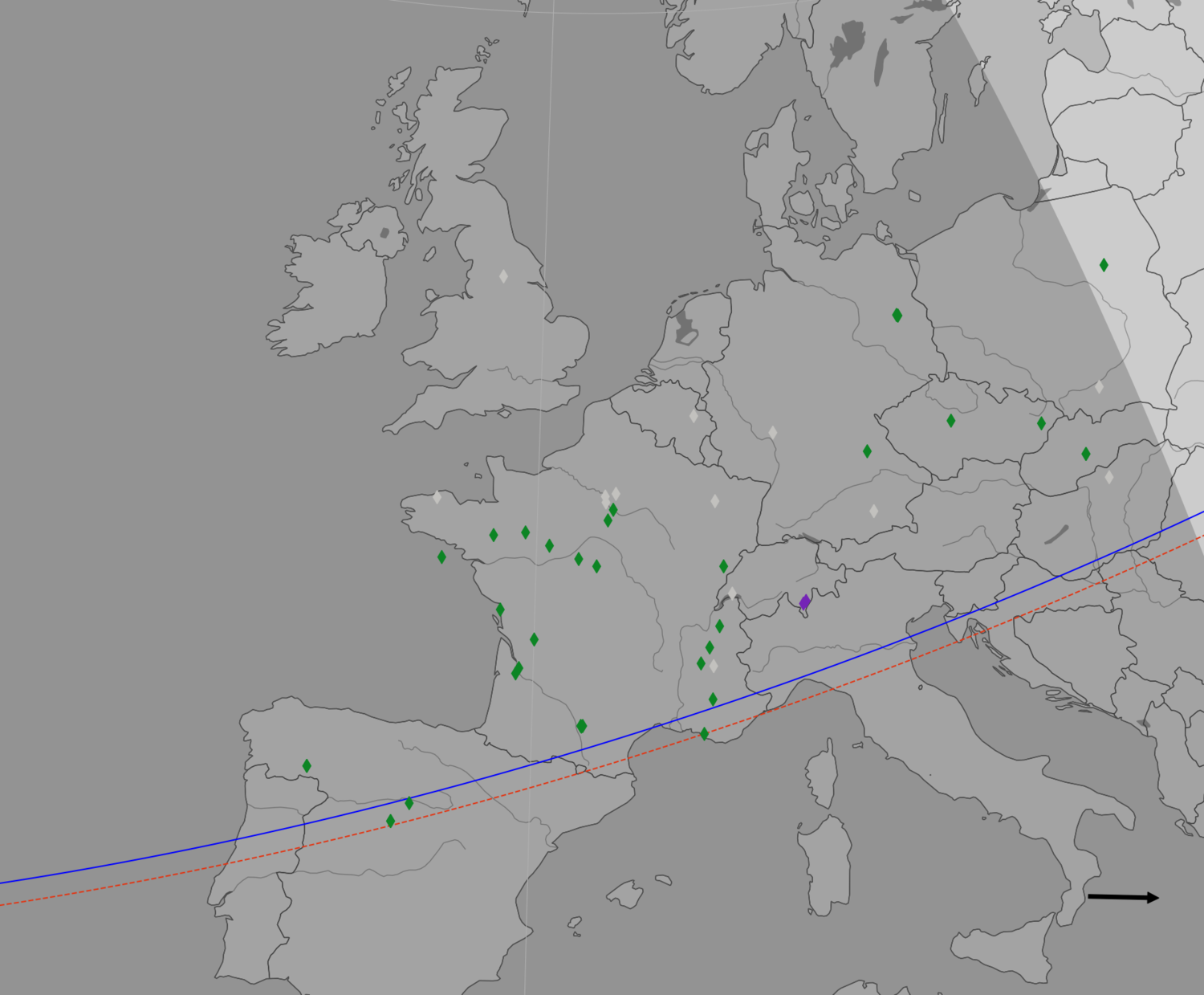
Among the most fascinating objects in our solar system, Ganymede stands out as the largest moon of Jupiter and one of its four Galilean satellites, discovered by Galileo Galilei in 1610. Its colossal size, even surpassing that of the planet Mercury, makes it a prime target for scientific exploration in the JUICE ESA mission. However, its close proximity to Jupiter presents a unique challenge : the influence of the planet complicate efforts to determine Ganymede’s precise position in space. To overcome this hurdle, we choosed to observe Ganymede using the stellar occultation technique. Stellar occultations occur when a solar system object passes in front of a star, briefly blocking its light, creating a shadow detectable by the observer. As the object moves, the shadow also moves along way, creating an occultation path on the surface of the Earth. The analysis of the light curve emitted by the star using aperture photometry allows the determination of key physical parameters of the object - such as size, shape, orientation, and relative component geometry [1,2] - with kilometric accuracy [3]. On October 14, 2025, Jupiter’s largest natural satellite occulted a 6-magnitude star all over Europe. This occultation has been observed by 52 observers, with 36 positives chords Europe (Figure 1). Amateur and professional astronomers gathered to provide unique insight in Ganymede astrometry. An overview of this campaign will be presented. A focus will be made on the analysis of the results with the implications for the future flyby of JUICE over Ganymede in 2029.

Figure 1: Post occultation map of the stellar occultation by Ganymede on October 14, 2025. The observing stations are displayed with the following colour code: Green - Positive, White - Overcast, Purple - Technical issues. The black arrow shows the direction of motion of the shadow. The dark grey region corresponds to astronomical night, while the light grey region corresponds to astronomical twilight.


Acknowledgement

The organisation of the observation campaigns for this work was supported by Occultation Portal - Kilic et al. (2022). Occultation Portal: A web-based platform for data collection and analysis of stellar occultations. MNRAS, Volume 515, Issue 1, pp. 1346-1357. This work made use of the SORA package - Gomes-Júnior et al. (2022). SORA: Stellar occultation reduction and analysis. MNRAS, Volume 511, Issue 1, March 2022, Pages 1167–1181. This work made use of the PRAIA package - Assafin M., 2023a, Differential aperture photometry with PRAIA, Planetary and Space Science Planetary and Space Science, Volume 239, article id. 105816. This work made use of the Pymovie package - Anderson, B. (2019) PyMovie – A Stellar-Occultation Aperture-Photometry Program, Journal for Occultation Astronomy (ISSN 0737-6766), Vol. 9, No. 4, p. 9-13. We made use of Astropy, a community-developed core Python package for Astronomy. The team gratefully acknowledges the amateur communities of IOTA/ES and Planoccult for their essential support, dedication, and significant contributions to this work. The authors would like to thank the Action Pluriannuelle Incitative (API) Pro-Am initiated and supported by Paris Observatory in the ROADIES program context.


[1] Morgado et al, 2022, The Astrophysical Journal, Milliarcsecond astrometry for the Galilean moons using stellar occultations
[2] Kiliç et al., 2026, Astronomy & Astrophysics, Constraining the size, shape, and albedo of the large Trans-Neptunian Object (28978) Ixion with multi-chord stellar occultations
[3] Desmars et al., 2019, Astronomy & Astrophysics, Pluto's ephemeris from ground-based stellar occultations.


How to cite: Lallemand, R., Desmars, J., Lainey, V., and Leroy, A. and the co-authors: Pro/Am Collaborative Observation of Ganymede Stellar Occultation on 2025/10/14, Europlanet Science Congress 2026, The Hague, The Netherlands, 7–11 Sep 2026, EPSC2026-6, https://doi.org/10.5194/epsc2026-6, 2026.

Exoplanets
F3.81
|
EPSC2026-1222
|
ECP
|
On-site presentation
Joan Miquel González Navarra, Florence Libotte, Mercè Correa, Antelm Ginard, Gemma Domènech Rams, Xavier Bros, Trinidad Poyato, and Manoli Seco

The K2-36 planetary system consists of two planets in very tight orbits around a young, magnetically active K-dwarf star, thus representing one of the best studied systems of planets within the radius gap, with the inner super-Earth K2-36b and the outer sub-Neptune K2-36c being particularly well-suited for studies of photo-evaporation effects. Although both precise radii and masses of K2-36c can be reliably measured via K2 photometry and HARPS-N spectroscopy, accurate long-term transit ephemerides are still based on a relatively sparse data set consisting of mid-times spanning over a decade.
In the ExoClock project, that uses space lightcurves and literature timings, supplemented with extensive Pro-Am network ground-based observations to derive updated transit ephemerides for Ariel targets, K2-36c is currently marked as an ALERT object. The ExoClock model recently published by Kokori et al. (2025) uses the period of P=5.341051 ± 4.8 × 10 -5 days and mid-transit time of T_0 =2456866.249±0.0013 BJDTDB for K2-36c. At present, however, K2-36c shows an unusually large observed-minus-calculated (O-C) difference of -108.1±2.4 minutes that is dominated by the effect of two recent observations made by URANIA team members in 2025.
In this work we present the analysis of two new transit observations obtained with the IAC80 telescope at Teide Observatory and the 1.23m telescope at Calar Alto Observatory, and we re-evaluate the transit timings of K2-36c on the basis of the complete data set, including K2 space photometry, ground-based light curves and literature mid-times. Our preliminary timing analysis confirms a large negative O-C of more than 100 minutes with respect to the current ExoClock ephemeris and motivates a detailed investigation of the origin of this offset in the context of the K2-36 system, which will be presented in full at the conference.

How to cite: González Navarra, J. M., Libotte, F., Correa, M., Ginard, A., Domènech Rams, G., Bros, X., Poyato, T., and Seco, M.: K2-36c off schedule: large transit timing offsets revealed by the URANIA Pro-Am team in ExoClock, Europlanet Science Congress 2026, The Hague, The Netherlands, 7–11 Sep 2026, EPSC2026-1222, https://doi.org/10.5194/epsc2026-1222, 2026.

Small bodies
F3.82
|
EPSC2026-1073
|
On-site presentation
Jakub Černý, Jakub Koukal, Milan Kalina, Martin Zima, and Filip Walter

The Society for Interplanetary Matter (SMPH) is a specialized scientific association operating within the Czech Astronomical Society, focused on the observation, analysis, and dissemination of knowledge related to interplanetary matter. SMPH integrates amateur and professional researchers from the Czech Republic, Slovakia, and neighbouring countries and supports long‑term observational projects, software development, international data exchange, and educational and outreach activities related to meteoroids, comets, and small Solar System bodies.


A major component of SMPH activities is the systematic study of meteoroids entering the Earth’s atmosphere. This research is conducted primarily through coordinated multi‑station observing networks CEMeNT and CSMON supported by SMPH and partner organisations. 

The Central European Meteor Network (CEMeNT) is a long‑running network designed for high‑precision video and spectroscopic observations of meteors and bolides. It consists of 15 fixed stations across the Czech Republic and Slovakia and has recently been expanded to the Southern Hemisphere through the installation of stations in Chile. This extension enables improved coverage of southern‑sky meteor activity and contributes to reducing hemispheric biases in meteor data.

CEMeNT stations are equipped with sensitive Full HD CMOS cameras, fast lenses, and dedicated spectral setups. An angular scale up to about  2.8 arcmin/px  allows accurate determination of atmospheric trajectories, heliocentric orbits, meteor shower radiants, and meteoroid physical properties. Spectroscopic measurements with dispersion of 0.48−0.50 nm/px  provide information on the chemical composition of meteoroids and support classification of cometary and asteroidal meteoroid populations. Uniform instrumentation and centralized data processing based on UFO Tools software ensure long‑term homogeneity of the dataset. CEMeNt data are publicly available as aggregated processed results on the CEMeNt website, meteor data are available through the open EDMOND database.

Complementary to CEMeNT is the Czech and Slovak Meteor Observation Network (CSMON), a dense network of low‑cost, fully automated observing stations operated in cooperation with the Global Meteor Network (GMN). CSMON emphasizes wide spatial coverage with angular scale about 2.75 arcmin/pxand high detection rates, producing large volumes of multi‑station meteor trajectories suitable for statistical analyses of sporadic sources and meteor showers. The network relies on standardized hardware and software, and automated processing pipeline using RMS / RPi Meteor Station software, enabling scalable expansion and easy adoption by new contributors. CSMON data are available through the GMN Data Explorer under a CC BY 4.0 license.

Another key focus of SMPH is cometary observation and photometry, including systematic multispectral CCD/CMOS photometry of cometary comae. Members of SMPH regularly perform visual brightness estimates as well as electronic photometric measurements using unfiltered and standard photometric bands. These observations are routinely submitted to international databases such as the International Comet Quarterly (ICQ) and the Comet Observation Database (COBS) and contribute to long‑term light‑curve datasets.

To support unified methodology and facilitate data processing, SMPH has developed  the Comet Observation and Photometry Program (KOPR), a software tool optimized for comet observers. KOPR supports both visual and CCD/CMOS observations, including multispectral photometry, and covers the full observational workflow from planning and ephemeris generation to photometric measurements and standardized reporting to international databases like COBS, ICQ, or CARA.  It is already a proven tool in the community, with more than 11,800 observations submitted to the COBS database so far.

With support from the Europlanet Society, we are now developing new updates. These include faster image processing (calibration and stacking), better error prevention, and new tools for comet tail photometry to analyze dust grain size. These updates will make the software more powerful for both amateur and professional use. In the following years, we aim to organize a series of online and in-person workshops on the use of KOPR software in the context of contemporary problems in cometary research.


Education and knowledge transfer are integral to SMPH’s mission. The society organizes seminars, workshops, and observational expeditions focused on interplanetary matter, combining theoretical background with practical training in observational techniques and data analysis. These activities support the development of new observers and maintain continuity of expertise within the regional astronomical community. SMPH is also involved in public outreach and science communication, including public lectures, media contributions, and the preservation of historically significant meteoritic sites, such as the Morávka meteorite fall monument. Through these efforts, SMPH connects scientific research with public awareness and education. Overall, SMPH provides a stable Central European platform linking coordinated meteor networks, systematic visual and multispectral comet observations, software development, and educational activities.

How to cite: Černý, J., Koukal, J., Kalina, M., Zima, M., and Walter, F.: The Society for Interplanetary Matter (SMPH): Observational Networks, Cometary Photometry, and Outreach Activities in Central Europe, Europlanet Science Congress 2026, The Hague, The Netherlands, 7–11 Sep 2026, EPSC2026-1073, https://doi.org/10.5194/epsc2026-1073, 2026.