

- European Space Agency, ESTEC, Noordwijk, Netherlands (colin.wilson@esa.int)
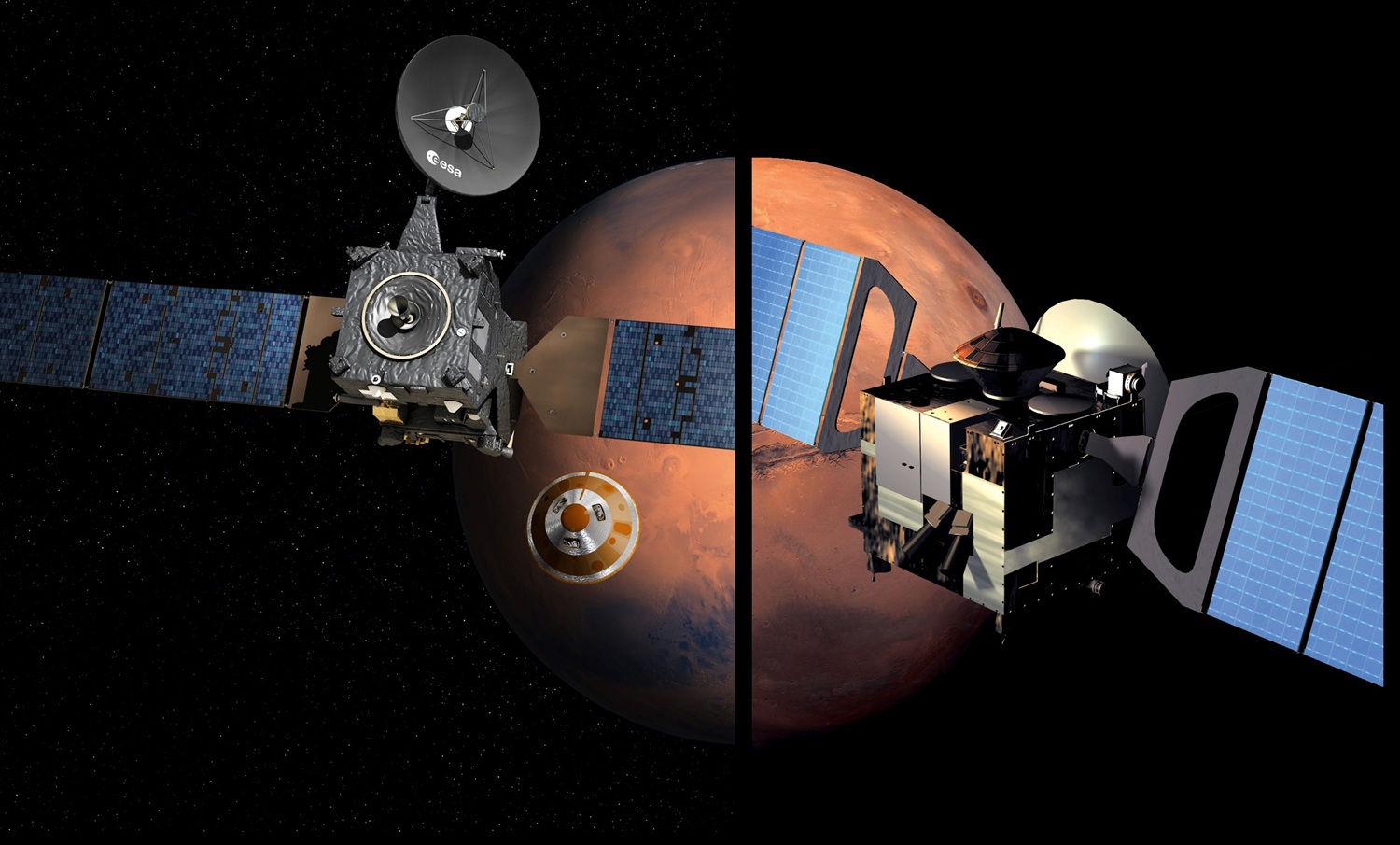
ExoMars Trace Gas Orbiter (TGO): TGO will soon reach its tenth year at Mars: it arrived at Mars on 19 October 2016, and reached its nominal science orbit in April 2018.
Recent science highlights include (a) a new climatology of water vapor, tracing high-altitude water [1,2]; (b) further characterization of variations of HCl, including search for magmatic sources [3] and co-ordinated ground-based observations [4]; (c) study of the seasonal cycle of ice & dust deposition at Louth Crater [5].
The TGO spacecraft health is nominal and appears consistent with operation well into the 2030s.
Mars Express (MEX): MEX remains a highly productive mission as it enters its third decade of operation at Mars.
Recent science highlights include (a) discovery of englacial (internal) folding of the South Polar Layered Deposits, providing evidence of ice flow [1]; (b) an analysis of clays at Oxia Planum and Mawrth Vallis showing that they clay layers at both sites appear to have a common origin; (c) a new climatology of atmospheric dust from SPICAM; (d) detection of a huge enhancement of the M2 ionospheric layer in response to a solar storm, measured using spacecraft-to-spacecraft (MEX-to-TGO) radio occultation.
Mars Express operations are currently funded until end of 2026, with extension requested until end of 2029.
Acknowledgments: This abstract represents the work of hundreds of researchers across the MEX and TGO teams, as well as the spacecraft and science operations teams for these missions. MEX and TGO data are freely and publicly available at ESA’s Planetary Science Archive (https://psa.esa.int/). Digital Elevation Models from CaSSIS are available at https://cassis.oapd.inaf.it/archive/ .
References:
[1] A. Brines et al., JGR 2026, https://doi.org/10.1029/2024JE008916
[2] A. Brines et al., JGR 2026 https://doi.org/10.1029/2025JE009191
[3] Mege et al EPSC-DPS 2025, https://doi.org/10.5194/epsc-dps2025-985
[4] S. Faggi et al., JGR 2026, https://doi.org/10.1029/2025JE009105
[5] M. Azevedo et al., LPSC 2026
[6] L. Guallini et al, EPSL 2026, https://doi.org/10.1016/j.epsl.2025.119749
[7] Auré et al, Icarus 2026, https://doi.org/10.1016/j.icarus.2026.117113
[8] Fedorova et al, JGR 2026, https://doi.org/10.1029/2025JE009388
[9] Parrott et al., Nat Comm 2026, https://doi.org/10.1038/s41467-026-69468-z
How to cite: Wilson, C.: Europe’s Mars orbiters: Status & Highlights, Europlanet Science Congress 2026, The Hague, The Netherlands, 7–11 Sep 2026, EPSC2026-270, https://doi.org/10.5194/epsc2026-270, 2026.


