
 1,2,3,1,4
- 1Dept. Applied Geomatics, Université de Sherbrooke, Sherbrooke, Canada (eloise.brassard@usherbrooke.ca)
- 2Dept. Earth Sciences, University Western Ontario, London, Canada
- 3Inst. Space & Earth Exploration, University Western Ontario, London, Canada
- 4Dept. Geography, University of Winnipeg, Winnipeg, Canada
Introduction
Hematite has been detected and characterized at several locations on Mars, using data acquired by orbit- and rover-based instruments. Global remote sensing studies were made using low spatial resolution datasets such as MGS/TES and MEX/OMEGA (both ~3–10 km/px), leading to the detection of large-scale hematite-rich regions such as Meridiani Planum, Aram Chaos and Aureum Chaos [e.g., 1–3]. Local remote sensing studies were made using higher spectral and spatial resolution datasets, such as oversampled MRO/CRISM data (6 to 18 m/px) [e.g., 4]. These local high-resolution orbital studies have mostly focused on rover exploration regions, leading to the detection of small-scale hematite occurrences such as the Vera Rubin Ridge in Gale Crater [4]. On the ground, hematite was identified at several locations by the Opportunity and Curiosity rovers [5, 6]. The presence of hematite is suggested as evidence of ancient aqueous environments on Mars [1, 2, 4, 7], since most formation mechanisms involve water [8, 9]. These mechanisms may also involve microbial activity, which could be preserved in the rocks [8]. Hematite occurrences may thus hint at past potential habitable environments.
In this study, we aim to refine global-scale mapping of hematite occurrences on Mars using a combination of high spatial and spectral resolution orbital images acquired by the TGO/CaSSIS, MRO/CRISM and MRO/HiRISE instruments. Methods include (1) laboratory samples characterisation, (2) known hematite locations survey, (3) CaSSIS spectral parameters assessment and (4) CaSSIS-CRISM-HiRISE combined analysis to spectrally and morphologically characterise hematite-rich locations in detail.
Datasets
The CaSSIS instrument is a 4-band (BLU: 495, PAN: 678, RED: 836, NIR: 939 nm) visible to near-infrared (VNIR) stereo camera (~4 m/px) onboard the ExoMars 2016 Trace Gas Orbiter that allows for near-unique identification of hematite in NIR-RED-PAN colour composite images [10]. Its distinctive magenta colour in such colour composite is caused by the sensitivity of the RED filter (836 nm) to a prominent hematite absorption feature at ~860 nm, which causes a slight deflection relative to the PAN and NIR filters on either side [10] (Fig. 1). The CRISM instrument is a VNIR+IR camera which acquired hyperspectral targeted images (18 or 36 m/px) and multispectral mapping images at coarser spatial resolution [11]. The CRISM Multispectral Reduced Data Records (MRDR) and newly released VNIR Hyperspectral Data Records (VRDR) products are two near-global mosaics of mapping strips. MRDRs combine VNIR+IR detectors (410–3924 nm) spatially and spectrally downsampled to 180 m/px and 72 bands; while the VRDRs only use the VNIR detector (370–1020 nm), which is spatially and spectrally downsampled to 90 m/px and 90 bands. BD530, BD920 and BDI1000VIS spectral indices based on these products are used to locate regions that may contain crystalline hematite [11]. The HiRISE instrument is a 3-band, 25–50 cm/px camera which allows for detailed morphologic and textural observations at a higher resolution than CaSSIS and CRISM. Here, we use CaSSIS to map hematite and bridge the substantial spatial resolution gap between CRISM and HiRISE [10].
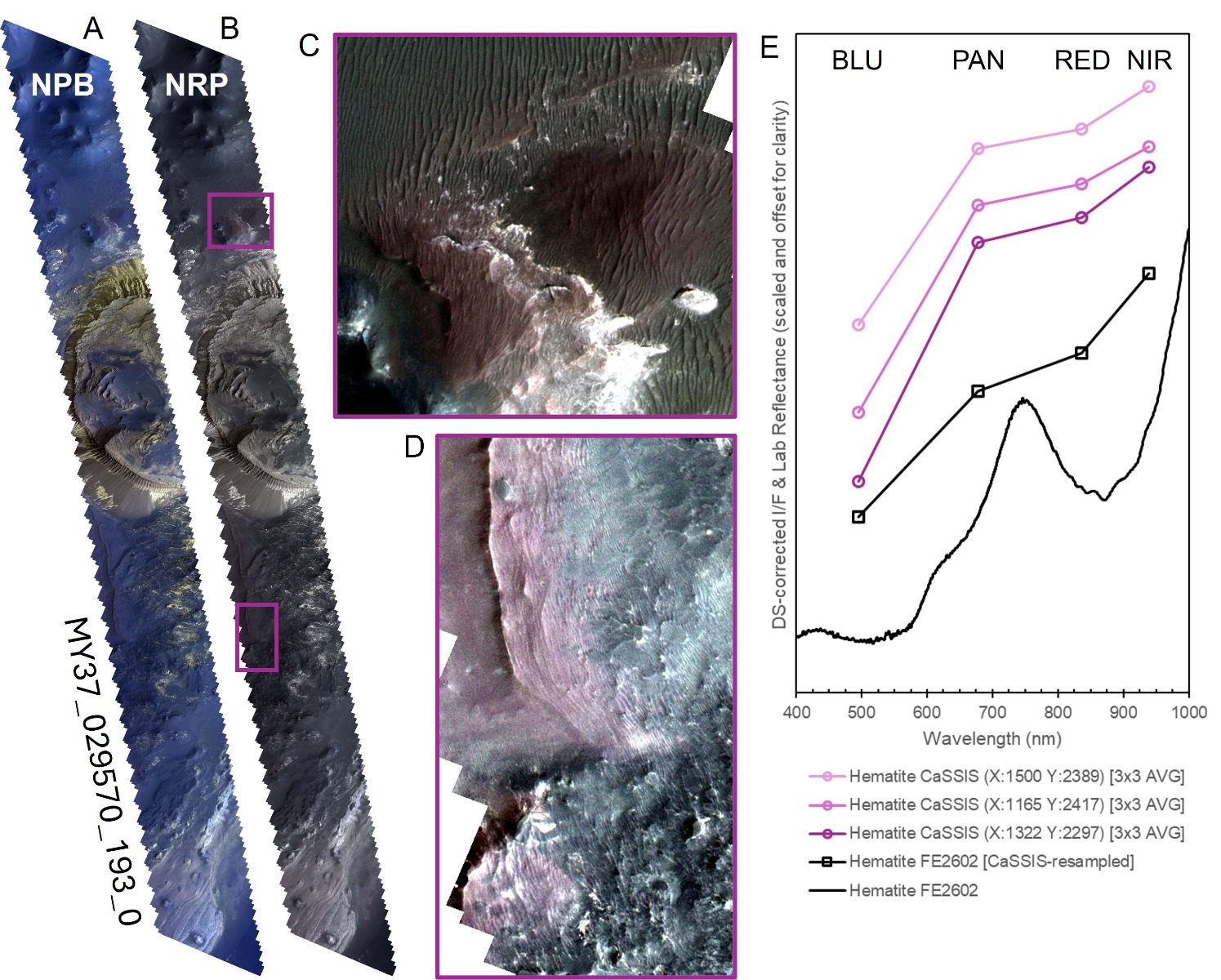
Fig. 1. Dark Subtraction corrected CaSSIS image MY37_029570_193_0 in Capri Chasma. A and B) NPB and NRP colour composite (0.1% linear stretch). Purple rectangles indicate the location of C and D insets. C and D) Hematite-rich locations exhibiting a dark magenta colour in NRP relative to the greyish background (linear stretch of 2% (C) and 1% (D)). E) CaSSIS-extracted spectra (purple circles), compared to hematite lab reference spectrum (USGS: FE2602) resampled to CaSSIS wavelengths (black squares).
Methods
First, samples were created in the lab by mixing 0 to 15 wt.% of fine-grained red hematite with planetary simulant, to represent the abundance range observed on Mars [12]. Samples were characterized by VNIR spectroscopy to estimate the limit of detection of fine-grained hematite by hyperspectral sensors [13].
Second, a survey of known hematite-rich locations was conducted by reviewing the literature and existing datasets to identify study areas for evaluating the hematite detection methods described below. CaSSIS, HiRISE and CRISM images and/or products overlapping the known locations are being corrected using a Dark Subtraction (DS) method to account for atmospheric scatter [14, 15], and a high-spatial-resolution spectral analysis and characterisation of known hematite locations is being conducted.
Third, a comprehensive suite of CaSSIS spectral parameters was calculated on a CaSSIS-resampled spectral library consisting of a variety of minerals present on the Martian surface, sourced from reference reflectance spectral libraries (e.g., USGS) and orbital imagery. Spectral parameters include band ratios, spectral slopes and band depth and height relative to different 2-band continuums (Fig. 2). Statistical methods are being used to assess which spectral parameters are the most useful to distinguish between hematite and other minerals, and to investigate the distinction of other iron minerals (goethite, jarosite, ferrihydrite) with CaSSIS. This spectral parameter set will be applied to the CaSSIS data to produce a refined global scale mapping of hematite, and potentially other ferric iron minerals, at unprecedented spatial resolution.
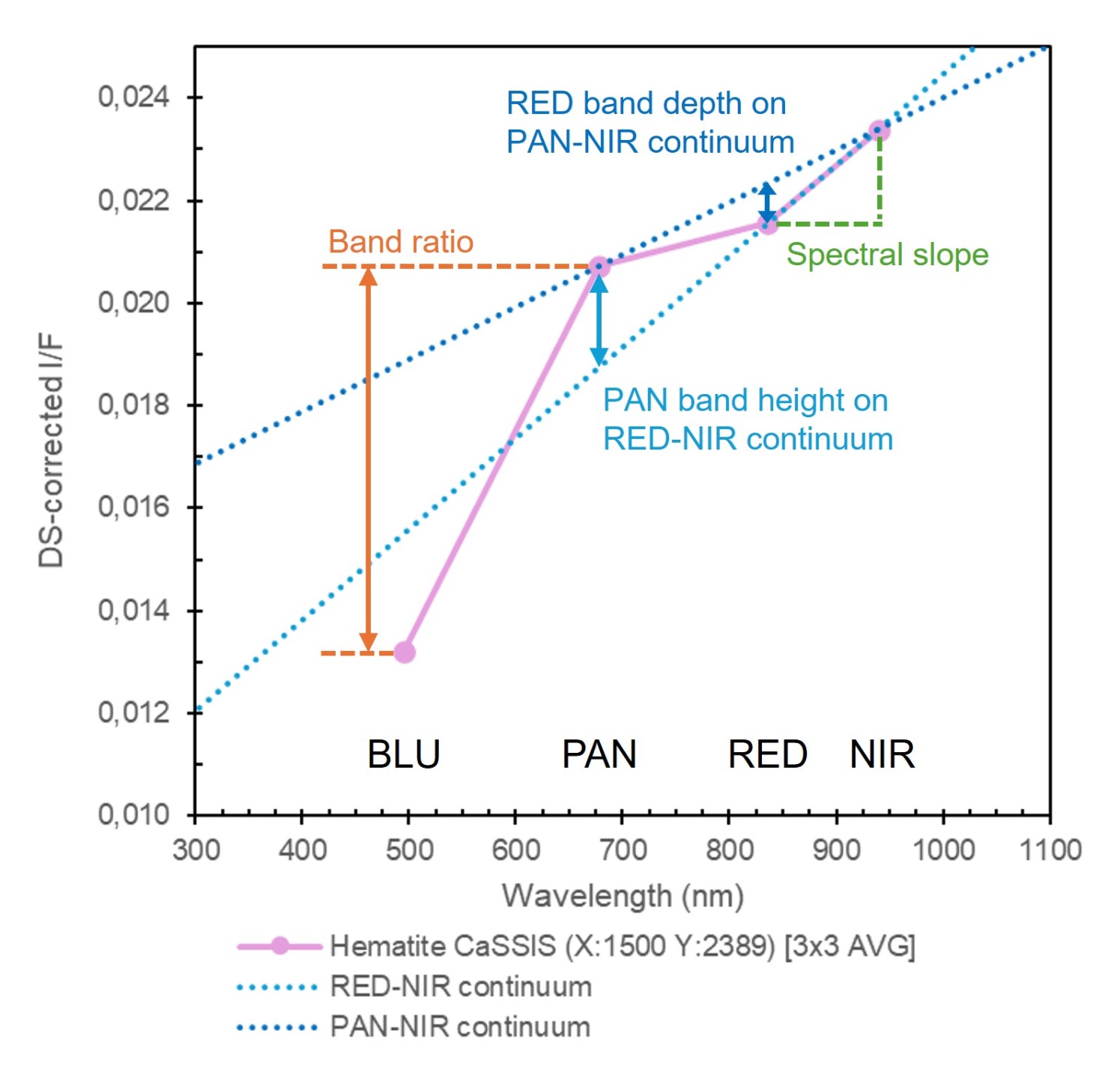
Fig. 2. Examples of spectral parameters used to distinguish hematite from other Mars minerals. On the figure, an example of a “classical” band depth (RED band depth on PAN-NIR continuum) and of a “modified” band height (PAN band height on RED-NIR continuum) are shown.
Future work will include a combined analysis of DS-corrected CaSSIS-CRISM-HiRISE data at high spatial resolution to characterize the potential new hematite locations in the refined mapping.
References
[1] Christensen et al. (2001) JGR: Planets, 106(E10). [2] Glotch and Rogers (2007) JGR: Planets, 112(E6), E06001. [3] Carrozzo et al. (2012) JGR: Planets, 117(E11), E00J17. [4] Fraeman et al. (2013) Geology, 41(10). [5] Squyres et al. (2004) Science, 306(5702). [6] Rampe et al. (2020) Geochemistry, 80(2), 125605. [7] Yoshida et al. (2018) Science Advances, 4(12). [8] Allen et al. (2001) Astrobiology, 1(1). [9] Jiang et al. (2022) Reviews of Geophysics, 60(1), e2020RG000698. [10] Tornabene et al. (2024) EPSC abstract EPSC2024-1321. [11] Murchie et al. (2025) EPSC abstract EPSC-DPS2025-136. [12] Fraeman et al. (2020) JGR: Planets, 125(12), e2020JE006527. [13] Brassard et al. (2025) LPSC abstract 2420. [14] Tornabene et al. (2018) Space Science Reviews, 214(18). [15] Rangarajan et al. (2024) Icarus, 419, 115849.
How to cite: Brassard, É., Tornabene, L. L., Lemelin, M., and Cloutis, E.: Using ExoMars-TGO/CaSSIS for the spatial and spectral characterization of hematite-rich locations on Mars, Europlanet Science Congress 2026, The Hague, The Netherlands, 7–11 Sep 2026, EPSC2026-285, https://doi.org/10.5194/epsc2026-285, 2026.


