
 1,2,1,3,1,1,3,3,1,
- 1INAF, IAPS, Roma, Italy (matteo.paris@inaf.it)
- 2Dipartimento di Fisica, Sapienza Università di Roma, Roma, Italy (matteo.paris@uniroma1.it)
- 3Dipartimento di Meccanica e Ingegneria Aerospaziale, Sapienza Università di Roma, Roma, Italy
- 4Southwest Research Institute, San Antonio, TX, USA
- 5Agenzia Spaziale Italiana, Roma, Italy
Introduction: Jupiter's moon Io, the most volcanically active body in the Solar System [1], exhibits intense internal heating driven by tidal dissipation [2]. While tidal friction is widely accepted as the primary mechanism powering this activity, the spatial distribution and depth of heating generation remain unresolved. Deriving Io's mantle material properties [3] requires the integration of its dynamic response, specifically the degree-2 Love number k2 and the gravity coefficients C20 and C22, which jointly preserve information on the anelastic deformation and the internal mass distribution.
Geophysical Constraints: Io's internal structure constraints are derived from the latest geophysical datasets, adopting a planetary mass of (8.932±0.010)×1022 kg [4]. Rather than relying on the derived moment of inertia, the model directly incorporates static gravitational harmonics refined by the Juno mission [5]: C20=(-1834.6±1.5)×10-6 and C22= (549.6±0.3)×10-6. Anelastic response and internal dissipation are quantified through the complex degree-2 Love number k2, for which recent Juno-Galileo analyses yield Re(k2)=0.125±0.047 and Im(k2)=-0.0109±0.0054 [5].
Methodology: Interior models are inverted using a Bayesian MCMC framework [6, 7]. To ensure robust parameter space sampling and mitigate initial condition dependence, we employ 15 independent chains, each yielding 250,000 accepted models. Following a 50,000-model burn-in period per chain, the converged samples are combined into a final posterior distribution of 3,000,000 models. Io is represented as a four-layer body comprising a fluid core, viscoelastic lower and upper mantle, and an elastic crust. Mantle rheology follows an Andrade formulation with a fixed frequency exponent α=0.3, while the compliance parameter β, layer thicknesses, and densities are treated as free variables. The specific latent heat of fusion (L) of the upper mantle is included as a free parameter to evaluate thermodynamic uncertainties in melt production. To account for deviations from hydrostatic equilibrium, non-hydrostatic gravity contributions (C20nh, C22nh) are introduced as free parameters [5]. Observed gravity coefficients are thus modeled as the sum of these non-hydrostatic terms and the hydrostatic components derived from internal interface shapes using a fourth-order formulation [8]. The complex degree-2 Love number k2 is computed via an adapted version of the PyALMA code [9], incorporating a self-consistent thermo-viscoelastic loop [10, 11]. For each sampled configuration, radial tidal dissipation profiles are coupled with magmatic transport equations [12]. Upper mantle rheological properties, such as viscosity, shear modulus, and the Andrade parameter β, are iteratively updated based on the local melt fraction Φ(r) until thermal and mechanical equilibrium is reached [10, 11]. This approach enables the determination of the maximum melt fraction (Φmax) within the upper mantle to assess the stability of a "magmatic sponge" configuration against the formation of a global magma ocean [13, 14, 15]. Longitudinal libration amplitude is computed for each accepted model to ensure consistency with no magma ocean models [5, 16].
Inversion Results: Posterior distributions for layer thicknesses, densities, and mantle rheological properties are recovered through a comprehensive exploration of the parameter space (Figure 1). The accurate recovery of the target geophysical observables, including Io's mass, the static gravity harmonics, and both components of the complex Love number k2 (Figure 2), alongside the inversion of the non-hydrostatic gravity contributions (Figure 3), combined with thermodynamic equilibrium requirements, substantially reduces the range of admissible interior configurations.
The resulting posterior distribution of Φmax is characterized by a median value of 0.080; the upper bound of the 95.5% credible interval remains below the rheologically critical threshold of 0.20 [13], demonstrating that partial melt is structurally retained within a solid rock matrix rather than coalescing into a uniform liquid layer. These findings provide strong evidence against the existence of a global, fully liquid magma ocean, supporting instead a stable "magmatic sponge" configuration [13, 15]. The accepted models yield a predicted longitudinal libration amplitude of 263.9-19.4+18.9 m. This result is consistent with independent estimates reported in the literature [5, 16].
This methodology establishes a framework for rigorously constraining Io’s interior dynamics through the joint inversion of Juno gravity and complex k2 within a fully self-consistent thermo-viscoelastic–melt coupling.
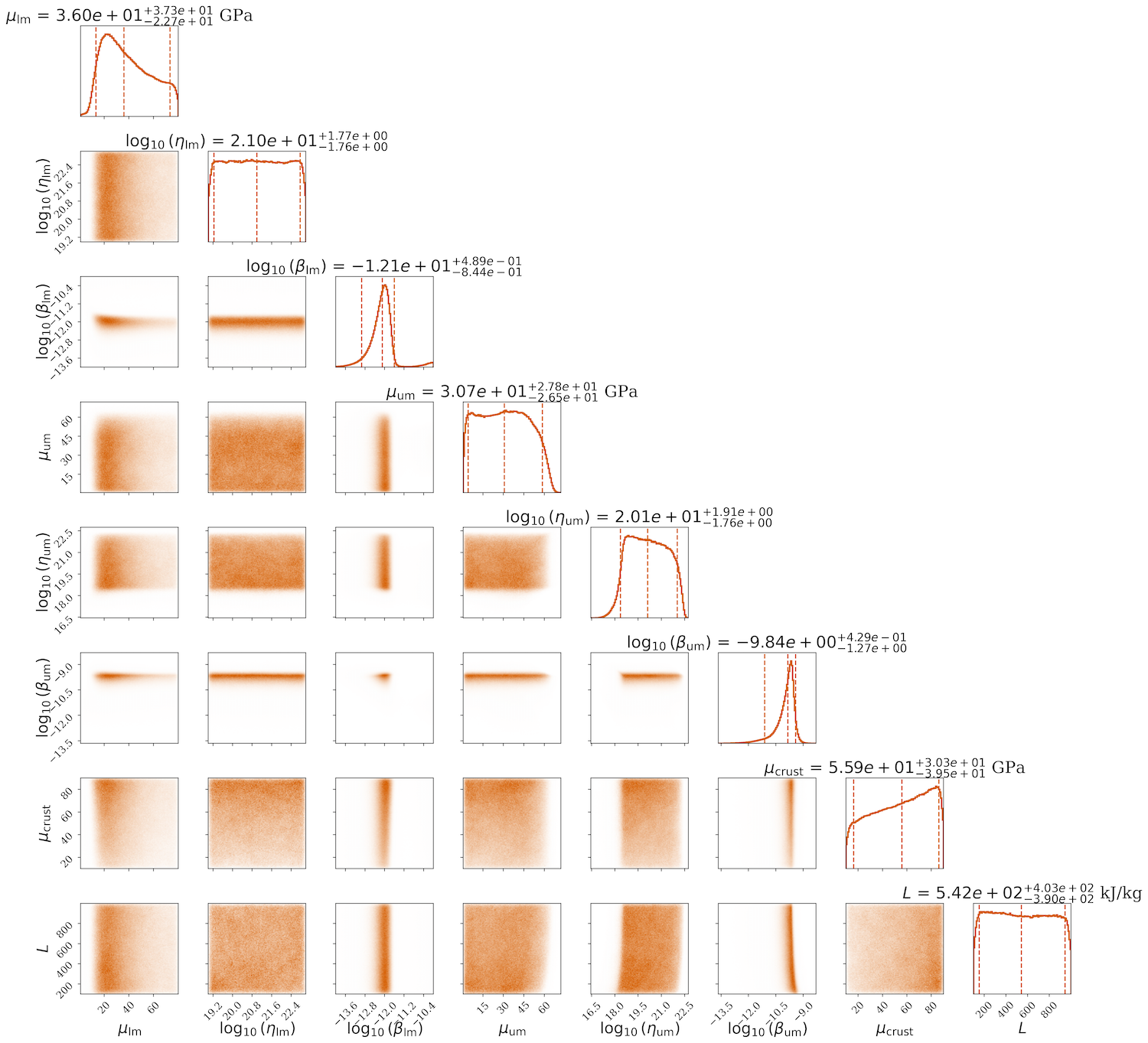
Figure 1: MCMC posterior distributions for the retrieved rheological and structural parameters. The panels illustrate the probability densities for shear moduli, viscosities, and Andrade compliance parameters (β) for the crust and mantle layers, alongside the specific latent heat of fusion (L) for the upper mantle.
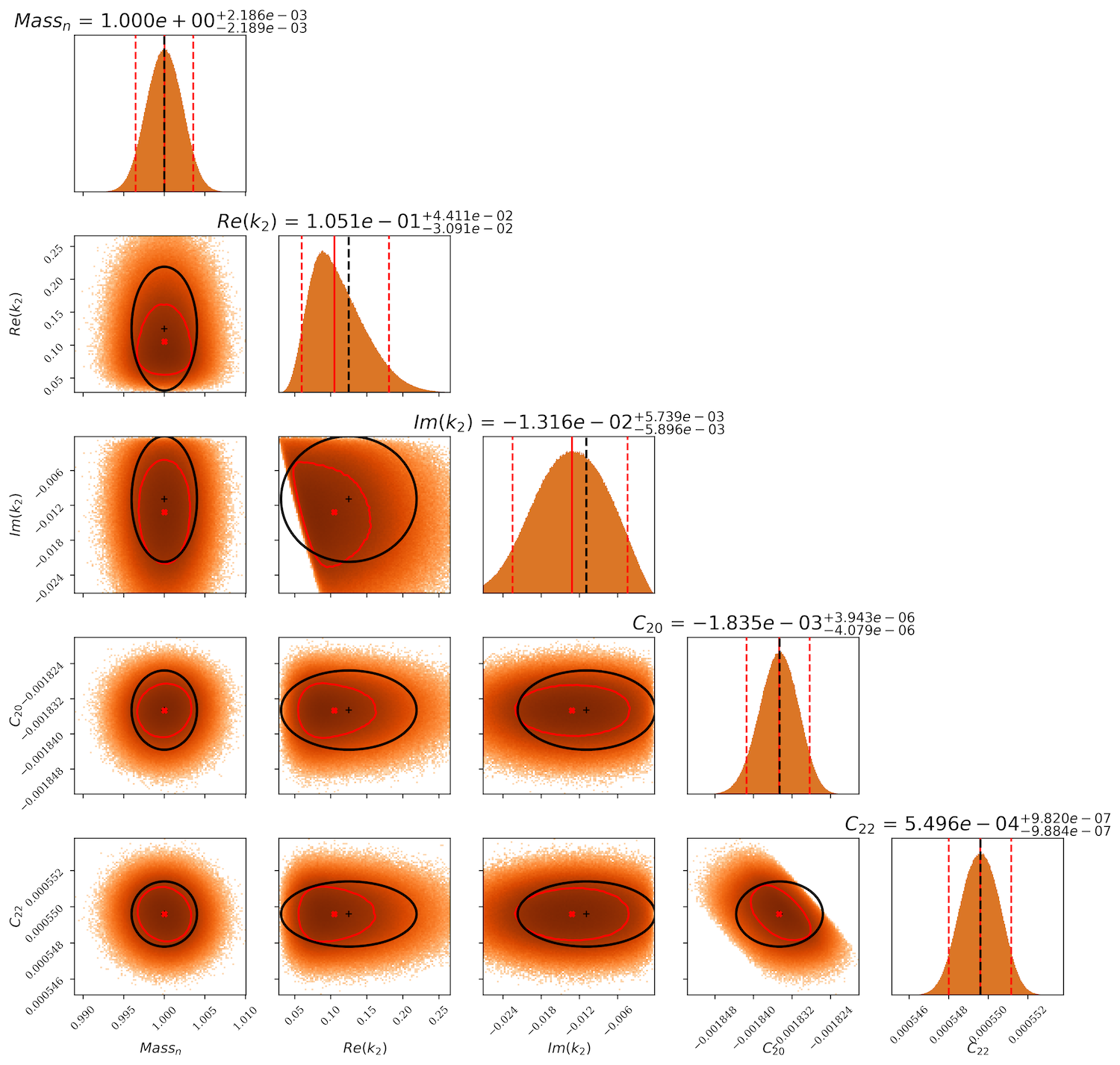
Figure 2: MCMC posterior distributions for the target geophysical observables: Io's mass, the static gravitational harmonic coefficients C20 and C22, and the real and imaginary components of the complex degree-2 Love number k2 [4,5]. Observational constraints are shown in black with their 1-σ uncertainties. The 2D marginal distributions are displayed as contour levels corresponding to the 16th and 84th percentiles (red).
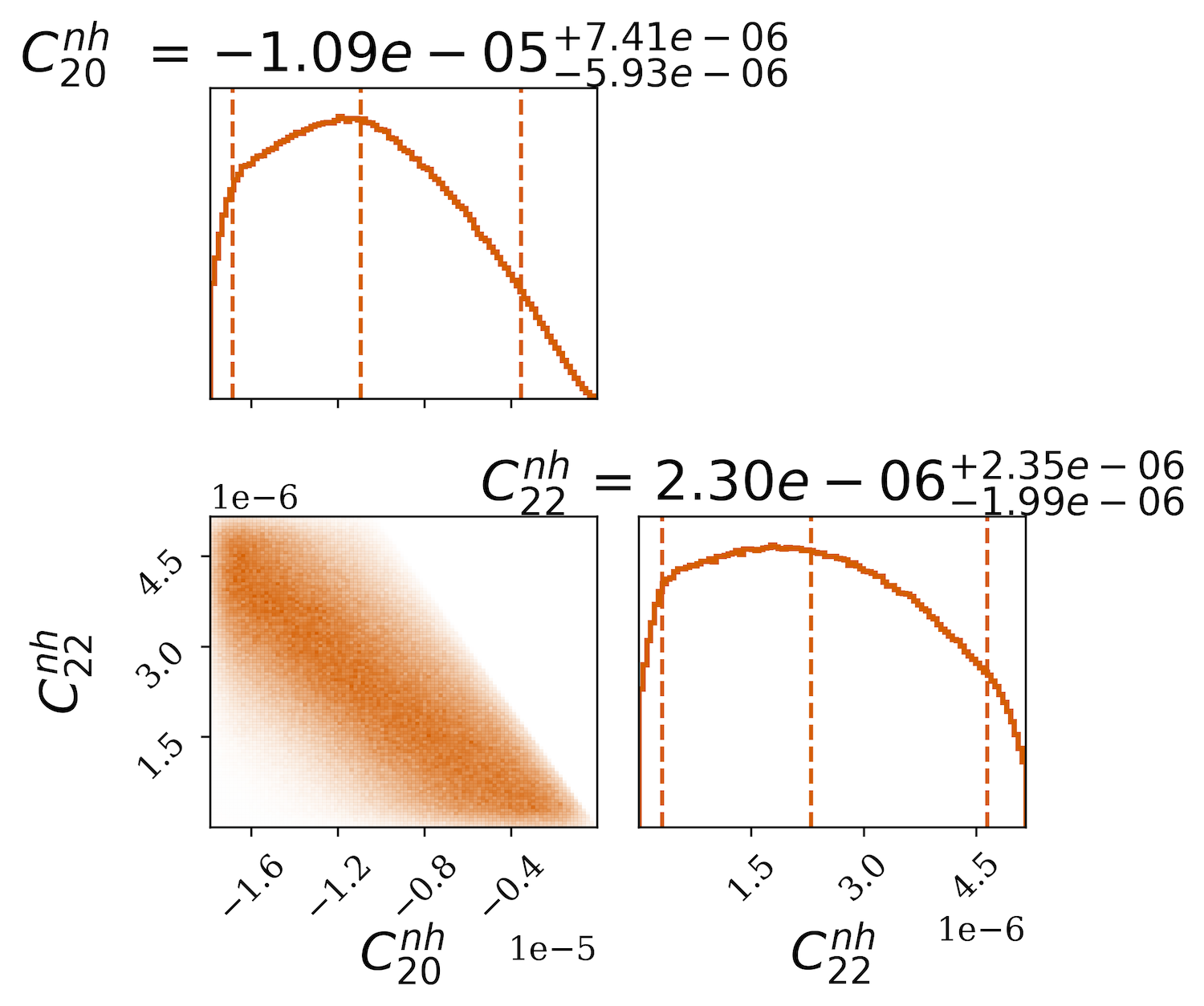
Figure 3: MCMC posterior distributions for the non-hydrostatic gravitational harmonic coefficients C20nh and C22nh.
Acknowledgments: We thank Agenzia Spaziale Italiana (ASI) for the support of the JIRAM contribution to the Juno mission; this work is supported by the ASI–INAF Addendum n. 2016-23-H.3-2023 to grant 2016-23 H.0. AG acknowledges funding from the Italian Space Agency (ASI) grant n. 2023-60-HH.0.
References:
[1] Veeder, G. J. et al. (1994) J. Geophys. Res., 99(E8), 17095-17162.
[2] Peale, S. J. et al. (1979) Science, 203(4383), 892-894.
[3] Keane, J. T. et al. (2021) BAAS, 53, 178.
[4] Lopes, R. M. C. et al. (2023) Io: A New View of Jupiter’s Moon, Springer.
[5] Park, R. S. et al. (2025) Nature, 638, 69–73.
[6] Genova, A. et al. (2019) Geophys. Res. Lett., 46, 3625–3633.
[7] Petricca, F. et al. (2023) Geophys. Res. Lett., 50, e2023GL104016.
[8] Tricarico, P. (2014) Astrophys. J., 782, 99.
[9] Petricca, F. et al. (2024) Icarus, 417, 116120.
[10] Bierson, C. J. & Nimmo, F. (2016) J. Geophys. Res., 121, 2211–2224.
[11] Paris, M. et al. (2026) arXiv e-prints, arXiv:2603.19095.
[12] Moore, W. B. (2001) Icarus, 154, 548–550.
[13] Miyazaki, Y. & Stevenson, D. J. (2022) Planet. Sci. J., 3, 256.
[14] Tyler, R. H. et al. (2015) Astrophys. J. Suppl. Ser., 218, 22.
[15] Mura, A., et al. (2026). J. Geophys. Res., 131, e2025JE009047
[16] Van Hoolst, T. et al. (2020) J. Geophys. Res., 125, e2020JE006473.
How to cite: Paris, M., Mura, A., Genova, A., Zambon, F., Tosi, F., Gargiulo, A. M., Ciambellini, M., Boccacci, G., Bolton, S., Cicchetti, A., Noschese, R., Piccioni, G., Plainaki, C., Sindoni, G., and Sordini, R.: Bayesian inversion of Io's interior: self-consistent rheology from Juno gravity data and tidal dissipation, Europlanet Science Congress 2026, The Hague, The Netherlands, 7–11 Sep 2026, EPSC2026-287, https://doi.org/10.5194/epsc2026-287, 2026.


