EPSC Abstracts
Vol. 19, EPSC2026-293, 2026, updated on 02 Jul 2026
https://doi.org/10.5194/epsc2026-293
Europlanet Science Congress 2026
© Author(s) 2026. This work is distributed under the Creative Commons Attribution 4.0 License.

Analysis of brightness and color evolution of active Centaur (2060) Chiron observed by the Two-meter Twin Telescope
 1,2,3,
- 1Comenius University, Faculty of Mathematics, Physics and Informatics, Department of Astronomy, Physics of the Earth, and Meteorology, Bratislava, Slovakia (vitalii.kuksenko@fmph.uniba.sk)
- 2Instituto de Astrofísica de Canarias, La Laguna, Tenerife, Spain
- 3Departamento de Astrofísica, Universidad de La Laguna, La Laguna, Tenerife, Spain
- 4Light Bridges, Observatorio Astronómico del Teide, Güímar, Tenerife, Spain
(2060) Chiron was one of the first classified Centaurs – transition population of small Solar System bodies residing between the orbits of Jupiter and Neptune (Kowal and Gehrels 1977). Previous studies have shown that Chiron demonstrated several periods of comet-like activity in the past. Recent ground-based photometric observations of this object by various instruments have discovered a sudden increase of brightness in February-June 2021 by ~1 mag (Dobson et al. 2021,2024). Possible explanations of this brightening event include cometary outbursts (Dobson et al. 2024), changing geometry of debris ring system (Ortiz et al. 2023), or resurfacing that altered Chiron’s albedo (Betzler 2023). According to these observations (valid for 2023), Chiron has not yet returned to its pre-brightening magnitude after the event.
In this work, we performed new photometric observations of Chiron covering the period from December 2023 till January 2026. The target was observed in several seasons by the facilities of the Two-meter Twin Telescope, which consists of two identical 2 m Ritchey-Chrétien robotic telescopes and their two smaller 0.8 m replicas (https://ttt.iac.es/). The data were collected with Sloan g’r’i’z-s’ broadband filters and Lum filter (equivalent to Sloan g’+r’ bands). In this poster, we will present the evolution of absolute brightness of Chiron in the post-brightening period and potential surface and/or dust coma color changes. Our results suggest that during the observed period, Chiron showed a potential continuous dimming that may be related to dust particle removal or settlement on the surface, or to the return of Chiron to its baseline activity regime.
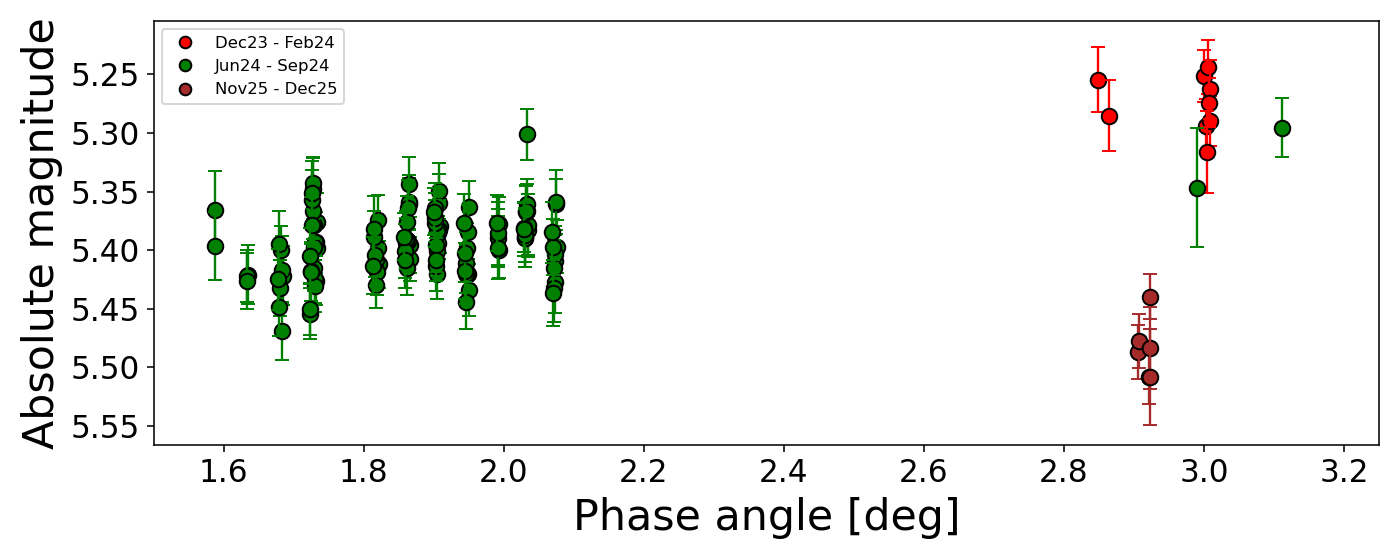
Figure 1: Absolute magnitude in Sloan r’ band (phase corrected with β = 0.095) vs phase angle observed in different seasons (assigned with colors) showing the decrease in brightness with time.
How to cite: Kuksenko, V., Licandro, J., R. Alarcon, M., and Serra-Ricart, M.: Analysis of brightness and color evolution of active Centaur (2060) Chiron observed by the Two-meter Twin Telescope , Europlanet Science Congress 2026, The Hague, The Netherlands, 7–11 Sep 2026, EPSC2026-293, https://doi.org/10.5194/epsc2026-293, 2026.


