
- 1Department of Astronomy and Astrophysics, University of California, Santa Cruz, CA, USA
- 2Instituto de Astronomía, Universidad Nacional Autónoma de México, Apartado Postal 106, CP 22800 Ensenada, Baja California, México
- 3Solar System Science and Exploration Division, Southwest Research Institute, Boulder, CO, USA
Introduction
Saturn exhibits atmospheric volatile enrichments and bulk metallicities exceeding those of Jupiter despite comparable heavy-element masses, implying formation in a chemically distinct region of the protosolar nebula (PSN). Jupiter is increasingly associated with formation near the H2O iceline, where inward drift and recondensation of icy solids generate strong metallicity enhancements. By analogy, Saturn’s enhanced carbon abundance suggests formation farther from the Sun, potentially near the CO2 or CO icelines.
This study investigates whether Saturn’s atmospheric and interior composition can be reproduced through formation near these icelines. Particular emphasis is placed on the cold-finger effect, in which inward-drifting icy solids sublimate at icelines, producing vapor enhancements that diffuse and partially recondense near condensation fronts. These processes create localized enrichments in solids and vapors that may control giant-planet compositions.
The work also explores broader implications for Solar System formation. If Jupiter formed near the H2O iceline and Saturn near the CO2 iceline, the giant planets would reflect a systematic chemical gradient across the PSN. The study therefore tests whether Saturn’s observed carbon and phosphorus enrichments favor formation near the CO2 iceline over alternative scenarios.
Methodology
The study employs a one-dimensional viscous α-disk model describing the evolution of the PSN. The model tracks the coupled transport of gas, solids, and vapors while computing the radial and temporal evolution of volatile species. Turbulent viscosities range from α = 5×10⁻⁴ to 5×10⁻³.
The chemical inventory includes 13 trace species: H2O, CO, CO2, CH3OH, CH4, N2, NH3, H2S, PH3, Ar, Kr, Xe, which form pure condensates, and refractory dust. These species evolve through advection, diffusion, radial drift, sublimation, and condensation. Icelines are dynamically defined as locations where solid and vapor abundances are equal.
The model assumes protosolar abundances and explores several carbon partitioning scenarios. Fiducial models adopt CO:CO2:CH3OH:CH4 ratios of 10:30:1.67:1, motivated by interstellar and cometary measurements, while additional CO-rich cases test the sensitivity of Saturn’s formation environment.
Disk metallicity profiles, including both solids and vapors, are compared with Saturn’s inferred envelope metallicity and atmospheric enrichments derived from Cassini observations and interior models. The study also includes a simplified pebble-to-planetesimal conversion prescription to evaluate whether regions enriched by the cold-finger effect can efficiently support giant-planet core formation.
Results
The simulations show that strong metallicity enhancements naturally arise at volatile icelines through the cold-finger effect. Among all volatile species, the CO2 iceline produces the most favorable conditions for reproducing Saturn’s composition. In contrast, the CO iceline generates only weak enrichment peaks because vapor diffusion becomes inefficient at large heliocentric distances (see Fig. 1).
Saturn’s envelope metallicity is reproduced only under relatively low turbulence conditions (α ≤ 10−3) and during the early stages of PSN evolution (<0.3 Myr). Under these conditions, inward drift of CO2-rich icy particles and vapor accumulation interior to the CO2 iceline generate carbon and phosphorus enrichments consistent with Saturn’s atmosphere.
The simulations further show that enrichment amplitudes depend strongly on disk turbulence and the initial CO/CO2 ratio. Lower turbulence preserves sharper enrichment peaks, while CO2-dominated volatile inventories produce stronger carbon enhancements than CO-rich disks.
A key result is that the CO iceline never reaches sufficiently high metallicity to reproduce Saturn’s inferred envelope composition, even in CO-rich scenarios. This strongly disfavors Saturn formation near the CO iceline and instead supports formation near the CO2 iceline.
Noble-gas enrichments remain close to protosolar values because Ar, Kr, and Xe diffuse more slowly than major carbon-bearing species. Saturn’s noble-gas abundances therefore become sensitive diagnostics of formation timing and location, highlighting the importance of future in situ measurements.
Additional tests indicate that removing solar irradiation strengthens enrichment peaks by moving icelines inward toward denser disk regions. Under these conditions, the model most successfully reproduces Saturn’s carbon and phosphorus abundances. Finally, planetesimal formationcalculations show that efficient pebble concentration naturally occurs near volatile icelines, particularly near the CO2 iceline, providing favorable conditions for both core formation and volatile enrichment.
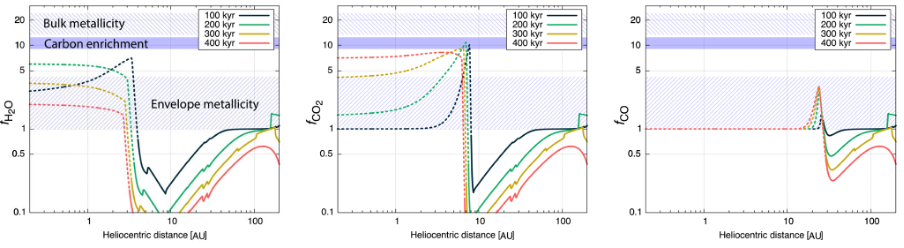
Fig 1. Volatile enrichment profiles as a function of heliocentric distance at several stages of disk evolution for the fiducial case (α = 10−3 and CO:CO2 = 10:30). From top to bottom: H2O, CO2, and CO, ordered according to the locations of their icelines. Solid lines indicate regions where the species is predominantly in solid form, while dashed lines indicate vapor-dominated regions. In each panel, the lower shaded, central filled, and upper shaded bands represent Saturn’s envelope metallicity, atmospheric enrichment considering only C and P abundances, and bulk metallicity, respectively. Agreement with Saturn’s atmospheric enrichment occurs where the dashed curves intersect the central band, here only near the CO2 iceline.
Conclusions
This work provides strong evidence that Saturn most likely formed near the CO2 iceline of the protosolar nebula rather than near the CO iceline or interior to the H2O iceline. Saturn’s atmospheric carbon enrichment, phosphorus abundance, and inferred envelope metallicity are naturally reproduced through early formation in a low-turbulence disk with a CO2-rich volatile inventory.
The results support a broader picture in which giant planets formed sequentially at distinct icelines within the PSN, with Jupiter associated with the H2O iceline and Saturn with the CO2 iceline. The study also demonstrates that the cold-finger effect plays a fundamental role in shaping giant-planet volatile inventories by generating localized metallicity enhancements near icelines.
The findings imply that Saturn initiated rapid core accretion very early in PSN evolution, within the first few 105 years after disk formation. Finally, future in situ measurements at Saturn, particularly noble-gas abundances and isotopic ratios, will provide decisive tests of this formation scenario and improve our understanding of the chemical evolution of the early Solar System.
Reference:
Aguichine, A., Mousis, O., Canup, R.M. Saturn’s formation at the carbon dioxide iceline. The planetary Science Journal, submitted.
How to cite: Aguichine, A., Mousis, O., and Canup, R.: Saturn’s Carbon Enrichment Points to the CO2 Iceline , Europlanet Science Congress 2026, The Hague, The Netherlands, 7–11 Sep 2026, EPSC2026-302, https://doi.org/10.5194/epsc2026-302, 2026.


