
 1,7,2,5,6,6,
- 1The University of Tokyo, Japan
- 2Kyoto Sangyo University, Japan
- 3European Southern Observatory
- 4INAF-Istituto di Radioastronomia, Italy
- 5NASA Goddard Space Flight Center, USA
- 6Royal Belgian Institute for Space Aeronomy, Belgium
- 7Tohoku University, Japan
One of the most significant features of the Martian atmosphere is the presence of dust. Dust particles are constantly suspended in the atmosphere and absorb the solar radiation, heating the lower and middle atmosphere. Therefore, dust plays an important role in determining the thermal structure of the Martian atmosphere. When strongly enhanced dust lifted from the surface covers the entire planet, the event is called a “Global Dust Storm (GDS)”. Such extreme condition can have a large influence on atmospheric circulation and material transport processes.
Wind fields during the GDS have been inferred indirectly through data assimilation using observed temperature fields (Asumi et al., 2026). However, due to observational limitations, direct measurements of the wind velocities remain scarce, and the structure of the atmospheric circulation during GDS has not been revealed. Miyamoto et al. (2021) directly measured the zonal winds around 80 km altitude in equatorial regions during the Mars Year (MY) 34 GDS by infrared heterodyne spectroscopy, but the spatial coverage was limited. In addition, the observed strong retrograde winds in the decay phase of GDS were not reproduced in the Mars global circulation model. This discrepancy implies the need for additional observational datasets to improve our understanding of Martian atmospheric circulation.
This study aims to directly determine the global wind fields during and after the MY34 GDS using data from the Atacama Compact Array (ACA) within the Atacama Large Millimeter/submillimeter Array (ALMA). ACA provides high spectral and spatial resolution, which enables to derive the global wind fields. It observed the absorption lines of 12CO and 13CO around 200 GHz, which are sensitive to higher (50-70 km) and lower (30-40 km) altitudes, respectively. The line-of-sight wind velocities of 12CO and 13CO were derived by the Doppler shift technique. Results for June 30, 2018 are shown in Figures 1 and 2.
Comparisons between ALMA observations and the GEM-Mars model’s predictions will also be presented. Several GEM-Mars simulations constrained by ALMA observations will be performed to identify the physical processes governing the observed wind fields.
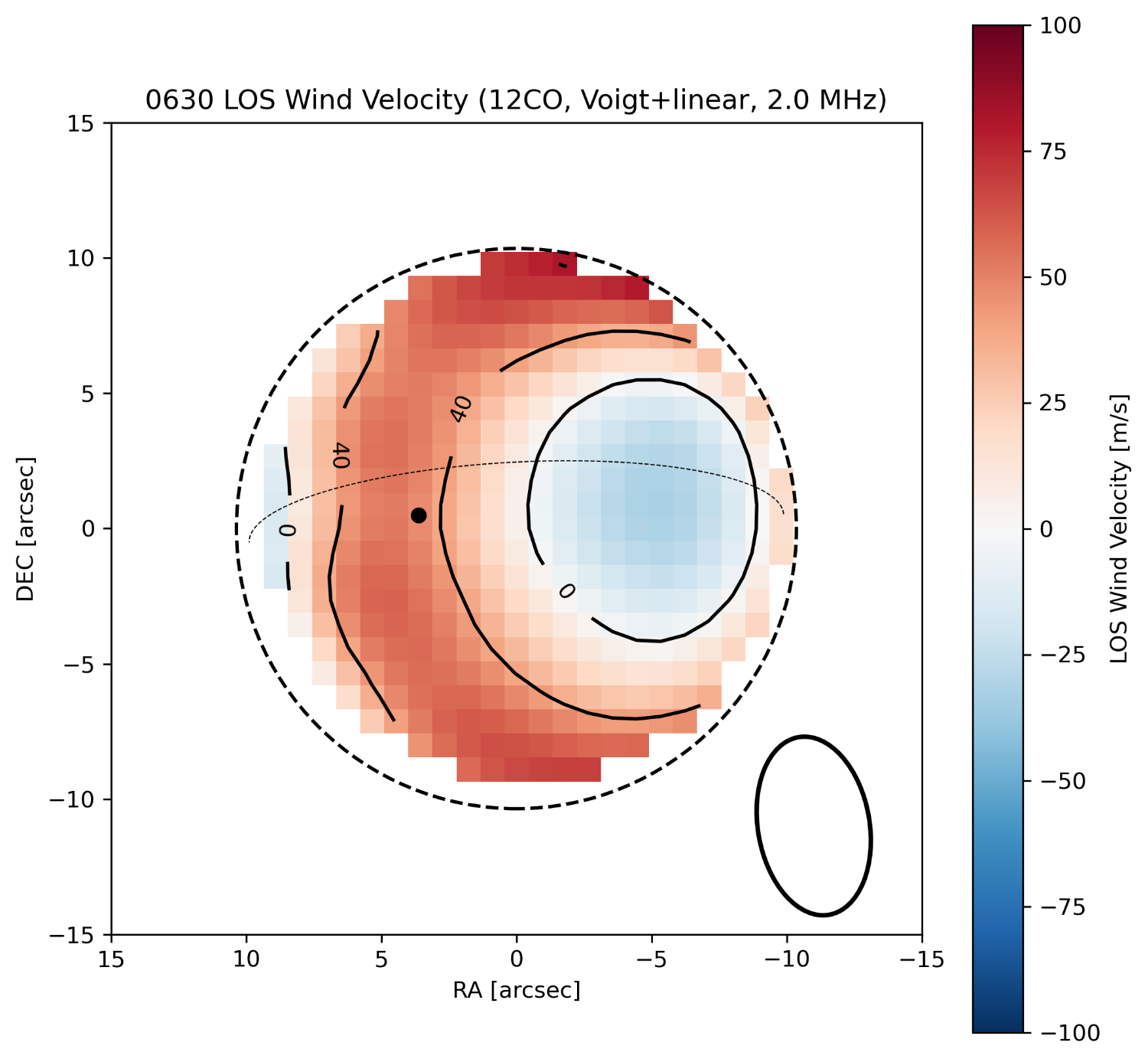
Figure 1: Global wind field on June 30, 2018 derived from 12CO absorption line. Line-of-sight velocity is taken as positive. The black circle shows the beam size.
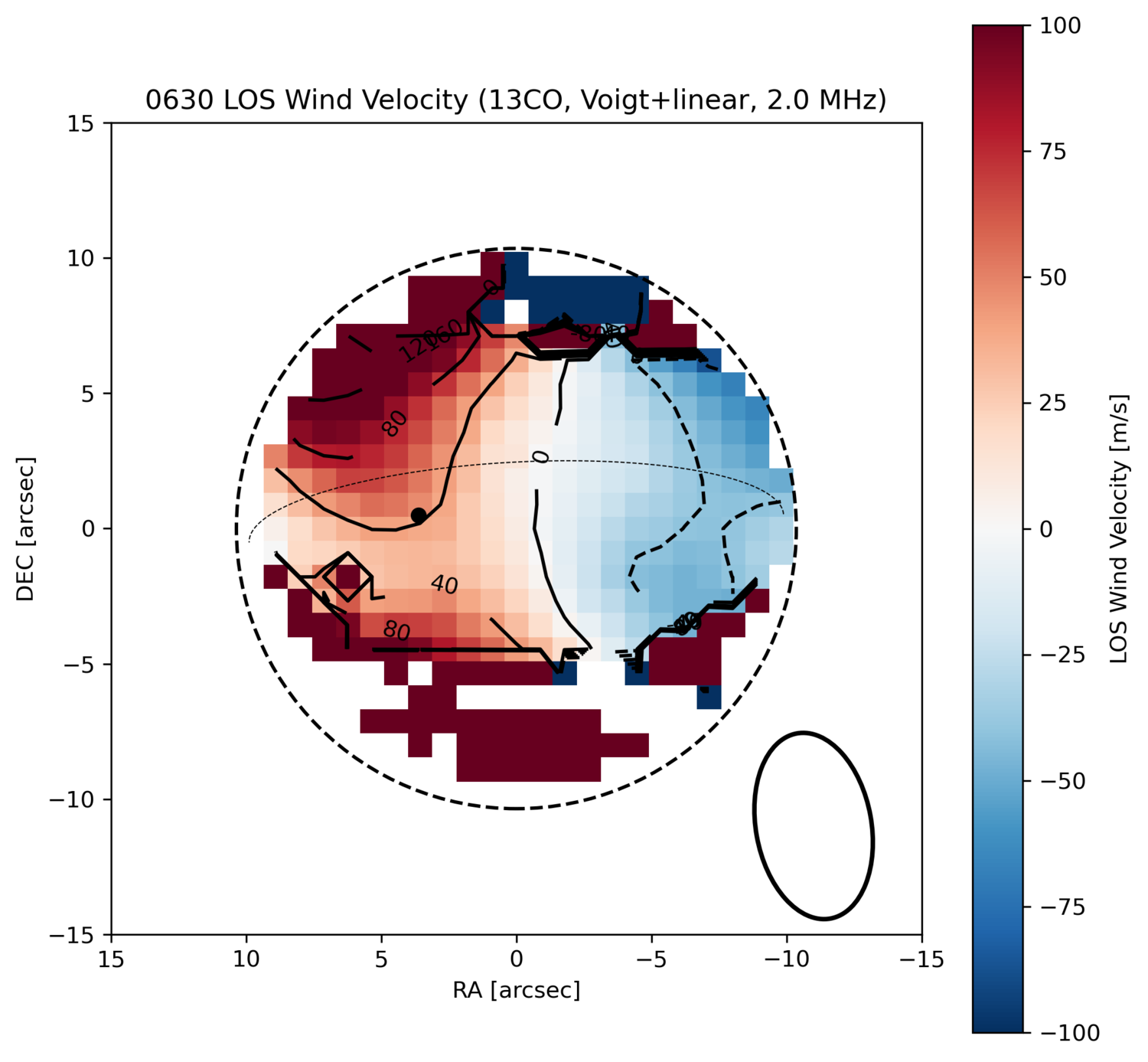
Figure 2: Same as Figure 1, but global wind fields derived from 13CO absorption line.
References
[1] Asumi, A., Sato, K., & Hayashi, Y.-Y. (2026). Effects of global dust storm in MY28 and roles of unresolved waves on the general circulation of Mars. Journal of Geophysical Research: Planets, 131, e2025JE009200. https://doi.org/10.1029/2025JE009200
[2] Miyamoto, A., Nakagawa, H., Kuroda, T., Takami, K., Murata, I., Medvedev, A. S., et al. (2021). Intense zonal wind in the Martian mesosphere during the 2018 planet-encircling dust event observed by ground-based infrared heterodyne spectroscopy. Geophysical Research Letters, 48, e2021GL092413. https://doi.org/10.1029/2021GL092413
How to cite: Kakinuma, N., Aoki, S., Sagawa, H., Villard, E., Rygl, K., Villanueva, G., Faggi, S., Daerden, F., Robert, S., and Imamura, T.: Global map of wind in Mars during and after the MY34 Global Dust Storm observed by ALMA, Europlanet Science Congress 2026, The Hague, The Netherlands, 7–11 Sep 2026, EPSC2026-305, https://doi.org/10.5194/epsc2026-305, 2026.


