
 2,2,3,1,1
- 1Planetary Atmospheres Group, Institute for Basic Science (IBS), Daejeon, Republic of Korea
- 2LATMOS, CNRS, Sorbonne Université, Université Versailles St-Quentin, Paris, France
- 3Instituto de Astrofísica de Andalucía (IAA-CSIC), Granada, Spain
Introduction
Unlike the other terrestrial bodies in the Solar System, Venus is shrouded in a thick, multi-layered cloud at an altitude ranging from 48 to 70 kilometers[1]. These clouds consist of droplets of liquid SO₂ (70–95% by mass) and H₂O, divided into three modes with radii of approximately 0.3, 1, and 2 micrometers, respectively[2].
The lack of in situ observations (only one in-situ profil of the cloud droplets characteristics[2]) means we have to actively try to model these clouds to understand them. The models developed so far are primarily 1D[3-7], and the few 2D and 3D models are restricted to simplified equilibrium schemes[8-11]. Here, we present the first 3D simulation of Venus's clouds using the Venus PCM[12-13], a global climate that includes chemistry, radiative transfer and dynamics, coupled with the microphysical scheme MAD-VenLA[14-16]. We use this opportunity to make comparison with Akatsuki UV observations.
Method
We coupled the MAD-VenLA model, developed by Guilbon[14], Määttänen[15] and Streel[16], with the Venus PCM. MAD-VenLA is a modal model that describes two particle modes with a lognormal shape and fixed standard deviation. It includes a homogeneous nucleation scheme[17], a simplified parametrization of heterogeneous nucleation, and Brownian coagulation, condensation, and evaporation[14-15]. Additionally, MAD-VenLA incorporates mode merging[18], which allows particles to be transferred from one mode to another. In its latest version, a sedimentation scheme has also been added[16].
Results
We will present the first 3D comparisons between and observations from previous missions.
For example, an ongoing study[19] of the Japanese Akatsuki mission's ultraviolet (UV) observations revealed different reflectivity patterns between sulfur dioxide (SO₂) at 283 nm and the unknown UV absorber at 365 nm at low latitudes. The averaged minimum reflectivity at 365 nm occurred ~2 hours earlier in local time than at 283 nm. Our simulations using the Venus PCM (Fig. 1) reveal the presence of a droplet layer situated in the afternoon at low latitude at 70 km, which could mask the unknown UV absorber below and alter the afternoon albedo, explaining the observations made. These droplets are the result of homogeneous nucleation episodes, which are allowed by the chemistry and vertical transport.
This highlights the need for 3D simulations in order to understand such processes.
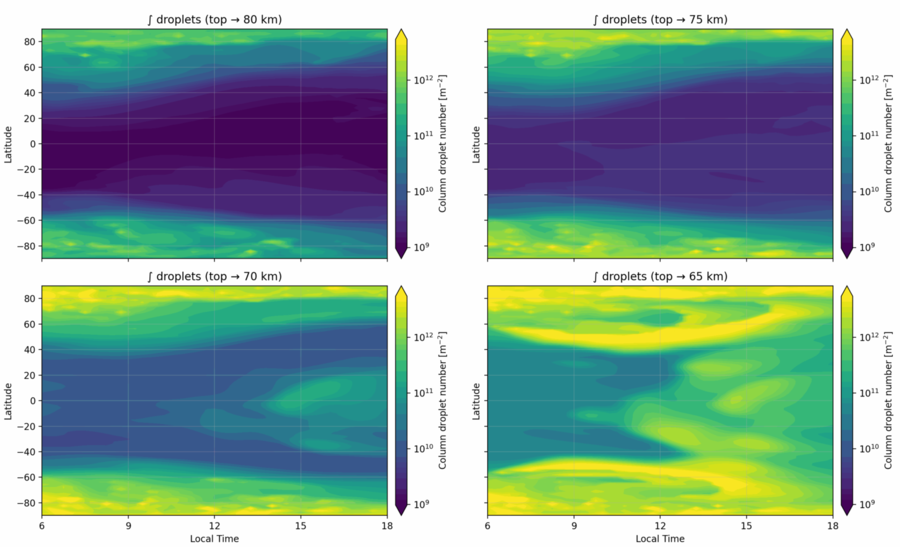
Figure 1: Horizontral map of the integrated number of droplets from the top of the atmosphere to a specific altitude (resp. 80,75,70 and 65 km) after 2 venusian days.
References
- P. Mills, L. W. Esposito, Y. L. Yung, Geophys. Monogr. Ser. 176, 73–100 (2007).
- R. G. Knollenberg, D. M. Hunten, J. Geophys. Res. 85, 8039–8058 (1980).
- P. James, O. B. Toon, G. Schubert, Icarus. 129, 147–171 (1997).
- Imamura, G. L. Hashimoto, J. Geophys. Res. 103, 31349–31366 (1998).
- Yamamoto, M. Takahashi, J. Geophys. Res. 111, 2006JE002688 (2006).
- McGouldrick, E. L. Barth, Planet. Sci. J. 4, 50 (2023).
- Karyu et al., Planet. Sci. J. 5, 57 (2024).
- Lee, S. R. Lewis, P. L. Read, Icarus. 206, 662–668 (2010).
- Ando, M. Takagi, N. Sugimoto, H. Sagawa, Y. Matsuda, Journal of Geophysical Research: Planets, in press, doi:10.1029/2019JE006208.
- Karyu et al., Journal of Geophysical Research: Planets, in press, doi:10.1029/2022JE007595.
- Stolzenbach, F. Lefèvre, S. Lebonnois, A. Määttänen, Icarus. 395, 115447 (2023).
- Lebonnois, N. Sugimoto, G. Gilli, Icarus. 278, 38–51 (2016).
- Gilli et al., Icarus. 281, 55–72 (2017).
- Guilbon, thesis, Université Paris Saclay (COmUE) (2018).
- Määttänen, S. Guilbon, J. Burgalat, F. Montmessin, Advances in Space Research. 71,1116–1136 (2023).
- Streel, thesis, Sorbonne-Université (2025).
- Määttänen et al., JGR Atmospheres. 123, 1269–1296 (2018).
- Whitby, F. Stratmann, M. Wilck, Journal of Aerosol Science. 33, 623–645 (2002).
- R. L. S. E. Aliste Castillo et al., BACO-25 conference abstract (2025).
How to cite: Streel, N., Määttänen, A., Lefèvre, F., Stolzenbach, A., Aliste Castillo, R. L. S. E., and Lee, Y. J.: 3D Venus Cloud Modelling: the Venus Planetary Climate Model coupled with a microphysical model, first comparisons, Europlanet Science Congress 2026, The Hague, The Netherlands, 7–11 Sep 2026, EPSC2026-306, https://doi.org/10.5194/epsc2026-306, 2026.


