
 12
12- 1University of Maryland at College Park, Department of Geology, College Park, United States of America (hbernhar@umd.edu)
- 2Institute of Geophysics of the Czech Academy of Sciences, Prague, Czech Republic (petr.broz@ig.cas.cz)
Introduction
Explosive volcanism produces diverse pyroclastic landforms, including scoria cones, which on Earth make up ~90% of subaerial volcanoes and form during Strombolian eruptions as steep edifices with slopes near the angle of repose (~30°). Similar features occur on Mars and the Moon but are less common and morphometrically distinct; Martian cones are broader with gentler slopes due to enhanced pyroclast dispersal [1,2].
On Mercury, such edifices were long thought absent, with explosive volcanism inferred mainly from diffuse deposits around irregular vents, consistent with models predicting wide dispersal under low gravity and near-vacuum conditions [3]. Two small candidate cones—the ~1.1 km Heaney cone and ~1.7 km NW Caloris cone—have been tentatively identified, but their origin remained uncertain [4].
Here, we identify a larger, breached pitted cone in NE Caloris Planitia (Fig. 1) and present the first morphometric analysis of all three structures using a new global high-resolution DTM. Their morphology is consistent with scoria cones, with the NE Caloris cone providing the strongest evidence.
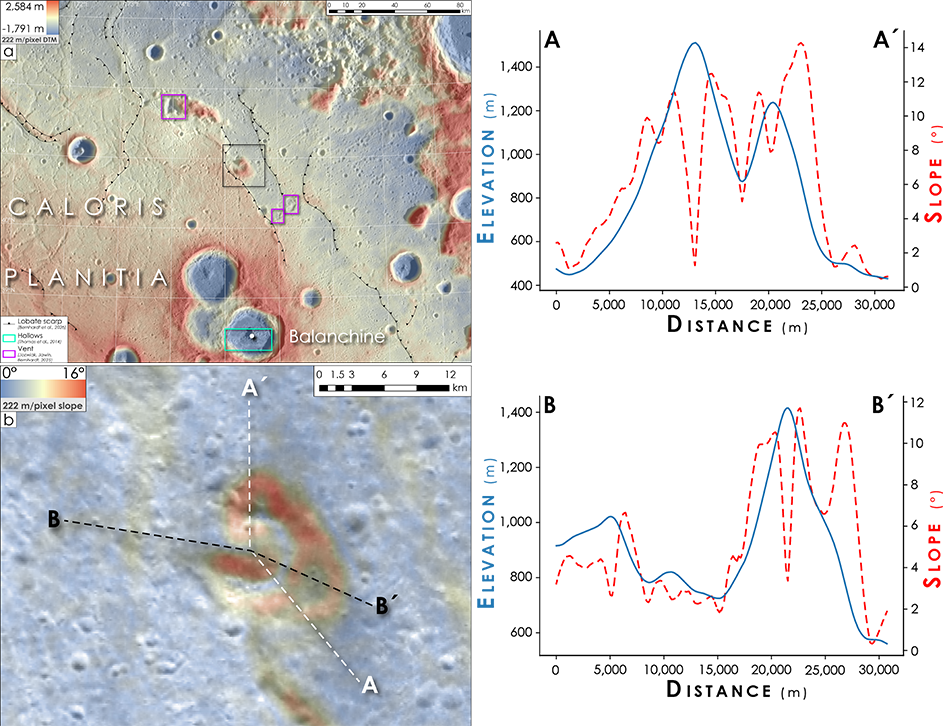
Figure 1: (a) Physiographic overview of northeastern Caloris Planitia with the new 222 m/pixel DTM overlaid on the MDIS high-incidence global mosaic; key landforms are indicated (see legend). Black box outlines the location of Fig. 1b. (b) Slope map from the same DTM over the low-incidence MDIS mosaic. Dashed lines A–A′ and B–B′ mark the elevation and slope profiles shown on the right.
Methods
We analyzed MESSENGER topographic and image data, including a new global ~222 m/pixel stereo-DTM and derived slope maps. Previously published stereo-DTMs (DLR) were complemented with new quadrangles to produce a merged global model [5]. The DTM was combined with MDIS mosaics (166 m/pixel) and enhanced color data.
Our measurements (Table 1) included basal diameter, height, flank slopes, and volume, and assessed summit morphology and breach geometry using approaches comparable to terrestrial and Martian cone studies [2].
Results
The NE Caloris landform is a conical mountain with a breached flank and partially preserved summit, located ~60 km from the edge of Caloris Planitia within smooth plains and near vents, lobate scarps, and hollows. The NE Caloris cone is significantly larger than the Heaney and NW Caloris cones, with an average diameter of ~16.5 km and relief of ~1 km, yielding a volume of ~70–75 km³ (vs. ~15–20 km³ for the smaller cones) (Fig. 2). The central depression is unusually large (~6 km in diameter and ~0.7 km deep; ~35% of cone diameter). Flank slopes reach up to ~16°, well below the angle of repose (~30°), but comparable to or slightly lower than values reported for smaller cones (~13–19°). Compared to the two smaller, quasi-circular cones, the NE Caloris cone shows pronounced asymmetry and a breached flank. The northern summit of the NE Caloris cone hosts a ~2 km-wide light-blue anomaly associated with an irregular depression.
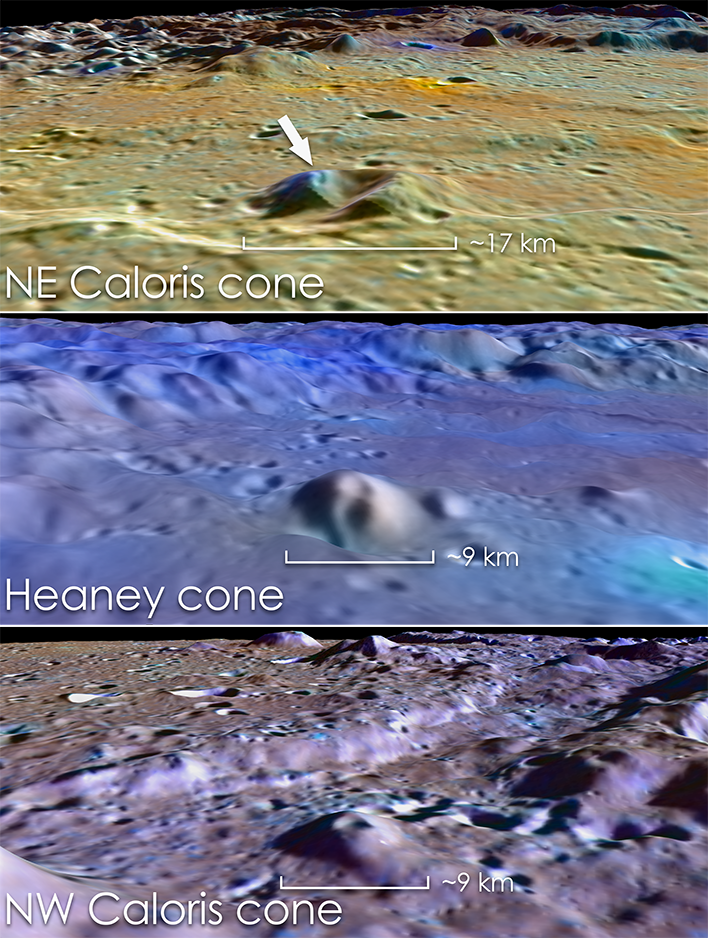
Figure 2: Perspective views of the NE Caloris cone (top) and the smaller Heaney and NW Caloris cones (center, bottom [4]), shown with enhanced color over the high-incidence MDIS mosaic and 6× vertically exaggerated elevation from the 222 m/pixel global DTM. The white arrow marks a small irregular depression with a light-blue anomaly on the NE Caloris cone summit.
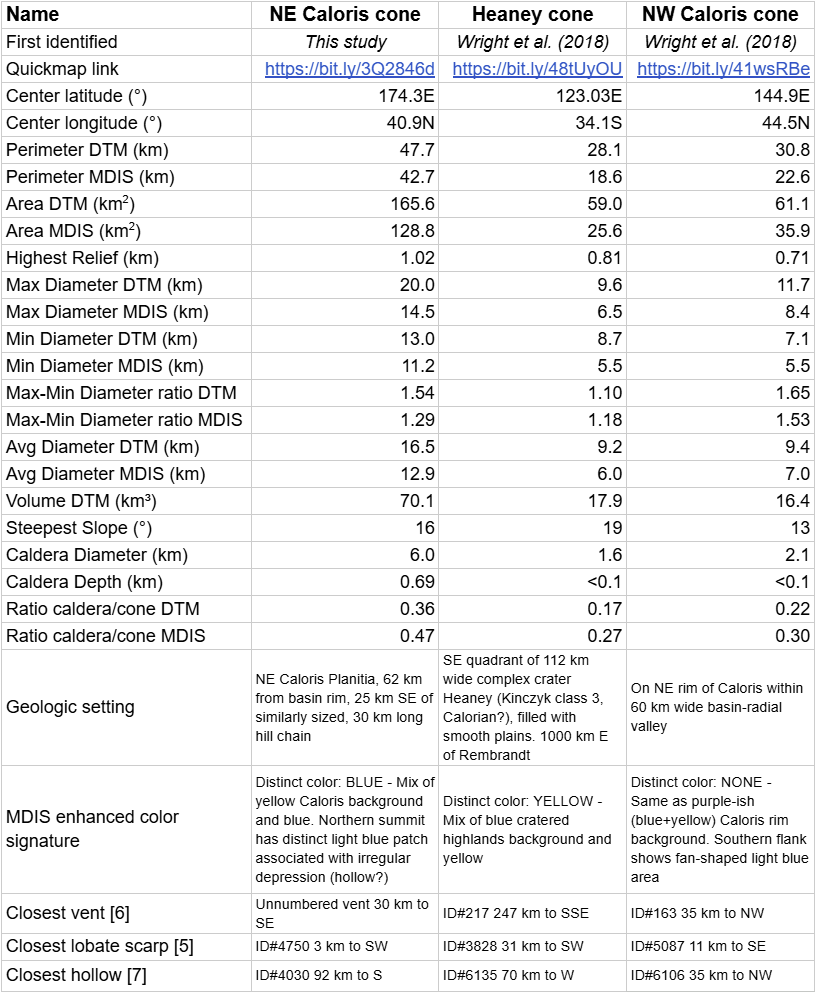
Table 1: Comparison of morphometric and geographic parameters of the three pitted cones discussed here.
Discussion
Opposite a volcanic edifice interpretation, we consider two alternative origins for the breached cone-like landform on NE Caloris Planitia:
Impact origin (degraded/ghost crater): Although Mercury hosts irregular, discontinuous craters, these typically have much lower rims than the observed cone. Even fresh craters of similar size have rims less than half as high. Ghost craters may appear breached, but their interiors are flat and level with surrounding plains, unlike the cone’s sloping floor ~200 m above the plains.
Caloris inner ring remnant: The cone has comparable relief and radial position to nearby inner ring massifs, but is less rugged and uniquely hosts a non-circular, non–bowl-shaped central depression. This feature is unlike impact craters or vents elsewhere in the region, with the vents typically lying below surrounding plains and occurring adjacent to, not within, massifs.
We therefore favor an origin as a volcanic construct. Compared to the smaller, more symmetric Heaney and NW Caloris cones, the NE Caloris cone is larger, elongate, and breached, suggesting a higher eruptive volume, more complex evolution associated with flank instability (possibly caused by different lava rheologies), and/or structural control (Fig. 2). The small depression and light-blue anomaly on its northern summit may represent an early-stage hollow formed by volatile loss within the cone. All three mercurian cones discussed here occur near lobate scarps and hollows, suggesting structural control and the potential for volatile-enriched magmas.
The cone’s size, asymmetry, and lack of visible lava flows supports an explosive emplacement scenario, possibly ballistic scoria deposition. This would be the largest scoria cone in the Solar System implying sustained, high-volume magma supply at low ejection speeds, which is unexpected under current models that predict widespread pyroclast dispersal on Mercury and not steep, kilometer-scale cones. On the Moon and Mars, diameters and reliefs of scoria cone-like landforms (e.g., Marius Hills and Ulysses Colles) reach ~40–70% of the NE Caloris cone values, while only ambiguous, less conical examples (e.g., the lunar Rümker or Gardner domes) achieve them [8,9]. On Earth, dimensions comparable to the NE Caloris cone are only achieved by stratovolcanoes breached by lateral eruptions, e.g., Mount St. Helens. For all three discussed cones, better DTMs, images, and hyperspectral data by BepiColombo will help to distinguish between basaltic or more evolved lavas and refine flank slopes, dimensions of central depressions, existences of associated lava flows, and the nature the potential hollow.
References
[1] Brož et al., 2014, EPSL 406 [2] Brož et al., 2015, JGR-Planets 120 [3] Brož et al., 2018. GRL 45 [4] Wright et al., 2018, JGR-Planets 123 [5] Bernhardt et al., 2025, EPSC 2108 [6] Jozwiak, et al., 2025, LPSC 2193 [7] Bickel et al., 2025, JGR: Machine Learning and Computation 1. [8] Yin et al., 2025, JGR-Planets 129. [9] Brož et al., 2020, J. Volc. Geotherm. Res. 409
How to cite: Bernhardt, H. and Brož, P.: A breached cone-like mountain on Caloris Planitia, Mercury: A candidate scoria cone?, Europlanet Science Congress 2026, The Hague, The Netherlands, 7–11 Sep 2026, EPSC2026-31, https://doi.org/10.5194/epsc2026-31, 2026.


