
- 1SSI, Boulder CO, USA.
- *A full list of authors appears at the end of the abstract
The Curiosity rover’s ChemCam instrument suite and the Perseverance rover’s SuperCam instrument suite have been conducting routine passive UV-to-near-IR spectroscopy of the Martian sky since, respectively, 2013 and 2021. From these “passive sky” observations we retrieve column abundances of trace gases O2 and H2O, as well as aerosol properties, using a combination of grid-search based and Nelder Mead (also known as “downhill simplex”) optimization, and discrete-ordinates multiple-scattering radiative transfer models with correlated-k-based gas absorption. Ratios of high-elevation angle to low-elevation angle sky pointings are used to divide out most instrumental uncertainties and make weak spectral features detectable.
The latest passive sky aerosol results are described by Stcherbinine et al. (this meeting; EGU 2026). Here, we focus on the latest trace gas measurement results.
The passive sky trace gas results are important for testing hypotheses about the unexplained variability of O2 abundances relative to argon and other inert trace gases (Trainer et al., 2019; Lo et al., 2024). They also help constrain surface-atmosphere exchange of water vapor (e.g. Savijärvi et al., 2019). Furthermore, the rapid (roughly every 14 – 21 days in most years) sampling of O2 and water vapor abundances provided by passive sky combined with similar sampling of Ar with APXS on Curiosity (VanBommel et al. 2018, 2024) provides evidence for close correlation of water vapor with the O2/Ar variability in northern summer (McConnochie et al., 2024).
The possibility of such a correlation was first suggested by the results of the Viking Gas Exchange experiments, which showed release of O2 from a soil sample in response to adding water vapor (Klein, 1978; Oyama & Berdahl, 1977), and by the fact that a surface/subsurface reservoir of O atoms appears to be required because atmospheric reservoirs of O atoms are too small to supply the observed magnitude of O2 variability (Trainer et al., 2019). Soil oxychlorines have been proposed (Trainer et al., 2019; Lo et al., 2024) as the soil reservoir for O atoms, as were superoxide ions in the context of the Viking Gas Exchange experiments (Yen et al., 2000), but specific reactions with the necessary rates to explain the apparent seasonal cycle of O2 into and out of the soil have not been identified.
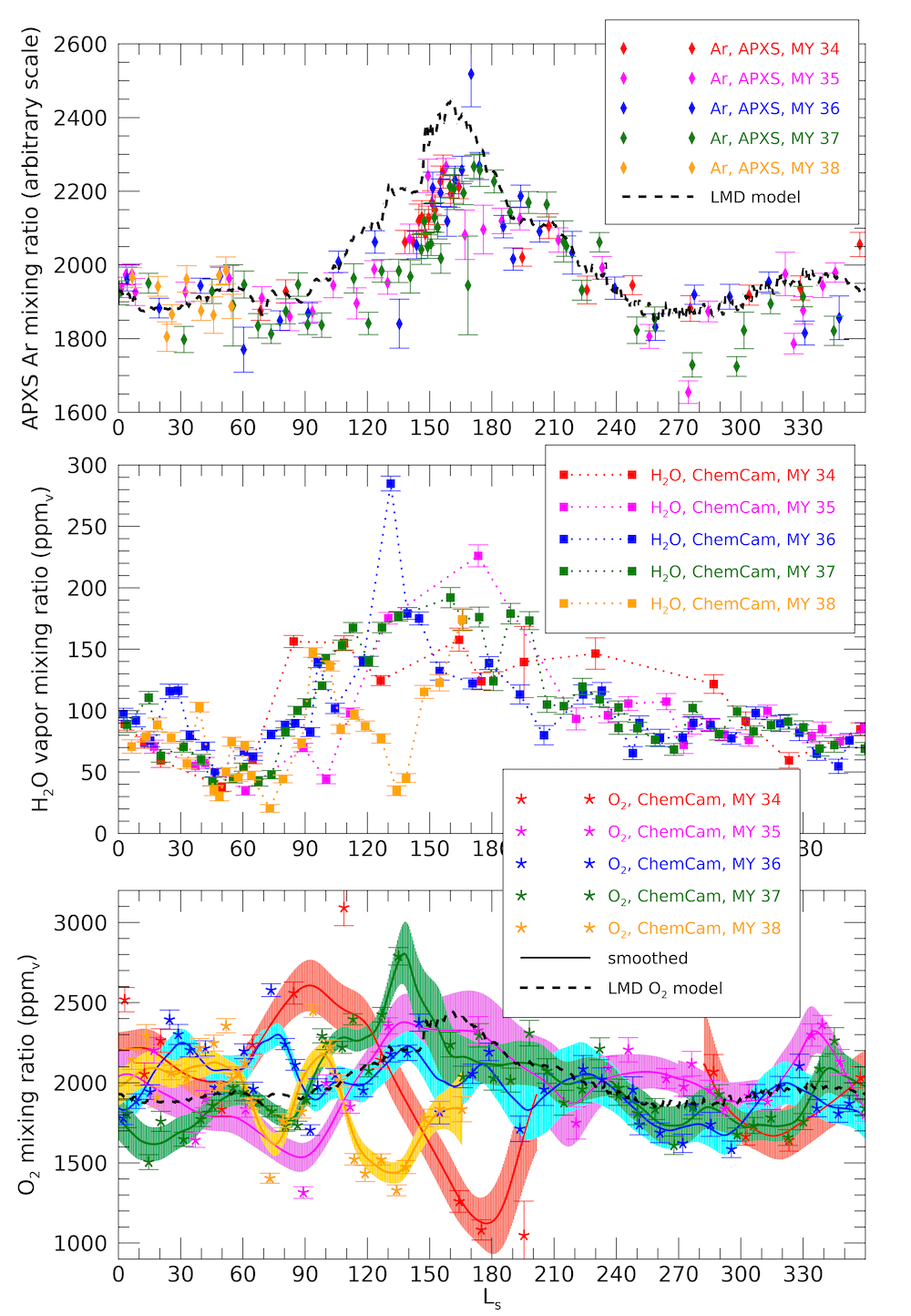
The details and timing of the O2-to-water-vapor correlation, combined with the information about the effects of the global circulation on all trace gases that is provided by Ar measurements, could potentially constrain the mechanisms and predominant locations for the apparent O2 cycle. However as shown in Figure 1, the apparent O2 cycle has substantial interannual variability despite only modest interannual variability in Ar and H2O. We have therefore been working to both extend the passive sky and APXS argon data sets and to improve data analysis methods. New developments in work include initial O2 measurements from Perseverance-SuperCam, explicit modeling of stray light effects on gas absorption lines for both SuperCam and ChemCam, and more accurate detector background subtraction and outlier rejection for ChemCam. Even in their current form, however, the ChemCam O2 measurements show statistically significant variability relative to argon, just as the SAM O2 measurements in Trainer et al. (2019) do. They also show, as detailed in Figure 1, significant interannual variability, especially around northern hemisphere summer solstice, and a tendency for the timing of the northern spring-summer seasonal increase in O2/Ar to be correlated with that of water vapor.
Table 1 shows an alternative approach to understanding the nature of the apparent O2 cycle, in this relying on long term averages of ChemCam and SuperCam measurements, compared to long term averages from SAM mass spectrometer in-situ atmospheric samples (Trainer et al. 2019), and to other available O2 measurements. What we see is that the measurements representative of column-averaged O2 are all consistent with each other and significantly higher than what SAM observes. This implies that there is a net sink for O2 near the surface at Gale crater and that that sink is relatively fast compared to vertical mixing time scales.
References: Barker, 1972, Nature, 238(5365), https://doi.org/10.1038/238447a0. Carleton and Traub, 1972, Science, 177(4053), https://doi.org/10.1126/science.177.4053.988. Fedorova et al., 2021 EGU Meeting. Hartogh et al., 2010, A & A, 521, https://doi.org/10.1051/0004‐6361/201015160. Klein, 1978, Icarus, 34(3), https://doi.org/10.1016/0019‐1035(78)90053‐2. ,Lefevre et al., 2004, JGR, 109, https://doi.org/10.1029/2004JE002268. Lo et al. 2024, PSJ 5, https://doi.org/10.3847/PSJ/ad251b.McConnochie et al., 2022, Mars Atmosphere Modeling and Observations Conference. McConnochie et al. 2024 10th Mars Conference. Oyama & Berdahl, 1977, JGR, 82(28), https://doi.org/10.1029/JS082i028p04669. Stcherbinine et al., 2026, EGU Meeting. Trainer et al. 2019, JGR12, https://doi.org/10.1029/2019JE006175, Savijärvi et al. 2019, Icarus 326, https://doi.org/10.1016/j.icarus.2019.03.020. VanBommel et al. 2018, JGR, 123, https://doi.org/10.1002/2017JE005454. VanBommel et al. 2024, 10th Mars Conference. Yen et al, 2000, Science, 289(5486), https://doi.org/10.1126/science.289.5486.1909.
TABLE 1: Comparison of lower-atmosphere O2 mixing ratios from various sources
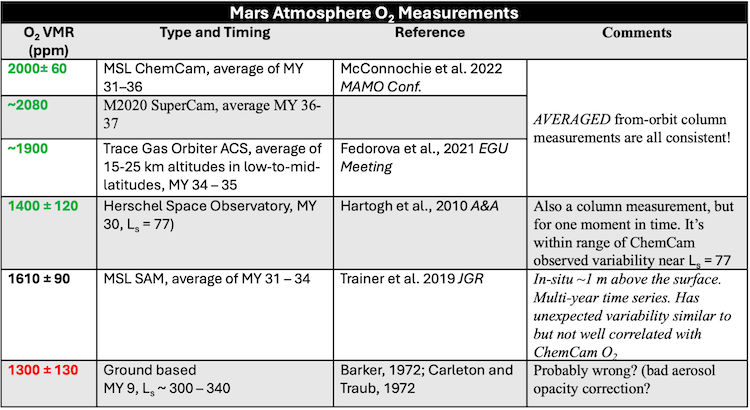
FIGURE 1: Comparison of trace gas seasonal cycles at Gale Crater over 5 Mars years. Individual points are retrieval results for the indicated year and solar longitude, with 1-sigma error bars. The smooth lines for O2 are the result a LOESS regression and the shaded region around those smoothed lines represents the 1-sigma uncertainties of that LOESS regression. The “LMD model” for O2 and Ar is from Lefevre et al. (2004), but scaled so that the average model value matches the average observed value.The argon data in the top panel is from VanBommel et al. (2024) using methodology from VanBommel et al. (2018).
Scott J. VanBommel, Washington University, St. Louis MO, USA Daniel Y. Lo, SSI, Boulder CO, USA. Michael Hecht, MIT Haystack Observatory, Westford MA, USA. Tanguy Bertrand, LIRA, Paris Observatory, France. Elise Wright Knutsen, U. of Oslo, Norway. Vytenis Orlauskis, U. of Oslo, Norway. Aurélien Stcherbinine, IRAP, Toulouse, France. Franck Montmessin, LATMOS, Université Paris-Saclay, Guyancourt, France Thierry Fouchet, LIRA, Paris Observatory, France. Clement Royer, IAS, Université Paris-Saclay, CNRS, Orsay, France. Sylvestre Maurice, IRAP, Toulouse, France. Roger Wiens, Purdue University, West Lafayette IN, USA. Agnes Cousin, IRAP, Toulouse, France. Mark Lemmon, SSI, Boulder CO, USA. Mike Wolff, SSI, SSI, Boulder CO, USA. Michael. D. Smith, NASA GSFC, Greenbelt MD, USA. Alain Khayat, NASA GSFC, Greenbelt MD, USA. Melissa Trainer, NASA GSFC, Greenbelt MD, USA. Heather Franz, NASA GSFC, Greenbelt MD, USA. Olivier Gasnault, IRAP, Toulouse, France. Jeremie. Lasue, IRAP, Toulouse, France. Nina Lanza, LANL, Los Alamos NM, USA. Sushil Atreya, U. Michigan, Ann Arbor MI, USA. German. Martinez, Centro de Astrobiología (CSIC-INTA), Madrid, Spain. Franck Lefèvre, LATMOS, Sorbonne Université, CNRS, Paris, France. Frank Daerden, Royal Belgian Institute for Space Aeronomy, Brussels, Belgium. Priya Patel, NASA JPL, Pasadena CA, USA.
How to cite: McConnochie, T. and the Co-authors: Sky Spectroscopy with the Perseverance and Curiosity Mars Rovers: Latest results for Molecular Oxygen and Water Vapor, Europlanet Science Congress 2026, The Hague, The Netherlands, 7–11 Sep 2026, EPSC2026-312, https://doi.org/10.5194/epsc2026-312, 2026.


