
 1,1,2,1,1
- 1Politecnico di Milano, Department of Aerospace Science and Technology, Milano, Italy (ericscott.frizzell@polimi.it)
- 2University of Bern, Space Research & Planetary Sciences, Bern, Switzerland
Introduction
The DART impact into Dimorphos demonstrated that kinetic impacts can strongly modify rubble-pile asteroids and produce substantial momentum enhancement [1,2]. Hera will provide new constraints on the impact outcome, target morphology, and mechanical state of Dimorphos [3]. Interpreting these observations requires understanding not only the final crater, ejecta field, or momentum-transfer efficiency, but also how the impact impulse is stored, transmitted, and dissipated within a weakly confined granular body. This is especially important for rubble piles, where the internal contact network and pre-impact confinement control both wave propagation and mechanical relaxation [4].
Methods
We investigate these processes using discrete element method (DEM) simulations of rubble-pile asteroid analogs using GRAINS [5]. The aggregates are composed of nonspherical particles subject to self-gravity, Hertzian contact forces, and friction. This particle-based approach allows the impact response to be decomposed at the contact scale. Normal elastic energy represents reversible compression at grain contacts, while tangential elastic energy represents recoverable shear deformation stored in the contact history. Dissipative terms represent energy removed through dashpot damping and frictional slip: normal damping approximates imperfect compression and rebound, tangential damping captures shear-motion losses, and Coulomb sliding occurs when the trial tangential contact force exceeds the frictional limit set by the normal contact force and friction coefficient , i.e., when this criterion is exceeded, the tangential spring slips rather than continuing to store elastic energy.
We apply controlled low-speed impacts to surface particles directed through the barycenter, allowing the post-impact mechanical response of the body to be isolated from the unresolved details of hypervelocity fragmentation and ejecta production. Across stiffness cases, with particle elastic moduli from approximately 1 MPa to 100 GPa, we track the evolution of translational and rotational kinetic energy, gravitational potential energy, normal and tangential elastic contact energy, candidate dissipative pathways, linear and angular momentum, and the propagation of the impact-induced disturbance through pressure and body-frame velocity.
Results
The impact produces a two-stage elastic response: tangential elastic energy rises sharply during initial penetration, while normal elastic energy becomes more important as the disturbance propagates through the aggregate. Immediately after impact, the tangential component dominates the contact response, reflecting shear deformation through newly formed and rearranged grain contacts (Fig. 1, left). The normal component is the dominant storage mechanism over longer timescales as the remaining impact energy disperses through body waves. This separation reflects the granular contact network’s role in storing and redistributing impact energy and suggests that an impact transient can carry information about the internal contact state, effective stiffness, and precompression of the body. The candidate dissipation diagnostics show that damping losses can dominate the early post-impact response, with tangential damping reflecting the strong shear component of the initial disturbance (Fig. 1, right). We treat these dissipative terms as developing diagnostics rather than a closed energy budget: ongoing work focuses on separating normal damping, tangential damping, and Coulomb sliding losses while closing the full contact-work residual. This bookkeeping is important because the same bulk kinetic-energy change can arise from different contact-scale pathways, each with different implications for regolith stiffness, frictional state, and internal structure.
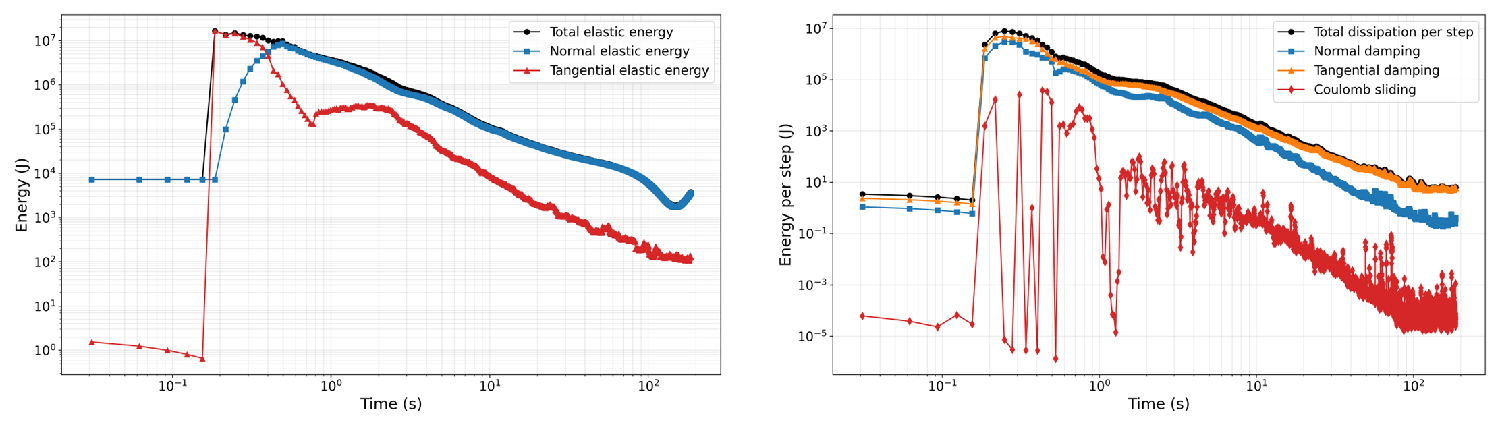
Figure 1. Left) Global elastic contact energy response following impact, separated into normal and tangential components. The initial spike corresponds to impact-energy injection, while the later decay records redistribution and relaxation through the aggregate contact network. Right) Candidate dissipative pathways tracked in the DEM contact model, including normal damping, tangential damping, and Coulomb sliding. Full contact-work closure is ongoing.
These diagnostics provide a bridge between grain-scale DEM physics and asteroid-scale observables. Rather than treating the impact-generated disturbance only through a bulk seismic efficiency or effective wave speed, the time history of elastic storage, dissipation, and wave propagation may help constrain the mechanical state of rubble-pile asteroids. This approach is directly relevant to interpreting DART/Hera observations and to future kinetic-impact or seismic experiments on small bodies.
Acknowledgement: The authors acknowledge funding of the European Union’s Horizon Europe research and innovation programme under grant agreements No. 101264707 (Marie Skłodowska-Curie Actions Postdoctoral Fellowship, SEISMOR: EF) and No. 101077758 (ERC, TRACES: IS, FF). Views and opinions expressed are however those of the authors only and do not necessarily reflect those of the European Union, the European Research Council Executive Agency, or the European Research Executive Agency. Neither the European Union nor the granting authorities can be held responsible for them. JW acknowledges funding from the Swiss National Science Foundation (SNSF) Ambizione grant No. 193346.
References
[1] Daly R.T., Ernst C.M., Barnouin O.S., et al., Nature 2023, 616, 443-447.
[2] Cheng A.F., Agrusa H.F., Barbee B.W., et al., Nature 2023, 616, 457-460.
[3] Michel P., Kueppers M., Sierks H., et al., Planet. Space Sci. 2022,
[4] Sánchez P., Scheeres D.J., Quillen A.C., Planet. Sci. J. 2022, 3, 245.
[5] Ferrari F., Lavagna M., Blazquez E., Mon. Not. R. Astron. Soc. 2020, 492, 749-761.
How to cite: Frizzell, E., San Sebastián, I., Wimarsson, J., Fodde, I., and Ferrari, F.: Impact-Induced Elastic and Dissipative Response in Rubble-Pile Asteroid Analogs, Europlanet Science Congress 2026, The Hague, The Netherlands, 7–11 Sep 2026, EPSC2026-324, https://doi.org/10.5194/epsc2026-324, 2026.


