
 1,2,1,2
- 1LATMOS/IPSL, UVSQ Université Paris-Saclay, Sorbonne Université, CNRS, Guyancourt, France
- 2LIRA, Observatoire de Paris, Université PSL, Sorbonne Université, Université Paris Cité, CY Cergy Paris Université, CNRS, 5 place Jules Janssen, Meudon, 92190, France
Context : Titan’s upper atmosphere is composed of ~99% nitrogen (N2) and ~1% methane (CH4). The sole direct and in situ measurement of the precise volume mixing ratio (VMR) of CH4 was performed by the Gas Chromatograph and Mass Spectrometer (GCMS) on board of Cassini’s Huygens probe that descended through Titan’s atmosphere on January 14th 2005 at a latitude of 10.4°S. It measured a constant-with-height VMR of 1.48 ± 0.09% in Titan’s stratosphere, gradually increasing in the troposphere up to 5.65 ± 0.18% at Titan’s surface[1]. However, subsequent works that analyzed atmospheric emission spectra with the Composite InfraRed Spectrometer (CIRS)[2] and absorption spectra with Huygens’ Descent Imager and Spectral Radiometer (DISR)[3] found that the data were overall better fit with a smaller VMR of CH4 of around 1.0%. Moreover the analysis of the CIRS data of the first half of the Cassini mission (2005-2010) found that this VMR varies both with latitude and time, between 1.0 and 1.5 ± 0.1%. The origin of these variations could be linked to the injection of CH4 in the stratosphere by strong CH4 tropospheric storms as well as the global dynamics that could maintain some stratospheric regions enhanced in CH4[2]. However this still remains to be proven. Moreover, the impact of the variations in CH4 abundance on the other parameters of Titan’s atmosphere, such as the haze composition, is unknown.
Objective and method : Our first goal was to check whether a local and temporary increase in CH4 abundance in the stratosphere could be correlated with the passage of a tropospheric CH4 cloud, which could inject methane further up in the atmosphere. To do so we extracted CH4 abundance profiles at altitudes corresponding to the deep stratosphere (at pressures between 102-10-1 mbar or altitudes between 50-300 km), from CIRS emission spectra. We focused on spectra acquisitions that matched in both time and latitude with Visual Infrared and Mapping Spectrometer (VIMS) observations of tropospheric CH4 clouds[4]. Our second goal was to investigate whether variations in the CH4 abundance could impact the composition of Titan aerosols. For this we produced tholins in the laboratory with the PAMPRE experiment[5]. We varied the initial injected CH4 abundance in the chamber between 0.5 and 10%, corresponding to a steady-state abundance between 0.1 and 5.5%[6], and performed both mid- and far-infrared spectroscopy (2.5-333 µm) on both films and grains, to gain insight on their structure and composition.
Results : After analyzing 20 sets of CIRS emission spectra covering 7 latitudes and the whole duration of the Cassini mission, we infer that the constant-with-height CH4 abundance in the stratosphere varies between 0.75 and 1.53%, with an average of 1.03 ± 0.02%, i.e on average lower than the value retrieved by Huygens’ GCMS. The inferred values are shown in fig 1. At some latitudes, eg at 80°S or 75°N, we seem to observe an increase in CH4 abundance during and after the passage of a cloud, but this does not generalize to the whole dataset. Therefore we cannot conclude yet, and the same analysis on a larger dataset should be done in the future. Moreover we think that the fits of the continuum of the emission spectra could be further improved by adding an absorption contribution of nitrile ice[7], regardless of the season and latitude.

Fig 1 : values of the constant CH4 VMRs in Titan’s stratosphere retrieved from the inversion of CIRS emission spectra, with their 1-σ error bars. The clouds refer to values retrieved from CIRS spectra captured at a time and latitude where VIMS observed a tropospheric CH4 cloud passing by. We added the value retrieved by Huygens’ GCMS for comparison.
Finally we quantified the impact of CH4 abundance on the composition of tholins. Fig 2 shows that a greater CH4 abundance creates more -CH3 and -CH2 bonds compared to –NH or –NH2 bonds, and also has a strong influence on the nature of the CN bonds. Therefore, the observed variations of the CH4 abundances in Titan’s upper atmosphere could be responsible for local variations of the composition of Titan's aerosols, which can be investigated with other Cassini observations (see the poster of Maurice et al.).
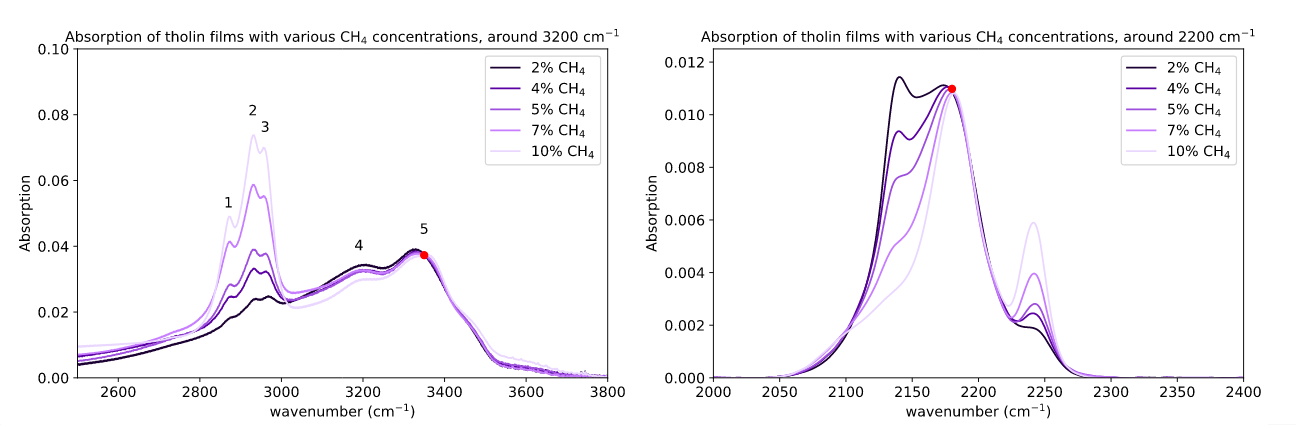
Fig 2 : Absorption spectra obtained by analyzing tholin films produced by PAMPRE with various CH4 concentrations on CaF2 substrates using a Fourier Transform InfraRed (FTIR) spectrometer, Left : in the 2500-3800 cm-1 spectral region, normalized with respect to the red dot. The visible bands correspond to symmetric stretching of -CH3 bonds (1), asymmetric stretching of -CH2 (2) and -CH3 (3) bonds, stretching of primary amines (-NH, 4) and secondary amines (-NH2, 5). Right : in the 2000-2400 cm-1 spectral region, normalized with respect to the red dot. The three visible bands can be attributed to stretching of carbodiimides (-N=C=N), isocyanides (-N≡C) or nitriles (-C≡N)[8].
References :
[1] : Niemann, H. B. et al (2010), Composition of Titan’s lower atmosphere and simple surface volatiles as measured by the Cassini‐Huygens probe gas chromatograph mass spectrometer experiment, J. Geophys. Res., 115, E12006, doi:10.1029/2010JE003659.
[2] : Lellouch, E. et al (2014), The distribution of methane in Titan’s stratosphere from Cassini/CIRS observations, Icarus, 231, 323–337, doi:10.1016/j.icarus.2013.12.016
[3] : Rey, M. et al (2018), New accurate theoretical line lists of 12CH4 and 13CH4 in the 0–13400 cm-1 range: Application to the modeling of methane absorption in Titan’s atmosphere, Icarus, 303, 114–130, doi:10.1016/j.icarus.2017.12.045
[4] : Turtle, E. P. et al (2018), Titan’s Meteorology Over the Cassini Mission: Evidence for Extensive Subsurface Methane Reservoirs, Geophysical Research Letters 45, 11, 5320‑28, doi:10.1029/2018GL078170
[5] : Szopa, C. et al (2006), PAMPRE: A dusty plasma experiment for Titan’s tholins production and study, Planetary and Space Science, 54, 394–404, doi:10.1016/j.pss.2005.12.012
[6] : Sciamma-O’Brien, E. et al (2010), Titan’s atmosphere: An optimal gas mixture for aerosol production?, Icarus, 209, 704–714, doi:10.1016/j.icarus.2010.04.009
[7] : Anderson, C. M. et al (2018), Organic Ices in Titan’s Stratosphere, Space Sci Rev, 214:125, doi:10.1007/s11214-018-0559-5
[8] : Gautier, T. et al (2012), Mid- and far-infrared absorption spectroscopy of Titan’s aerosols analogues, Icarus, 221, 320-327, doi:10.1016/j.icarus.2012.07.025
How to cite: Rering, O., Maurice, C., Chatain, A., and Vinatier, S.: New constraints on Titan’s stratospheric methane variability from Cassini/CIRS and its influence on laboratory tholins composition, Europlanet Science Congress 2026, The Hague, The Netherlands, 7–11 Sep 2026, EPSC2026-329, https://doi.org/10.5194/epsc2026-329, 2026.


