
 12
12- 1Centro de Astrobiologia CSIC-INTA, Planetology and Habitability, Torrejon de Ardoz, Spain (iherreros@cab.inta-csic.es)
- 2Université Paris Cité / CNRS /IPGP, IPGP, CAGE, Paris, France (charnoz@ipgp.fr)
The kinetic impact of NASA’s Double Asteroid Redirection Test (DART) on Dimorphos generated a massive ejecta cloud, including material with velocities comparable to or lower than the escape speed of the satellite. Most of the low-velocity ejecta is expected to remain gravitationally bound to the Didymos-Dimorphos system and to re-impact Dimorphos within the first 10 hours after the impact. Understanding the fate of this material is essential for interpreting the surface state of Dimorphos at the time of the ESA Hera encounter.
In this work, we introduce RAVEL (Regolith Astrodynamics in Variable Effective Low-Gravity Environments), a model particularly well suited for investigating the early post-impact evolution of low-velocity ejecta produced by the DART impact. Here, we apply RAVEL to ejecta with initial velocities of 1-9 cm/s, using a realistic shape model of Dimorphos derived from DART/DRACO observations. We couple three-dimensional orbital dynamics in the binary system with surface transport on shape models of Dimorphos. The model accounts for self-gravity, centrifugal acceleration, Coriolis acceleration, tidal forcing by Didymos, rebounds after surface contact, and friction-controlled sliding. The particles are treated as Lagrangian tracers, allowing us to map the main transport pathways from launch to final deposition without assuming detailed grain-scale properties. We assume a crater radius of 35 m, consistent with current estimates, although this value will be refined after Hera’s arrival. The initial tracers are launched with angles between 24° and 43°, measured with respect to the plane perpendicular to the ejection-cone axis, following DART observations, and with velocity distribution derived from a Housen-Holsapple-type scaling law. Surface motion is computed on the Digital Terrain Model (DTM) derived from DART/DRACO images (Fig.1). Since the DART/DRACO-based DTM only covers the leading hemisphere imaged during the DART encounter, the non-imaged part of Dimorphos is therefore represented as a smooth surface in the model.
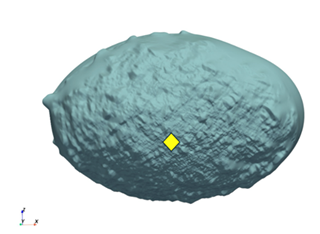
Fig.1: DART/DRACO-based DTM. The yellow diamond marks the DART impact site.
Our simulations show that the dynamics of low-velocity ejecta is highly asymmetric and strongly controlled by the binary environment. Ejecta with the lowest velocities (<5 cm/s) re-impact close to the DART impact site, whereas faster particles can follow partial orbits around Dimorphos or even circulate around Didymos before returning to the surface. More than 90% of the ejecta is reaccreted within the first 5 hours, and most of the ejecta returns to Dimorphos within the first 20 hours (Fig. 2). After re-impact, the material does not remain at the first contact point: rebounding and frictional sliding can redistribute ejecta over distances comparable to a significant fraction of the body radius.

Fig.2: Re-impacting low-velocity ejecta on Dimorphos' surface.
The final deposits show clear velocity-dependent sorting. Low-velocity ejecta preferentially accumulates around the DART impact region, intermediate velocities tend to produce antipodal accumulation, and the fastest reaccreted material generates a broader and more asymmetric surface pattern, with enhanced deposition on the trailing hemisphere and in polar regions. When a rough DART/DRACO-based terrain model is used, the interaction between ejecta and local topography can produce ray-like deposits around the impact site, mainly associated with the lowest-velocity material. These structures may extend farther than shown in our simulations, but their full extent cannot yet be assessed because the non-imaged part of the DART/DRACO-based DTM is represented as a smooth surface.
Our model, RAVEL, provides direct predictions for Hera observations. Ray-like structures, smooth mantling deposits, preferential resurfacing terrains, or antipodal accumulations would provide constraints on the low-velocity ejecta population, the post-impact redistribution of material, and the mobility of regolith under extremely low gravity. Our results therefore link DART impact physics, orbital dynamics, and surface transport, and provide a framework for interpreting the geomorphological state of Dimorphos during the Hera encounter.
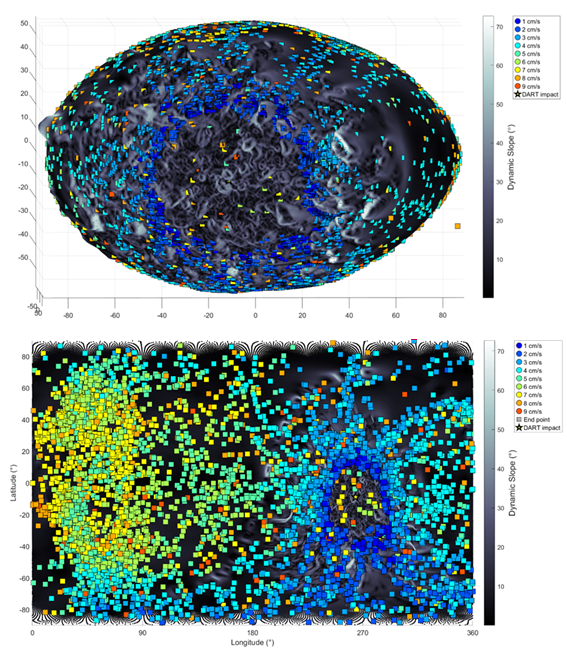
Fig.3: Distribution of low-velocity ejecta after re-impacting on Dimorphos’ surface.
How to cite: Herreros, I. and Charnoz, S.: The morphological signature of DART ejecta distribution on Dimorphos: Predictions for the Hera encounter, Europlanet Science Congress 2026, The Hague, The Netherlands, 7–11 Sep 2026, EPSC2026-345, https://doi.org/10.5194/epsc2026-345, 2026.


