
 1,1,1,2
- 1Institute of Geophysics of the Czech Academy of Sciences, Prague, Czechia (petr.broz@ig.cas.cz)
- 2Institute of Atmospheric Physics of the Czech Academy of Sciences, Prague, Czechia
Explaining planetary and geophysical processes to the general public is inherently difficult. Many of the key phenomena shaping Earth and other planets — mantle convection, magnetic field, subduction, or magma–water interaction — are deep-seated or elusive as they occur over immense spatial and temporal scales, and are therefore challenging to communicate through static figures or conventional presentations alone. While modern outreach increasingly relies on digital animations and screen-based visualization, for many years, we have been exploring an alternative approach based on large-scale physical, kinetic, and visually immersive machines designed to transform abstract planetary processes into tangible experiences and engage the public in a way that will not become outdated from a technical standpoint.
At the Institute of Geophysics of the Czech Academy of Sciences, we have developed a series of custom-built educational installations that combine mechanical motion, light, sound, and direct audience interaction. Their design philosophy intentionally draws inspiration from historical fairground attractions, mechanical barrel organs, and cabinet-of-curiosities exhibits. The primary goal is not merely to explain scientific concepts, but first to attract attention, create curiosity, and spontaneously gather audiences in public spaces, science festivals, exhibitions, schools, and outreach events. Rather than functioning as passive educational aids, the installations are conceived as performative science-communication machines capable of transforming invisible planetary processes into physically observable experiences.
One of the installations, the Barrel Organ of Plate Tectonics (Fig. 1), is a hand-powered mechanical model of Earth’s interior and lithosphere [1]. By turning a crank, the operator activates the illusion of moving tectonic plates, mantle convection cells, subduction zone, mantle plumes, volcanic arcs, and seafloor spreading centres. The installation combines layered geological cross-sections, moving components, rotating wheels, and dramatic internal illumination to transform the familiar static plate tectonic diagram into a dynamic storytelling device. The machine was originally inspired by classical USGS-style tectonic schematics but reimagined as an interactive kinetic sculpture that physically demonstrates the interconnected nature of Earth’s internal processes.
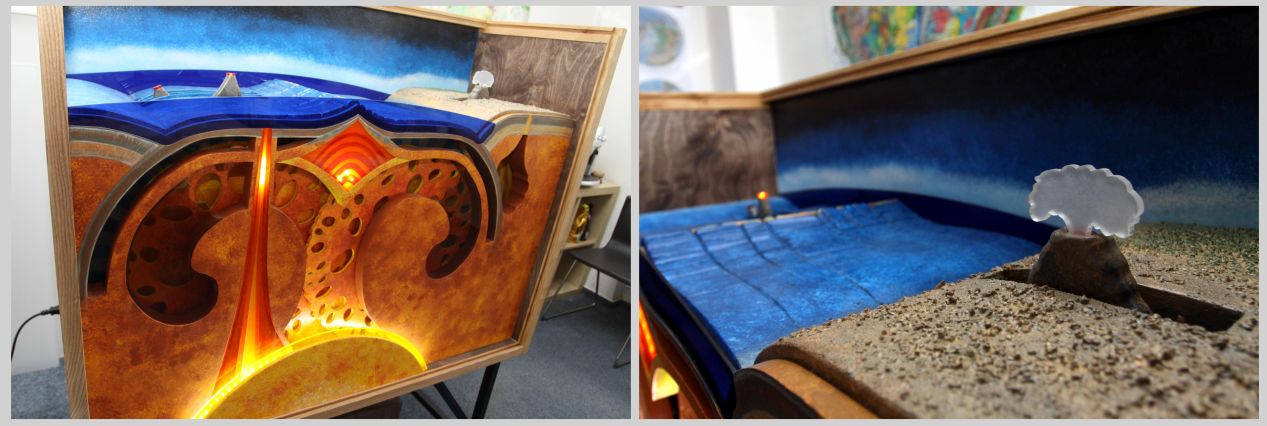
Figure 1: The Barrel Organ of Plate Tectonics is a hand-powered kinetic educational installation that transforms a classical static plate tectonic diagram into an immersive physical model visualizing mantle convection, subduction, seafloor spreading, and volcanism through moving components and dynamic illumination.
A second installation, developed in collaboration with the Institute of Atmospheric Physics of the Czech Academy of Sciences, is the Magnetospheric machine (Fig. 2) — a large-scale demonstrator visualizing planetary magnetic fields and their interaction with the solar wind. The apparatus consists of a central electromagnet surrounded by numerous small magnetized compass needles that respond in real time to changes in the magnetic field geometry. Dynamic lighting and integrated airflow allow spectators to observe the contrast between Earth-like global dipolar magnetic fields and the localized remnant crustal magnetism associated, for example, with Mars. The interaction between magnetic structures and simulated solar wind creates a visually striking representation of otherwise invisible planetary processes.
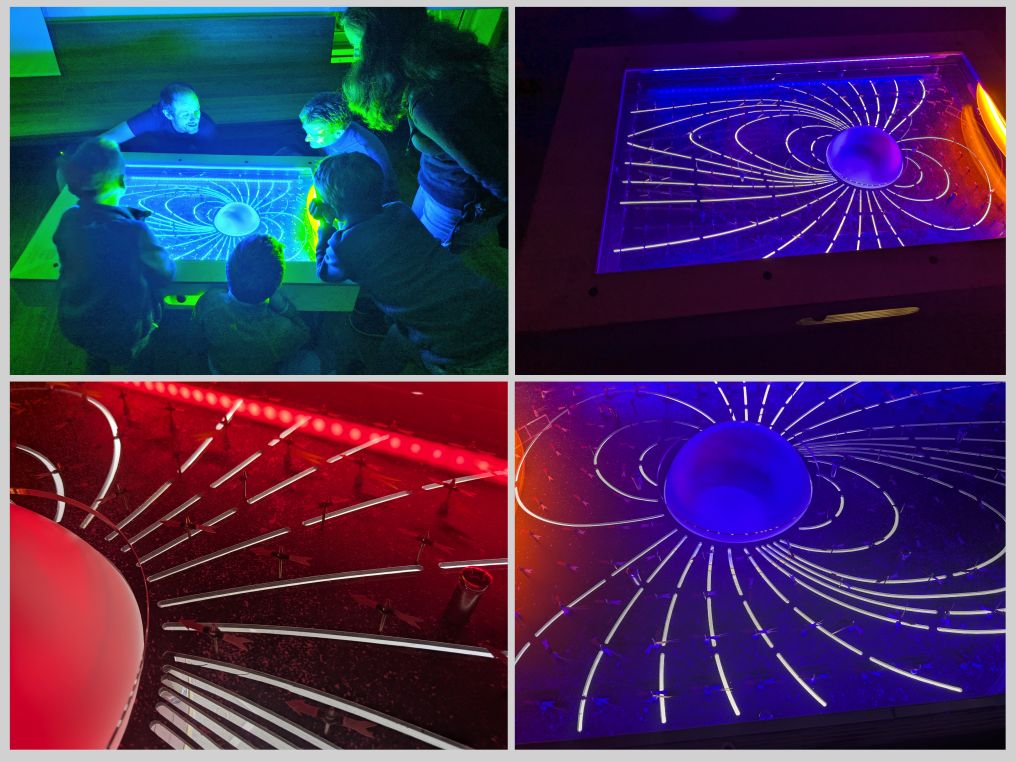
Figure 2: The Magnetosphere Machine is an interactive kinetic installation that uses an electromagnet, magnetized compass needles, airflow, and dynamic illumination to visualize planetary magnetic fields and their interactions with the solar wind around planets.
We also constructed a Phreatomagmatic Eruption Machine (Fig. 3) capable of safely simulating explosive magma–water interaction. The installation uses compressed air released into a sand-filled funnel embedded within a transparent cross-sectional model of a maar–diatreme volcanic system. Activation produces a sudden sand eruption reaching heights of nearly two metres while simultaneously allowing the audience to observe the internal structure of the volcanic conduit through a transparent frontal section. The device provides an intuitive visualization of subsurface processes associated with phreatomagmatic eruptions and diatreme formation — processes that are otherwise extremely difficult to communicate to non-specialist audiences.
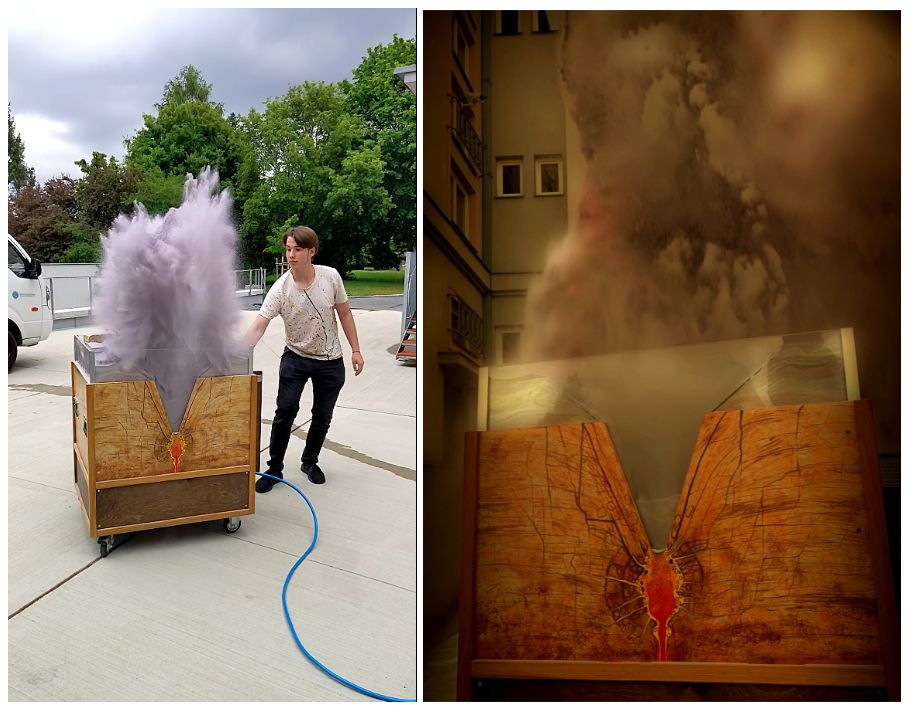
Figure 3: The Phreatomagmatic Eruption Machine is a compressed-air-powered educational installation that safely simulates explosive magma–water interaction while simultaneously revealing the internal structure of a maar–diatreme volcanic system through a transparent cross-sectional view.
Lesson learned
Our experience from science festivals, public exhibitions, and schools shows that physical installations naturally function as “attention anchors”, around which spontaneous audiences rapidly form. Unlike static posters or digital displays, kinetic machines encourage collective viewing, discussion, and direct interaction, often becoming natural starting points for longer conversations about planetary science.
However, visually striking machines alone are insufficient for effective outreach. Their impact critically depends on the presence of a skilled speaker capable of translating complex geophysical processes into simple, engaging, and emotionally resonant narratives understandable to non-specialist audiences. We found that the strongest outreach effect emerges when physical demonstrations, storytelling, and direct audience interaction operate together as a unified performance.
Equally important is extending audience engagement beyond the demonstration itself. To support longer-term educational impact, our institute developed complementary outreach materials including a trilogy of illustrated comics and board games focused on earthquakes, magnetic fields, and volcanoes for younger teenagers [2], an almanac of geoscience experiments for teachers [3], and paper cut-out models for younger children. All materials are freely accessible online (in Czech and English) through the institute’s website, allowing visitors to revisit the presented concepts after the event itself.
Developing successful outreach machines also requires close collaboration between scientists, artists, designers, and professional fabricators. In our experience, robustness, operational simplicity, rapid reset capability between demonstrations, and minimal maintenance are not secondary technical considerations, but key design requirements that fundamentally determine whether an installation can function effectively during public events. Outreach machines intended for repeated transport and continuous interaction with large audiences cannot be reliably built as improvised low-cost prototypes.
We argue that immersive physical science machines represent a powerful complement to digital science communication. By transforming invisible planetary phenomena into tangible shared experiences, they create a form of engagement fundamentally different from screen-based outreach alone. When combined with compelling live interpretation and carefully designed take-home materials, such installations can evolve from short-lived attractions into effective gateways for deeper and longer-lasting public engagement with Earth and planetary sciences.
References
[1] Brož et al., 2016; EPSC abstract 17908 [2] Machek et al., 2021, EGU abstract 10853, [3] Brož et al., 2025, EPSC-DPS abstract EPSC-DPS2025-511.
How to cite: Broz, P., Machek, M., Závada, P., and Píša, D.: From Barrel Organs to Magnetospheres: Developing Immersive Physical Machines for Planetary Science Outreach , Europlanet Science Congress 2026, The Hague, The Netherlands, 7–11 Sep 2026, EPSC2026-353, https://doi.org/10.5194/epsc2026-353, 2026.


