
 1,2,4,6,7,9,12,13,14,
- 1Univ. Grenoble Alpes, CNRS, IPAG, 38000 Grenoble, France (lucia.mandon@univ-grenoble-alpes.fr)
- 2LPG, CNRS, Nantes Université, Univ Angers, Université le Mans, 44322 Nantes, France
- 3Institut de Recherche en Astrophysique et Planétologie, Université de Toulouse 3 Paul Sabatier, CNRS, CNES, 31400 Toulouse, France
- 4Université Claude Bernard Lyon 1, ENS de Lyon, CNRS, UJM, LGL-TPE, UMR 5276, F-69622, Villeurbanne cedex, France
- 55 Institut de Minéralogie, de Physique des Matériaux et de Cosmochimie, CNRS UMR 7590, Muséum National d’Histoire Naturelle, Sorbonne Université, 75005 Paris, France
- 6DLR Institute of Space Research, Rutherfordstr. 2, 12489 Berlin, Germany
- 7Division of Geological and Planetary Sciences, California Institute of Technology, Pasadena, CA, USA
- 8Department of Geosciences, Stony Brook University, Stony Brook, NY, USA
- 9Department of Earth Science and Engineering, Imperial College London
- 10Department of Earth, Environmental and Planetary Sciences, Rice University, Houston, TX 77005
- 11Johns Hopkins University Applied Physics Laboratory
- 12LIRA, Observatoire de Paris, Université PSL, CNRS, Sorbonne Université, Université Paris Cité, 5 place Jules Janssen, 92195 Meudon, France
- 13Earth, Atmospheric, and Planetary Sciences, Purdue University, West Lafayette, Indiana USA
- 14Astromaterials Research & Exploration Science, NASA Johnson Space Center, Houston TX, 77058, USA
- 15RISE Research Institutes of Sweden, Stockholm
- 16University of Oregon
The Perseverance rover landed on Mars in 2021 in Jezero crater, which contains evidence of an ancient lake. Deltaic deposits are preserved at the inlet of this paleolake, and connected to an ancient fluvial network via a valley dissecting the crater rim, named “Neretva Vallis” (Figure 1a). Between sols (i.e., Martian days) 1169 and 1244 of the mission (June to August 2024), the rover explored light-toned deposits in Neretva Vallis, informally named the “Bright Angel formation” (Figure 1b). This formation attracted significant interest after the discovery of rocks interpreted as fluvio-lacustrine mudstones containing organic compounds, as well as reduction spots (mm-scale nodules and redox fronts enriched in Fe-phosphates and Fe-sulfides) interpreted as potential biosignatures (Hurowitz et al., 2025).
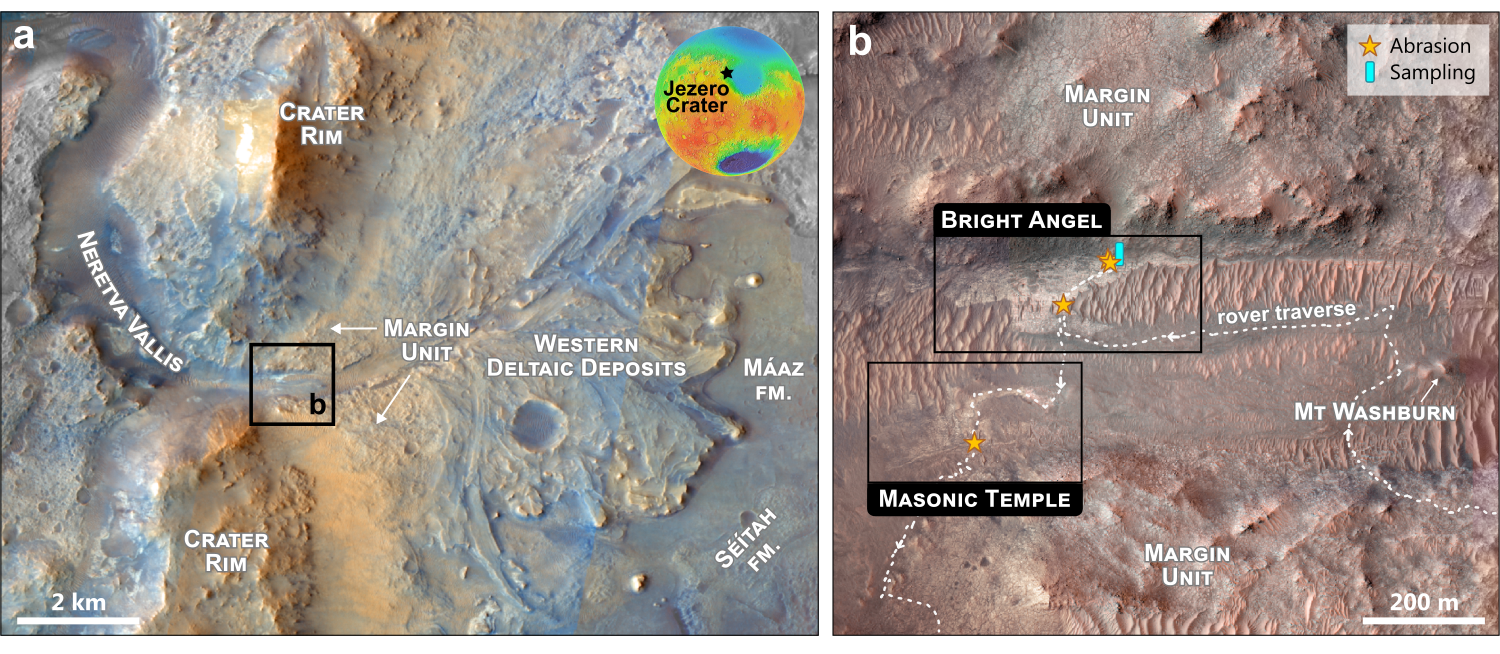
Figure 1. Context for the Bright Angel formation exposed at the Bright Angel and Masonic Temple localities. (a) Colour and Stereo Surface Imaging System (CaSSIS; Thomas et al., 2017), Context Camera (CTX; Malin et al., 2007) and (b) High Resolution Imaging Science Experiment (HiRISE; McEwen et al., 2007) enhanced-color composite basemaps over Western Jezero crater.
Here, we characterize the elemental and mineralogical composition of the Bright Angel formation using complementary datasets from Perseverance instruments to further constrain past water-rock interactions and diagenetic evolution. Our analysis integrates: elemental composition from SuperCam Laser-Induced Breakdown Spectroscopy (LIBS; Wiens et al., 2020; Maurice et al., 2021) and from the Planetary Instrument for X-Ray Lithochemistry (PIXL; Allwood et al., 2020), as well as mineralogy from SuperCam Visible and near-infrared reflectance, SuperCam Raman spectroscopy (Wiens et al., 2020; Maurice et al., 2021), and deep ultraviolet Raman spectroscopy using the Scanning Habitable Environments with Raman and Luminescence for Organics and Chemicals (SHERLOC; Bhartia et al., 2021) instrument.
We confirm that most of the stratigraphy of the exposed bedrock consists of mudstones with a composition distinct from previously investigated formations at Jezero crater, which exhibited mafic to ultramafic compositions. In contrast to other units, the Bright Angel formation is enriched in Al-silicates and Ca-sulfates, broadly lacks olivine and its alteration products, and exhibits high Al and very low Mg contents. Preliminary interpretation of the associated mineral assemblages suggest diverse and prolonged fluid activity, consistent with enhanced diagenesis and hydrothermal processes:
- Elevated Chemical Index of Alteration values (up to ~80) indicate open-system weathering, either acquired in situ or inherited from pre-deposition processes
- The co-occurrence of illite (and/or a mixed-layer illite/aluminous smectite phase) and fluorite suggests hydrothermal processes at moderately elevated temperatures (>~85°C), assuming that these minerals are not detrital. This warm-temperature scenario could favor an abiotic origin for sulfate reduction in the reduction spots; however, these temperatures may have occurred independently of sulfur reduction, leaving the biogenic hypothesis still possible
- Jarosite and akaganeite in the upper stratigraphy attest to episodic circulation of oxidizing and saline fluids
Overall, the degree of alteration and diagenesis recorded by the Bright Angel formation may be inconsistent with a late post-delta origin, leaving open the possibility that it represents one of the oldest sedimentary units explored by Perseverance, preserving key constraints on Noachian aqueous environments.
References
- Allwood, A.C. et al., 2020. PIXL: Planetary Instrument for X-Ray Lithochemistry. Space Science Reviews 216, 134. https://doi.org/10.1007/s11214-020-00767-7
- Bhartia, R. et al., 2021. Perseverance’s Scanning Habitable Environments with Raman and Luminescence for Organics and Chemicals (SHERLOC) Investigation. Space Science Review 217, 58. https://doi.org/10.1007/s11214-021-00812-z
- Hurowitz, J.A. et al., 2025. Redox-driven mineral and organic associations in Jezero Crater, Mars. Nature 645, 332–340. https://doi.org/10.1038/s41586-025-09413-0
- Malin, M.C. et al., 2007. Context Camera Investigation on board the Mars Reconnaissance Orbiter. Journal of Geophysical Research: Planets https://doi.org/10.1029/2006JE002808
- Maurice, S. et al., 2021. The SuperCam Instrument Suite on the Mars 2020 Rover: Science Objectives and Mast-Unit Description. Space Science Reviews 217, 47. https://doi.org/10.1007/s11214-021-00807-w
- McEwen, A.S. et al., 2007. Mars Reconnaissance Orbiter’s High Resolution Imaging Science Experiment (HiRISE). Journal of Geophysical Research: Planets https://doi.org/10.1029/2005JE002605
- Thomas, N. et al., 2017. The Colour and Stereo Surface Imaging System (CaSSIS) for the ExoMars Trace Gas Orbiter. Space Science Reviews 212, 1897–1944. https://doi.org/10.1007/s11214-017-0421-1
- Wiens, R.C. et al., 2020. The SuperCam Instrument Suite on the NASA Mars 2020 Rover: Body Unit and Combined System Tests. Space Science Reviews 217, 4. https://doi.org/10.1007/s11214-020-00777-5
How to cite: Mandon, L., Mangold, N., Forni, O., Dehouck, E., Beck, P., Beyssac, O., Schröder, S., Phua, Y. Y., Hurowitz, J., Jones, A., Moreland, E., Clavé, E., Johnson, J., Fouchet, T., Manelski, H., Simon, J., Siljeström, S., Broz, A., Cousin, A., and Wiens, R.: Complex diagenetic history of organic-bearing sedimentary rocks in Neretva Vallis, Mars, Europlanet Science Congress 2026, The Hague, The Netherlands, 7–11 Sep 2026, EPSC2026-356, https://doi.org/10.5194/epsc2026-356, 2026.


