EPSC Abstracts
Vol. 19, EPSC2026-36, 2026, updated on 06 Jul 2026
https://doi.org/10.5194/epsc2026-36
Europlanet Science Congress 2026
© Author(s) 2026. This work is distributed under the Creative Commons Attribution 4.0 License.

Trans-Neptunian Objects: Discovery predictions from the Long-term Evolution after the Stellar Flyby

- Forschungszentrum Jülich, JSC, Jülich, Germany (s.pfalzner@fz-juelich.de)
Trans-Neptunian objects (TNOs) predominantly occupy highly inclined and eccentric orbits around the Sun. A hypothesis posits that these orbital architectures arose from a stellar flyby, which gravitationally perturbed the primordial planetesimal disk of the early solar system. Specifically, simulations indicate that a stellar encounter involving a star of Mp = 0.8 M☉, reaching a perihelion distance of rp = 110 au and inclined by ip = 70°, closely reproduces the observed orbital distribution of known. Such a flyby would most likely have occurred several Gyr ago. A key scientific question is whether the fit between the model and observations persists after accounting for subsequent orbital evolution of TNOs over gigayear timescales. Remarkably, incorporating long-term dynamical evolution yields even stronger agreement with the current TNO population.
Our starting point is the situation in which, without interactions with Neptune, the solar system would have reached a new equilibrium state (~12ky after periastron passage). We determine how the long-term evolution of interactions with the giant planets in the Solar System affects the TNO dynamics over the consecutive 4.5 Gyr. One feature is that the resonant population emerges. However, in this work, we concentrate on the non-resonant populations.
Our simulations reveal that dynamical interactions efficiently clear test particles from the vicinity of Neptune within less than 10 million years, particularly those residing in the planetary plane. Consequently, the modelled distribution of TNOs with perihelion distances in the range 30 au < p < 35 au shows improved concordance with observations.
On intermediate timescales (1 Myr < t < 100 Myr), transient resonant TNOs are generated within the planetary region, but these objects are ultimately depleted over ∼1 Gyr. Crucially, prolonged dynamical evolution erases the initial overpopulation of high-eccentricity test particles with semi-major axes 80 au < a < 100 au that emerged immediately post-flyby. As a result, the long-term dynamics further enhance the agreement between the simulated and observed TNO populations.
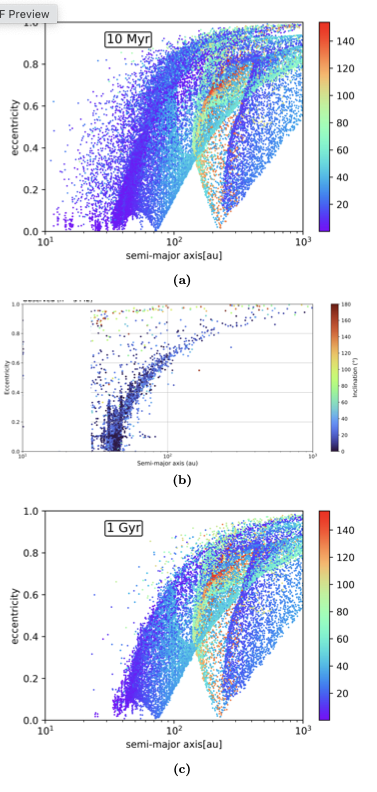
A modest refinement of the flyby parameters could further improve the match to the perihelion distribution of the non-resonant cold classical population and yield a marginally greater abundance of centaurs after 4.5 Gyr of evolution. Nevertheless, we anticipate that only minimal fine-tuning is necessary to resolve the residual discrepancies in the fit to the non-resonant TNOs. Prior to implementing such adjustments, it is essential to employ higher-resolution simulations to discern whether these minor deviations are genuine features or artifacts of limited numerical resolution.
By modelling the long-term dynamical evolution following the stellar flyby, we are able to formulate testable predictions for future TNO surveys. Specifically, we predict (1) an absence of low-eccentricity TNOs with 80 au < a < 200 au, and (2) the existence of a population of retrograde TNOs with 150 au < a < 300 au and eccentricities in the range 0.6–0.8. These anticipated features provide clear observational diagnostics for upcoming discoveries and serve as critical tests of the stellar flyby scenario.
How to cite: Pfalzner, S., Wagner, F., and Bischoff, M.: Trans-Neptunian Objects: Discovery predictions from the Long-term Evolution after the Stellar Flyby , Europlanet Science Congress 2026, The Hague, The Netherlands, 7–11 Sep 2026, EPSC2026-36, https://doi.org/10.5194/epsc2026-36, 2026.


