SB12 | Dynamics of Small Bodies in the Solar System and beyond

SB12

Dynamics of Small Bodies in the Solar System and beyond
Convener: Ziyu Liu | Co-conveners: Man-To Hui, Josep Maria Trigo Rodríguez, Daniel Hestroffer, Michael Küppers
Orals MON3
| Mon, 07 Sep, 14:30–15:57 (CEST)|Room Earth (Tango 1)
Orals MON4
| Mon, 07 Sep, 16:30–17:57 (CEST)|Room Earth (Tango 1)
Posters MON-POS
| Attendance Mon, 07 Sep, 18:00–19:30 (CEST) | Display Mon, 07 Sep, 08:30–19:30|Foyer 3, F3.55–62
Mon, 14:30
Mon, 16:30
Mon, 18:00
This session invites the submission of abstracts dedicated to the study of the dynamics and physical properties of small bodies in the Solar System and beyond, including asteroids, meteoroids, comets, Kuiper Belt objects, the Oort Cloud, interplanetary and interstellar dust, and interstellar objects. Contributions addressing their origin, formation, orbital evolution, transport mechanisms, resonances, impact processes, non-gravitational effects, and long-term dynamical behavior are welcome, as well as the study of their composition, internal structure, rotational and thermal properties, and surface evolution. We encourage abstracts based on observations, theoretical and numerical modeling, laboratory experiments.

Orals MON3: Mon, 7 Sep, 14:30–15:57 | Room Earth (Tango 1)

Chairpersons: Ziyu Liu, Man-To Hui
14:30–14:42
|
EPSC2026-778
|
ECP
|
On-site presentation
Marco Baj, Iosto Fodde, Lucia Francesca Civati, and Fabio Ferrari

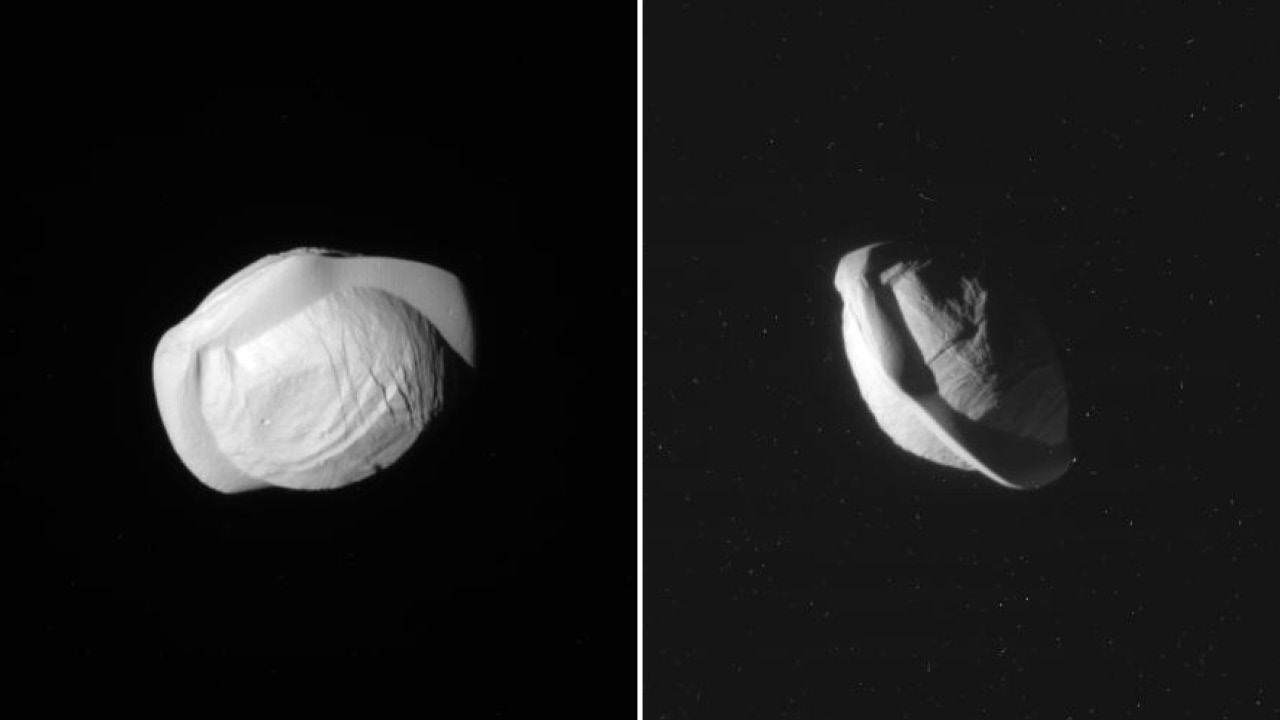
Saturn’s small inner moons present some of the most unusual shapes observed in the Solar System. Among these, Pan stands out for its distinctive equatorial ridge, which gives the moon its characteristic appearance as seen in Figure 1. The ridge displays a polygonal longitudinal profile defined by five lobes [7]. Understanding the origin of these structures offers a small-scale analogue to broader astrophysical processes such as pebble accretion onto planetesimals in protoplanetary disks [1].

Figure 1: Cassini image of Pan. Credits: NASA/JPL-Caltech/Space Science Institute

Three main formation hypotheses have been proposed. The first invokes gravitational forcing from the rings driving granular surface flow toward the equator [6], but predicts uniform ridge structures. The second interprets the ridges as remnants of low-velocity merging events between comparable-sized moonlets [4], but requires highly constrained impact parameters and leaves the polygonal shape unexplained. The third scenario proposes accretion of ring particles onto a pre-existing core [1], determined from the ridge’s equatorial location, smoother texture, and lower crater density. However, previous implementations of this framework could only reproduce simplified single-lobed morphologies and could not account for the multi-lobed structure or latitudinal extent without ad hoc assumptions [5].

Figure 2: Lagrange points L1, L2 and zero-velocity curves for the Pan, including (perturbed)
and excluding (unperturbed) shape effects.

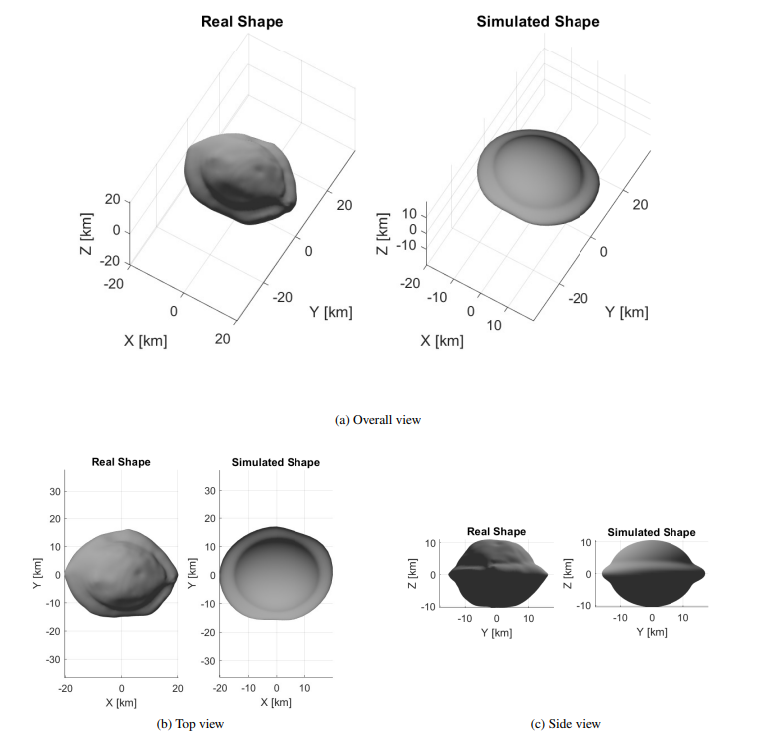
This study investigates the low-energy dynamics of ring particles in the vicinity of Pan using a Circular Restricted Three-Body Problem (CR3BP) framework augmented with spherical harmonic perturbations from both Saturn and Pan. In the low-energy regime, ring particles can only reach Pan’s surface by transiting through the necks of the zero-velocity surface near the L1 and L2 Lagrange points, located within approximately 18–19 km of Pan’s centre, see Figure 2. This constraint is exploited to perform systematic grid-search simulations of particle trajectories initiating at the L1 and L2 sections, reducing the search space and analysing mainly physically feasible pathways to accretion. Both planar and three-dimensional configurations are explored, and backward propagations from Pan’s surface are performed to characterize the original orbits of impacting particles. The 2D grid search reveals a strong dynamical symmetry between trajectories transiting through the two necks, a consequence of the small mass ratio. This symmetry implies that symmetric accretion conditions cannot reproduce the observed asymmetric ridge profile. The best agreement with the observed ridge altitude distribution is obtained when inner-ring particles are located closer to Pan than their outer-ring counterparts, and when impacts from the L1 neck slightly exceed those from L2. Under these conditions, the simulated impact longitude distribution reproduces the correct number of peaks and troughs and correlates strongly with the ridge altitude profile, particularly on the Saturn-facing hemisphere. The 3D grid search demonstrates that reproducing the observed latitudinal spread requires strictly limiting the out-of-plane position and velocity components of accreting particles at the neck sections. This strongly indicates that the ridge could only have formed through accretion from a very thin particle disk, consistent with Saturn’s ring geometry [3]. This result removes the need to invoke Pan’s orbital inclination as the primary driver of the ridge’s latitudinal extent, a hypothesis that had yielded inconsistent results in prior studies [1, 5]. The simulated three-dimensional shape of Pan shown in Figure 3 shows good visual agreement with the observed morphology, particularly on the Saturn-facing and trailing sides. Analysis of impact transverse velocities yields a mean value of approximately 0.33- 0.36 m/s, roughly one order of magnitude smaller than previously assumed [5], revising the minimum accretion timescale from ∼105 down to ∼104 years. Backward propagation of impacting trajectories confirms that virtually all low-energy impacting particles originate from nearly circular orbits within the Encke Gap, with effective eccentricities never exceeding 10−3, consistent with accretion from local ring material.

Figure 3: Different views of the simulated shape of Pan resulting from the 3D grid search,
alongside the observed shape of Pan for comparison.

These results provide dynamically and morphologically consistent explanation for Pan’s equatorial ridge, demonstrating that its polygonal shape, latitudinal extent, and asymmetric altitude distribution are natural consequences of low-energy ring particle accretion. The methodology is directly transferable to Atlas and Daphnis, and broadly applicable to other low-energy deposition and impact processes in the Solar System.

Acknowledgments
Funded/co-funded by the European Union (ERC, TRACES, 101077758). Views and opinions expressed are however those of the authors only and do not necessarily reflect those of the European Union, the European Research Executive Agency, or the European Research Council. Neither the European Union nor the granting authority can be held responsible for them. This work was also partly carried out within the Space It Up! project funded by the Italian Space Agency (ASI) and the Italian Ministry of University and Research (MUR) under contract No. 2024-5-E.0, CUP No. I53D24000060005.

References
[1] S. Charnoz, A. Brahic, P. C. Thomas, C. C. Porco, Charnoz, S´ebastien, Brahic, Andr´e,
Thomas, P. C., Porco, and C. C. The Equatorial Ridges of Pan and Atlas: Terminal
Accretionary Ornaments? Science, 318(5856):1622, 12 2007.
[2] M. Ciarniello, G. Filacchione, P. D. Nicholson, M. M. Hedman, S. Charnoz, J. N. Cuzzi,
M. El Moutamid, A. R. Hendrix, N. Rambaux, K. E. Miller, O. Mousis, K. Bailli´e, P. R.
Estrada, and J. H. Waite. The Origin and Composition of Saturn’s Ring Moons. Space
Science Reviews 2024 220:7, 220(7):72–, 9 2024.
[3] L. W. Esposito. Composition, structure, dynamics, and evolution of saturn’s rings.
Annual Review of Earth and Planetary Sciences, 38(Volume 38, 2010):383–410, 5 2010.
[4] A. Leleu, M. Jutzi, and M. Rubin. The peculiar shapes of Saturn’s small inner moons as
evidence of mergers of similar-sized moonlets. Nature Astronomy 2018 2:7, 2(7):555–561,
5 2018.
[5] A. C. Quillen, F. Zaidouni, M. Nakajima, and E. Wright. Accretion of ornamental
equatorial ridges on Pan, Atlas and Daphnis. Icarus, 357:114260, 3 2021.
[6] T. Shinbrot. Gravitational influence of Saturn’s rings on its moons: a case for free
granular flow. Frontiers in Astronomy and Space Sciences, 10:1146705, 5 2023.
[7] P. Thomas and P. Helfenstein. The small inner satellites of Saturn: Shapes, structures
and some implications. Icarus, 344:113355, 7 2020.

How to cite: Baj, M., Fodde, I., Civati, L. F., and Ferrari, F.: The Shape of Small Embedded Ring Moonlets: Low-Energy Dynamics and the Origin of Pan's Polygonal Ridge, Europlanet Science Congress 2026, The Hague, The Netherlands, 7–11 Sep 2026, EPSC2026-778, https://doi.org/10.5194/epsc2026-778, 2026.

14:42–14:54
|
EPSC2026-660
|
ECP
|
On-site presentation
Flavia Saveriano, Michael Jump, and Lee Devlin

The impact of the Double Asteroid Redirection Test (DART) spacecraft on Dimorphos in 2022 provided the first controlled kinetic-impact experiment on an asteroid and enabled observations of the resulting ejecta environment [1]. The observed momentum transfer [1, 2] and ejecta evolution highlighted the importance of understanding the complex dynamics governing debris transport in binary asteroid systems. In particular, the diversity in ejecta particle sizes produces a wide range of dynamical behaviours, from rapidly escaping micrometre dust to larger boulders primarily influenced by the mutual gravity of the Didymos-Dimorphos system. With ESA’s Hera mission scheduled to arrive at the system in late 2026 [3], understanding the long-term evolution of post-impact ejecta has become increasingly relevant.

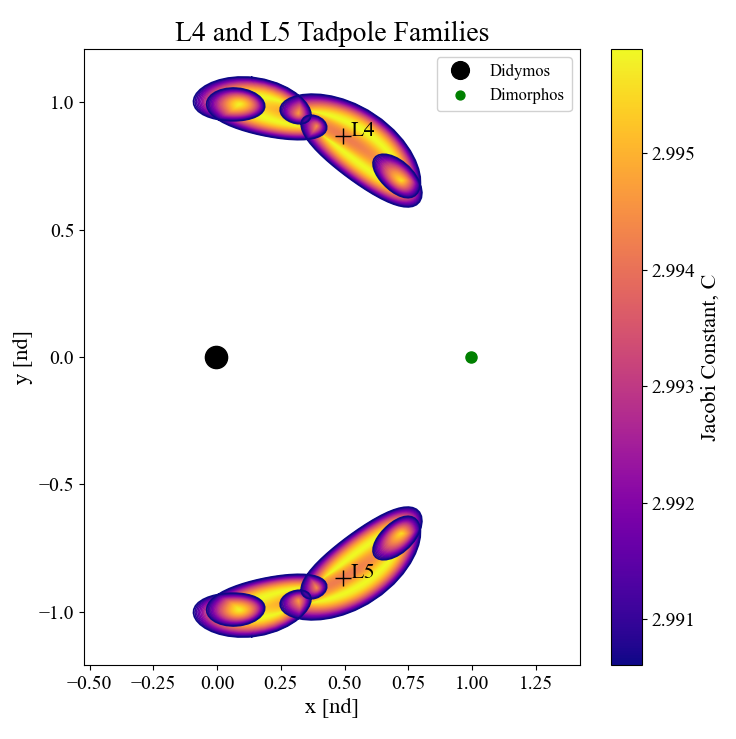
In this work, we investigate the possibility of ejecta capture within co-orbital tadpole regions surrounding the equilateral equilibrium points of the post-impact Didymos-Dimorphos system, extending previous studies of ejecta capture in binary asteroid environments [4]. The Circular Restricted Three-Body Problem (CRTBP) [5] with parameters representative of the Didymos binary system is employed to study the dynamics near the L4 and L5 equilibrium regions. Families of periodic tadpole orbits [6] are computed through differential correction and continuation methods [7], and their stability and surrounding dynamical environment are analysed using Poincaré maps. Figure 1 shows representative families of bounded tadpole trajectories around both equilateral equilibrium regions up to nondimensional amplitudes of approximately 0.6 [nd], selected to visualize the transition from near-linear librational motion to increasingly nonlinear co-orbital configurations approaching the horseshoe-transition domain. The surrounding dynamical structure is consistent with KAM-type behaviour [8], indicating the persistence of locally bounded motion in the vicinity of the tadpole families.

To investigate whether DART ejecta can access these regions, multiple trajectories are propagated from the Dimorphos surface at the impact location over a range of ejection velocities and geometries representative of DART-generated debris. The simulations show that a subset of ejecta trajectories naturally enters the tadpole regions surrounding both L4 and L5, where capture and sustained librational motion can occur before eventual escape or re-impact.

Preliminary long-term integrations indicate that some ejecta trajectories may remain confined within the co-orbital regions for extended durations. These results suggest that resonant co-orbital motion may contribute to the long-term evolution of debris in the Didymos system and provide a dynamical framework for understanding ejecta transport and confinement in binary asteroids, with potential relevance for interpreting the debris environment to be encountered by Hera.

Future work will extend this analysis beyond the idealized CRTBP by incorporating additional perturbations relevant to the Didymos-Dimorphos environment, including solar radiation pressure with a double-eclipse shadowing, third-body perturbations, and irregular gravity fields represented by polyhedral models of both primaries. While these perturbations break the idealized CRTBP geometry, the periodic tadpole solutions computed here provide suitable initial guesses for identifying surviving bounded trajectories in the perturbed system.

Figure 1: Families of periodic tadpole trajectories around the L4 and L5 equilibrium regions of Didymos-Dimorphos system in the CRTBP. The colour bar represents the Jacobi constant, illustrating the nonlinear growth and deformation of the co-orbital families with increasing amplitude up to 0.6 [nd].

References

[1] Li, Jian-Yang, et al. "Ejecta from the DART-produced active asteroid Dimorphos." Nature 616.7957 (2023): 452-456.

[2] Ferrari, Fabio, et al. "Morphology of ejecta features from the impact on asteroid Dimorphos." Nature communications 16.1 (2025): 1601.

[3] Michel, Patrick, et al. "The ESA Hera mission: detailed characterization of the DART impact outcome and of the binary asteroid (65803) Didymos." The planetary science journal 3.7 (2022): 160.

[4] Fu, Xiaoyu, et al. "Orbital Capture of Ejecta into Periodic Orbits around Binary Asteroid (65803) Didymos." The Planetary Science Journal 6.7 (2025): 174.

[5] Szebehely, Victor, and E. Grebenikov. "Theory of Orbits-The Restricted Problem of Three Bodies." Soviet Astronomy, Vol. 13, p. 364 13 (1969): 364.

[6] Murray, Carl D., and Stanley F. Dermott. Solar system dynamics. Cambridge university press, 1999.

[7] Munoz-Almaraz, Francisco J., et al. "Continuation of periodic orbits in conservative and Hamiltonian systems." Physica D: Nonlinear Phenomena 181.1-2 (2003): 1-38.

[8] Arnold, Vladimir I. "Small denominators and problems of stability of motion in classical and celestial mechanics." Russian Mathematical Surveys 18.6 (1963): 85-191.

How to cite: Saveriano, F., Jump, M., and Devlin, L.: The Fate of DART Ejecta in Co-orbital Tadpole Regions , Europlanet Science Congress 2026, The Hague, The Netherlands, 7–11 Sep 2026, EPSC2026-660, https://doi.org/10.5194/epsc2026-660, 2026.

14:54–15:06
|
EPSC2026-34
|
On-site presentation
Nicholas Attree, Pieter de Boer, Pedro Gutiérrez, Pedro Lacerda, Dominic Dirkx, and Michael Küppers

Comet Interceptor (CI), the next ESA comet mission, is targetting an as-yet unknown long-period or dynamically new comet for a fast fly-by, some time after mission launch in 2028 [1]. In order to plan the interception accurately, mission requirements currently call for a maximum uncertainty in the incoming comet’s position and velocity two months before closest approach of 1000 km and 1 m/s, respectively. Newly discovered comet trajectories will be subject, however, to significant uncertainties due to limited observational data and the effects of cometary outgassing-induced non-gravitational accelerations (NGAs). Hence, we have conducted numerical simulations to asses the capability of standard orbit-fitting techniques [2] to reach the required accuracy. We generate synthetic observations, with Vera Rubin LSST-level astrometric accuracy, of various reference trajectories, before fitting orbits to them and propagating the determined orbit and their uncertainty (covariance matrix) forwards to the time of intercept. Fitted-orbit heliocentric positions are then compared to those of the reference trajectories. Both gravitational and non-gravitational reference trajectories are tested, with NGAs provided either by the standard Marsden model [3], or by Monte Carlo sampling of a suite of plausible thermophysical model accelerations [4]. Orbit determination uses either a purely gravitational or  Marsden-style model, with both symmetric [3] and asymmetric [5] versions tested. Here we will present the results of the orbit fitting, which demonstrate the difficulty in constraining incoming comet trajectories, as well as presenting an analysis of the physical interpretability of the fitted Marsden NGA terms as compared to the thermophysical model accelerations.

Fig 1. Difference at perihelion between reference trajectories perturbed by a suite of Monte Carlo sampled thermophysical models, and orbits fitted to them with various models (Case A: pure-gravity, Case B: symmetric Marsden, Case C: asymmetric Marsden). Each point represents the median over the suite of divergences from the reference orbits and its standard deviation, incorporating astrometric data up-until that time. Mission goal is 1000 km uncertainty at 60 days.

[1] Jones G. H., et al., 2024, Space Science Reviews, 220, 9

[2] Dirkx D., et al., 2025, in EPSC-DPS Joint Meeting 2025. pp EPSC–DPS2025–673, doi:10.5194/epsc-dps2025-673

[3] Marsden B. G., Sekanina Z., Yeomans D. K., 1973, AJ, 78, 211

[4] Attree N., et al., 2019, A&A, 630, A18

[5] Yeomans D. K., Chodas P. W., 1989, AJ, 98, 1083

How to cite: Attree, N., de Boer, P., Gutiérrez, P., Lacerda, P., Dirkx, D., and Küppers, M.: Trajectory uncertainties of incoming Comet Interceptor targets including non-gravitational forces, Europlanet Science Congress 2026, The Hague, The Netherlands, 7–11 Sep 2026, EPSC2026-34, https://doi.org/10.5194/epsc2026-34, 2026.

15:06–15:18
|
EPSC2026-207
|
ECP
|
On-site presentation
Ziyu Liu, Daniel Hestroffer, Josselin Desmars, and Pedro David

Gaia is an ESA space mission primarily designed to perform high precision astrometric observations of stars, but it also observes more than 350,000 small bodies in the Solar System. Its measurements have revealed signatures of binarity such as in the (4337) Arecibo system, demonstrating Gaia's ability to detect binary motion [1]. Furthermore, under certain assumptions, these data allow us to derive the mass ratio and flux ratio of these close-by systems (unresolved systems) [2].

In this study, we explore Gaia data for widely separated binary systems where Gaia can partially or fully resolve the components. We combine Gaia astrometry with complementary observational datasets to derive the relative orbits and physical properties of a set of seven binary systems: (22) Kalliope and Linus; (317) Roxane and Olympias; (1509) Esclangona and S/2003 (1509) 1; (617) Patroclus and Menoetius; (90482) Orcus and Vanth; (174567) Varda and Ilmarë; and (136199) Eris and Dysnomia.

Our methodology consists of two steps. First, we determine the heliocentric orbit of each system using Gaia astrometry, which corresponds to the motion of the system’s center of mass. We then analyze the residuals from this solution, which reveal the motion of the photocentre of the most massive component. The offset between the center-of-mass orbit and the photocentre directly imposes constraints on the mass ratio of the binary system. Thanks to the Gaia data, our results demonstrate that, for the first time using this astrometric approach, we can directly infer, with good precision, the mass ratio and thus determine the individual masses and densities of the components.

We will present the derived orbital solutions, total masses, mass ratios, and individual component masses of our test objects, in addition with the future observation events (stellar occultations and mutual events) for constraining the size of the bodies, and hence their densities. 

1. Tanga, P., Pauwels, T., Mignard, F., et al. 2023, A&A, 674, A12

2. Liu, Z., Hestroffer, D., Desmars, J., and David, P. 2024, A&A, 688, L23.

Acknowledgements. This work has received support from France 2030 through the project named Académie Spatiale d'Île-de-France (https://academiespatiale.fr/) managed by the National Research Agency under bearing the reference ANR-23-CMAS-0041

How to cite: Liu, Z., Hestroffer, D., Desmars, J., and David, P.: Study of widely separated binary systems based on Gaia data , Europlanet Science Congress 2026, The Hague, The Netherlands, 7–11 Sep 2026, EPSC2026-207, https://doi.org/10.5194/epsc2026-207, 2026.

15:18–15:30
|
EPSC2026-1018
|
On-site presentation
Gijs Verdoes Kleijn, Max Chong, Dominic Dirkx, Trienko Grobler, Eduardo Balbinot, Rees Williams, Leon Koopmans, Luigi Gisolfi, and Steve Gehly

Orbital-dynamics analyses are central to understanding the orbital evolution, transport mechanisms, impact risk, and long-term dynamical behaviour of asteroids and comets. They are also essential for planetary defense, where reliable orbit determination, uncertainty propagation, and reproducible impact-hazard assessment are critical. However, many orbit-propagation and orbit-estimation pipelines remain closed-source, application-specific, or difficult to reproduce outside the originating team. This limits independent validation, reuse of previous analyses, systematic combination of heterogeneous observations, and broader community participation.

We present the General Open Orbital Dynamics (GOOD) platform, an open-science infrastructure for reproducible orbit-dynamics analysis of Solar System bodies. GOOD combines the TU Delft Astrodynamics Toolbox (Tudat), which provides open-source high-fidelity numerical propagation and estimation capabilities, with the University of Groningen’s WISE-based data-handling technology, which supports scalable data management, detailed lineage tracking, and reproducible workflows. The project is funded by OpenScience NL and supported by five three-year researcher/scientific-software-development positions.

GOOD will allow researchers, data providers, and citizen-science contributors to run, validate, archive, retrieve, and update orbit-dynamics analyses together with their input data, configuration files, software versions, processing history, and output products. A central goal is that the complete setup for a published orbit-determination analysis can be retrieved through a single web action or terminal command. This will allow users to continue from previous analyses instead of reconstructing processing chains from publications, local scripts, or undocumented assumptions. The platform will support established data sources such as MPC, PDS, PSA, Gaia, Euclid, and LSST and AstroWISE, while also allowing users to upload and share their own datasets.

A key use case is asteroid and comet orbit determination from optical astrometry extracted from wide-field imaging surveys. To feed GOOD with scalable astrometric measurements, we are implementing machine-learning-based streak detection within AstroWISE. Convolutional neural networks have the potential to outperform traditional parameter-tuned detection methods for asteroid streaks. Building on earlier work, we train and test a CNN on simulated and real asteroid streaks in OmegaCAM images, together with real non-asteroid sources retrieved through AstroWISE. In training, simulated streaks are injected into raw images to preserve realistic backgrounds to improve the performance.

At the session, we will present the scientific motivation, architecture, initial asteroid-focused use cases, and development roadmap of GOOD and the ML-based astrometric extraction. We seek feedback on priority datasets, dynamical-model requirements, configuration standards, and community-contributed use cases, with the long-term goal of making small-body orbit propagation, orbit estimation, and planetary-defense data products open, reproducible, and reusable by design with the help of AI.

How to cite: Verdoes Kleijn, G., Chong, M., Dirkx, D., Grobler, T., Balbinot, E., Williams, R., Koopmans, L., Gisolfi, L., and Gehly, S.: Reproducible asteroid orbit determination with the General Open Orbital Dynamics platform and machine-learning-based astrometry, Europlanet Science Congress 2026, The Hague, The Netherlands, 7–11 Sep 2026, EPSC2026-1018, https://doi.org/10.5194/epsc2026-1018, 2026.

15:30–15:42
|
EPSC2026-672
|
ECP
|
On-site presentation
Alexander Sivitilli, Apostolos Christou, and Andrew Marshall-Lee

Asteroid families are commonly identified using the Hierarchical Clustering Method (HCM), in which objects are linked in proper orbital element space according to a velocity-like distance metric and a chosen cutoff velocity (Zappalà et al., 1990, 1994). Although HCM has been highly successful in identifying collisional families, the adopted cutoff velocity is not uniquely defined and can strongly affect the resulting family membership, particularly in dynamically crowded regions or in families with extended halo populations. This issue is expected to become increasingly important as the Vera C. Rubin Observatory Legacy Survey of Space and Time is predicted to increase the number of known main-belt asteroids to 5.09 x 10⁶, enhancing the density of objects in proper element space and potentially strengthening chaining effects in HCM-based family identification (Kurlander et al., 2025).

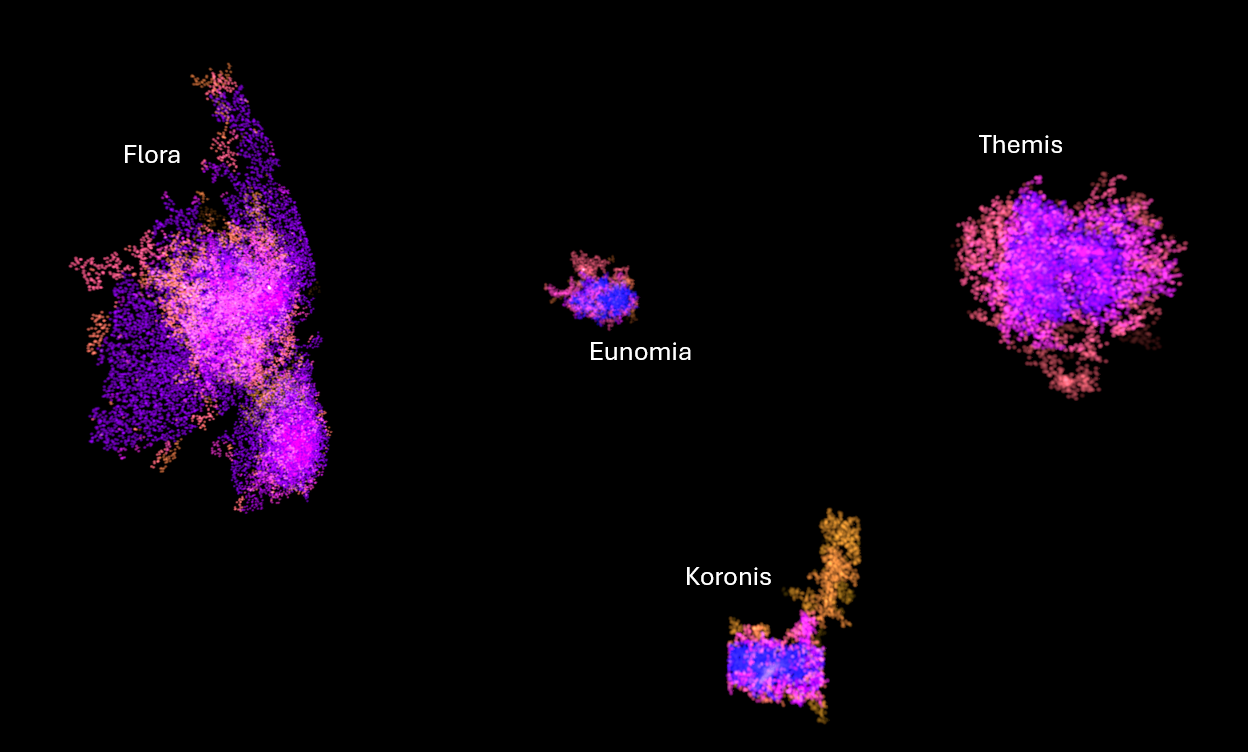
We present a continuous representation of asteroid family membership that reformulates the output of HCM without changing the underlying clustering framework. For each asteroid, we define a joining threshold, vjoin, as the minimum cutoff velocity at which the object becomes connected to a selected family seed. In this formulation, classical HCM membership at any chosen cutoff corresponds to a slice through the distribution of vjoin, while the full set of joining thresholds describes the growth history of the family in cutoff space.

The method is implemented using the standard HCM metric in proper element space introduced by Zappalà et al. and used in modern family catalogues (Nesvorný et al., 2024). Pairwise links are processed in order of increasing HCM distance, and the connected component containing the family seed is tracked as the cutoff velocity increases. This allows vjoin to be assigned to each object in a single pass through the hierarchical connectivity structure. We apply this approach to representative asteroid families using the recent proper-element catalogue of Nesvorný et al. (2024) and compare the resulting vjoin distributions with published family classifications. Population profiles as a function of vjoin reveal distinct regimes corresponding to compact cores, transitional boundary populations, extended halos, and possible large-scale chaining events. Marking published cutoff velocities within these profiles provides a unique way to assess how existing binary family definitions fit within the underlying continuous structure.

Figure 1. Using iDaVIE to plot four asteroid families in proper orbital space with colour and opacity mapped to vjoin reveal different effects of types of family growth with increasing vjoin.

To aid interpretation, we integrate vjoin into the iDaVIE immersive visualisation platform (Sivitilli et al., 2026). In this environment, opacity, colour, or particle size can be mapped to vjoin, or other independent physical parameters such as spectral slope, albedo, or diameter (see Figure 1). This enables interactive exploration of family growth in proper element space, with selected subsets exported or summarised statistically for quantitative follow-up.

This framework does not replace conventional HCM family classifications, but provides an additional object-level diagnostic of membership robustness. It is particularly relevant for increasingly dense asteroid catalogues, where chaining effects and ambiguous family boundaries are expected to become more prominent.

References

  • Zappalà, V., et al., 1990, AJ, 100, 2030.
  • Zappalà, V., et al., 1994, AJ, 107, 772.
  • Nesvorný, D., et al., 2024, ApJS, 274, 25.
  • Kurlander, J. A., et al., 2025, AJ, 170, 99.
  • Sivitilli, A., et al., 2026, Astronomy and Computing, 56, 101109.

How to cite: Sivitilli, A., Christou, A., and Marshall-Lee, A.: Continuous representation of asteroid family membership using hierarchical clustering and immersive visualization, Europlanet Science Congress 2026, The Hague, The Netherlands, 7–11 Sep 2026, EPSC2026-672, https://doi.org/10.5194/epsc2026-672, 2026.

15:42–15:57
|
EPSC2026-36
|
On-site presentation
Susanne Pfalzner, Frank Wagner, and Marco Bischoff
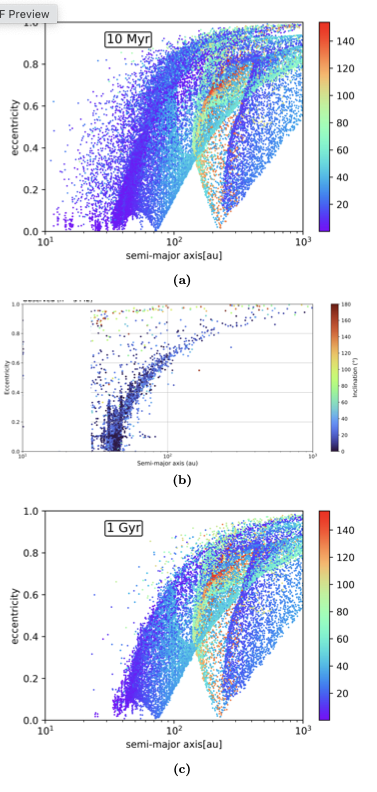
Trans-Neptunian objects (TNOs) predominantly occupy highly inclined and eccentric orbits around the Sun. A hypothesis posits that these orbital architectures arose from a stellar flyby, which gravitationally perturbed the primordial planetesimal disk of the early solar system. Specifically, simulations indicate that a stellar encounter involving a star of Mp = 0.8 M☉, reaching a perihelion distance of rp = 110 au and inclined by ip = 70°, closely reproduces the observed orbital distribution of known. Such a flyby would most likely have occurred several Gyr ago. A key scientific question is whether the fit between the model and observations persists after accounting for subsequent orbital evolution of TNOs over gigayear timescales. Remarkably, incorporating long-term dynamical evolution yields even stronger agreement with the current TNO population.
Our starting point is the situation in which, without interactions with Neptune, the solar system would have reached a new equilibrium state (~12ky after periastron passage). We determine how the long-term evolution of interactions with the giant planets in the Solar System affects the TNO dynamics over the consecutive 4.5 Gyr. One feature is that the resonant population emerges. However, in this work, we concentrate on the non-resonant populations.
Our simulations reveal that dynamical interactions efficiently clear test particles from the vicinity of Neptune within less than 10 million years, particularly those residing in the planetary plane. Consequently, the modelled distribution of TNOs with perihelion distances in the range 30 au < p < 35 au shows improved concordance with observations.
On intermediate timescales (1 Myr < t < 100 Myr), transient resonant TNOs are generated within the planetary region, but these objects are ultimately depleted over ∼1 Gyr. Crucially, prolonged dynamical evolution erases the initial overpopulation of high-eccentricity test particles with semi-major axes 80 au < a < 100 au that emerged immediately post-flyby. As a result, the long-term dynamics further enhance the agreement between the simulated and observed TNO populations.
A modest refinement of the flyby parameters could further improve the match to the perihelion distribution of the non-resonant cold classical population and yield a marginally greater abundance of centaurs after 4.5 Gyr of evolution. Nevertheless, we anticipate that only minimal fine-tuning is necessary to resolve the residual discrepancies in the fit to the non-resonant TNOs. Prior to implementing such adjustments, it is essential to employ higher-resolution simulations to discern whether these minor deviations are genuine features or artifacts of limited numerical resolution.
By modelling the long-term dynamical evolution following the stellar flyby, we are able to formulate testable predictions for future TNO surveys. Specifically, we predict (1) an absence of low-eccentricity TNOs with 80 au < a < 200 au, and (2) the existence of a population of retrograde TNOs with 150 au < a < 300 au and eccentricities in the range 0.6–0.8. These anticipated features provide clear observational diagnostics for upcoming discoveries and serve as critical tests of the stellar flyby scenario.

How to cite: Pfalzner, S., Wagner, F., and Bischoff, M.: Trans-Neptunian Objects: Discovery predictions from the Long-term Evolution after the Stellar Flyby , Europlanet Science Congress 2026, The Hague, The Netherlands, 7–11 Sep 2026, EPSC2026-36, https://doi.org/10.5194/epsc2026-36, 2026.

Orals MON4: Mon, 7 Sep, 16:30–17:57 | Room Earth (Tango 1)

Chairpersons: Ziyu Liu, Man-To Hui
16:30–16:42
|
EPSC2026-635
|
On-site presentation
Marco Fenucci, Bojan Novakovic, Mikael Granvik, and Pengfei Zhang

Asteroid (469219) Kamo'oalewa, discovered by Pan-STARRS in 2016 as 2016 HO3, has attracted significant attention because of both its unusual orbit and its peculiar spectral properties. In addition to being a long-term quasi-satellite of Earth [1,2], its spectrum led to the hypothesis that it may have originated from the Moon as impact ejecta [3], possibly from the Giordano Bruno crater [4]. Kamo'oalewa is also the target of the Tianwen-2 sample-return mission by the China National Space Administration, further increasing interest in its origin and evolution [5,6,7].

In this work, we investigate the relative contribution of two possible sources of Kamo'oalewa-like objects: the general near-Earth asteroid (NEA) population originating from the main asteroid belt, and lunar ejecta from the Giordano Bruno impact. We first used NEA population models to estimate the expected number of Earth co-orbitals in the same size range as Kamo'oalewa. We then performed numerical simulations to determine the fraction of Earth's co-orbital population occupying quasi-satellite states, allowing us to estimate the expected number of Kamo'oalewa-like objects originating from the main belt. An analogous approach was applied to estimate the contribution from the ejecta of Giordano Bruno crater. In addition, we simulated the detection efficiencies of the Catalina Sky Survey and Pan-STARRS for Kamo'oalewa-like objects.

Our simulations show that, on average, 1.4% of the Earth's co-orbital phase space is occupied by quasi-satellite orbits. Combined with current NEA population models, this implies an average of 1.23 ± 0.13 Kamo'oalewa-like objects originating from the main belt. In contrast, the expected number of Kamo'oalewa-like objects produced as Giordano Bruno ejecta is only 0.042, more than an order of magnitude lower. We also find that the detection efficiency of Earth quasi-satellites by Pan-STARRS ranges from about 95% to 70% for objects with absolute magnitudes between 22 and 25, whereas CSS showed a slightly lower efficiency, both in good agreement with the currently known quasi-satellite population.

These results show that current NEA population models based on migration from the main asteroid belt can naturally account for Kamo'oalewa-like objects. In contrast, lunar ejecta do not appear capable of producing a sufficient number of Earth quasi-satellites in the Kamo'oalewa size range, making a lunar origin less likely. Future observations, together with in situ exploration and sample return by Tianwen-2, will provide important new constraints on the origin of this remarkable asteroid.

For more details, see our paper [8]:    https://doi.org/10.1051/0004-6361/202558680

References:

1. de la Fuente Marcos, C., de la Fuente Marcos, R. 2016. Asteroid (469219) 2016 HO3, the smallest and closest Earth quasi-satellite. Monthly Notices of the Royal Astronomical Society 462, 3441–3456

2. Fenucci, M., Novakovic, B. 2021. The Role of the Yarkovsky Effect in the Long-term Dynamics of Asteroid (469219) Kamo'oalewa. The Astronomical Journal 162, id.227

3. Sharkey, B.~N.~L. and 9 colleagues 2021. Lunar-like silicate material forms the Earth quasi-satellite (469219) 2016 HO3 Kamoʻoalewa. Communications Earth and Environment 2, id.231

4. Jiao, Y. and 8 colleagues 2024. Asteroid Kamo`oalewa's journey from the lunar Giordano Bruno crater to Earth 1:1 resonance. Nature Astronomy 8, p. 819-826

5. Zhang, R. and 7 colleagues 2026. Tianwen-2 Mission of China's Planetary Exploration Program. Space Science Reviews 222, id.11

6. Fenucci, M. and 11 colleagues 2025. Astrometry, orbit determination, and thermal inertia of the Tianwen-2 target asteroid (469219) Kamo'oalewa. Astronomy and Astrophysics 695, id.A196

7. Ren, J., Wu, B., Liu, W., Yu, T., Li, H. 2026. Thin regolith layer anticipated on the surface of the Tianwen-2 target asteroid (469219) Kamo'oalewa. Astronomy and Astrophysics 708, id.A142

8. Fenucci, M., Novakovic, B., Granvik, M., Zhang, P. 2026. Origin of asteroid (469219) Kamo'oalewa: The main asteroid belt or the Giordano Bruno crater on the Moon?. Astronomy and Astrophysics 706, id.A276

How to cite: Fenucci, M., Novakovic, B., Granvik, M., and Zhang, P.: On the Origin of Asteroid (469219) Kamo'oalewa: Main-Belt Asteroid or Lunar Ejecta?, Europlanet Science Congress 2026, The Hague, The Netherlands, 7–11 Sep 2026, EPSC2026-635, https://doi.org/10.5194/epsc2026-635, 2026.

16:42–16:54
|
EPSC2026-760
|
On-site presentation
Matthias Läuter, Tobias Kramer, Pedro Gutiérrez, and Nicholas Attree

The dynamics of a solar system object assumed to be a rigid body can be described by the evolutions of its center-of-mass position and of its rotational state. Close to the surface of a cometary nucleus, volatiles sublimate and expand into the surrounding space. This activity causes non-gravitational forces and torques which correspond to dynamical changes of translational and rotational momenta. Sublimation is related to solar irradiation with the corresponding incoming energy. Within a column of cometary material a thermophysical model describes reradiation of energy, fluxes into subsurface layers, and the transformation into the sublimation process. The curvature and the shape of the nucleus are parameters for the incoming energy and the direction of the forces. Most of these parameters are known with high uncertainties only.

In our study we discuss the temporal evolution of the rotational state of a cometary nucleus and its relation to non-gravitational torques. For rotations close to principal axis state, e.g. in the case of comet 67P/Churyumov-Gerasimenko, observed changes of the rotation state yield constraints for activity in certain regions on the surface, see [3,4]. Other comets rotate in non- principal rotation state, e.g. like comet 103P/Hartley 2, see [1]. Rotational dynamics for the asymmetric rotator with zero torque result in complex signals for the analysis of lightcurves, see [2,5]. We attribute temporal changes in the characterisitic periods of the rotator to acting torques. For the shape of 103P which is close to be symmetric, the decision between short axis mode and long axis mode is linked to high uncertainties.

[1] Belton et al. 2013, Icarus 222, 595-609, doi:10.1016/j.icarus.2012.06.037
[2] Gutiérrez et al. 2003, A&A 406, 1123-1133, doi:10.1051/0004-6361:20030845
[3] Kramer et al. 2019, A&A 630, A3, doi:10.1051/0004-6361/201834349
[4] Läuter&Kramer 2025, A&A 699, A75, doi:10.1051/0004-6361/202553845
[5] Samarasinha et al. 2011, ApJL 734, L3, doi:10.1088/2041-8205/734/1/L3

How to cite: Läuter, M., Kramer, T., Gutiérrez, P., and Attree, N.: Constraints for non-gravitational torque given by lightcurve analysis of comet 103P/Hartley 2, Europlanet Science Congress 2026, The Hague, The Netherlands, 7–11 Sep 2026, EPSC2026-760, https://doi.org/10.5194/epsc2026-760, 2026.

16:54–17:06
|
EPSC2026-1109
|
ECP
|
On-site presentation
Csilla Kalup, Csaba Kiss, Zsolt Regály, Viktória Fröhlich, and Thomas Müller

Recent stellar occultations indicate that Quaoar's apparent shape is consistent across all observed events, suggesting that the body is close to a Maclaurin spheroid rather than a triaxial ellipsoid. Such a nearly axisymmetric figure naturally implies a single-peaked rotational light curve with a period of ∼8.8 h, instead of the previously proposed double-peaked 17.7 h period. In this work, we investigate which patterns of surface albedo variation can reproduce the observed visible and infrared thermal emission light curves under this faster rotation scenario. 

We further show that while standard tidal evolution can explain Weywot's present orbit, it cannot explain Quaoar's 17.7 h rotation period. If the true rotation period is instead close to half this value, the tension largely disappears, and Quaoar's figure, primordial rotation, and the long-term tidal influence of Weywot become mutually consistent. Moreover, the dynamical evolution of Quaoar's inner ring provides independent constraints that could be tested using sufficiently high-resolution occultation measurements.

How to cite: Kalup, C., Kiss, C., Regály, Z., Fröhlich, V., and Müller, T.: A Faster Spin for Quaoar?, Europlanet Science Congress 2026, The Hague, The Netherlands, 7–11 Sep 2026, EPSC2026-1109, https://doi.org/10.5194/epsc2026-1109, 2026.

17:06–17:18
|
EPSC2026-718
|
On-site presentation
Nelson Callegari Jr.
To date, hundreds of asteroids have their rotational and orbital parameters well-determined (see [1]). The interest in this topic increased recently with the DART mission on the Didymos-Dimorphos system [2], and the Lucy mission on the Dinkinesh-Selam pair [3]. Focusing on the dynamics of the small secondary companions, a diversity of rotational and orbital configurations is known, e.g., capture into synchronous spin-orbit resonance and asynchronous secondaries (including fast rotators) [4-6]. Rotational dynamics of the small companions in double systems have been studied numerically and analytically in several works (see [7-10] and references therein). The most interesting cases are those where the satellite is out-of-round, since several structures rise inside the synchronous domain of the phase space, leading to more complex rotational scenarios. Among those sites, secondary resonances give rise to centers and saddles within the synchronism, which can occupy considerable volume in the rotational phase space. In this work, we apply the analytical and numerical models given in Wisdom (2004) [11] and Callegari (2024) [12] to map the secondary resonances of several satellites of asteroids and TNOs (including dwarf planets with satellites, like Quaoar and Weywot).  More general modelling and numerical simulations where the orbital dynamics is simulated in the domain of the full 2-body problem are also shown [13, 14].  We show a catalog of the resonances and estimate the amplitude of physical libration of a great deal of asteroid companions in all the centers associated with secondary islands. This mapping should be used in the determination of the current rotational state of several small moons of minor bodies.
 
References
 
[1] Katherine Minker. Origin and structure of binary asteroids. PhD thesis. Université Côte d’Azur (2025). 
[2] Agrusa, H. F. et al. (and more 14 authors). The excited spin state of Dimorphos resulting from the DART impact. Icarus 370 (2021) 114624.
[3] Levison, H. F. et al. (and more 118 authors). A contact binary satellite of the asteroid (152830) Dinkinesh. Nature 629 (2024) 1015.
[4] Pravec, P. et al. (and more 49 authors). Asteroid pairs: A complex picture. Icarus 333 (2019) 429–463.
[5] Pravec, P. et al. (and more 48 authors). Binary asteroid population. 3. Secondary rotations and elongations. Icarus 267 (2016) 267–295.
[6] Minker, K., Carry, B., Vachier, F. (more 36 authors). Orbits of very distant asteroid satellites. Astronomy and Astrophysics 698 (2025) A136.
[7] Cúk, M., Nesvorný, D. Orbital evolution of small binary asteroids. Icarus 207 (2010) 732–743
[8] Gkolias, I., Celletti, A., Efthymiopoulos, C., Pucacco, G. The theory of secondary resonances in the spin–orbit problem. MNRAS 459 (2016) 1327.
[9] Lei, H. Dynamical structures associated with high-order and secondary resonances in the spin–orbit problem. Astron J (2023) 167(3). id.121, 11 pp..
[10] Jafari-Nadoushan, M Surfing in the phase space of spin–orbit coupling in binary asteroid systems. MNRAS 520 (2023) 3514–3528.
[11] Wisdom, J. Spin-orbit secondary resonance dynamics of Enceladus. Astron J (2004) 128:484–91.
[12] Callegari Jr., N. A Hamiltonian for 1/1 rotational secondary resonances, and application to small satellites of Saturn and Jupiter. Commun Nonlinear Sci Numer Simulat 138 (2024) 108224.
[13] Scheeres, D. J. Stability of the planar full 2-body problem. Celest Mech Dyn Astr (2009) 104:103–128.
[14] Carita, G. A., Hussmann, H., Prado, A. F. B. A., Callegari Jr., N., Morais, M. H., Safwan, S., de Carvalho, R. E. Planar dynamics of non-spherical close tidally locked binaries and the restricted three body problem. Nonlinear Dynamics  (2025) 113:16343–16366.
 
Acknowledgments
The São Paulo Research Foundation (FAPESP) (process 2025/02325-1).

How to cite: Callegari Jr., N.: Spin-orbit Dynamics of Binary Asteroids, Europlanet Science Congress 2026, The Hague, The Netherlands, 7–11 Sep 2026, EPSC2026-718, https://doi.org/10.5194/epsc2026-718, 2026.

17:18–17:33
|
EPSC2026-473
|
ECP
|
On-site presentation
John Wimarsson, Richard E. Cannon, Eric Frizzell, Martin Jutzi, and Fabio Ferrari
There is strong evidence of rubble-pile asteroids and comets being tidally disrupted by planets in our Solar System. First and foremost, the destruction of comet Shoemaker-Levy 9 was directly observed as it flew by Jupiter at a distance of 1.33 Jovian radii and was disrupted into 21 fragments due to the overwhelming tidal forces [1]. Second, observations form of crater chains on the moons of Jupiter that likely originate from impacts with fragments from a disruption event [2]. Third, population studies further indicate that tidal disruption of near-Earth objects (NEOs) by terrestrial planets would explain discrepancies between the observed and predicted NEO populations [3]. While analytical models can approximate the tidal distance at which a given rubble pile structurally fails [4], numerical simulations using discrete elements emphasise that the nature of granular mechanics introduces complex dynamical behaviour during the disruption process [5]. For example, computational rubble-pile models consisting of non-spherical elements with randomised packing have significantly higher internal strength [5,6].
 
In this work, we expand on this topic, showing that the choice of particle-size frequency distribution (SFD) also strongly affects the outcome of a given disruption event. Further, we find that tidal chains serve as efficient environments for the formation of contact binaries via low-velocity mergers, providing a complementary mechanism to mergers between fragments created in sub-catastrophic impacts [7].
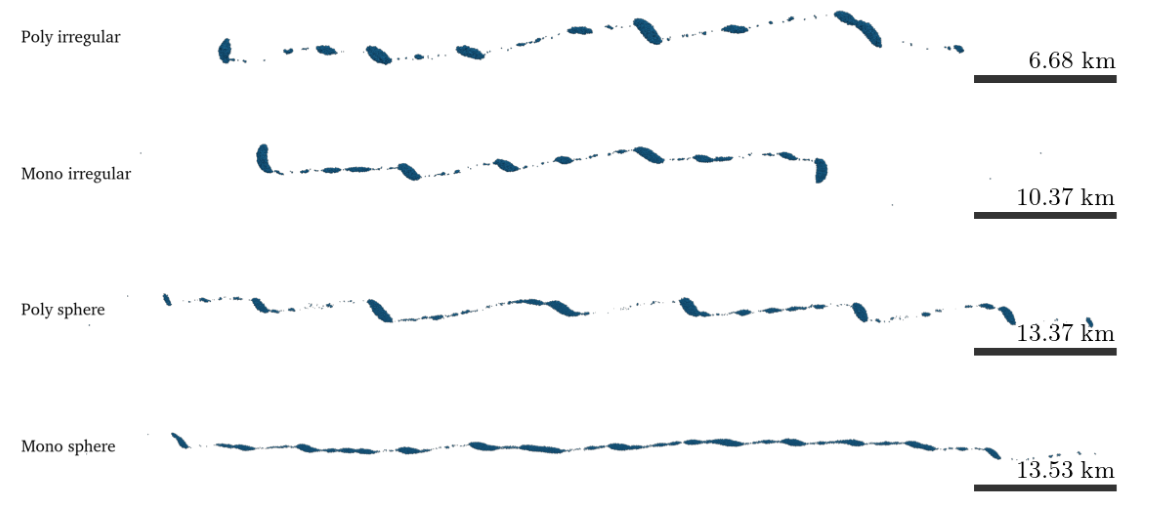
Figure 1: Tidal chains generated from tidal disruption of four different progenitors with identical hyperbolic orbits. The progenitors have irregular or spherical particles, and polydisperse or monodisperse SFDs. Each chain has been aligned with the inertial x-axis of the equatorial plane of the planet. Note the difference in scale, showing the variance in length.
 
Each disruption simulation was modelled using the discrete element method N-body code GRAINS [8], which can use both spherical and irregularly shaped particles. We generated four progenitors with different configurations and let them undergo close encounters with Earth on hyperbolic orbits defined by the periapse distance, q, and the encounter velocity at infinite separation, v. While the resulting mass distributions of fragments are comparable for the four different progenitors when q < 1.7 planetary radii, R, there is a distinct variance further out. In Figure 1, we show the tidal chain 6.3 h after the periapsis passage when q = 1.8R and v = 2 km/s. It is evident that using irregularly shaped particles with a polydisperse SFD leads to a more confined and less continuous tidal chain, where the largest fragment is more massive compared to the other cases. Hence, the heterogeneous internal structure makes both the progenitor and its fragments more stable against disruption.
 
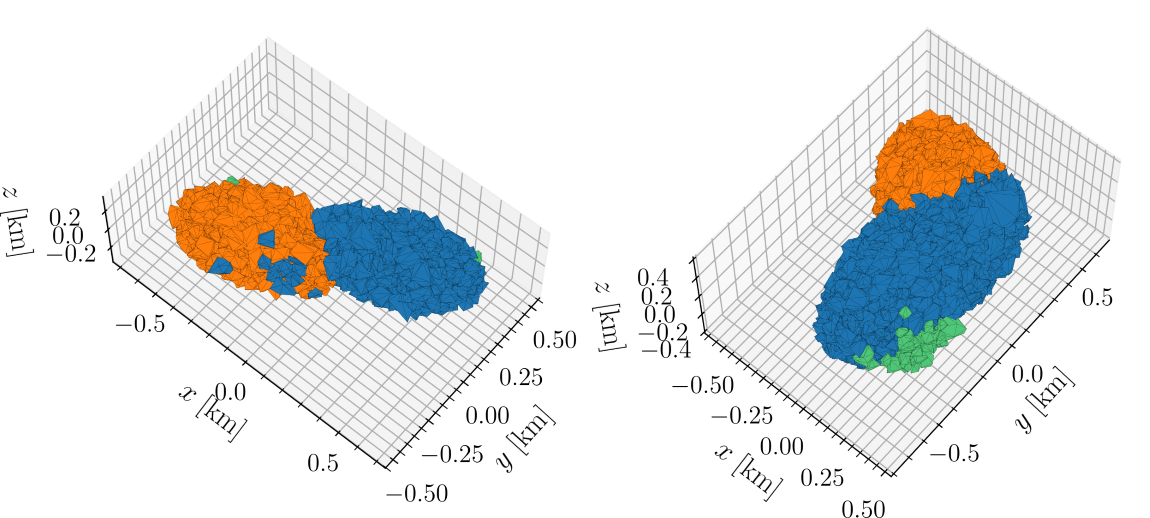
The inherent mechanical strength of the rubble piles consisting of boulders of varying size also plays a role during mergers that occur between remnants in the tidal chain. Given that the individual fragments have velocities that only deviate slightly from the group velocity, there are many cases of bodies remaining gravitationally bound and merging. The same mechanism without a collision can also produce highly eccentric binary systems [9]. We find that more than 150 mergers between fragments across 36 simulations with a mass ratio of at least 0.1 all occur in the sub-escape-velocity regime. The combination of a low impact velocity and significant internal strength allows both the target and impactor to retain their initial shape and create distinct bilobate features in many cases [10]. We show two examples of bilobate objects formed in a tidal chain that remain structurally stable by the end of the simulation in Figure 2.

Figure 2: Two bilobate objects formed in a tidal chain from a disruption event. The colours of a given particle indicate if it originates from the target (blue), the impactor (orange) or from other sources (green).

The number of known bilobate objects in the NEO population is steadily growing, from both radar observations [e.g. 11] and in-situ imaging [12], highlighting that contact binaries are common in the Solar System. One such object with a seemingly bilobate shape is Apophis [13], which will approach the Earth within a distance of 32,000 km in 2029. It is likely that Apophis has undergone previous close encounters with Earth [14], which means tidal disruption provides a solid explanation for its unusual shape. Upcoming missions such as RAMSES [15] that will visit Apophis during its fly-by will be an excellent opportunity to better constrain its shape and bulk density, providing further insights into its origin.
 
J.W. and F.F. acknowledge funding from the Swiss National Science Foundation (SNSF) Ambizione grant No. 193346. M.J. acknowledges support from SNSF project No. 200021_207359.
 
References
1. Sekanina et al. (1994), Astronomy & Astrophysics, 289, 607-636.
2. Schenk et al. (1996), Icarus, 121, 249-274.
3. Granvik & Walsh (2024), The Astrophysical Journal Letters, 960, L9.
4. Holsapple & Michel (2006), Icarus, 183, 331-348.
5. Movshovitz et al. (2012), The Astrophysical Journal, 759, 93-104.
6. Zhang & Michel (2020), Astronomy & Astrophysics, 640, A102.
7. Jutzi & Asphaug (2015). Science, 348, 1355-1358.
8. Ferrari et al. (2020), MNRAS, 492, 749-761.
9. Walsh & Richardson (2006), Icarus, 180, 201-216.
10. Wimarsson et al. (2025), Astronomy & Astrophysics, 704, A29.
11. Cannon et al. (2026). MNRAS, 548, stag543.
12. Demura et al. (2006). Science, 312, 1347-1349.
13. Brozović et al. (2018). Icarus, 300, 115–128.
14. Brož et al. (2026). Astronomy & Astrophysics, 708, A162.
15. Lazzarin et al. (2025). EPSC-DPS 2025, 806.

How to cite: Wimarsson, J., Cannon, R. E., Frizzell, E., Jutzi, M., and Ferrari, F.: From disruption to creation: contact binary formation in tidal chains of heterogeneous rubble piles, Europlanet Science Congress 2026, The Hague, The Netherlands, 7–11 Sep 2026, EPSC2026-473, https://doi.org/10.5194/epsc2026-473, 2026.

17:33–17:45
|
EPSC2026-465
|
On-site presentation
Michael Efroimsky, Michaela Walterová, Yeva Gevorgyan, Amirhossein Bagheri, Valeri V. Makarov, and Amir Khan

The dwarf planet Pluto and its largest moon Charon represent a fully tidally evolved system: their orbital eccentricity is almost zero and their respective rotational periods are equal to the mutual orbital period. Due to Pluto’s unusually high obliquity (119.6°, i.e., high-obliquity retrograde rotation), the similarly tilted, equatorial orbits of its satellites, and the similar sizes of Pluto and Charon, the system is believed to have originated in a giant oblique impact (e.g., Canup, 2005; Arakawa et al., 2019). In this scenario, Charon formed on a tight orbit above the synchronous radius, and evolved by tidal recession from the primary, which was endowed with a large angular momentum and thus fast rotation. A recent, alternative scenario proposes formation by collisional capture (Denton et al., 2025), resulting in Charon’s emplacement on an initially circular close-in orbit and a primordial synchronisation at a high spin rate.

A tidally evolving binary is subjected to surface stresses that are strongly dependent on the mutual distance and, for small orbital separations, may lead to the formation of tidally-oriented fractures in the ice shell, similar to those on Enceladus or Europa. However, the orientation of fractures identified on images from the New Horizons mission is not correlated with expected tidal stresses and has instead been attributed to ocean freezing, which would have postdated the full orbital evolution (Rhoden et al., 2020). Moreover, an initially quickly rotating Pluto (and Charon) consistent with the giant impact scenarios would lead to a considerable rotational bulge that would only be able to relax before present in the case of a thin lithosphere and a weak ice shell above a subsurface ocean (McKinnon et al., 2025). Pluto and Charon also show comparable ice-to-rock fractions, which puts strong limitations on the formation mechanism. The estimated compositions can only be reconciled with a grazing, low-velocity collision of two undifferentiated objects (Canup, 2005) or by the collisional capture model of Denton et al. (2025).

In this work, we adopt the hypothesis that the Pluto-Charon binary was formed by a standard capture, similar to the case of Neptune and Triton. Although Pluto is much smaller than Neptune, a capture of a similarly sized satellites has been shown as feasible, at least in the case of terrestrial planets (Williams & Zugger, 2024; Makarov & Goldin, 2024). We assume that Charon was initially emplaced on a retrograde orbit with respect to Pluto’s rotation and its tidal action gradually led to Pluto’s spin reversal.

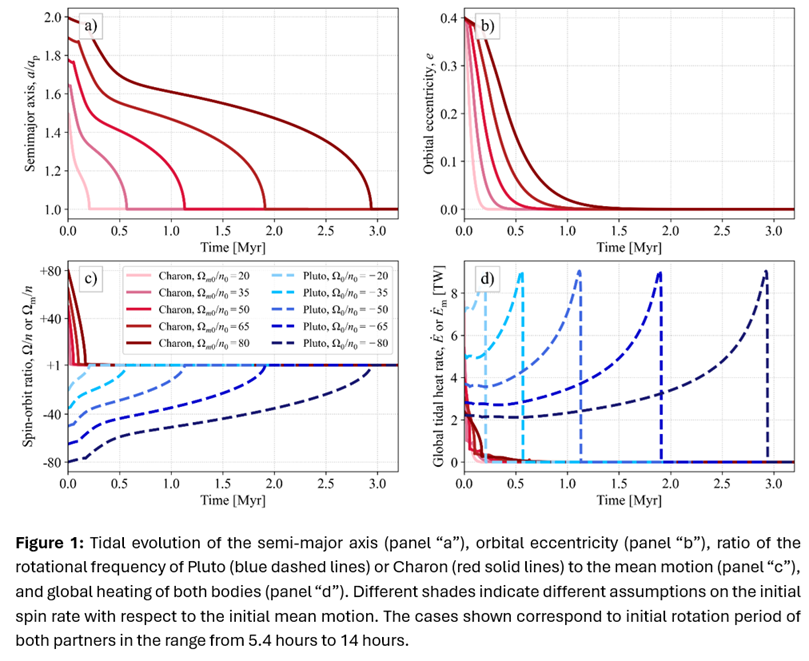
To model the rotational and orbital evolution of two tidally interacting differentiated bodies, we implement the evolution equations of Boué & Efroimsky (2019) and calculate the frequency-dependent tidal Love numbers of both Pluto and Charon using the normal mode theory approach (e.g., Sabadini & Vermeersen, 2004). We also self-consistently evaluate the ongoing tidal dissipation in both partners, following Efroimsky & Makarov (2014). Among the studied parameters are the effect of different initial spin rates of the partners, different initial orbital eccentricities, as well as the role of the ice shell viscosity and the presence of a subsurface ocean on both Pluto and Charon. A test run with varied initial spin rate is depicted in Figure 1.

In all studied cases, the tidal evolution is concluded within several millions of years, on timescales that are two orders of magnitude longer than in the tidal recession scenario (formation by impact). Evolution from a greater distance also leads to two orders of magnitude decrease in tidal heating and tidal stresses with respect to the tidal recession scenario, potentially explaining the lack of tidally oriented fractures. While Pluto’s spin rate evolves on the same time scales as the binary’s orbit and eventually attains retrograde rotation, Charon’s despinning is very rapid (Figure 1c). Depending on the ice shell viscosity, it may get temporarily locked into higher spin-orbit resonances (such as 3:2 or 2:1) that are stable for tens of thousands of years.

Although our model is currently limited to the evolution of the Pluto-Charon binary and does not explain the formation and orbital evolution of Pluto’s smaller satellites, it shows that a tidal evolution from a wider separation following Charon’s capture is a viable alternative that can be reconciled with some of the observed features (missing tidally oriented fractures, Pluto’s retrograde rotation). It also illustrates the dynamical effect of a retrograde secondary on the primary’s rotation, which might have played a role in the tidal evolution of other solar system bodies, such as Venus (Makarov & Goldin, 2024).


Acknowledgements

M.W. has been supported by the Czech Science Foundation grant number 23-06513I.


References

[1] Canup, R. (2005), Science, 307(5709): 546-550, doi: 10.1126/science.1106818.

[2] Arakawa, S., Hyodo, R., Genda, H. (2019), Nature Astronomy, 3: 802-807, doi: 10.1038/s41550-019-0797-9.

[3] Denton, C. A., Asphaug, E., Emsenhuber, A., Melikyan, R. (2025), Nature Geoscience, 18: 37-43, doi: 10.1038/s41561-024-01612-0.

[4] Rhoden, A. R., Skjetne, H. L., Henning, W. G., et al. (2020), Journal of Geophysical Research: Planets, 125: e2020JE006449, doi: 10.1029/2020JE006449.

[5] McKinnon, W. B., Schenk, P. M., Singer, K. N., et al. (2025), Progress in Understanding the Pluto System: 10 Years After Flyby, LPI Contribution No. 3059, 2025, id.7045.

[6] Williams, D. M. and Zugger, M. E. (2024), The Planetary Science Journal, 5(208), doi: 10.3847/PSJ/ad5a9a.

[7] Makarov V. V. and Goldin A. (2024), Universe, 10, 15, doi: 10.3390/universe10010015.

[8] Boué, G. and Efroimsky, M. (2019), Celestial Mechanics and Dynamical Astronomy 131(7), doi: 10.1007/s10569-019-9908-2.

[9] Sabadini, R. and Vermeersen, B. (2004), Global Dynamics of the Earth: Applications of Normal Mode Relaxation Theory to Solid-Earth Geophysics. Kluwer Academic Publishers, Dordrecht, the Netherlands. ISBN 1-4020-2135-6.

[10] Efroimsky M. and Makarov V. V. (2014), The Astrophysical Journal, 795(6), doi: 10.1088/0004-637X/795/1/6.

How to cite: Efroimsky, M., Walterová, M., Gevorgyan, Y., Bagheri, A., Makarov, V. V., and Khan, A.: Tidal evolution of the Pluto-Charon binary in a capture scenario, Europlanet Science Congress 2026, The Hague, The Netherlands, 7–11 Sep 2026, EPSC2026-465, https://doi.org/10.5194/epsc2026-465, 2026.

17:45–17:57
|
EPSC2026-1136
|
On-site presentation
Csaba Kiss, Zsolt Regály, Róbert Szakáts, and Csilla Kalup
Among the largest trans-Neptunian objects (TNOs), the majority of known satellite systems are now understood to possess satellites on nearly circular orbits. This emerging picture contrasts markedly with earlier interpretations, in which several systems appeared to retain significant orbital eccentricities. However, recent high-precision observations, together with careful re-analysis of archival data, have systematically shifted orbital solutions toward very low eccentricities, strengthening the case for efficient tidal dissipation and long-term tidal evolution in these distant binaries. Notably, this revision now includes the Quaoar–Weywot system, whose satellite orbit was originally reported to have an eccentricity of ~0.14, but which is now consistent with a substantially more circular configuration.
 
At present, the Gonggong–Xiangliu system remains the sole major outlier among the large TNO binaries, with Xiangliu’s orbit retaining a substantial eccentricity of e~0.29). Understanding whether this eccentricity reflects incomplete tidal evolution, recent dynamical excitation, or fundamentally different interior and tidal properties is therefore of considerable importance for constraining the formation and long-term evolution of outer Solar System satellite systems.
 
Here we present new measurements of Xiangliu obtained with the Hubble Space Telescope (HST), significantly extending the astrometric baseline available for orbital determination. By combining these new observations with previously published data, we derive an updated orbital solution and revised orbital elements for the Gonggong–Xiangliu system. We further carry out detailed tidal evolution calculations to investigate the dynamical history of the system and assess whether the currently observed orbit can be reconciled with plausible tidal evolution scenarios over the age of the Solar System.

How to cite: Kiss, C., Regály, Z., Szakáts, R., and Kalup, C.:  Refined Orbit and Tidal Evolution of the Gonggong–Xiangliu System, Europlanet Science Congress 2026, The Hague, The Netherlands, 7–11 Sep 2026, EPSC2026-1136, https://doi.org/10.5194/epsc2026-1136, 2026.

Poster lighting talk

Posters: Mon, 7 Sep, 18:00–19:30 | Foyer 3

Display time: Mon, 7 Sep, 08:30–19:30
Chairperson: Ziyu Liu
F3.55
|
EPSC2026-20
|
Virtual presentation
Sergei Ipatov

Introduction. Сollisions of large bodies with planets (mainly during planet formation) could produce ejection of bodies and dust particles. The probabilities of collisions of bodies ejected from the Earth with planets and the Moon were studied by Ipatov (2024a, 2025a). Ipatov (2024b-c, 2025b-c, 2926) presented shorter information about probabilities of collisions of bodies ejected from all terrestrial planets and the Moon with planets. Migration of dust particles was shortly discussed in (Ipatov, 2025c). Below I study the migration of dust ejected from the Earth and Mars. In each calculation variant (“run”), the motion of 250 ejected dust particles was studied for the fixed values of an ejection angle iej, a velocity vej of ejection, and one of three points of ejection. In different variants, iej equaled to 45o, or 15o, or 90o, and vej varied from 11.3 to 20 km/s for the Earth and from 5.05 to 20 km/s for Mars. For points W and B, the particles started from the forward point on the planet's surface in the direction of the planet's motion and from the back point on the opposite side of the planet, respectively. The starting point F is located most far from the Sun. The gravitational influence of the Sun and all planets, radiation pressure, the Poynting-Robertson effect and the solar wind were taken into account. The evolution of orbits was studied during the dynamical lifetime Tend of all particles (until all particles left the Solar System or collided with the Sun or planets). Calculations were carried out for the ratio β of radiation pressure force to gravitational force equaled to 0.0004, 0.004, 0.04 and 0.4 (corresponding to silicate particle diameters of about 1 mm, 100, 10 and 1 micron).

Ejection from the Earth. At β=0.0004 the values of Tend (for a run with 250 particles) were typically between 0.5 and 10 Myr, but could exceed 100 Myr. For 8500 considered 1-mm particles, there were 35 collisions with Mercury, 43 with Venus and 40 with the Earth. For iej=45o the fraction pej of ejected particles was 0 for all ejections from point B and for ejection at small vej from other points. At vej=20 km/s and iej=45opej reached 0.3 for point F and 1 for point W.

At β=0.004 the values of Tend were between 0.006 and 10 Myr. For 8500 considered 100-micron particles, there were 2 collisions with Mercury, 7 with Venus, and 6 with the Earth. Most of particles collided with the Sun. Ejection of particles was in 7 among 34 runs. All particles were ejected from point W at vej=20 km/s and iej=45o. For ejection from point F at vej=20 km/s and iej=45o, pej equaled to 0.27.

At β=0.04 the values of Tend were between 0.003 and 5 Myr. Among 7750 considered 10-micron particles, there was only one collision with planets. The fraction of ejected particles was 0 in all calculations for ejection from point B and also for ejection from point W at iej=89o. For ejection from point W at iej=45o, pej varied from 0 at vej=11.5 km/s to 1 at vej=20 km/s. For ejection from point F at iej=45o, pej varied from 0 at vej=11.3 km/s to 0.3 at vej=20 km/s.

At β=0.4, Tend was less than 0.4 Myr. For 8500 considered micron particles, there were no their collisions with planets. In most calculations at β=0.4, about a half of particles collided with the Sun, and other particles were ejected from the Solar System. For ejection from point W at vej≥14 km/s and iej≥45o, all micron particles were ejected into hyperbolic orbits.

The estimated (based on arrays of orbital elements of migrating particles) ratio of probabilities of collisions of particles with the Earth and the Moon was between 20 and 65 (more often between 25 and 35).

Ejection from Mars. For each β, 4000 particles were considered at iej=45o and different vej and ejection points. At β=0.0004, for 4000 particles there were 15 collisions with Mercury, 20 with Venus, 18 with Earth, and 4 with Mars. For considered series of calculations, Tend was between 0.0005 and 7 Myr. Tend equaled to 0.0005 Myr for ejection from point W at vej=20 km/s. The fraction of bodies collided with the Sun and the fraction pej of ejected particles varied from 0 to 1. At β=0.004, there were 5 collisions with Mercury, 4 with Venus, and 4 with Earth. Depending on vej and an ejection point, pej and the fraction of bodies collided with the Sun varied from 0 to 1, and 0.0005≤Tend≤5 Myr. At β=0.04, the values of pej were between 0 and 1, 0.0005≤Tend≤1.3 Myr, and there were no collisions of particles with planets. At β=0.4, there were no collisions of particles with planets, and in different runs pej varied from 0.5 to 1 (other particles collided with the Sun). The values of Tend were between 0.0004 and 0.45 Myr. For a few series of runs, the estimated ratio of probabilities of collisions with the Earth and the Moon was between 21 and 23 at β=0.4, between 30 and 50 at β=0.04, between 15 and 40 at β=0.004, and between 15 and 35 at β=0.0004.

Acknowledgements: The studies of delivery of material to the Moon were supported by the Russian Science Foundation, project 25-17-00051. Other studies were carried out under government-financed research project for the Vernadsky Institute.

References: Ipatov S.I. (2024a) Solar System Research 58:94-111. https://doi.org/10.1134/S0038094624010040, http://arxiv.org/abs/2405.19797. Ipatov S.I. (2024b) Solar System Research 58. Suppl. 1. P. S50-S63. https://doi.org/10.1134/S0038094623600105. http://arxiv.org/abs/2411.05436. Ipatov S.I. (2024c) Modern astronomy: from the Early Universe to exoplanets and black holes. P. 904-909. https://doi.org/10.26119/VAK2024.143. https://arxiv.org/abs/2501.00134. Ipatov S.I. (2025a) Icarus 425, id. 116341 (24 p.). https://doi.org/10.1016/j.icarus.2024.116341, http://arxiv.org/abs/2411.04218. Ipatov S.I. (2025b) Moscow University Physics Bulletin, V. 80. Suppl. 1. P. S423-S427. https://doi.org/10.3103/S0027134925701279, https://www.researchgate.net/publication/403719268. Ipatov S.I. (2025c) Formation and evolution of planetary systems (in Russian). ISBN 978-5-6055159-1-3. Moscow. Onebook.ru. 132 p. DOI: 10.17513/np.649. https://dx.doi.org/10.17513/np.649. Ipatov S.I. (2026) Proc. of IAU, V. 20, Symposium S393. P. 9-13. DOI: https://doi.org/10.1017/S1743921324001911.

How to cite: Ipatov, S.: Migration of dust particles ejected from the Earth and Mars, Europlanet Science Congress 2026, The Hague, The Netherlands, 7–11 Sep 2026, EPSC2026-20, https://doi.org/10.5194/epsc2026-20, 2026.

F3.56
|
EPSC2026-634
|
On-site presentation
Zsolt Regály, Viktória Frölich, Csilla Kalup, and Csaba Kiss

Can micron-sized dust survive in rings around small, irregular Solar System bodies? We explore this question for Chiron, Chariklo, Quaoar, and Haumea by modeling pebble-sized to sub-millimeter particles under solar radiation pressure, shadowing, heliocentric motion, and the rotating triaxial gravity of the host body. In spherical models, radiation pressure rapidly excites eccentricities and can drive small grains into the central body. Realistic triaxial shapes, however, change the picture: rapid apsidal precession suppresses this eccentricity growth and keeps dusty rings confined over 10^3 yr. For particles larger than roughly 7–40 micron, narrow rings remain dynamically stable. These results show that the oblate and elongated shapes of small bodies may be the key to preserving their surprisingly delicate dusty rings.

How to cite: Regály, Z., Frölich, V., Kalup, C., and Kiss, C.: Rings Around Oddly Shaped Worlds, Europlanet Science Congress 2026, The Hague, The Netherlands, 7–11 Sep 2026, EPSC2026-634, https://doi.org/10.5194/epsc2026-634, 2026.

F3.57
|
EPSC2026-578
|
On-site presentation
Tobias Kramer and Matthias Läuter

The rotation of a rigid body can be expressed by evolution equations for classical Euler angles. For torque-free evolution, analytic solutions for two Euler angle periods are available.
In the presence of a torque generating force, such as in sublimation processes, a perturbative treatment is sometimes possible [1,2]. The body will never return to its initial state, unless the rotation around the body fixed angular momentum after one revolution is commensurable with 2π.
Therefore, light-curves of an irregularly shaped object are in general never repeating exactly.
However, the Fourier spectrum of this object still shows sharp and distinct peaks in various combinations of averaged periods derived from Euler angles [3,4]. We relate this finding to the theory of almost periodic functions and discuss specific examples of light curves for non-principal axis rotators.

[1] Kramer et al. 2019, A&A 630, A3, doi:10.1051/0004-6361/201834349
[2] Läuter&Kramer 2025, A&A 699, A75, doi:10.1051/0004-6361/202553845
[3] Kaasalainen, 2001, A&A 376, 302–309, doi:10.1051/0004-6361:20010935
[4] Samarasinha et al. 2011, ApJL 734, L3, doi:10.1088/2041-8205/734/1/L3

How to cite: Kramer, T. and Läuter, M.: Almost periodic light curves of small rotating bodies, Europlanet Science Congress 2026, The Hague, The Netherlands, 7–11 Sep 2026, EPSC2026-578, https://doi.org/10.5194/epsc2026-578, 2026.

F3.58
|
EPSC2026-183
|
ECP
|
On-site presentation
Artur Aleksandrov and Oleksiy Golubov

Introduction

Binary asteroid systems are of fundamental interest to planetary science, as their orbital and rotational characteristics serve as sensitive indicators of the internal structure of small bodies (particularly porosity and tensile strength) and tidal dissipation parameters. According to photometric and radar observations, the fraction of binary systems in the Near-Earth Asteroid (NEA) population is 15±4% [2,3]. A significant population of binary objects and asteroid pairs is also present in the Main Asteroid Belt (MBA). Investigating the mechanisms of formation, secular evolution, and disruption of these systems is crucial for understanding the overall collisional and dynamical evolution of the Solar System. This work proposes a comprehensive approach to asteroid evolution, combining analytical solutions for equilibrium states with numerical Monte Carlo population modeling.

1. Formation Mechanisms, Evolution, and Equilibrium States

For small asteroids (diameter D≤10 km), the dominant mechanism of binary system formation is the rotational fragmentation of "rubble pile" bodies due to the normal YORP effect (NYORP). The NYORP effect generates a non-zero torque, leading to a secular increase in the angular spin rate ω. Upon reaching the critical angular velocity, centrifugal forces at the equator exceed gravitational forces, initiating mass shedding and satellite formation.

The subsequent dynamics of the newly formed system are governed by the transfer of angular momentum between the components via tidal interactions and the binary YORP (BYORP) effect. The tidal torque promotes the synchronization of the satellite's and primary's rotation with the orbital period. The BYORP effect, in turn, alters the orbital angular momentum.

The system's evolution may culminate in disruption into an asteroid pair (upon orbital expansion) or a merger into a contact-binary asteroid. However, stable dynamical equilibrium states exist that can halt this process. Specifically:

  • NB-equilibrium: a balance between the normal YORP effect and the BYORP effect in doubly synchronous systems.
  • NTBt-equilibrium: a complex equilibrium involving the tangential YORP effect (TYORP), which arises from the asymmetric thermal emission of surface structures (boulders), and tidal friction in systems where only the satellite is synchronized.

2. Observational Data Analysis

Observational data impose strict boundary conditions on modeling results. We analyzed a sample of binary asteroids and asteroid pairs in the inner Main Belt from the Johnston's Archive database.

The age distribution of asteroid pairs exhibits an exponential decline in the number of detected pairs older than 500 kyr, which is attributed to the kinematic divergence of their orbits in the phase space of orbital elements.

To correct for observational bias, a differential asteroid size distribution in the form of a power law N=aD-b was applied. The theoretical estimate of the binary asteroid fraction, calculated solely as the ratio of the BYORP effect timescale to the combined NYORP and BYORP timescales, is 7.2%. This discrepancy with the empirically established 15% [3] demonstrates that simple decay models are insufficient, and the lifecycle of these systems is significantly prolonged by dynamical equilibrium states and stochastic perturbations.

3. Numerical Modeling Methodology of System Evolution

To investigate the dynamics of transitions between different synchronization states, a numerical integration program for orbital and rotational evolution was developed. The algorithm solves a system of ordinary differential equations, accounting for the combined action of the torques: NYORP, TYORP, BYORP, and tides.

Phase portraits of the systems demonstrate that, given appropriate combinations of YORP coefficient signs, phase trajectories asymptotically converge to stable equilibrium points (for both singly and doubly synchronous configurations), making these states powerful attractors in the evolution of binary asteroids.

4. Monte Carlo Population Modeling

To reproduce the macroscopic properties of the asteroid belt, a special population module was created. Instead of isolated modeling of a single system, the program integrates the evolutionary track of a large ensemble (population) of asteroids over timescales of 107-109 years.

Initial parameters are generated stochastically: sizes correspond to observed Size-Frequency Distributions (SFD), rotation periods are drawn from a Maxwellian distribution, and dimensionless YORP coefficients are assigned randomly.

The Monte Carlo modeling incorporates two key evolutionary channels:

  • Secular YORP cycle: spin-up of a single body, rotational fission, tidal evolution of the binary system, reaching equilibrium or disrupting into a pair under the BYORP effect.
  • Stochastic collisional cascade: collisions with the background asteroid population are simulated as a Poisson process. Micro-collisions alter surface morphology, leading to random walks (stochastic YORP), significantly extending the lifetime of asteroids before disruption, but also allowing an exit from stable YORP equilibria. Sub-catastrophic impacts can generate satellites of the SMATS (Smashed Target Satellites) [1] type or shatter the body into fragments, forming pairs bypassing the YORP constraints.

The objective of the module is the multi-parameter optimization of physical constants (energy dissipation factor Q, mass fraction of a newly formed secondary) to minimize deviations between the simulation results and empirical data (binary asteroid fraction, age spectrum of asteroid pairs, size, and rotational period distribution for binaries and pairs).

Conclusions

The integration of secular evolution models with Monte Carlo population synthesis allows for a quantitative comparison of different theoretical paradigms of asteroid dynamics. The simulations confirm that dynamical equilibrium states (involving tangential YORP and BYORP) are a necessary factor for maintaining the observed binary population fraction (about 15%), as without them, the systems disrupt too rapidly. 

References

1. Durda D. D., Bottke Jr W. F., Enke B. L., Merline W. J., Asphaug E., Richardson D. C., Leinhardt Z. M. (2004). Icarus, 167(2), 382-396.

2. Margot J.-L., Pravec P., Taylor P., Carry B., Jacobson S. (2015). Asteroid systems: binaries, triples, and pairs. Asteroids IV, 355, 373.

3. Pravec P., Scheirich P., et al. (2016). Icarus, 267, 267-295.

How to cite: Aleksandrov, A. and Golubov, O.: Simulation of binary asteroid populations under the influence of the YORP effects, tides, and collisions, Europlanet Science Congress 2026, The Hague, The Netherlands, 7–11 Sep 2026, EPSC2026-183, https://doi.org/10.5194/epsc2026-183, 2026.

F3.59
|
EPSC2026-689
|
On-site presentation
Dusan Marceta and Marko Gavrilovic

The orbital evolution of potentially hazardous asteroids is strongly affected by the Yarkovsky effect, which plays a key role in long-term trajectory prediction and impact risk assessment. Modeling this effect becomes particularly challenging for asteroids in complex rotational states, such as tumbling objects. The close encounter of 99942 Apophis on 13 April 2029 is expected to significantly modify its rotational state (Benson et al. 2023), providing a unique opportunity to investigate how changes in tumbling dynamics influence the resulting Yarkovsky acceleration and the subsequent orbital evolution. Building on the open-source thermophysical model TEMPEST(Lyster et al. 2025), we present a new numerical framework specifically designed for tumbling rotational states. The model enables the implementation of full tumbling dynamics, as illustrated in Fig. 1 for the case of 99942 (Pravec et al. 2014). 


Figure 1. Short-principal-axis tumbling period convention illustrated for the case of 99942 Apophis

This framework explicitly accounts for the dual-frequency nature of non-principal axis rotation by integrating both the average precession period (0) of the asteroid’s inertia axis around the angular momentum vector H and the intrinsic rotation period (Pψ) about that axis. By continuously propagating the asteroid’s heliocentric orbit while simultaneously resolving its complex rotational motion, the model naturally captures the total Yarkovsky acceleration. 

Numerical simulations are being performed to investigate the sensitivity of the semi-major axis drift to variations in the tumbling parameters, representing the range of possible states Apophis might adopt after its 2029 close approach. Preliminary analysis suggests that expected shifts in the orientation of the angular momentum vector or the ratio of rotation periods can noticeably alter the magnitude of the Yarkovsky effect, and in certain cases might even reverse the direction of the resulting acceleration. These findings contribute to more reliable orbit determination and long-term impact risk analysis, providing a robust framework to maintain accurate trajectory prediction across the 2029 close encounter and beyond.

Acknowledgements: This research is supported by The Science Fund of the Republic of Serbia through Project No. 7453 Demystifying enigmatic visitors of the near-Earth region (ENIGMA)

References:

Benson, C. J., Scheeres, D. J., Brozović, M., et al. (2023). Spin state evolution of (99942) Apophis during its 2029 Earth encounter. Icarus, 390, 115324.

Lyster, D., Howett, C., Penn, J. (2025). TEMPEST: A Modular Thermophysical Model for Airless Bodies with Support for Surface Roughness and Non-Periodic Heating. EPSC-DPS Joint Meeting 2025, EPSC-DPS2025-1479.

Pravec, P., Scheirich, P.,Ďurech, J., et al. (2014). The tumbling spin state of (99942) Apophis. Icarus, 233, 48-60.

How to cite: Marceta, D. and Gavrilovic, M.: Numerical Modeling of the Yarkovsky Effect for Tumbling Asteroids: The Case of 99942 Apophis, Europlanet Science Congress 2026, The Hague, The Netherlands, 7–11 Sep 2026, EPSC2026-689, https://doi.org/10.5194/epsc2026-689, 2026.

F3.60
|
EPSC2026-442
|
ECP
|
On-site presentation
Michaela Walterová and Alexandr Dizov

Pluto’s small moons, Styx, Nix, Kerberos, and Hydra, present a unique probe of the system’s past dynamical evolution. All four are located on circular orbits aligned with the orbital plane of Pluto’s largest satellite Charon, and all reside close to integer mean-motion resonances with Charon, with orbital periods approximately in the ratios of 3:4:5:6 [1]. Styx, Nix, and Hydra are also locked in a Laplace-like three-body resonance [2]. Furthermore, the small satellites have a high albedo, indicating their ice-rich composition and a likely origin within the Pluto system [1].

The system’s present-day orbital configuration was likely affected by past tidal evolution of the central binary. According to the leading formation hypothesis, Charon originated in a collision of its progenitor with an ancient Pluto and the two bodies then evolved by tidal recession onto their present circular mutual orbit, fully synchronising their rotation frequencies with the mean motion [3]. Alternatively, Charon might have been captured as an originally retrograde satellite of Pluto, which would result in an inward orbital evolution and change in Pluto’s rotation direction [4]. While the former scenario provides a clear mechanism for the small satellites’ formation from the post-impact debris [5], the latter scenario may be reconciled with the idea of a subsequent collision of another Kuiper Belt object with Charon [6]. Nevertheless, whether the inward tidal evolution can lead to the observed configuration of the circumbinary satellite system is currently unknown and has not been tested by [4].

In this preliminary study, we combine calculations of the Pluto-Charon binary’s tidally-induced rotational and orbital evolution in both aforementioned scenarios with an N-body simulation of circumbinary satellites, similarly to the model of [7]. For the tidal interaction, we assume that Pluto and Charon are differentiated bodies composed of liquid and viscoelastic solid layers. This assumption leads to different evolution timescales than the constant time lag or constant phase lag tidal models that are usually used. The tidal evolution is treated within the Darwin-Kaula formalism [8,9], where both the tidal potential and the evolution equations (in particular, Lagrange planetary equations and Euler’s second law) are expanded in series of multiple tidal modes at different frequencies. Since the tidal response of viscoelastic bodies is frequency-dependent, we precalculate tables of complex tidal potential Love numbers of both Pluto and Charon at a wide range of frequencies and use the appropriate values for each mode.

The tidal model is then coupled to the N-body integrator Rebound [10]. For testing purposes, we assume that the only massive particles are Pluto and Charon, and we evaluate the stability of possible circumbinary orbits by including a cloud of ~10,000 massless particles extending up to several present-day radii of Hydra’s orbit. The initial conditions for these particles are chosen from a model distribution of Keplerian elements based on a prior test run over 100 orbital periods of Charon, which is initially emplaced on an eccentric orbit below or above its present-day location (at a larger or smaller semi-major axis, depending on the tidal evolution scenario).

During the simulation runs with a tidally-evolving Pluto and Charon, we monitor collisions of the test particles with the two massive bodies as well as ejections from the system. We then assess both the initial and the final orbital elements of the surviving particles and we discuss the configuration of the resulting system.


Acknowledgements

This work has been supported by the Czech Science Foundation grant number 23-06513I.


References:

[1] Weaver, H. A. et al. (2016), Science, 351(6279), doi: 10.1126/science.aae0030.

[2] Showalter, M. R. and Hamilton, D. P. (2015), Nature, 522(7554):45-49, doi: 10.1038/nature14469.

[3] Canup, R. M. (2005), Science, 307(5709):546-550, doi: 10.1126/science.1106818.

[4] Efroimsky, M. et al. (2026), Planet. Sci. J., 7(3):68, doi: 10.3847/PSJ/ae47f7.

[5] Canup, R. M. (2011), Astron. J., 141(2):35, doi: 10.1088/0004-6256/141/2/35.

[6] Bromley, B. C. and Kenyon, S. J. (2020), Astron. J., 160(2):85, doi: 10.3847/1538-3881/ab9e6c.

[7] Woo, J. M. Y. and Lee, M. H. (2018), Astron. J., 155(4):175, doi: 10.3847/1538-3881/aab367.

[8] Kaula, W. M. (1964), Rev. Geophys. Space Phys., 2(4):661-685, doi: 10.1029/RG002i004p00661.

[9] Boué, G. and Efroimsky, M. (2019), Cel. Mech. Dyn. Astron., 131(7), id. 30, doi: 10.1007/s10569-019-9908-2.

[10] Rein, H. and Spiegel, D. S. (2015), Mon. Not. R. Astron. Soc., 446(2):1424-1437, doi: 10.1093/mnras/stu2164.

How to cite: Walterová, M. and Dizov, A.: Numerical investigation of Pluto’s system in two tidal evolution scenarios, Europlanet Science Congress 2026, The Hague, The Netherlands, 7–11 Sep 2026, EPSC2026-442, https://doi.org/10.5194/epsc2026-442, 2026.

F3.61
|
EPSC2026-336
|
ECP
|
On-site presentation
Martina Kováčová

Resonances play a significant role in the transport of bodies throughout the Solar System and, therefore, also in the transport to the NEO (Near-Earth Object) region.

Our last presentations at EPSC conferences were dedicated to the transportation abilities of the 5:2 and 3:1 MMRs (Mean Motion Resonances) with Jupiter [1, 2]. It was interesting to find that the 5:2 MMR may not be as inefficient in transport into the NEO region as we thought, compared to the 3:1 MMR. However, our integrations did not include non-gravitational effects to be consistent with previous studies. To select initial conditions for the simulations, we used short-term FLI (Fast Lyapunov Indicator [3]) maps to differentiate between stable and unstable orbits. This time, we decided to include non-gravitational effects, specifically the Yarkovsky effect, because we are also interested in potentially hazardous objects. Other non-gravitational effects (e.g., Poynting-Robertson effect) are effective mainly for dust particles.

We study the 3:1 MMR with Jupiter again to determine how significant the difference will be after adding the Yarkovsky effect to the integrations. We use an implementation of the Yarkovsky effect available within REBOUNDx [4]. We plan to repeat our simulations for 10 Myr with the same initial conditions as previously; however, these particles will no longer be massless. We started with generally used values, such as 0.15 for albedo and 2.5 g/cm3 for mean density. We plan to take several particle radii into account and also to consider migration inwards as well as outwards. For each combination of these values, we will integrate the whole set of 10080 particles and track their orbital evolution. Later, we want to try also other values for albedo and mean density. As in previous works, we are interested in transport into the NEO region, final states, migration toward the Sun, close encounters and collisions with planets or the Sun, potentially hazardous orbits, etc.

At EPSC 2026 in the Hague, we will present our preliminary results.


Acknowledgement:

This work was supported by the PostdokGrant APD0197 and by the VEGA - Slovak Scientific Grant Agency, grant No. 2/0041/26.


References:

[1] Kováčová, M.: Re-examination of the transportation abilities of the 5:2 MMR with Jupiter, Europlanet Science Congress 2024, Berlin, Germany, 8–13 Sep 2024, EPSC2024-565, https://doi.org/10.5194/epsc2024-565, 2024.

[2] Kováčová, M.: Examination of the transportation abilities of the 3:1 MMR with Jupiter, EPSC-DPS Joint Meeting 2025, Helsinki, Finland, 7–12 Sep 2025, EPSC-DPS2025-355, https://doi.org/10.5194/epsc-dps2025-355, 2025.

[3] Skokos C., Gottwald G. & Laskar J., 2016, Chaos detection and predictability (Chapter 2)

[4] REBOUNDx (https://reboundx.readthedocs.io/en/latest/)

How to cite: Kováčová, M.: Examination of the transportation abilities of the 3:1 MMR with Jupiter II, Europlanet Science Congress 2026, The Hague, The Netherlands, 7–11 Sep 2026, EPSC2026-336, https://doi.org/10.5194/epsc2026-336, 2026.

F3.62
|
EPSC2026-1085
|
On-site presentation
Frank W. Wagner, Marco Bischoff, and Susanne Pfalzner

The resonant populations of Trans-Neptunian Objects (TNOs), particularly those in mean-motion resonances with Neptune, provide crucial insights into the early history of the Solar System, specifically the mechanisms that shaped the outer Solar System. Currently, the prevailing model suggests that Kuiper Belt Objects (KBOs) in resonance with Neptune result from resonant capture during planetary migration (e.g., Malhotra, 2019); however, this model requires an additional external force to account for TNOs with orbits far beyond the gravitational influence of the planets. We investigate an alternative scenario, where long-term interactions with Neptune after a potential stellar flyby produce resonant TNO populations (Pfalzner et al., 2024). Using N-body simulations on a compute cluster, we model 4.5 Gyr of orbital evolution of TNOs and the four giant planets, with and without a small primordial population of classical KBOs, considering two different primordial disk sizes (150 AU and 300 AU). A machine learning classifier, similar to the one proposed by Volk & Malhotra (2025), is employed to identify objects in the simulation data that are in mean-motion resonance (MMR) with Neptune. Our initial results indicate that interactions with Neptune quickly produce resonant orbits, including the 5:2 resonance, which is often underpopulated in other models. Unlike the current incomplete picture from astronomical observations, which suggests the 3:2 MMR as the most dense population due to proximity, simulations favour the more distant 2:1 MMR as densest. Additionally, the simulations reveal a few other significant denser populations for farther-out resonances that are affected by the primordial disk size. The inclusion of a small primordial population of classical TNOs with mutual interactions appears to sustain the resonant population over time, probably resulting from processes described in Punzo et al. (2014). Our findings have implications for understanding the mechanisms that shaped the Solar System and the origins of TNO populations.

References:

Malhotra, R. (2019): Resonant Kuiper belt objects: a review. Geosci. Lett. 6, 12. https://doi.org/10.1186/s40562-019-0142-2

Pfalzner, S., Govind, A. & Portegies Zwart, S. (2024): Trajectory of the stellar flyby that shaped the outer Solar System. Nat. Astron. 8, 1380-1386. https://doi.org/10.1038/s41550-024-02349-x

Volk, K. & Malhotra, R. (2025): Chapter Seven - Machine learning-assisted dynamical classification of trans-Neptunian objects. In: Machine Learning for Small Bodies in the Solar System. Edited by V. Carruba, E. Smirnov & D. Oszkiewicz. ISBN: 978-0-443-24770-5. Elsevier. https://doi.org/10.1016/B978-0-44-324770-5.00012-X

Punzo, D., Capuzzo-Dolcetta, R. & Portegies Zwart, S. (2014): The secular evolution of the Kuiper belt after a close stellar encounter. Mon. Not. R. Astron. Soc. 444, 3, 2808-2819. https://doi.org/10.1093/mnras/stu1650

How to cite: Wagner, F. W., Bischoff, M., and Pfalzner, S.: Resonant Trans-Neptunian Objects from Neptune Interactions in the Stellar Flyby Scenario, Europlanet Science Congress 2026, The Hague, The Netherlands, 7–11 Sep 2026, EPSC2026-1085, https://doi.org/10.5194/epsc2026-1085, 2026.