
 1,2,1,2
- 1LATMOS/IPSL, UVSQ Université Paris-Saclay, Sorbonne Université, CNRS, Guyancourt, France
- 2LIRA, Observatoire de Paris, Université PSL, Sorbonne Université, Université Paris Cité, CY Cergy Paris Université, CNRS, 92195 Meudon, France
1. Introduction
Titan hosts a unique atmosphere in the Solar System, characterized by an extremely complex organic chemistry. Composed primarily of nitrogen (≈ 98% N2 ) and methane (≈1.5% CH4 ) in the stratosphere, it undergoes photochemical processes driven by solar radiation and energetic particles, leading to the formation of a wide range of complex organic species.
These processes result in the production of photochemical aerosols, initially formed in the ionosphere at altitudes between 900 and 1300 km as spherical monomers of less than 10–30 nm in size (Lavvas et al. (2013)). These particles then sediment into the stratosphere, where they aggregate into fractal structures and continue to evolve through additional chemical and physical processes. They ultimately settle onto the surface over timescales of a few years.
The Cassini-Huygens mission provided observational constraints on aerosol composition, revealing variations in infrared spectral signatures with latitude and altitude. However, the physical and chemical processes driving these variations — and their seasonal evolution — remain poorly understood. Laboratory analogues offer a powerful approach to disentangling these effects, yet a direct and systematic comparison with observational data across a broad range of latitudes and seasons has not yet been performed.
2. Methods
The methodology adopted in this work combines both observational and experimental approaches in order to better constrain the nature of Titan’s photochemical aerosols.
The observational approach consists of analyzing the continuum of Cassini/CIRS limb spectra, following the methodology developed by Vinatier et al. (2012). We retrieved the aerosols spectrum over the 7–16 µm (600–1500 cm-1 ) spectral range from high-resolution limb observations collected throughout the Cassini mission, from 2006 to 2015 (Mathé et al. (2020)). This allows us to investigate spatial and seasonal variability across latitudes from 84°S to 88°N and spanning northern winter, equinox, and northern spring.
In parallel, we produced tholins with the PAMPRE experiment (Szopa et al. (2006)), which simulates ion-driven chemistry responsible for aerosol formation on Titan, using different input gas mixtures. Infrared spectroscopy of the samples was performed over the same spectral regions as observed by CIRS, following approaches described in Gautier et al. (2012). Complementary techniques — SEM (scanning electron miscroscopy), elemental analysis, and mass spectrometry — allow for further characterization of their physical and chemical properties.
Previous studies (Hadamcik et al. (2009)) explored the influence of experimental parameters on Titan aerosol analogues, but without direct comparison to the large seasonal and latitudinal variability observed by Cassini. Here, by varying gas composition and plasma exposure time — allowing the chemistry to evolve to different stages — and comparing the resulting spectra with CIRS observations acquired over a wide range of latitudes and seasons, we aim to better constrain the chemical composition of Titan’s aerosols and its evolution with atmospheric conditions.
3. Results and perspectives
The analysis of the Cassini/CIRS high-resolution limb spectra, with spectral bins of 5 cm-1 wide over the 600–1500 cm-1 spectral range, reveals no latitudinal variations of the haze extinction coefficient kext during Titan’s northern winter (Figure 1), suggesting stable aerosol composition with latitude during this season. In contrast, clear seasonal variations are observed throughout Titan's northern spring (Figure 2), with differences in band intensity near 1380 cm-1 and 1460 cm-1 — associated with C–H vibrational modes — indicating seasonal changes in aerosol composition.
Figure 3 presents a preliminary comparison between a CIRS spectrum near the equator (5°N) at different pressure levels and a tholin spectrum from the PAMPRE experiment using a 5% CH4 mixture at 55 sccm. The partial agreement observed in the 1380–1460 cm-1 region supports the relevance of PAMPRE tholins as aerosols analogues.
The next step of this work is to perform a systematic comparison between the aerosol observed spectra and the full laboratory tholin dataset to constrain, aerosol composition and chemical complexity as a function of altitude, latitude, and season — providing a basis for interpreting future Dragonfly mission measurements at Titan's surface.
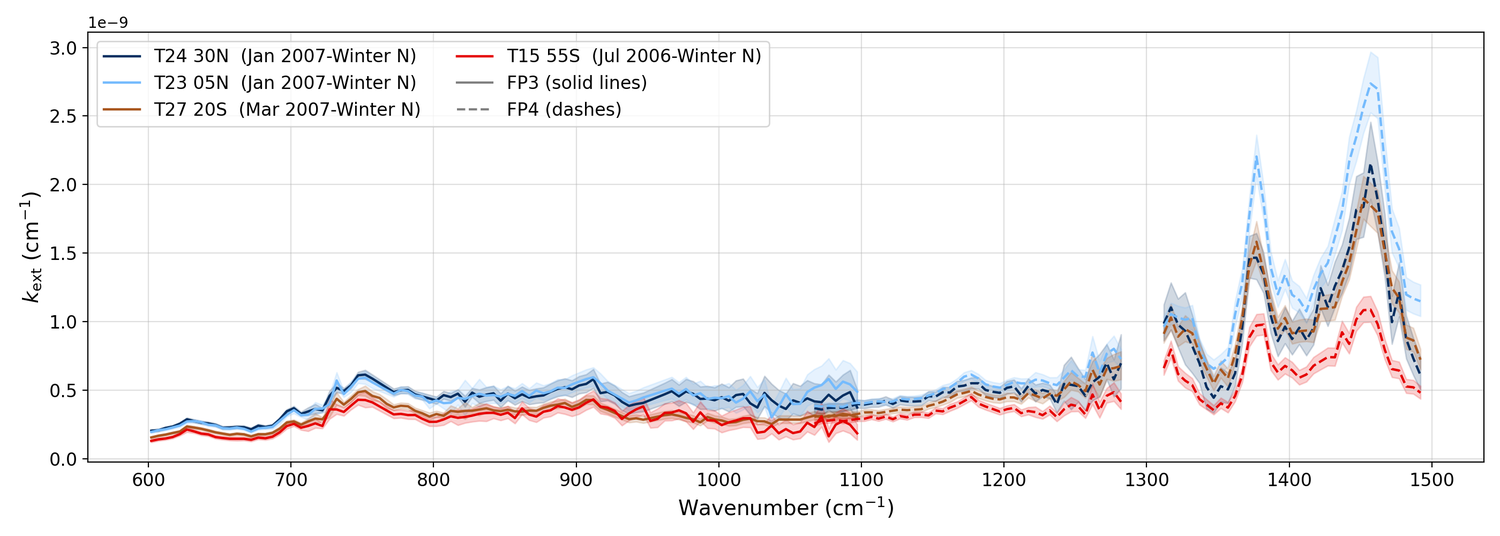
Figure 1: Comparison of the haze extinction coefficient kext at four latitudes during Titan’s northern winter, from 600 cm-1 to 1500 cm-1 between 0.2-1 mbar (≈ 175-220 km), observed with the FP3 and FP4 detectors of the Cassini/CIRS instrument.
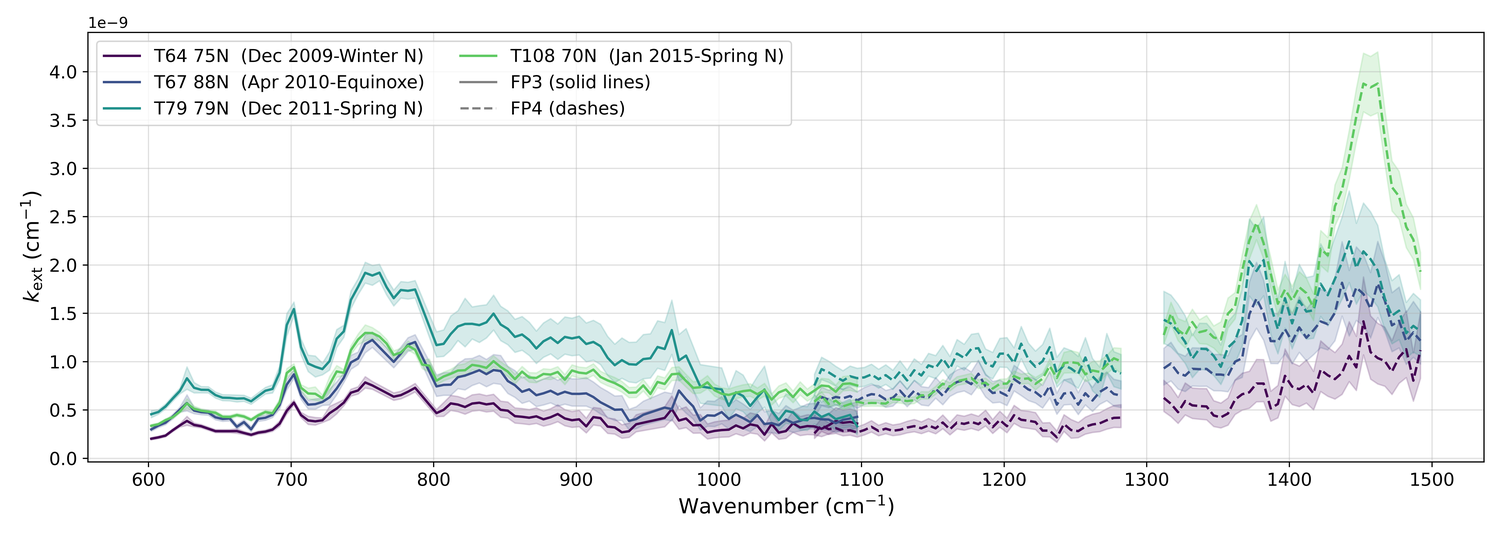
Figure 2: Comparison of the haze extinction coefficient kext at four latitudes across Titan’s northern spring, from 600 cm-1 to 1500 cm-1 between 0.2-1 mbar (≈ 175-220 km), observed with the FP3 and FP4 detectors of the Cassini/CIRS instrument.
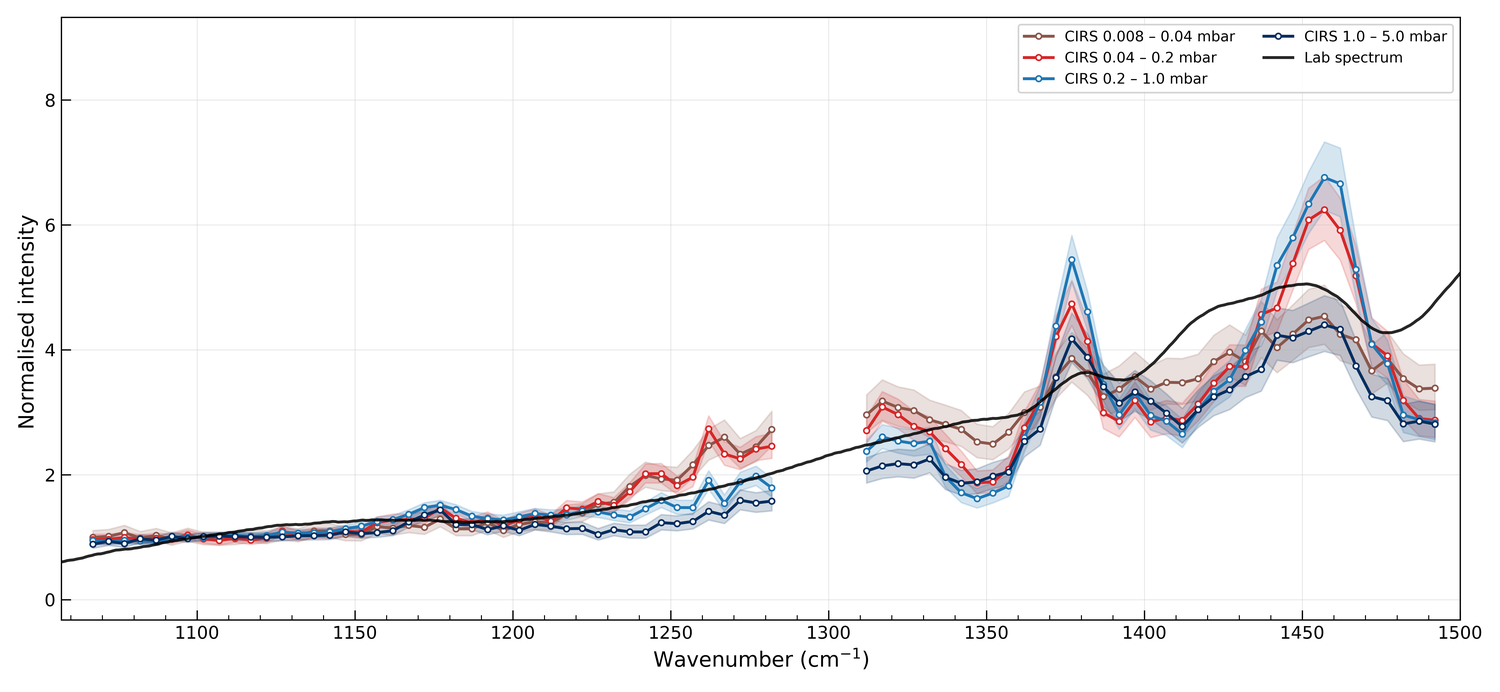
Figure 3: Preliminary comparison in the 1000-1500 cm-1 spectral range between a CIRS spectrum at 05°N during the T23 flyby, retrieved at different pressure levels in Titan’s atmosphere, and a tholin spectrum produced in the PAMPRE experiment using a 5% CH4 mixture at a flow rate of 55 sccm, both normalized at 1100 cm-1 .
References
[1] P. Lavvas et al. “Aerosol growth in Titan’s ionosphere”. In: Proceedings of the National Academy of Sciences 110.8 (2013), pp. 2729–2734. doi: 10.1073/pnas.1217059110.
[2] S. Vinatier et al. “Optical constants of Titan’s stratospheric aerosols in the 70–1500 cm−1 spectral range constrained by Cassini/CIRS observations”. In: Icarus 219.1 (2012), pp. 5–12. doi: 10.1016/j.icarus.2012.02.009.
[3] C. Mathé et al. “Seasonal changes in the middle atmosphere of Titan from Cassini/CIRS observations: Temperature and trace species abundance profiles from 2004 to 2017”. In: Icarus 344 (2020). Cassini Mission Science Results, p. 113547. doi: 10.1016/j.icarus.2019.113547.
[4] C. Szopa et al. “PAMPRE: A dusty plasma experiment for Titan’s tholins production and study”. In: Planetary and Space Science 54.4 (2006), pp. 394–404. doi: 10.1016/j.pss.2005.12.012.
[5] T. Gautier et al. “Mid- and far-infrared absorption spectroscopy of Titan’s aerosols analogues”. In: Icarus 221.1 (2012), pp. 320–327. doi: 10.1016/j.icarus.2012.07.025.
[6] E. Hadamcik et al. “Laboratory light-scattering measurements with Titan’s aerosols analogues produced by a dusty plasma”. In: Planetary and Space Science 57.13 (2009), pp. 1631–1641. doi: 10.1016/j.pss.2009.06.013.
How to cite: Maurice, C., Rering, O., Chatain, A., and Vinatier, S.: Seasonal and Latitudinal Variability of Titan's Stratospheric Aerosols Composition: Cassini/CIRS and Laboratory Constraints, Europlanet Science Congress 2026, The Hague, The Netherlands, 7–11 Sep 2026, EPSC2026-363, https://doi.org/10.5194/epsc2026-363, 2026.


