
 1,1,1,1,2,3,1,4,5,2,
- 1Instituto Nacional de Técnica Aerospacial (INTA), Torrejon de Ardoz, Madrid, Spain (rrodvel@inta.es)
- 2Centro de Astrobiología (INTA-CSIC). Torrejón de Ardoz, Madrid. Spain.
- 3Space Science Institute, Boulder, CO, USA.
- 4Bilbao School of Engineering, Universidad del País Vasco UPV/EHU, Bilbao, Spain.
- 5NASA Godard Space Flight Center, Greenbelt, MD, USA.
Aerosols on Mars are a primary element for studying the interaction between the solar radiation and the atmosphere and surface. Depending on properties such as aerosol number density, particle radius, or refractive index, the aerosols can provide positive or negative radiative feedbacks on the atmospheric dynamics. Previous studies have revealed large temporal and spatial variability in the aerosol optical properties, emphasizing the need for continuous monitoring throughout the day and at multiple locations. To address these measurements, the Radiation and Dust Sensor (RDS) [1] was included as part of the Mars Environmental Dynamics Analyzer (MEDA) [2] payload onboard the Perseverance rover of the Mars 2020 mission. The RDS instrument is composed of two sets of eight photodiodes (RDS-DP) and a sky-pointed camera (RDS-SkyCam). One set, oriented toward the zenith, captures radiation from 190 to 1200 nm, while the other, inclined 20° above the horizon at 45° azimuthal intervals, samples a single wavelength. The analysis of these observations, through a radiative transfer model [3], allows for the retrieval of key aerosol parameters such as aerosol opacity at different wavelengths and particle radius. However, the continuous deposition of dust over the sensors [4], since the beginning of the mission, introduces modifications in their optical response. In particular, the zenith-pointed photodiodes require angular response calibration due to the progressive accumulation of dust on their optical surfaces. Here, we present the calibration approach developed for the mission, essential to ensure the accuracy of aerosol property retrievals and reliable long-term atmospheric monitoring. Figure 1 shows the temporal evolution of the RDS-TOP 7 irradiance change derived from our calibration alongside Matscam-Z opacities [5], highlighting the impact of atmospheric conditions. In addition, we report ongoing radiative transfer retrievals of aerosol (dust and ice) optical properties during the first two years of the Mars 2020 mission. The relationship between vortex population and dust deposition rates will also be discussed.
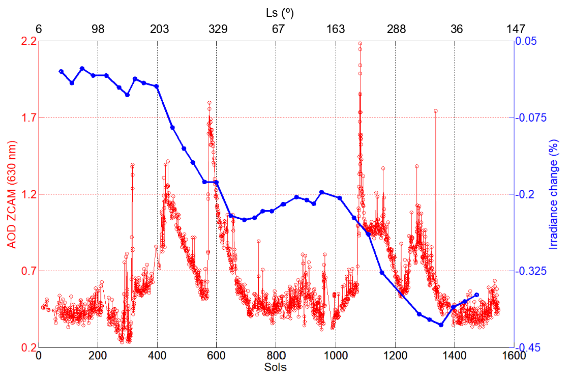
Figure 1. Temporal evolution of the irradiance change measured by MEDA-RDS TOP 7 (blue) of the Mars 2020 mission at Jezero Crater, compared with atmospheric opacity at 630 nm measured by Mastcam-Z (red) over the first two years.
References:
[1] Apestigue, V., et al. “Radiation and Dust Sensor for Mars Environmental Dynamic Analyzer
Onboard M2020 Rover”. Sensor 22.8 (2022): 2907.
[2] Rodriguez-Manfredi, Jose Antonio, et al. “The Mars Enviromental Dynamics Analyzer, MEDA. A suite of enviromental sensors for the Mars 2020 mission.” Space science reviews 217.3 (2021): 1-86.
[3] Toledo, D., et al. “Measurement of aerosol optical depth and sub-visual cloud detection using the optical depth sensor (ODS)”. Atmospheric Measurement Techniques 9.2 (2016): 455-467.
[4] Vicente-Retortillo, A., et al. “Dust Accumulation and Lifting at the Landing Site of the Mars 2020 Mssion, Jezero Crater, as Observed From MEDA.” Geophysical Research Letters 51 (2024).
[5] Lemmon, M. T. Et al. “Dust, sand and winds within an active Martian storm in Jezero crater.” Geophysical Research Letters, 49.17 (2022): 0094-8276.
How to cite: Rodriguez-Veloso, R., Toledo, D., Apestigue, V., Arruego, I., Lorenzo-Corvo, C., Martínez, G. M., Lemmon, M. T., Jiménez-Martín, J. J., García-Menéndez, E., Hueso, R., Smith, M. D., Vicente-Retortillo, Á., Viudez-Moreiras, D., and Rodríguez-Manfredi, J. A.: Aerosol Optical Properties and Dust Deposition as observed by MEDA Radiation and Dust Sensor (RDS) at Jezero Crater, Mars, Europlanet Science Congress 2026, The Hague, The Netherlands, 7–11 Sep 2026, EPSC2026-378, https://doi.org/10.5194/epsc2026-378, 2026.


