
 1,3,2,3,2,
- 1INAF - Osservatorio Astrofisico Arcetri, Firenze, Italy (manuela.lippi@inaf.it)
- 2Institute for Astronomy, University of Edinburgh, Royal Observatory, Edinburgh, UK
- 3STAR Institute, University of Liège, Liège, Belgium
- 4Northumbria University, Ellison Pl, Newcastle upon Tyne NE1 8ST, United Kingdom
- 5University of Canterbury, Christchurch 8041, New Zealand
Comets are considered the most well-preserved fossils of the early solar system. Analyzing their volatile inventories allows us to quantify the extent of chemical and thermal evolution within the protoplanetary disk, offering key clues into the origins of planetary materials (Mumma M. J. & Charnley S. B., 2011, Lippi M., et al., 2024). The recent discovery of interstellar objects (ISOs, Fitzsimmons A., et al, 2018, 2019) has opened a new window, offering a direct baseline to compare our Solar System’s building blocks with those of other planetary systems. Investigating ISOs in the context of our solar system can ultimately reveal whether the chemical foundations of planets are universal or unique to their birth environments.
In this contribution, we present high-resolution infrared (2–5 µm) data of the third interstellar visitor 3I/ATLAS, collected using CRIRES+ at ESO-VLT telescope (PI of the observing program C. Opitom). We sampled the object’s activity both before and after perihelion, and across heliocentric distances ranging from 1.8 to 2.7 au. In Figure 1, we show two selcted spectra.
We report detections of CO, CH3OH, CH4, C2H6, and HCN, and significant upper limits for H2O, NH3, H2CO, and C2H2. Furthermore, we examine the spectral data for emission lines that may be attributed to isotopic species (e.g., HDO and CH3D), as well as HCl and C2H4.
Finally, we compare the volatile composition of 3I/ATLAS to the existing cometary database (Dello Russo N., et al, 2016, Lippi M., et al, 2021) to place this interstellar object within the broader context of planet formation and chemical inheritance.
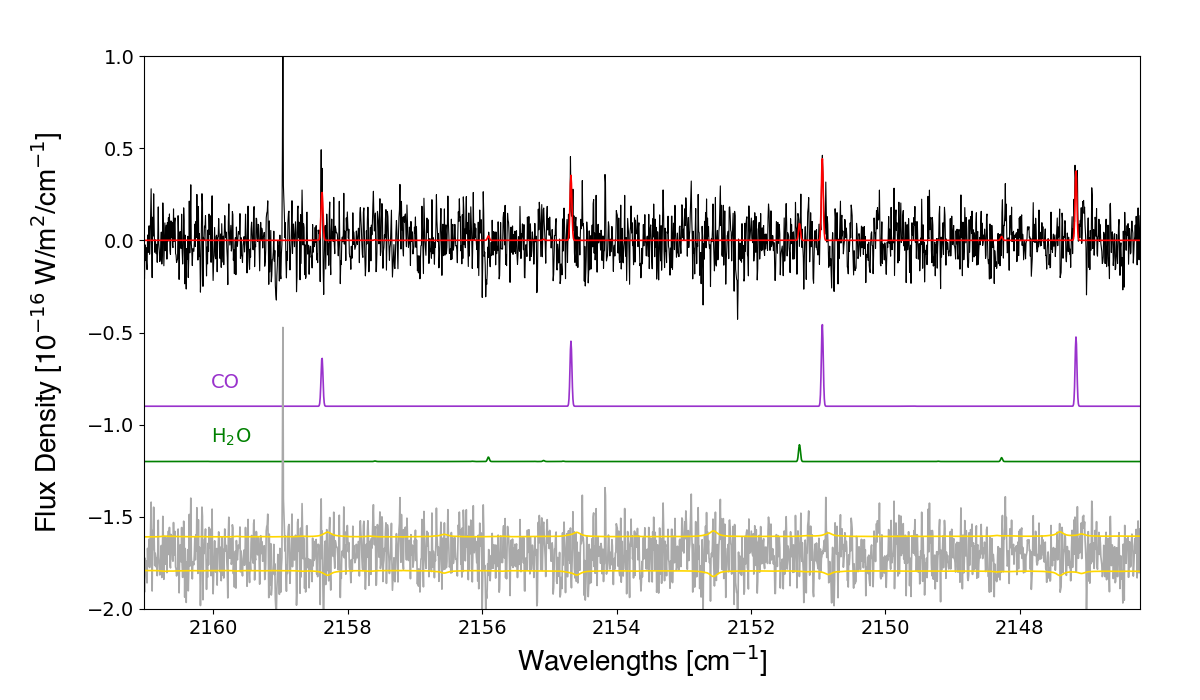
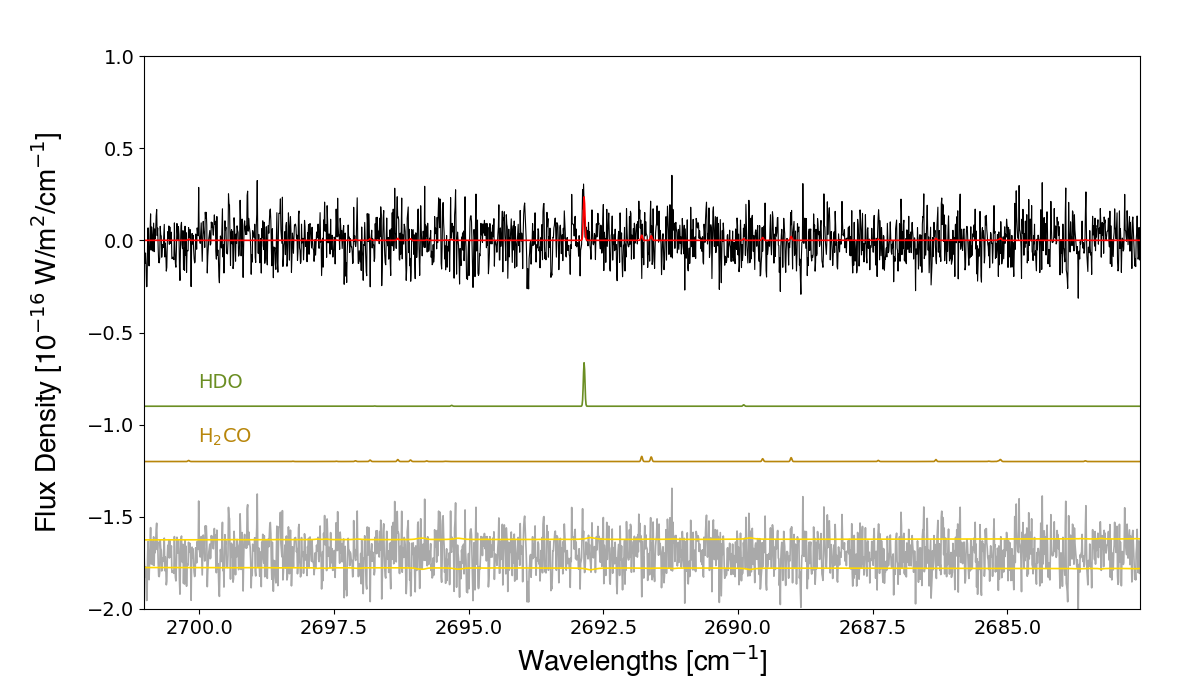
Figure 1: Detection of CO and tentative detection of HDO for comet 3I/ATLAS in December 2025.
References: Mumma M. J., Charnley S. B., Annual Review of Astronomy and Astrophysics, 2011, 49, 471-524; Lippi M., Podio L., Codella C., Faggi S., De Simone M., Villanueva G. L., Mumma M. J., Ceccarelli C., The Astrophysical Journal, 2024, 970; Fitzsimmons A., Snodgrass C., Rozitis B., Yang B., Hyland M., Seccull T., Bannister M. T., Fraser W. C., Jedicke R., Lacerda P., Nature Astronomy, 2018, 2, 133-137; Fitzsimmons A., Hainaut O., Meech K. J., Jehin E., Moulane Y., Opitom C., Yang B., Keane J. V., Kleyna J. T., Micheli M., Snodgrass C., The Astrophysical Journal, 2019, 885, L9; Dello Russo N., Kawakita H., Vervack R. J., Weaver H. A., Icarus, 2016, 278, 301-332; Lippi M., Villanueva G. L., Mumma M. J., Faggi S., The Astronomical Journal, 2021, 162, 74
How to cite: Lippi, M., Opitom, C., Jehin, E., Hutsemekers, D., Manfroid, J., Snodgrass, C., Ferellec, L., Vander Donckt, M., Murphy, B., and Bannister, M.: Exploring the Volatile Composition of the Interstellar Visitor 3I/ATLAS with CRIRES+, Europlanet Science Congress 2026, The Hague, The Netherlands, 7–11 Sep 2026, EPSC2026-384, https://doi.org/10.5194/epsc2026-384, 2026.


