SB6 | Interstellar Targets of Opportunity: Science from Interstellar Objects, Past, Present and Future

SB6

Interstellar Targets of Opportunity: Science from Interstellar Objects, Past, Present and Future
Co-organized by EXOA
Convener: Thomas Marshall Eubanks | Co-conveners: Michael Küppers, Quanzhi Ye, Andreas Hein, Olivier Witasse
Orals WED1
| Wed, 09 Sep, 08:30–10:00 (CEST)|Room Earth (Tango 1)
Posters TUE-POS
| Attendance Tue, 08 Sep, 18:00–19:30 (CEST) | Display Tue, 08 Sep, 08:30–19:30|Foyer 3, F3.47
Wed, 08:30
Tue, 18:00
Observations of Interstellar Objects (ISOs) passing through the solar system allow for the direct examination of planetesimals from other star systems. The passage of the third known interstellar object (ISO), 3I/ATLAS, through the solar system has produced the largest set of spacecraft observations for any comet or ISO to date, with observations were obtained from a total of 24 spacecraft to date, including interplanetary spacecraft, a number of solar probes, and 6 astronomical space telescopes. This session invites presentations on science results from terrestrial and spacecraft observations of all three known ISOs, on how the lessons learned from their observation can be applied to future interstellar targets of opportunity, and on plans for future ISO interceptor missions.

Orals: Wed, 9 Sep, 08:30–10:00 | Room Earth (Tango 1)

08:30–08:45
|
EPSC2026-759
|
solicited
|
On-site presentation
Thomas Marshall Eubanks, Adam Hibberd, W. Paul Blase, Robert G. Kennedy III, and Andreas Hein

The detection of Interstellar Objects (ISOs) passing through the solar system allows for the direct examination of material from other star systems. The ISO 3I/ATLAS, discovered July 1, 2025, with an incoming velocity at infinity of 57.9778 km/s,  was rapidly recognized to in a retrograde but low-inclination orbit that would take it within the orbit of Mars, relatively close to many of the interplanetary spacecraft in and traversing the inner solar system. This orbit, and the discovery of 3I/ATLAS out near the orbit of Jupiter, enabled an unprecedented spacecraft observing campaign, with at least 25 spacecraft observing 3I/ATLAS during its passage through the solar system. Observations in IR, visual, UV and X-ray wavelengths, were obtained from 11 interplanetary spacecraft,
8 solar probes and observatories, and 6  space telescopes. Of these, the Psyche spacecraft observed 3I/ATLAS on Sep. 8 and Oct. 29, 2025, the Lucy spacecraft from Sep. 15-17, 5 spacecraft on or orbiting Mars observed from Sep. 27 to Oct. 7, the Europa Clipper observed in Nov. and the Juice spacecraft from Nov. 2 - Nov. 25, with observations from the Juno spacecraft orbiting Jupiter finishing this campaign with observations in  March of 2026. The PUNCH, STEREO, SOHO, and GOES-19 solar observatories also provided near continuous monitoring of the integrated visual brightness of 3I/ATLAS for the period Sep. 12 - Nov. 13, 2025, when observations from Earth were difficult or impossible. The spacecraft data acquired in these 7 months will undoubtedly revolutionize the study of ISOs. In this talk, we will review these results, and examine how future ISO observing campaigns should be conducted,  and what sort of ISO interceptor missions will be possible. Planning needs to begin now to prepare for future such observing campaigns for not-yet-discovered ISOs, and space agencies need to consider setting up means to fund this work.  

How to cite: Eubanks, T. M., Hibberd, A., Blase, W. P., Kennedy III, R. G., and Hein, A.: An Interstellar Target of Opportunity: Lessons Learned from the 3I/ATLAS Spacecraft Campaign, Europlanet Science Congress 2026, The Hague, The Netherlands, 7–11 Sep 2026, EPSC2026-759, https://doi.org/10.5194/epsc2026-759, 2026.

08:45–09:00
|
EPSC2026-384
|
solicited
|
On-site presentation
Manuela Lippi, Cyrielle Opitom, Emmanuel Jehin, Damien Hutsemekers, Jean Manfroid, Colin Snodgrass, Lea Ferellec, Mathieu Vander Donckt, Brian Murphy, and Michele Bannister

Comets are considered the most well-preserved fossils of the early solar system. Analyzing their volatile inventories allows us to quantify the extent of chemical and thermal evolution within the protoplanetary disk, offering key clues into the origins of planetary materials (Mumma M. J. & Charnley S. B., 2011, Lippi M., et al., 2024). The recent discovery of interstellar objects (ISOs, Fitzsimmons A., et al, 2018, 2019) has opened a new window, offering a direct baseline to compare our Solar System’s building blocks with those of other planetary systems. Investigating ISOs in the context of our solar system can ultimately reveal whether the chemical foundations of planets are universal or unique to their birth environments.

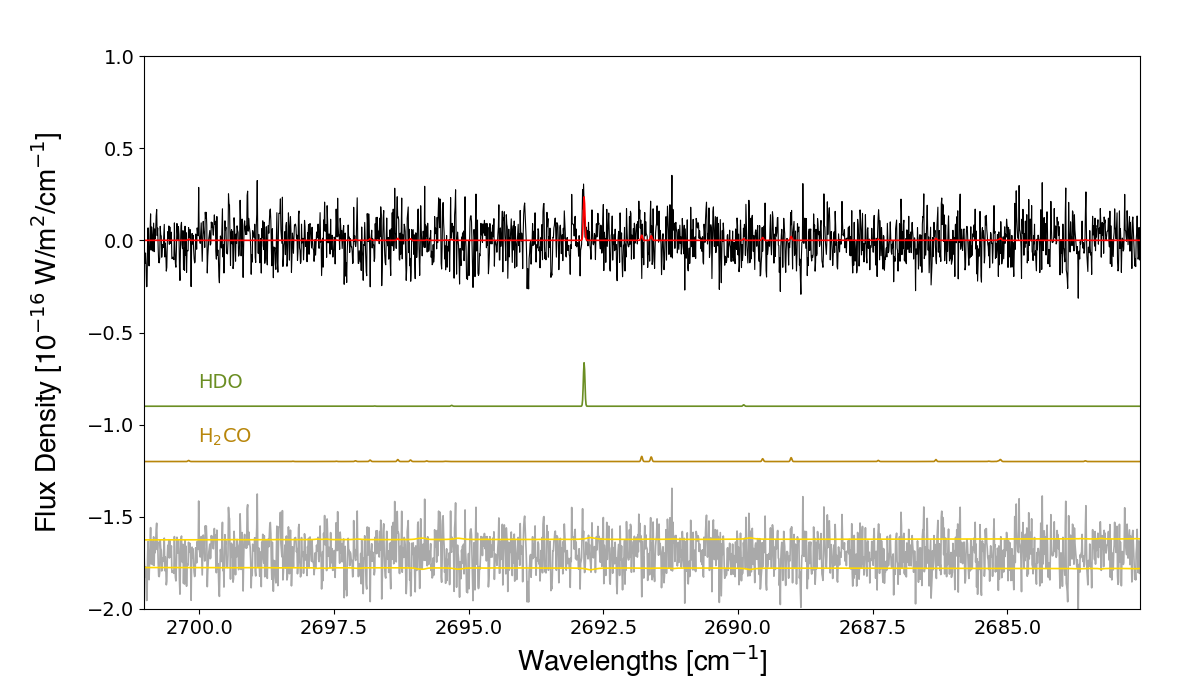
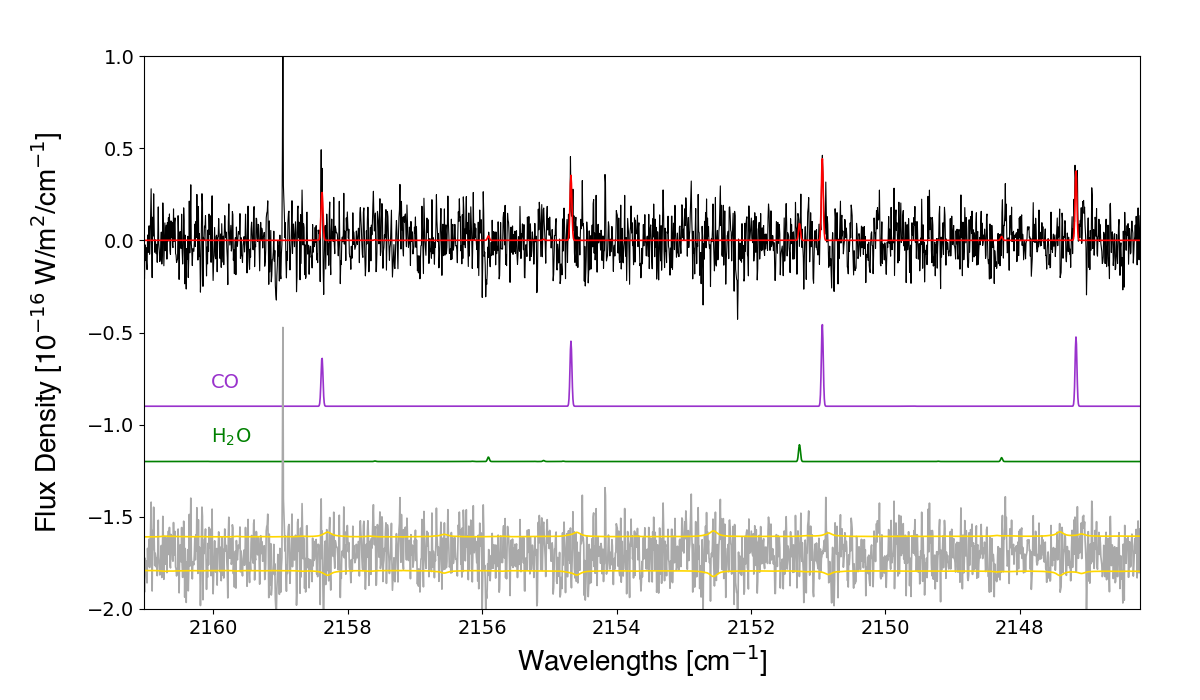
In this contribution, we present high-resolution infrared (2–5 µm) data of the third interstellar visitor 3I/ATLAS, collected using CRIRES+ at ESO-VLT telescope (PI of the observing program C. Opitom). We sampled the object’s activity both before and after perihelion, and across heliocentric distances ranging from 1.8 to 2.7 au. In Figure 1, we show two selcted spectra. 

We report detections of CO, CH3OH, CH4, C2H6, and HCN, and significant upper limits for H2O, NH3, H2CO, and C2H2. Furthermore, we examine the spectral data for emission lines that may be attributed to isotopic species (e.g., HDO and CH3D), as well as HCl and C2H4.

Finally, we compare the volatile composition of 3I/ATLAS to the existing cometary database (Dello Russo N., et al, 2016, Lippi M., et al, 2021) to place this interstellar object within the broader context of planet formation and chemical inheritance.

Figure 1: Detection of CO and tentative detection of HDO for comet 3I/ATLAS in December 2025.

References: Mumma M. J., Charnley S. B., Annual Review of Astronomy and Astrophysics, 2011, 49, 471-524; Lippi M., Podio L., Codella C., Faggi S., De Simone M., Villanueva G. L., Mumma M. J., Ceccarelli C., The Astrophysical Journal, 2024, 970; Fitzsimmons A., Snodgrass C., Rozitis B., Yang B., Hyland M., Seccull T., Bannister M. T., Fraser W. C., Jedicke R., Lacerda P., Nature Astronomy, 2018, 2, 133-137; Fitzsimmons A., Hainaut O., Meech K. J., Jehin E., Moulane Y., Opitom C., Yang B., Keane J. V., Kleyna J. T., Micheli M., Snodgrass C., The Astrophysical Journal, 2019, 885, L9; Dello Russo N., Kawakita H., Vervack R. J., Weaver H. A., Icarus, 2016, 278, 301-332; Lippi M., Villanueva G. L., Mumma M. J., Faggi S., The Astronomical Journal, 2021, 162, 74

How to cite: Lippi, M., Opitom, C., Jehin, E., Hutsemekers, D., Manfroid, J., Snodgrass, C., Ferellec, L., Vander Donckt, M., Murphy, B., and Bannister, M.: Exploring the Volatile Composition of the Interstellar Visitor 3I/ATLAS with CRIRES+, Europlanet Science Congress 2026, The Hague, The Netherlands, 7–11 Sep 2026, EPSC2026-384, https://doi.org/10.5194/epsc2026-384, 2026.

09:00–09:12
|
EPSC2026-257
|
On-site presentation
Yves Langevin, Dominique Bockelée-Morvan, François Poulet, Benoît Seignovert, Emiliano D'Aversa, John Carter, Thibault Cavalié, Cédric Leyrat, Giuseppe Piccioni, Séverine Robert, Sébastien Rodriguez, and Clément Royer

We present the results of observations of interstellar object (ISO) 3I/ATLAS close to its perihelion (October 29, 2025) by MAJIS, the VISNIR imaging spectrometer (Poulet et al.,2024) on-board the JUICE ESA mission to Jupiter (Grasset et al., 2013). ISO’s provide a unique opportunity for investigating the properties of planetesimals from distant planetary systems. 3I/ATLAS became exceptionally active close to perihelion, which made possible detailed spectroscopic investigations in the spectral range of MAJIS, 0.5 – 5.63 µm (two channels, VISNIR from 0.5 to 2.35 µm and IR from 2.28 µm to 5.54 µm)

Observing 3I/ATLAS with MAJIS was a challenge as while JUICE was relatively close to its trajectory, the minimum distance during observations was ~ 66 million km, so that the expected MAJIS signal levels were very small (a few e- to a few 10 e- for the dust continuum, up to a few 100 e- for H2O and CO2 emissions from the coma). H1RG detectors had been selected by MAJIS so as to provide adequate performances for weak signals of interest in the Jupiter system, in particular those for rings and exospheres. All observations of 3I/ATLAS were performed using a dedicated “low signal” readout mode with an integration time of 2 s and on-board co-adding of 4 acquisitions. Each observation generated image cubes with 400 x 23 spatial samples and 508 spectral samples for each channel. Given the time available, two such observations were performed for the first 3 slots, eight observations for the last slot (Table 1).

Table 1: 3I/ATLAS MAJIS observations; Rh: heliocentric distance of 3I/ATLAS; D: distance from Juice to 3I/ATLAS; sampling: projected MAJIS IFOV (0.15 mrad) at the comet distance D (spatial sampling of the coma)  

As shown by Fig. 1, H2O and CO2 molecular emissions were unambiguously detected during the first slot (2025/11/02). The dispersion for MAJIS data elements away from the comet is ~ 10 e- in both spectral ranges, in line with the noise model, so that the SNR is in the range of 15 to 20 for the brighest spectral samples, making it possible to determine with high accuracy the column content of H2O and CO2.

Figure 1: H2O (left) and CO2 (right) molecular emissions for bright IFOV’s in the coma (2025/11/02 slot). The red profiles show the observed spectra. The black profiles are H2O (CO2) synthetic spectra modeled with the MAJIS spectral sampling. The blue stars are signal levels for 8 frames away from the comet. Gaps corrrespond to unoperable spectels (~ 10% for the IR channel with a 2 s integration time due to a high dark current).


The SNR decreases from one slot to the next due to the increasing distances of the comet to the sun and to the JUICE S/C (see Table 1). As shown by Fig. 2,  MAJIS could still obtain information on the spatial distribution of H2O and CO2 emissions, which made it possible to determine H2O and CO2 production rates for all 4 observation slots. Emissions were also observed in the C-H spectral range (~ 3.4 µm).

Figure 2: spatial distribution of the H2O emission for the 2025/11/02 slot (left), the CO2 emission for the 2025/11/12 slot (center) and the the CO2 emission for the 2025/11/19 slot (right)

The dust scattering continuum of 3I/ATLAS was observed during the first observation slot (2025/11/02) mainly in the VISNIR range (0.5 – 2.35 µm). As shown in Fig. 3, the signal for the brightest IFOV’s peaks at ~ 25 e- to be compared with a noise level of 4 e-, smaller than that in the IR as the dark current is very small for the VISNIR H1RG detector. The dust continuum is expected to be spectrally smooth. An increase of the reflectance with wavelength at a steeper slope from 0.5 to 1 µm could be identified by co-adding the 4 brightest IFOV’s and stacking in the spectral direction.

Fig. 3: Signal  from dust scattering in the coma;  dashed red lines: ± 1 sigma (4 e-)

The MAJIS results on the H2O and CO2 production rates and rotational temperatures, and on the dust continuum will be presented in a forthcoming article and at the conference. The comparison of these results with measurements by other instruments of the H2O and CO2 production rates farther from the Sun revealed strong variations of the CO2 / H2O ratio with heliocentric distance. The radial distributions of H2O and CO2 do not reveal significant extended production of these species from icy grains near perihelion.

The primary objective of the 3I/ATLAS observations by MAJIS was the science return from an interstellar object. They were also of particular interest to the MAJIS team as a very successful litmus test of the MAJIS readout mode dedicated to weak signals in the Jupiter system (rings and exospheres).

Acknowledgements: JUICE is a mission under ESA leadership with contributions from its Member States, NASA, JAXA and the Israel Space Agency. It is the first Large-class mission in ESA’s Cosmic Vision programme. This work was  supported by CNES, focused on MAJIS. This work has  been developed under the ASI-INAF agreement no. 2023-6-HH.0. 

References 

  • Poulet F., Piccioni G., Langevin Y., Dumesnil C. et al., Space Sci. Rev., 2024, 220, 27
  • Grasset O., Dougherty M.K., Coustenis A. et al., Planet. Space Sci., 2013, 78, 1


How to cite: Langevin, Y., Bockelée-Morvan, D., Poulet, F., Seignovert, B., D'Aversa, E., Carter, J., Cavalié, T., Leyrat, C., Piccioni, G., Robert, S., Rodriguez, S., and Royer, C.: Near-perihelion Observations of 3I/ATLAS with the MAJIS Instrument onboard the Juice Spacecraft  , Europlanet Science Congress 2026, The Hague, The Netherlands, 7–11 Sep 2026, EPSC2026-257, https://doi.org/10.5194/epsc2026-257, 2026.

09:12–09:24
|
EPSC2026-278
|
Virtual presentation
Bryce Bolin

Interstellar objects (ISOs) are planetary formation byproducts ejected from extrasolar star systems. To date, only three are known: 1I/'Oumuamua, 2I/Borisov, and 3I/ATLAS, which all showed vastly different physical properties. We describe the observational campaign led by our team to characterize the most recently discovered ISO, 3I/ATLAS, using a combination of visible- and infrared observations from Keck and Gemini, and relay observations from around the world as the comet passed through the solar system. We observed the evolution in the comet’s activity mechanisms and volatile production over a ~9-month period as the comet reached and left perihelion. Our observations provided high-signal-to-noise visible- and near-infrared spectroscopy, enabling constraints on surface composition, dust properties, and potential volatile-driven activity. Multi-band photometry and spectroscopy were used to derive color indices, spectral slopes, and limits on absorption features diagnostic of ices and silicates. Our observations provide an example of an observational framework for future interstellar object discoveries in the Vera C. Rubin era, where early identification and immediate follow-up will be essential to fully characterize these rare messengers from other planetary systems.

How to cite: Bolin, B.: Comprehensive visible and near-infrared characterization of 3I/ATLAS during its encounter with the Solar System, Europlanet Science Congress 2026, The Hague, The Netherlands, 7–11 Sep 2026, EPSC2026-278, https://doi.org/10.5194/epsc2026-278, 2026.

09:24–09:36
|
EPSC2026-555
|
On-site presentation
Paul Hartogh, Ladislav Rezac, Nicolas Biver, Dominique Bockelée-Morvan, Raphael Moreno, Eva Wirström, Thibault Cavalié, and Miriam Rengel

The Submillimeter Wave Instrument (SWI) aboard the JUpiter Icy Moon Explorer (JUICE) conducted a series of targeted observations of the interstellar comet 3I/ATLAS, discovered on July 1, 2025, by the ATLAS survey in Chile. As the third confirmed interstellar object to traverse our solar system—following 1I/ʻOumuamua and 2I/Borisov—3I/ATLAS offers a unique opportunity to study the composition and physical properties of material from outside the Solar System. JUICE-SWI executed dedicated observations of the comet between November 2 and November 19, 2025, during which the SWI instrument performed four 30-minute observations at a distance of approximately 80 million kilometers. The observations targeted the ground-state rotational transitions of ortho- and para-water in the 600 GHz and 1200 GHz frequency bands, using frequency-switching mode to maximize on-source integration time. We present the data reduction, calibration procedures, and  results from the SWI observations. These include derived rotational line intensities and the water production rate. We discuss the implications of the measurements in the context of interstellar comet composition, comparing them with other observations. The results provide early insights into the volatile content of an interstellar visitor and contribute to our understanding of the chemical diversity of cometary material across stellar systems.

How to cite: Hartogh, P., Rezac, L., Biver, N., Bockelée-Morvan, D., Moreno, R., Wirström, E., Cavalié, T., and Rengel, M.: Observations of 3I/ATLAS with JUICE-SWI, Europlanet Science Congress 2026, The Hague, The Netherlands, 7–11 Sep 2026, EPSC2026-555, https://doi.org/10.5194/epsc2026-555, 2026.

09:36–09:48
|
EPSC2026-605
|
On-site presentation
Elena Mazzotta Epifani, Cecilia Tubiana, Luisa M. Lara, Livio Agostini, Luca Penasa, Juan Luis Rizos, Alice Lucchetti, Federico Tosi, Elisabetta Dotto, Maurizio Pajola, Ricardo Hueso, Manish R. Patel, Ganna Portyankina, and Pasquale Palumbo and the JANUS team

In July 2025 the third known member of the Interstellar Objects (ISOs) class, 3I/ATLAS, was discovered on its inbound orbital branch, at a heliocentric distance rh = 4.5 au. An intense world-wide campaign started immediately after the discovery and continued up to a few weeks before its perihelion passage. It was possible to depict a scenario of a cometary body redder than most of the Solar System comets, with a deep and narrow negative polarization branch, and a CO2-dominated coma. While approaching its perihelion, a rapid rise in comet’s brightness and a steep heliocentric-distance scaling for the production rates of Ni and CN were observed [1] [2] [3] [4] [5] [6] [7].

Due to reciprocal positions of comet and Earth, ground-based observations through the perihelion passage (2025 October 29) were unfortunately impossible, but instead the JUICE spacecraft [8], on its cruise phase towards the Jovian system, was very well placed to observe 3I/ATLAS during those days. Therefore, an observational campaign has been designed and planned, involving several instruments onboard the spacecraft, including the JANUS visible camera [9].

123 JANUS images were obtained in 5 observing slots on 2025 November 5, 6, 12, 19, and 25, using 7 filters to cover the spectral range from 340 to 1080 nm. Figure 1 shows an example of image sequence in the F01 (panchromatic) filter obtained from November 5 to November 25, while the comet’s distance from the Sun varied from 1.39 to 1.67 au and the JUICE’s distance from the comet varied from 64 to 188 million km.

In this work, the JANUS images of 3I/ATLAS and the first results of the JANUS observing campaign will be presented and discussed.

References: [1] Seligman D.Z., Micheli M., Farnocchia D. et al., ApJL 2025. 989, L36-L46. [2] Opitom C., Snodgrass C., Jehin E. et al., MNRAS 2025, 544, 1, L31-L36. [3] Gray Z., Bagnulo S., Borisov G. et al., ApJL 2025, 992, 2, L29-L37. [4] Cordiner M.A., Roth N.X., Kelley M.S.P. et al., ApJL 2025, 991, 2, L43-L52. [5] Rahatgaonkar R., Carvajal J.P., Puzia T.H. et al., ApJL 2025, 995, 1, L34-L46. [6] Hoogendam W.B., Shappee B.J., Wray J.J. et al., 10.48550/arXiv.2510.11779. [7] Lazzarin M., Mura A.C., La Forgia F. et al., ApJL 2026, 998, 1, L30-L35. [8] Grousset O., Dougherty M.K., Coustenis A. et al., PSS 2013, 78, 1-2. [9] Palumbo P., Roatsch T., Lara L.M. et al., SSR 221, 3, id.32

How to cite: Mazzotta Epifani, E., Tubiana, C., Lara, L. M., Agostini, L., Penasa, L., Rizos, J. L., Lucchetti, A., Tosi, F., Dotto, E., Pajola, M., Hueso, R., Patel, M. R., Portyankina, G., and Palumbo, P. and the JANUS team: The interstellar comet 3I/ATLAS as seen by JANUS onboard the JUICE spacecraft, Europlanet Science Congress 2026, The Hague, The Netherlands, 7–11 Sep 2026, EPSC2026-605, https://doi.org/10.5194/epsc2026-605, 2026.

09:48–10:00
|
EPSC2026-628
|
On-site presentation
Thomas Greathouse, Kurt Retherford, Tracy Becker, Philippa Molyneux, and Cesare Grava and the the Europa-UVS Science Team, the JUICE-UVS Science Team, and the LRO-LAMP Science Team

Observations of interstellar object 3I/ATLAS were made from Europa UVS (ultraviolet spectrograph), JUICE UVS, and LRO LAMP from November to December 2025.  These sister instruments are from the SwRI UVS/Alice heritage family of ultraviolet spectrographs, with Europa UVS being the most recent addition.  On 6 November 2025 Europa-UVS performed observations pointed mostly sunward with a solar phase angle of ~143° at a comet/spacecraft distance of 1.09 AU.  A simultaneous observation performed by JUICE UVS was conducted with a solar phase angle of ~12° and a comet/spacecraft distance of 0.44 AU.  Other JUICE UVS observations were performed on 2, 3, 5, 6, 12, 19, and 25 of November 2025 (Figure 1).  The LRO-LAMP observation occurred on the same day as the JUICE-UVS scan observation, 25 of November 2025, with a solar phase angle of ~30° at a comet/spacecraft distance of 1.98 AU.  Initial results show detections of extended hydrogen Lyman alpha 121.6 nm, neutral oxygen 130.4 nm, and carbon 156.1 nm and 165.7 nm emissions.  Additional calibrations are needed to further the analysis and provide upper limits or additional, firmer detections.

Figure 1)  Sum of three JUICE UVS stare observations from 2, 5, and 12 November 2026.  The slit length (running vertically) spans 7.5° on the sky, while the spectral dispersion runs 55-206 nm, left-to-right.    Hydrogen, oxygen, and carbon emissions are easily identifiable in the raw data along with a star spectrum near spatial pixel row 1400.   

How to cite: Greathouse, T., Retherford, K., Becker, T., Molyneux, P., and Grava, C. and the the Europa-UVS Science Team, the JUICE-UVS Science Team, and the LRO-LAMP Science Team: Interstellar Object 3I/ATLAS Surrounded: Observations from 3 sister instruments, Europlanet Science Congress 2026, The Hague, The Netherlands, 7–11 Sep 2026, EPSC2026-628, https://doi.org/10.5194/epsc2026-628, 2026.

Posters: Tue, 8 Sep, 18:00–19:30 | Foyer 3

Display time: Tue, 8 Sep, 08:30–19:30
F3.47
|
EPSC2026-956
|
ECP
|
On-site presentation
Tobias Hoffmann, Marco Micheli, Marco Fenucci, Francisco Ocaña, and Richard Moissl

Background: The interstellar comet 3I/ATLAS was discovered in July 2025. Its particular orbit, passing through the Solar System on the opposite side relative to Earth, made it hardly observable during its perihelion passage, where the cometary activity is the strongest. In November 2025, ESA’s Jupiter Icy Moons Explorer (JUICE) performed a dedicated observation campaign of the comet during its cruise phase, reaching 0.4 AU distance at closest approach. Many remote sensing instruments participated and collected data of the interstellar visitor.

Idea: After the successful pointing, images of the Navigation Camera (NAVCAM) were downlinked and analysed astrometrically. Due to the orbital geometry of JUICE relative to 3I/ATLAS, the measured positions carry significant weight in the orbital solution of the comet, allowing a resolution on the order of a few hundred kilometres of its position in space.

Purpose: The astrometric data can be used to dynamically assess the orbit of 3I/ATLAS around perihelion passage, especially to measure the effect of non-gravitational effects on the comet’s trajectory due to its outgassing.

Results: The NAVCAM images provided a successful performance demonstration in JUICE’s early mission phase. The analysis shows good resolvability of non-gravitational effects in the orbit. Depending on the types of gasses involved in the outgassing at a certain heliocentric distance, the trajectory experiences slightly different perturbations. Observations by other instruments onboard JUICE (MAJIS, SWI) confirm H2O outgassing around perihelion, whereas earlier spectroscopy measurements from Earth detected high CO2 abundances in the coma at farther heliocentric distances. NAVCAM astrometry is used to discriminate the dominating volatile from orbital dynamics.

Outlook: The dynamics of the interstellar comet suggest a varying outgassing profile throughout time, indicating the need for more complex formulations of non-gravitational acceleration models for highly eccentric orbits. Using interplanetary spacecraft for the tracking of Small Bodies in the Solar System has proven to be a valuable asset for precise orbit determination in cases when Earth-based observations are limited.

How to cite: Hoffmann, T., Micheli, M., Fenucci, M., Ocaña, F., and Moissl, R.: 3I/ATLAS Astrometry and Orbital Dynamics from JUICE NAVCAM, Europlanet Science Congress 2026, The Hague, The Netherlands, 7–11 Sep 2026, EPSC2026-956, https://doi.org/10.5194/epsc2026-956, 2026.