
 1,2,1,2,4,3,3
- 1Institute of Geophysics of the Czech Academy of Sciences, Praha, Czechia
- 2Department of Geophysics, Charles University, Prague, Czech Republic
- 3School of Physical Sciences, The Open University, Milton Keynes, United Kingdom
- 4School of Geography and Planning, University of Sheffield, Sheffield, United Kingdom
Several icy worlds exhibit surface morphologies interpreted as products of effusive cryovolcanism (eg: [1-3]), yet the behaviour of saline liquids undergoing boiling, evaporative cooling, freezing, and salt precipitation under such low-pressure conditions remains poorly constrained because these processes cannot currently be directly observed. This study presents an experimental dataset of sixteen experiments documenting how large volumes (~40 kg) of water solutions with varying salinity behave when exposed to decreasing atmospheric pressure. The experiments were performed in the Large Dirty Mars Chamber (“George”) at the Open University, UK, and built upon previous work (see [4]).
Each experiment used a 40 × 40 × 40 cm glass tank with a wall thickness of 0.05 m, containing ~40 kg of liquid placed within a cylindrical vacuum chamber capable of reaching pressures down to approximately 1 mbar. We used deionised water as reference, and solutions of NaCl, MgSO₄, and a mix of NaCl–MgSO₄ salts were used for the experiment. Salinities ranged from 0.5 wt% through 2.5 wt% and 5.0 wt%, to near-eutectic compositions of approximately 23.3 wt% NaCl and 17.4 wt% MgSO₄. Each combination of salinity and salt type had two experimental runs for consistency. This study focuses on static or weakly-mixed systems; experiments investigating turbulent flow regimes are presented separately [5].
The experiments generally evolved through three stages: an initial boiling-driven cooling stage, a transition marked by ice nucleation and ice-lid formation, and a later stage of progressive porous ice growth (see Fig. 1 for details). During early depressurisation, vigorous boiling dominates heat loss through latent heat of vaporisation (Fig. 1a-c). Despite intense boiling aactivity at the surface, vertical temperature gradients initially remained small throughout the liquid column. The first ice crystals appeared only after sufficient heat had been removed from the solution to lower surface temperatures below the freezing point of the given mixture, and the onset time increased with salinity. The near-eutectic NaCl experimental runs alone did not reach the freezing stage even in 6 hours. However, these and the near-eutectic MgSO₄ runs show nucleation of salt crystals on surface, later also submerged in the water.
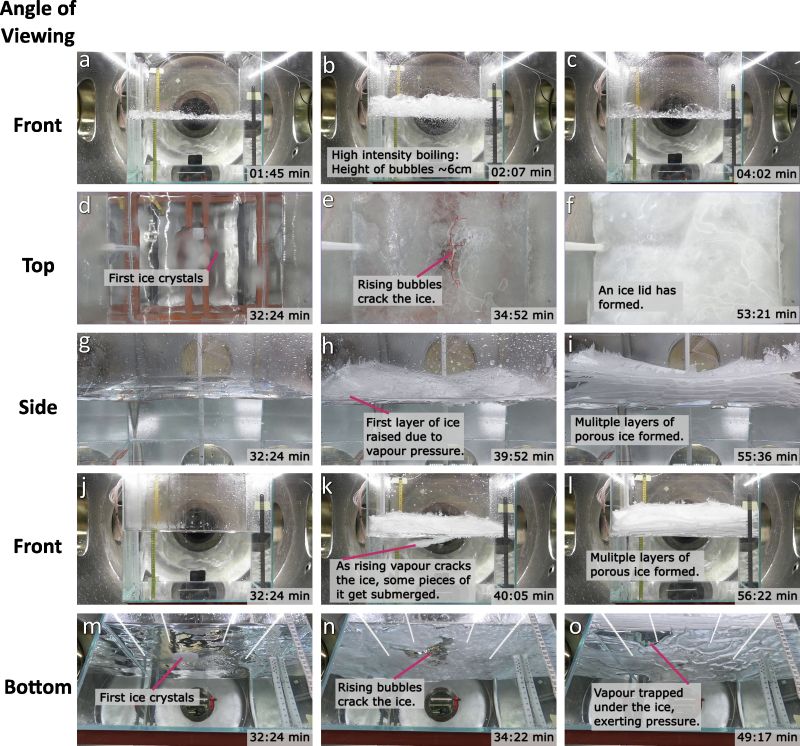
Fig. 1: Progression of boiling and freezing in solution with 0.5% NaCl, when exposed to a low pressure environment. Exp6.
Ice formation followed thin translucent patches that nucleated locally, expanded radially, merged, and were repeatedly disrupted by vapour generated beneath them (see Fig. 2). As cooling progressed, these patches evolved into a mechanically coherent surface layer (ice lid), although at higher salinities this lid retained vents and did not always seal the surface completely. The ice lid changed the pathways of mass and heat transfer by reducing direct liquid exposure to the chamber atmosphere.
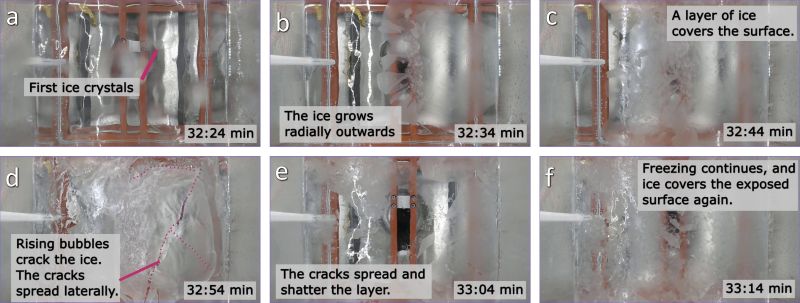
Fig. 2: Detail showing the growth of ice - spreading and merging of floating ice crystals as seen from the top camera. Exp6, 0.5% NaCl
Unlike previous studies focusing mainly on end-member compositions ([6,7]), this dataset allows systematic comparison of how salinity and salt composition affect ice morphology and mechanical behaviour. One clear trend observed is that increasing salinity fundamentally alters both the mechanical behaviour and internal structure of the resulting ice. Low-salinity systems produced brittle, highly porous, multilayered ice crusts [4,6], whereas increasingly saline solutions produced more ductile and compact ice structures with reduced porosity and more stable vapour vents (Figs. 3, 5).
At high salinities, freezing behaviour diverged significantly between MgSO₄ and NaCl systems. The 17.4 wt% MgSO₄ experiments produced highly ductile salty ice containing trapped salt and ice crystals, whereas 23.3 wt% NaCl runs formed only a disrupted pseudo-lid of precipitated salt crystals that partially suppressed evaporation and evaporative cooling (see [7]). Increasing salinity also systematically delayed freezing, extending the boiling-dominated stage from ~32 minutes in 0.5 wt% solutions to ~64 minutes in near-eutectic NaCl experiments. Higher-salinity solutions therefore lost more mass through evaporation before freezing began, although peak and late-stage mass-loss rates remained broadly similar across experiments. Cooling rates likewise decreased with increasing salinity, consistent with freezing-point depression and delayed ice-lid formation.
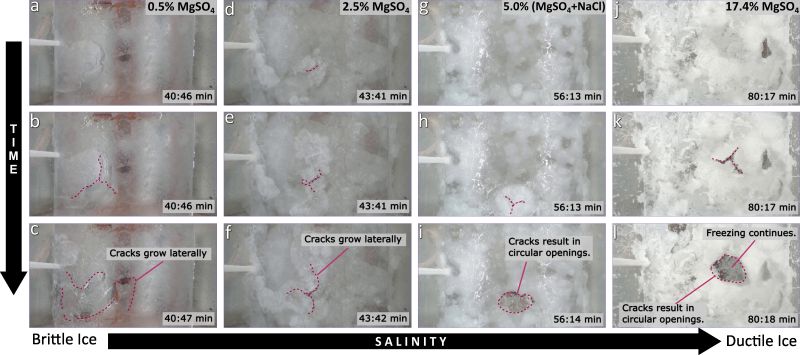
Fig. 3: The figure shows four ice surfaces formed from solutions of increasing salinity, illustrating a clear transition from brittle to ductile mechanical behaviour as salt concentration increases.

Fig. 4: Plots showing the loss of mass over time from the solutions across different salinities.

Fig. 5: Views of ice formed from solutions of increasing salinity, illustrating the progressive decrease in ice-lid porosity with increasing salt concentration.
The thermal and mass-loss measurements additionally provide constraints for numerical modelling of evaporation-driven cooling under low-pressure conditions. A preliminary model (Fig. 6) indicates that the heat sink during the pure evaporation stage can be modelled solely based on the mass lost from the system in this period.
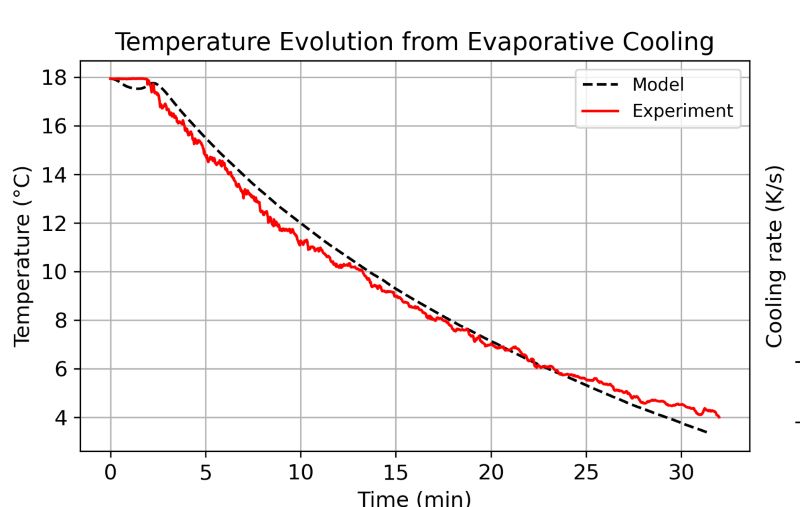
Fig. 6: Agreement of model with experimental data with cooling calculated from initial mass loss in the system. Exp6, 0.5% NaCl.
Our work provides experimental constraints to the behaviour of saline water and effusive cryovolcanic processes on icy moons such Europa, Enceladus, and Titan (also perhaps Pluto). As brines evaporate, cool, freeze, and become progressively enriched in salts, the morphology, porosity, and mechanical behaviour of the resulting ice crusts can change rapidly. The experiments suggest that salinity may exert a first-order control on the morphology, porosity, and mechanical stability of ice crusts forming during effusive cryovolcanism. Such differences are likely to influence vapour escape, crust permeability, and the long-term evolution of cryovolcanic deposits on icy worlds. Additionally, by comparing MgSO₄ and NaCl salts at different concentrations over repeated runs, the study establishes a foundation for future modelling of volatile loss, freezing rates, ice rheology, and the preservation potential of transient saline liquids under low-pressure planetary conditions.
References:
[1] Fagents, JGR, 108, E12 (2003) [2] Lesage et al. Nat Comm 16, 1886 (2025) [3] Wilson, JGR, 102, E4, (1997) [4] Brož et al. EPSL, 668 (2025) [5] Brož et al., EPSC abstract EPSC2026-190, (2026) [6] Patočka et al. EPSL, 685 (2026) [7] Fox-Powell et al. (2026), EGU abstract 26-21408.
How to cite: Biju Sindhu, P., Brož, P., Patočka, V., Fox-Powell, M., Butcher, F., Patel, M., and Sylvest, M.: Experimental Insights into Effusive Cryovolcanism: Boiling and Freezing of Saline Water under Low Pressure Conditions, Europlanet Science Congress 2026, The Hague, The Netherlands, 7–11 Sep 2026, EPSC2026-387, https://doi.org/10.5194/epsc2026-387, 2026.


