

- British Astronomical Association, Jupiter Section, Cambridge, United Kingdom (jrogers11@btinternet.com)
Summary & Introduction
Episodes of reddish or yellowish coloration of the Equatorial Zone (EZ), either in a broad Equatorial Band (EB) or more widely, have been noted throughout observational history [Ref.1]. More recently, a long-term survey at 5 microns by Antuñano et al. [Refs.2,3] has shown episodes of brightening, i.e. cloud clearance in the EZ (‘EZ disturbances’), which partially coincide with coloration episodes, and a periodicity of 6.6 (±0.5) years was proposed though some events were ‘missing’. Here we review the history of colorations since 1971 from amateur observations, so as to give a systematic account for comparison with the 5-mm data. This comparison reinforces the evidence for the 7-year period, and shows that this phenomenon has several dissociable aspects.
Reddish coloration and/or darkening was present more often than not in the 1960s and 1970s, but episodes have been more distinct in other decades. From the 1990s onwards they are well documented by colour and colour-filter imaging, which gives objective data even though our descriptions are still largely subjective. While some episodes exhibit obvious yellow or orange or duller ochre colour, and can last for several years, other episodes show only a brownish-grey shade changing to neutral dark grey, and only last for 1-2 years. Some episodes begin with a pure yellow or orange colour, which then becomes darker and less saturated [Ref.1].
Coloration episodes since 1971
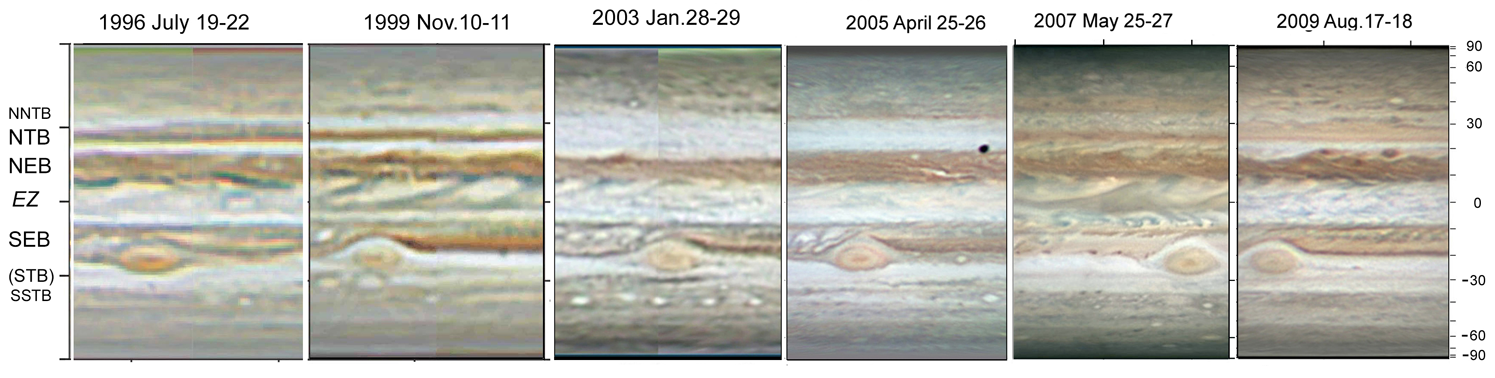
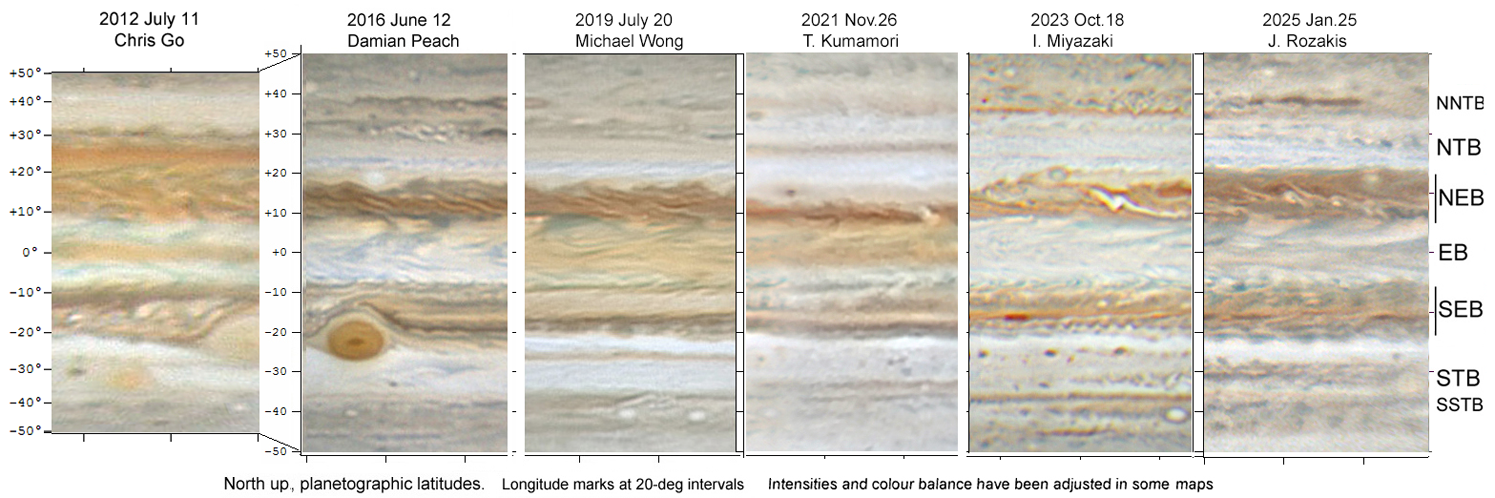
Episodes up to 1991 were described in [Ref.1]. Subsequent episodes were described in the interim reports of the BAA Jupiter Section [https://britastro.org/sections/jupiter]. Figs.1 & 2 show examples of maps from amateur images, mostly made by M. Vedovato and R. Bullen. In the following description, 5-micron information after 1979 is from [Refs.2-4].
1972-76: Pure yellow-orange colour during 1972, which then condensed into a massive dark brown or grey-brown EB including southern EZ while the SEB was whitened (1973-1975). It was grey in 1976, then faded away. (This massive belt was also 5-micron-bright from 1973-1976: Ref.5.)
1977-82: Largely pure colour, strong yellow or ochre over most of EZ, but with grey EB component in 1978-79 and thereafter; then, yellow colour gradually retreating to EZ(S) and fading. (It was 5-micron-bright in 1979 [Ref.5]; no data in other years.)
(1986: Although NEDFs and grey shadings were prominent, the EZ remained largely white so there was no coloration event. There was also no 5-micron event, pausing the 7-year periodicity.)
1989-1992: Started as pure yellow colour in late 1989, becoming brown or (eventually) grey in 1990-92, with the colour shifting southwards. (5 micron coverage was not continuous, but EZ was still dark until 1991 May, then bright in 1992 Jan-April.)
1999-2000: A brown EB developed in mid-1999, then became dark grey from 1999 Nov. to 2000 Jan. (At 5 microns, similar timecourse.)
2006-2007: In 2006, dark features accumulated all across the EZ including a brown EB. In 2007, the whole EZ was largely grey-brown. It faded after July but brown EB was still present at some longitudes up to 2008 May. (At 5 microns, similar timecourse.)
2012-2013: Orange colour in an EB from 2012 June to 2013 March, particularly in 2012 July-August, coinciding with the vigorous revivals of the NTB and NEB. Weak at some longitudes, and not methane-bright.
2018-2022: Orange colour developed gradually in 2018 (March-May), and was intense in late 2018 and in 2019. It was fainter in early 2020 but revived in late 2020, and was intense during 2021. It faded away in the second quarter of 2022. (There was a weak 5-micron-bright EB in 2019 Jan., but otherwise only small weakly 5-micron-bright streaks from 2018 Aug. (not earlier) to 2021 [Ref.4; G. Orton et al., EPSC2022-761; G. Orton, pers.com.].)
Stationary features in orange haze over EZ: During much of this episode, the orange EB was particularly bright in methane-band images, and we detected waves on its S edge (in 2020) and large methane-bright patches (in 2021) that were almost stationary in System III [J.Rogers & C.Go, EPSC2021-95]. This is unprecedented, and suggests that the orange, methane-bright haze extended up to very high altitude.
2024-2025: A grey-brown EB gradually appeared from 2023 Dec. onwards, and was notable in 2024-25; it faded away in 2025 Dec. (There was a partial 5-micron-bright EB for much of this time: G. Orton, pers.com.)
Relation to 5-micron clearances
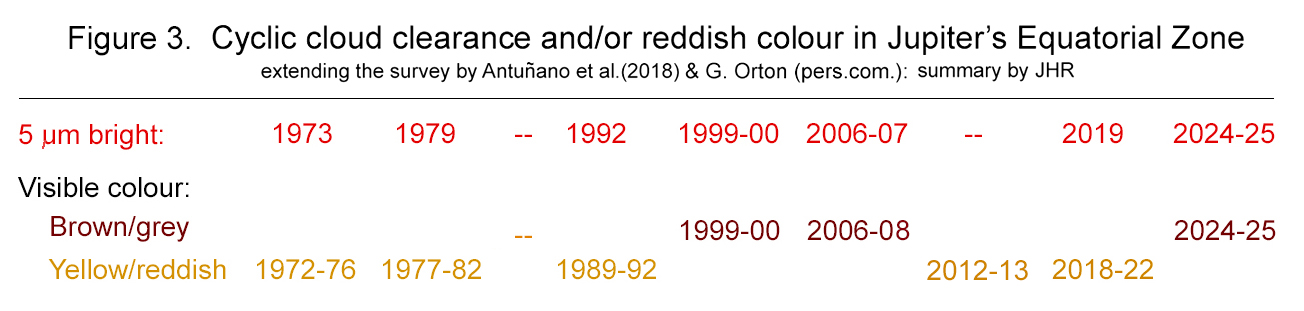
These coloration episodes fit the cycle of ‘EZ disturbances’ with period of 6-7 years proposed in [Refs.2,3] on the basis of brightening in the thermal infrared at 5 microns. Neither these, nor visible reddish coloration, alone reveal a clear periodicity. But if we combine the record of dark brownish-grey episodes, orange or ochre episodes, and 5-mm clearances, the 6-7-year periodicity is consistent (Fig.3):
_____________________________________________________________________________________________________
The brown/grey episodes have lasted less than 2 years, coinciding with the 5-micron clearances, and are simply understood as substantial clearance of the main cloud deck producing both the low albedo and the bright thermal signal. The more vividly coloured episodes are more complex, and sometimes last for several years while the 5-micron clearance is much shorter or even (in 2012) does not occur at all. The orange coloration must be an additional aerosol, which Antuñano et al.[Ref.4] suggested was exposed by the removal of the upper clouds. Indeed it is not always methane-bright (e.g. 2012), but sometimes it is (1972; 2020-21), indicating higher altitude. The temporal coincidence and periodicity of these events imply that they are all part of one complex phenomenon, which can entail cloud clearance and/or orange aerosol formation in different proportions.
References:
- [1] Rogers JH (1995) The Giant Planet Jupiter (Cambridge Univ. Press).
- [2] Antuñano A et al.(2018). Geophysical Research Letters 45, 10987-95. https://doi.org/10.1029/2018GL080382.
- [3] Antuñano A et al. (2019) . Astronomical Journal 158, no. 130. https://iopscience.iop.org/article/10.3847/1538-3881/ab2cd6
- [4] Antuñano A et al. (2020). JGR-Planets, 125, e2020JE006413. https:// doi.org/10.1029/2020JE006413
- [5] Terrile RJ & Beebe RF (1979) Science 204, 948-951.
I thank Glenn Orton for information about recent 5-micron clearances.
How to cite: Rogers, J.: Jupiter’s Equatorial Zone: Visible colorations and 5-micron clearances together support 7-year periodicity, Europlanet Science Congress 2026, The Hague, The Netherlands, 7–11 Sep 2026, EPSC2026-392, https://doi.org/10.5194/epsc2026-392, 2026.


