
 1,1,1,2,1,1,1
- 1IAPS-INAF, Rome, Italy (cristian.carli@inaf.it)
- 2Geoscience Dept., University of Padua, Padua, Italy
Introduction:
Kuiper crater (62 kilometers in diameter) overlies the northern rim of the larger and older crater Murasaki. The Kuiper crater is one of the highest albedo features on the surface of Mercury with an important ray system, indicative of its young age. It is a stratigraphic marker of the hermean surface evolution, giving the name at the last period of Mercury timeline (the Kuiperian age). Nevertheless, few dedicated investigations (D’Incecco et al 2015) were carried out to understand the evidence within such features, and the implication from a geological point of view. Here we investigate the geological evolution of Kuiper crater, investigating the variation from both morphological and spectral point of view.
Data and methods:
Here, we used MDIS data. 1) For geomorphological investigations we take into account a high-resolution Kuiper crater MDIS/NAC mosaic produced with a spatial resolution of about 120 m/pixel. In the background we used the MDIS BDR mosaic produced at global scale from MESSENGER team, with a resolution of 166 m/pixel. 2) For spectral investigations a MDIS/WAC 8 color mosaics at 385 m/px was produced, considering using images with < 500 m/px.
Results and conclusions:
The crater is in general saturating at the global planetary mosaics, whereas ad hoc mosaics permit different geological evidence to arise. The crater presents a well-defined central peak, with a relatively smooth floor, with some hummocky and mass waste deposits. The latter appears on the north and south regions of the crater characterizing all the wall section. The rest of the walls show several terraces and several patches of smooth material can be highlighted also on the wall. Considering the crater wall mass waste deposit orientation, as well as their spectral properties, it seems to reveal the possible impact direction. Moreover, the extension of the ejecta, improved by the use of reflectance properties (separating proximal and distal ejecta, Figure 1a,b,c) shows an asymmetry towards S-SE. The evidence of pyroclastic-like material is present on the N-E wall (Figure 1c,d), whereas from north to west the terraced wall seems to show the presence of re-melted material (Figure 1d). Interestingly, two different hollows-like terrain are present on both the inner peaks and on the southern wall (Figure 1d), indicating that hollows could be emplaced on different bedrock terrains. In addition, the spectral indication shows a clear distinction from Kuiper material with respect to the Murasaki terrains.
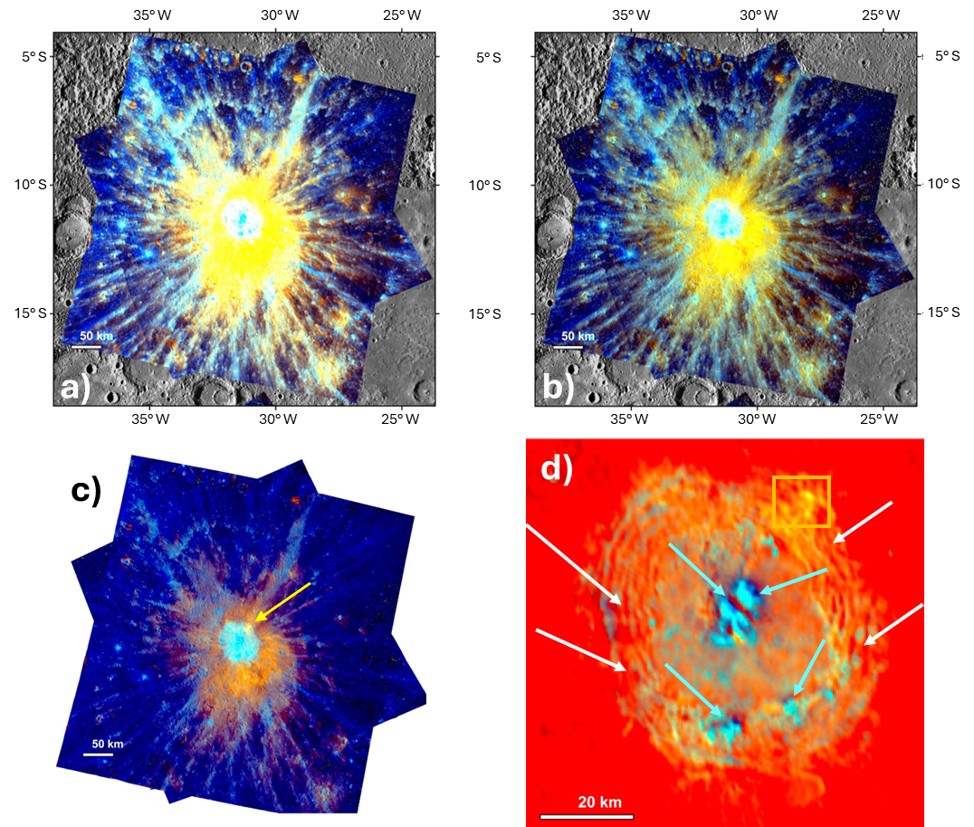
Fig.1 a,b,c enhanced color mosaic with different color stretches zooming to the crater, supporting the definition of ejecta and highlighting the pyroclastic-like material (yellow spot on the N-E wall in c, yellow arrows). d) exaggerated threshold on inner central peak, which permits to identify hollows like materials (cyan arrows) on the peak as well as on southern part of the wall; Pyroclastic-like material (yellow box) and terraces (white arrows).
References:
D’Incecco, P., Helbert, J., D’Amore, M., Maturilli, A., Head, J. W., Klima, R. L., Izenberg, N. R., McClintock, W. E., Hiesinger, H., & Ferrari, S. (2015). Shallow crustal composition of Mercury as revealed by spectral properties and geological units of two impact craters. Planet. Space Sci, 119, 250–263. https://doi.org/10.1016/j.pss.2015.10.007
Acknowledgment
Acknowledgements: We want to acknowledge the GMAP, Europlanet RI 20-24 grant n.: 871149-GMAP and the Bepicolombo (SIMBIO-SYS) project, ASI-INAF agreement n.: 2024-18-HH.0.
How to cite: Carli, C., Giacomini, L., Zambon, F., Massironi, M., Galiano, A., Capaccioni, F., and Palumbo, P.: Kuiper crater, a break within Mercury crust, Europlanet Science Congress 2026, The Hague, The Netherlands, 7–11 Sep 2026, EPSC2026-393, https://doi.org/10.5194/epsc2026-393, 2026.


