
 ,,
,,- Centrum Badań Kosmicznych Polskiej Akademii Nauk (CBK PAN), Warsaw, Poland (abaiju@cbk.waw.pl)
Graben systems are elongated topographic depressions bounded by normal faults and are widespread across rocky planetary bodies in the Solar System. They are commonly interpreted as surface expressions of crustal extension driven by tectonic and/or magmatic stresses. Similar morphologies occur under very different mechanical, thermal, and tectonic conditions, while the limited ability to probe extraterrestrial subsurfaces restricts understanding direct links between surface observations and underlying processes. Despite individual studies, no updated consensus framework exists that harnesses the wealth of high-resolution optical and topographic data collected by recent planetary missions to reconcile these interpretations across the different environments. Interpretations, therefore, often rely on morphology combined with simplified analytical or numerical models.
We present a comparative synthesis of graben-like structures across Mars, Earth, the Moon, Venus, and Mercury, prioritizing observable surface characteristics and morphologies while critically assessing the extent to which subsurface processes can be inferred. Published analyses of remote sensing and topographic datasets are evaluated across planetary bodies that differ in gravity, lithospheric thickness, tectonic regime, magmatic activity, and surface modification.
We identify systematic differences in graben scaling, fault spacing, and segmentation. Terrestrial grabens are typically small, segmented, and rapidly modified by erosion, whereas lunar grabens are narrow, shallow, and spatially restricted, commonly associated with basin loading and thermal contraction. Venusian grabens form extensive radial and concentric systems around volcanic rises, reflecting deformation dominated by lithospheric flexure. Martian grabens display the widest morphometric range, including large fault offsets, wide graben floors, and long fault continuity, likely facilitated by relatively low gravity, a thick lithosphere, and limited erosional modification.
These observations highlight the non-uniqueness of morphology-based interpretations. While a morphology-first framework provides a more consistent basis for classification, it also remains insufficient to uniquely constrain formation mechanisms, emphasizing the need for further observational and modelling studies.
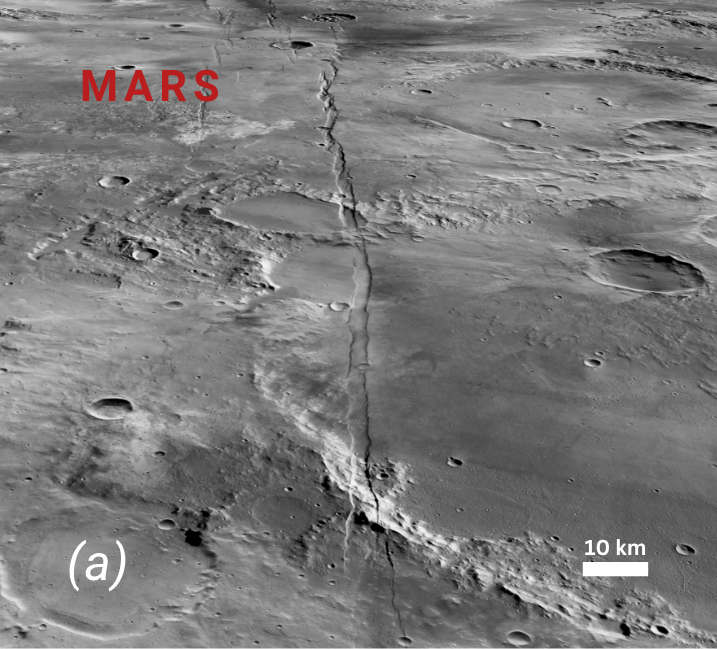
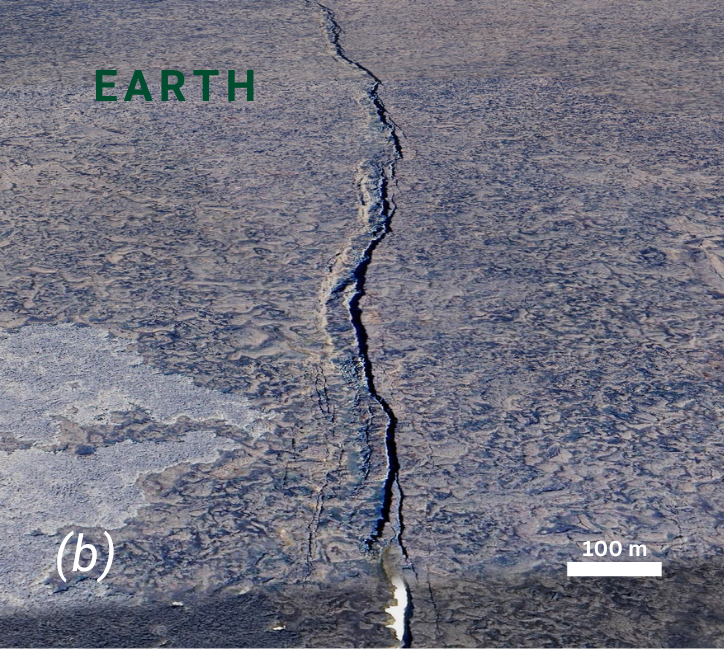
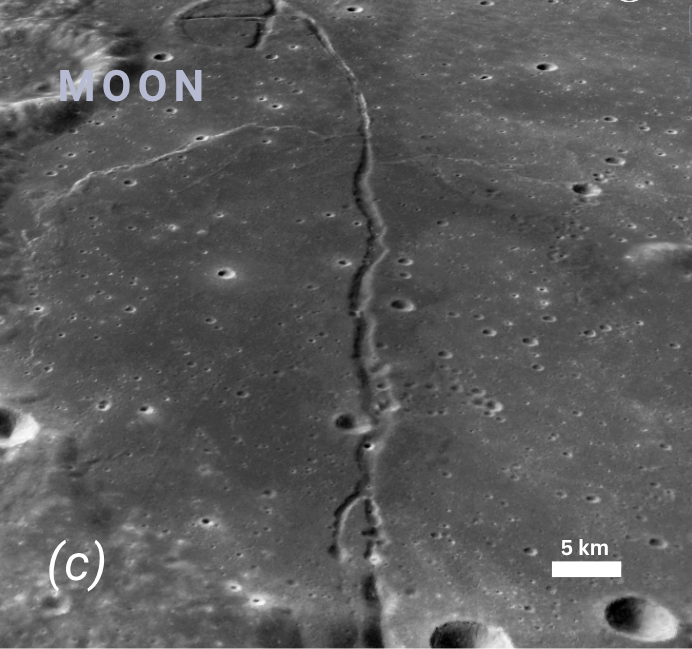
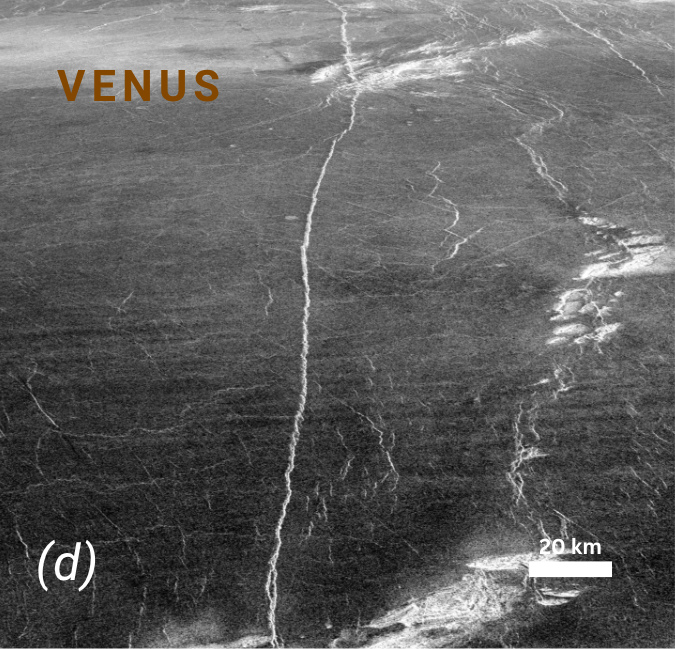
Fig.1: Graben and fracture systems across different planetary bodies - (a) Part of Sirenum Fossae Graben (MRO CTX Mars, NASA); (b) Part of the Sveinagj Graben system in Iceland (Google Earth); (c) Graben in the SW Mare Humorum (LROC, NASA); (d) Fatua Corona Graben (Venus Magellan, NASA)
How to cite: Baiju, A., Poppe, S., Havard, T., and Mège, D.: Graben systems across the Inner Solar System: a Comparative Framework for their Morphology and Formation Mechanisms, Europlanet Science Congress 2026, The Hague, The Netherlands, 7–11 Sep 2026, EPSC2026-394, https://doi.org/10.5194/epsc2026-394, 2026.


