
 1,2,3,1,3,3,3,5
- 1Czech Academy of Sciences, Institute of Geophysics, Prague 4, Czech Republic (kryza@ig.cas.cz)
- 2Department of Geophysics, Faculty of Mathematics and Physics, Charles University, Prague, Czech Republic
- 3School of Physical Science, STEM, The Open University, Milton Keynes, UK
- 4School of Earth and Space Exploration, Arizona State University, Tempe, AZ, USA
- 5Space Science and Technology Department, STFC Rutherford Appleton Laboratory, Oxford, UK
Metastable liquids (including water, brines, and mud) are thought to play an important role in shaping planetary surfaces, from putative sedimentary volcanism and recurring slope lineae on Mars to cryovolcanic activity on icy bodies such as Europa, Enceladus, and Triton (e.g., [1-3]). Under the cold and low-pressure conditions present on many planetary bodies, such liquids become inherently metastable once exposed at the surface, undergoing rapid boiling, evaporative cooling, and freezing (e.g., [4-6]).
All these different processes share one important requirement: a liquid must be suddenly exposed to a low-pressure environment before it has time to thermodynamically adjust to the new conditions. Yet most existing experimental setups, whether designed for flows of brines, pure water, or mud, rely on gradual depressurization (e.g., [7-10]). During this process, evaporative cooling progressively pre-conditions the fluid prior to eruption, promoting partial equilibration, early ice or salt-crystal nucleation, and changes in rheology before surface exposure occurs. As a result, the observed flow dynamics may preferentially reflect late-stage, partially equilibrated behaviour rather than the initial response of a metastable liquid to rapid decompression, potentially limiting the applicability of such experiments to planetary surface processes involving abrupt liquid release.
Here, we introduce a new experimental approach enabling controlled subsurface release of metastable mud under Mars-relevant low-pressure (~4.5 mbar) and subfreezing (−25 °C) conditions. The experiments used low-viscosity mud stored beneath a frozen crust within a low-pressure chamber. The fluid is stored beneath an ice-sealed reservoir that is subsequently thermally weakened and breached from below using a localized heating element (Fig. 1). Unlike previous surface-release experiments, the presented setup enables subsurface-confined eruptions driven by internally generated boiling pressure. This setup minimizes direct interaction between the mud and the low-pressure environment prior to eruption, allowing the fluid to remain close to its initial thermal state until rupture occurs. The ensuing eruption is therefore driven by in situ boiling and rapid decompression rather than by slow pre-equilibration during chamber evacuation.
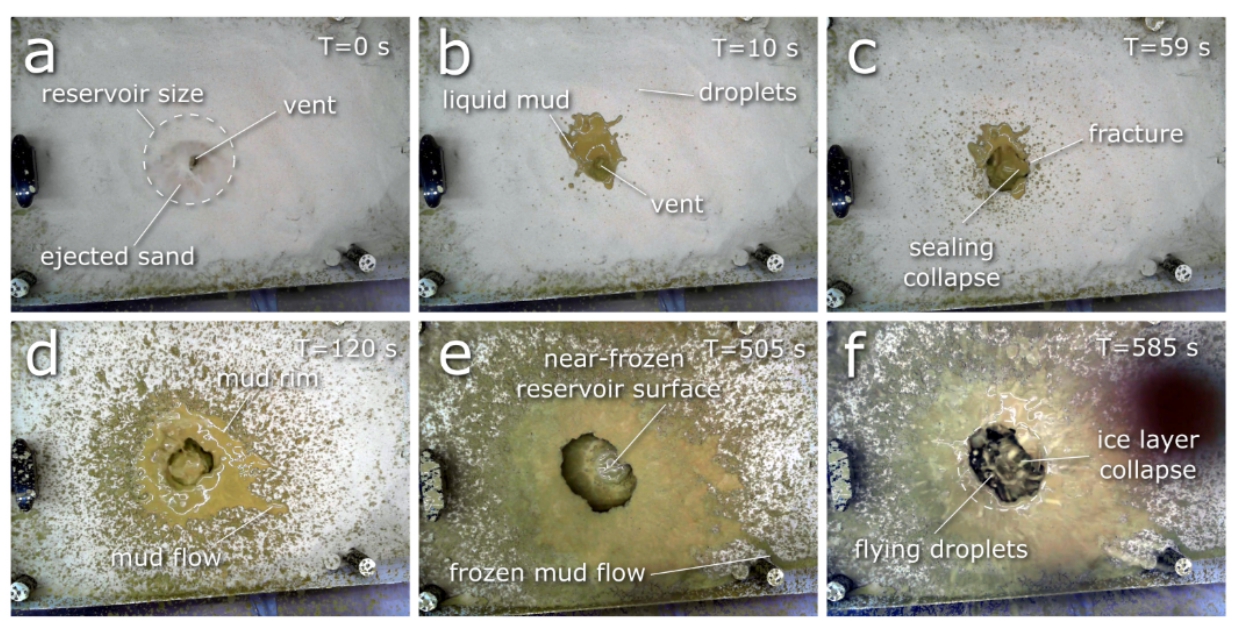
Fig. 1. Sequence of images showing reservoir opening, fountains, droplets, liquid mud, and flows on panels.
The experiments reveal a systematic progression in eruptive behaviour, recognisably analogous to natural sedimentary volcanism. An initial ballistic, Strombolian-like phase is characterised by discrete short-lived bursts ejecting mud droplets from the vent. This activity progressively transitions into a mixed ballistic-effusive regime and ultimately into pulsatory effusive emplacement forming coherent mud flows downslope (Fig. 2). Repeated ballistic and pulsatory activity also promoted proximal accumulation of erupted material and the development of cone-like edifices around the vent. The eruption dynamics are driven by internally generated pressure pulses associated with boiling and phase transitions within the metastable reservoir, rather than by externally imposed pressure gradients. The experiments therefore demonstrate that boiling of metastable mud alone is sufficient to generate cyclic pressurization, pulsatory eruptions, and sustained flow emplacement under Mars-like pressure conditions.
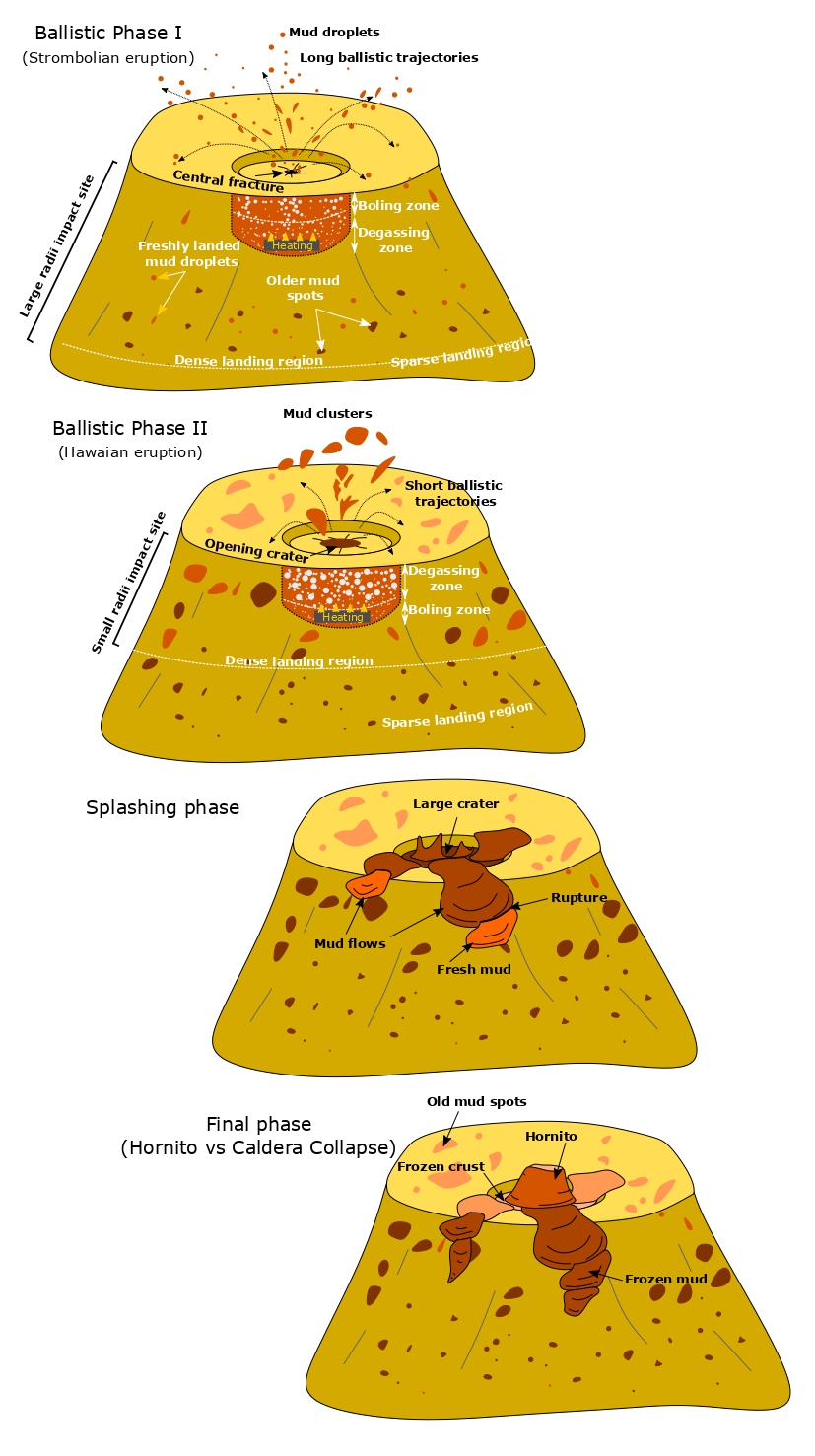
Figure 2: Conceptual evolution of eruptive behaviour from ballistic mud ejection to pulsatory effusive flow emplacement under low-pressure conditions.
Flow development is controlled by droplet size, transport distance, and limited cooling during ballistic transport (~0.5–4 °C). The relatively small thermal losses during flight allow erupted mud to remain liquid upon deposition despite ambient subfreezing conditions, promoting coalescence of ballistic ejecta into continuous flows (Fig. 3). This suggests that even under Martian gravity and atmospheric pressure, ballistic emplacement may directly contribute to the formation of coherent flow-like deposits. These observations suggest that similar coupling between ballistic emplacement and coherent flow formation may also occur under Martian surface conditions.
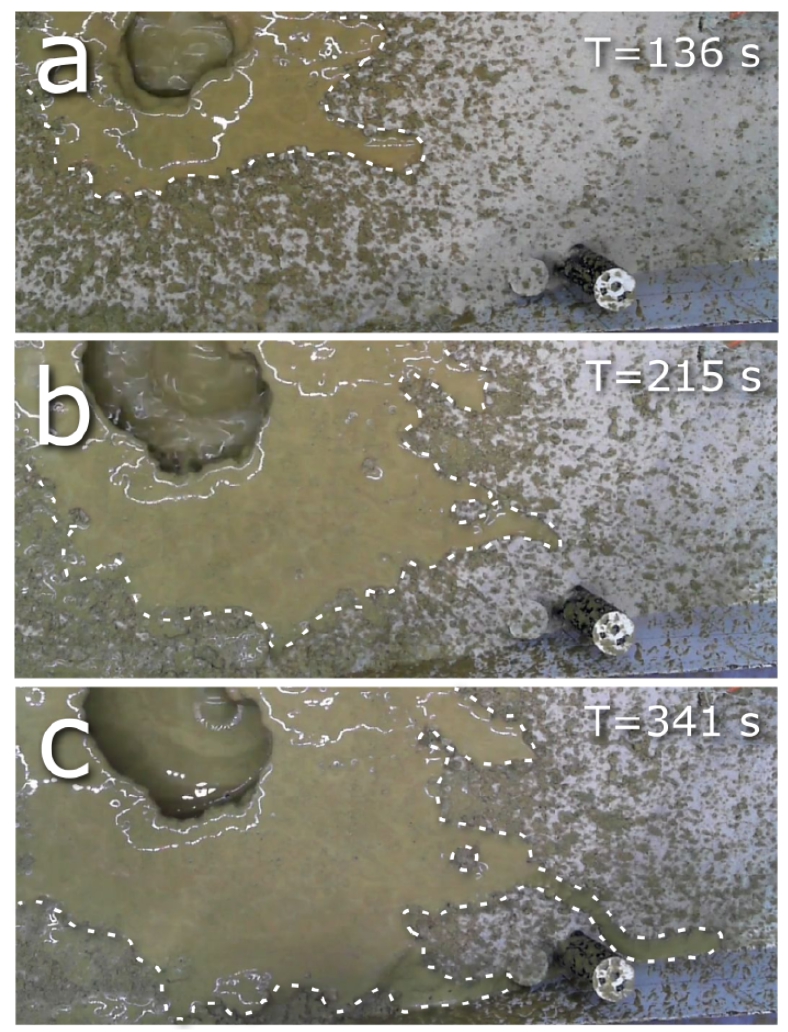
Figure 3: Formation of mud flows around the eruption site through progressive accumulation and coalescence of ballistic and effusive mud emplacement.
Together, these results demonstrate that sedimentary volcanism under low-pressure planetary conditions can operate as a self-sustaining mechanism capable of generating both explosive and effusive behaviour without the need for continuous external pressurization. The presented subsurface-confinement-and-breach approach provides a scalable experimental framework for investigating metastable liquids under rapidly changing low-pressure conditions. Beyond sedimentary volcanism on Mars, the setup is readily adaptable to brines, cryogenic fluids, and cryovolcanic analogues relevant to icy bodies, offering new experimental constraints on eruption dynamics, flow emplacement, and planetary surface evolution.
References
[1] Fagents (2003), JGR, 108, 5139. [2] Lesage et al. (2021). [3] Brož et al. (2023), Earth Surf. Dyn., 11, 633–661. [4] Hecht (2002), Icarus, 156, 373–386. [5] Bargery et al. (2010), Icarus, 210, 488–506. [6] Brož et al. (2025), EPSL, 668, 119331. [7] Brož et al. (2020a), Nat. Geosci., 13, 403–407. [8] Brož et al. (2023), JGR: Planets, 128, e2023JE007950. [9] Krýza et al. (2025), Commun. Earth Environ., 6, 116. [10] Adler et al. (2025), Commun. Earth Environ., 6, 841.
How to cite: Krýza, O., Brož, P., Adler, J., Sylvest, M., and Patel, M.: Beyond gradual depressurization: Building mud volcanoes from a metastable reservoir, Europlanet Science Congress 2026, The Hague, The Netherlands, 7–11 Sep 2026, EPSC2026-404, https://doi.org/10.5194/epsc2026-404, 2026.


