
 1
1- 1Imperial College London, Earth Science and Engineering, London, United Kingdom (p.j.mason@imperial.ac.uk)
- *A full list of authors appears at the end of the abstract
ESA’s Envision mission is a holistic investigation of Venus’ interior, surface and atmosphere, aimed at improving our understanding of the geodynamic, geological and climatic history and activity of our nearest planetary neighbour. To achieve that, we need a series of complimentary observations at global, regional and local scales, from different instruments and in different modes, and repeated observations for change detection. Envision will carry an integrated instrument suite of spectrometers (VenSpec), a Subsurface Radar Sounder (SRS) and a Synthetic Aperture Radar (VenSAR) that will collect these data. This will be further complemented by gravity and radio occultation observations using the satellite communications system to Earth.
Whilst we would like to image the entire planet at high resolution using the SAR instrument, that is not feasible in the 6-sidereal-day nominal mission life, hence Envision’s imaging strategy is targeted: collecting nested, multi-modal images which will be used to answer its complex science questions. At least 20% of the surface of Venus will be imaged using the SAR at 30 m spatial resolution (twice and at different angles, for generation of stereo topography for at least 18% of the surface) with a smaller fraction imaged a third time (for change detection) or at dual-polarisation, and an even smaller fraction imaged at 10 m resolution for detailed geomorphological analysis. The stereo-derived topography and Envision’s near-global altimetry data will be vital to answer science questions involving Envision’s other instruments and for its holistic science investigations. Considering EnVision’s overall scientific objectives, as well as individual instrument goals, synergies, and limitations, the key question then becomes how we decide which areas should be imaged and in which modes?
The Envision Science Working Team (SWT) formed an ROI Working Group (ROIWG), which was tasked with compiling a list of surface features on Venus, the imaging of which will help address the Envision Science Objectives. The list contains named and located features of interest, of all types (including, but not limited to, tectonic, volcanic, and impact features, and aeolian landforms), which was in turn used to construct Regions of Interest (ROIs), in a semi-automated, semi-objective way. It is anticipated that the imagery collected across the ROIs will capture a representative sample of its geological terrains and key features. These ROIs will thus form the basis of Envision’s SAR and radiometric imaging strategy and planning, as well as the strategy for the subsurface radar high density observations. Here we summarise the process and present an example of Envision’s ROIs (e.g. Figure 1) and how they will be used to optimize the scientific return of the EnVision mission. This target lists will be used by the Envision SWT to construct the mission Science Activity Plan for the Science Measurement Phase. In the future, as the mission advances, this target list will evolve, will be opened to community input, and will remain central to maximizing the value of synergistic, multi-instrument investigations of our sister planet.
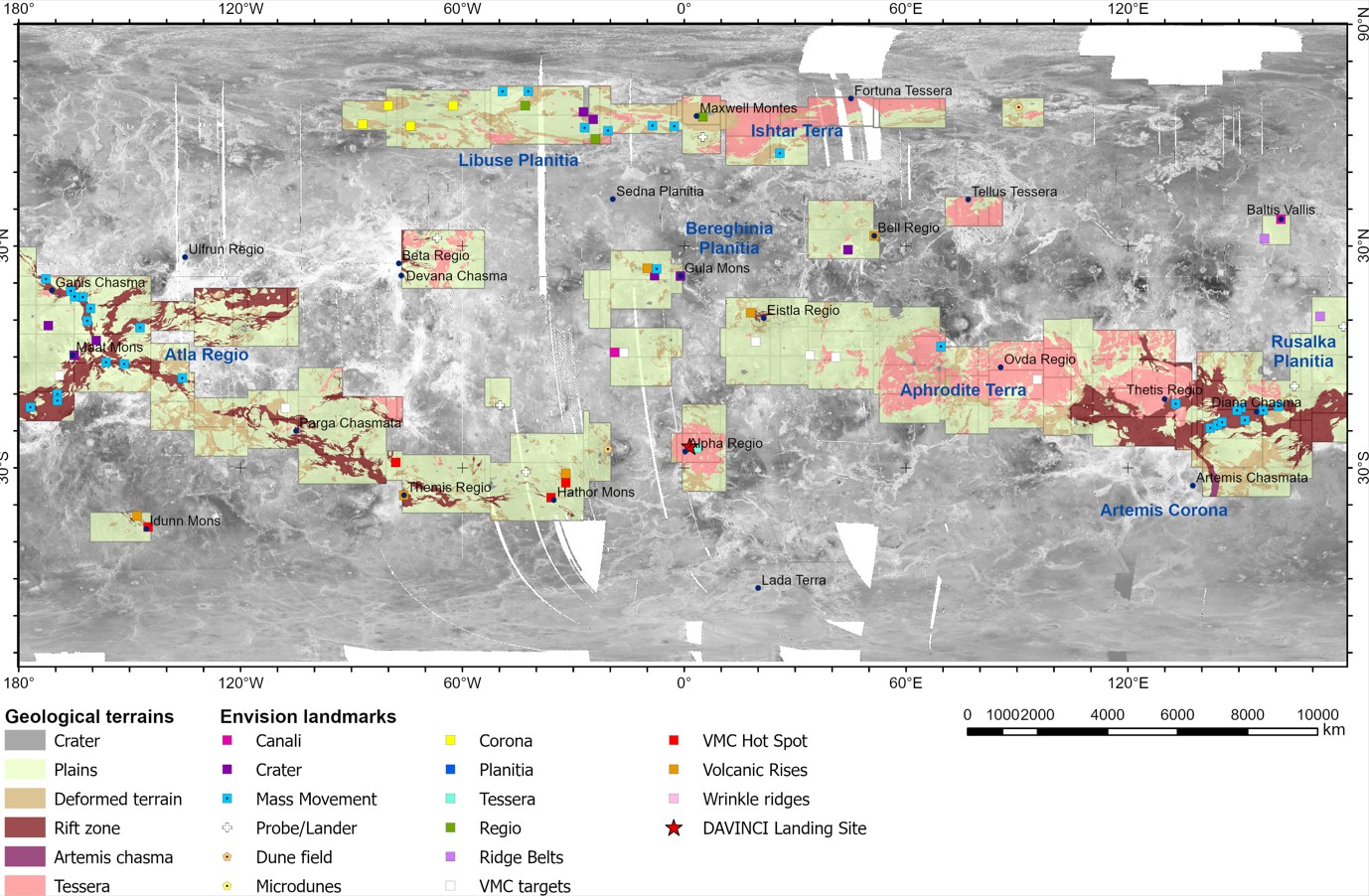
Figure 1. Illustration of EnVision’s planned Regions of Interest (ROIs) as published in the Definition Study Report or Red Book (ESA-SCI-DIR-RP-00, European Space Agency, Nov 2023) with a selection of known target features as well as the geological terrains they would intersect, overlain on the global Magellan SAR image mosaic.
Anne Grete Straume-Lindner, Justin Erwin, Alessandro Atzei, Helma Glasbergen, Jayne Lefort, Emmanuel Marcq, Lorenzo Bruzzone, Séverine Robert, Caroline Dumoulin, Giulia Alemanno, Anna Gülcher, Maxence Lefevre, Cédric Gillmann, Philippa Mason, Joseph O'Rourke, Jean-Luc Margot, Joao Manuel Mendonca. The ROI Working Group: Philippa Mason, Arnaud Mahieux, Anne Grete Straume-Lindner, Adam McSweeney, Lorenzo Bruzzone, Giulia Alemanno, Ana Plesa, Ines Belgacem, Lisa Molaro, Lynn Carter, Oceane Barraud, Julia Maia, Iván López Ruiz-Labranderas, Anna Gülcher, Cédric Gillmann, Robert Herrick, Samantha Moruzzi, Jayne Lefort, Nicholas Rambaux, Joseph O’Rourke, Gabrielle du Toit, Joseph O’Rourke, Carianna Herrera, Tilmann Denke, Aurelie van den Neucker, Bernhard Geiger, Bjoern Grieger, Ishuwa Sikaneta, Thomas Voirin. Members of the VenSAR Science Team, VenSpec Science Team and SRS Science Team. Automated ROI tool-building team: Amin Nadimy, Sajjiad Foroughi, Philippa Mason. Early manual ROI definition team: Richard Ghail, Colin Wilson, Thomas Widemann, Robbie Herrick, Walter Keifer, Paul Byrne, Philippa Mason.
How to cite: Mason, P. J. and the Envision Science Working Team: Defining Envision’s Regions of Interest (ROI): from a community-led feature list to a targeted imaging strategy, Europlanet Science Congress 2026, The Hague, The Netherlands, 7–11 Sep 2026, EPSC2026-406, https://doi.org/10.5194/epsc2026-406, 2026.


