
 1,1,3,4,5,5,
- 1LATMOS/IPSL, CNRS, Université Versailles Saint-Quentin, Sorbonne Université, Université Paris-Saclay, Saint-Quentin en Yvelines, France (chaufray@latmos.ipsl.fr)
- 2ESAC, Madrid, Spain
- 3Tokyo University, Tokyo, Japan
- 4Institute of Space and Astronautical Science, Japan, Aerospace Exploration Agency
- 5IKI, Moscow, Russia
- 6Department of Information Engineering, University of Padova, Italy
- 7National Research Council of Italy, Institute for Photonics and Nanotechnologies, Padova, Italy
Introduction
The BepiColombo mission will be inserted around Mercury on November 26th 2026, and scientific operations will start in March 2027, after the separation between Mercury Planetary Orbiter (MPO) and Mercury Magnetospheric Orbiter (MMO) on December. Probing the Hermean Exosphere By Ultraviolet Spectroscopy (PHEBUS), on MPO, is a UV spectrograph measuring the UV exospheric emissions with two main detectors: Extreme UV (EUV) (55-155 nm) and Far UV (FUV) (145 – 315 nm) and two Near UV (NUVs) channels at 404 nm and 422 nm [1,2]. A combination of a rotating primary mirror and baffle allows changing the pointing direction of PHEBUS field of view. The line of sight changes with the scanner position along a cone with a half-angle of 80° and centered on the Y axis of the spacecraft.
The emissions of H (121.6 nm), He (58.3 nm), Ca (422 nm), and Mg (285.3 nm), observed either by Mariner 10 or MESSENGER as well as the dayside surface, have been observed by PHEBUS during the flybys of Mercury by BepiColombo [3,4,5,6]. More systematic observations of the exosphere of Mercury will be performed during the orbital phase to study its variations. These observations will help to understand the origin of the different species in the exosphere of Mercury, and its relation to the surface and the plasma environment.
We present here the planification of the observations for the first two months during the Medium Term Plans 1 and 2 (MTP 1 and MTP 2) from March 14th 2027 to May 9th 2027.
Planification during Medium Term Plans 1 and 2
The orbit plane of MPO through Mercury year is represented on Fig. 1

Fig. 1 The evolution of the orbit plane of MPO through one Mercury year. The observations of PHEBUS are limited to approximatively the MPO orbit plane (red line) and then restricted in local time, depending on the TAA of Mercury.
During MTP1 and MTP2, regular observations of the exosphere will be done from TAA ~ 170 – 30° to study the seasonal variations of the exosphere. Because of the numerous instrumental (illumination) and mission (e.g. telemetry) constraints, PHEBUS cannot operate all the time, and a careful study of the possibility of observations must be considered. We plan to perform one observation per orbit, i.e. ~ 10 observations per day (the orbital period of MPO is ~2.2 hours), including 8 observations dedicated to the exosphere and two other observations dedicated to star or interplanetary background. Only one channel (EUV or FUV) can be used during one observation with the two NUV channels. During one day, one observation is done with the EUV channel and seven observations with the FUV channel. However, the duration of one EUV observation is ~1 hour, while it is ~40 minutes with the FUV. The different observations are distributed along the orbit (Fig. 2) to have the best spatial coverage during one week. Examples of EUV observations during the short-term planning 8 (STP8) are shown on Fig. 2
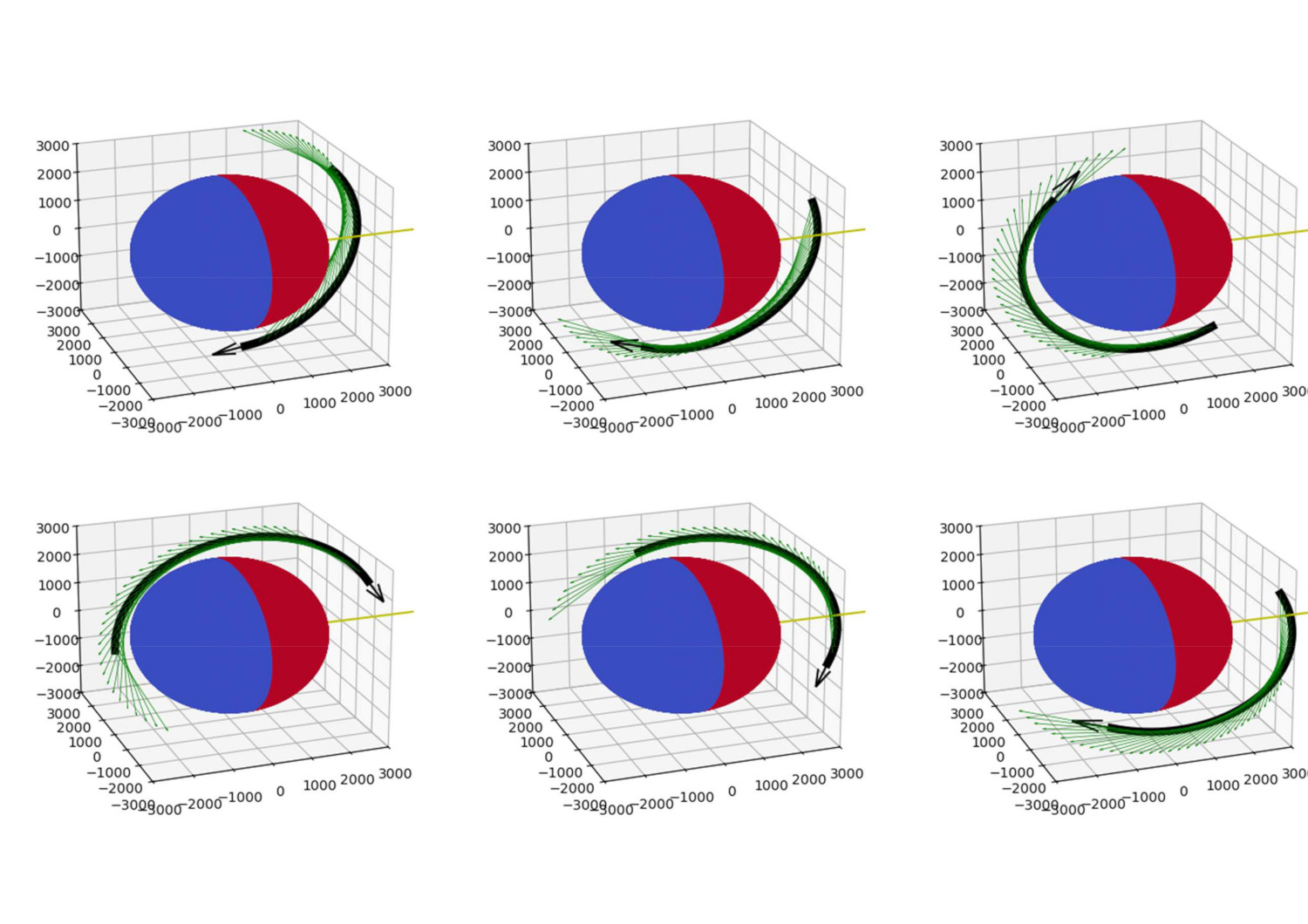
Fig. 2 Example of 6 exospheric observations with the EUV channel during MTP2/STP8 (near Mercury’s perihelion. TAA between 340 and 23°). These observations cover the dayside (e.g. top left and middle panels), and partly the tail direction (top right, bottom left and right panels). The red color represents the dayside of Mercury, the blue surface the nightside. The sun direction is represented by the yellow arrow. The spacecraft orbit is represented by the black arrow and a few PHEBUS lines of sight during the observations are represented by the green arrows.
For each line of sight, we can define the altitude, local time and latitude of the tangent point. The expected coverage in local time and latitude during the medium-term planning 2 (MTP2: TAA 240°- 30°), assuming the current planification, is displayed on Fig. 3. This coverage can still be slightly modified due to changes in the planification. The predicted brightness of the different emissions, based on numerical model [7] will be also discussed during the presentation.
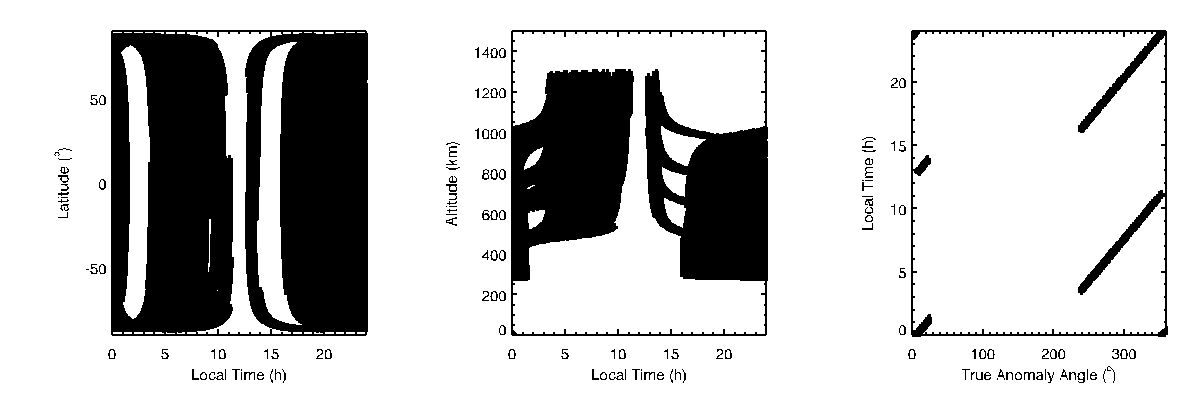
Fig. 3 Spatial and temporal coverage of the exospheric observations with the FUV detector during the MTP2. On the right panel, observations near the poles (latitude > 60°) are not considered.
Comparison with MESSENGER.
MESSENGER had a 12 hours periodic and highly elliptical orbit with its apoapsis (~15000 km) in the southern hemisphere and its periapsis (~200 km) near the north pole. Most of UVVS observations of the exosphere of Mercury occurred near apoapsis to have the largest coverage of altitudes (from ~ 200 to 2500 km) and local times but with a limited latitude coverage [8]. Due to the smaller orbit, PHEBUS/MPO altitude range will be reduced and limited to altitudes below ~ 1500 km. But PHEBUS will explore a larger range of latitude during one single observation at a fixed local time (Fig. 3 left). The local time coverage will be strongly dependent on the TAA, with observations near noon/midnight near Mercury’s perihelion and aphelion, and observations near terminator at TAA = 90 and 270° (Fig. 3 right). Therefore, the observations by PHEBUS will explore regions poorly sampled by MESSENGER/MASCS, offering the opportunity to distinguish between sputtering at high latitudes and dust impact or thermal desorption at mid and low latitudes.
References
[1] Chassefière, E. et al, Planet. Space Sci., 58, 201-223, (2010)
[2] Quémerais, E. et al., Space Sci. Rev., 216: 67, (2020)
[3] Quémerais, E., et al., J. Geophys. Res.: Planet, 128, e2023JE007743, (2023)
[4] Robidel, R., et al., , J. Geophys. Res. : Planets, 128, e2023JE007808, (2023)
[5] Suzuki, Y., et al., J. Geophys. Res.: Planets, e2024JE008524, (2024)
[6] Chaufray, J-Y., et al., J. Geophys. Res.: Planets, 128, e2022JE007669, (2023)
[7] Chaufray, J-Y, et al., Icarus, 384, 115081, (2022)
[8] McClintock, W.E., et al., Cambridge Planetary Science, Cambridge University Press, Cambride, 371-406., (2018)
How to cite: Chaufray, J.-Y., Quémerais, E., Koutroumpa, D., Robidel, R., Vontrat, A., Leblanc, F., Merusi, M., Laouisset, A., Yoshikawa, I., Yoshioka, K., Murakami, G., Suzuki, Y., Korablev, O., Belyaev, D., Ivanova, A., Pelizzo, M. G., and Corso, A.: Planification of the exospheric observations of Mercury by PHEBUS/BepiColombo during the first two months, Europlanet Science Congress 2026, The Hague, The Netherlands, 7–11 Sep 2026, EPSC2026-408, https://doi.org/10.5194/epsc2026-408, 2026.


