
 2,1,1,5,1,1,1,1
- 1DLR German Aerospace Center, Berlin, Germany (aurelie.vandenneucker@dlr.de)
- 2ESTEC, European Space Agency (ESA), Noordwijk, The Netherlands
- 3Freie Universität Berlin (FU), Berlin, Germany
- 4TESCAN, GROUP a.s., Brno, Czechia
- 5Museum fur Naturkunde (MfN), Berlin, Germany
Introduction
Fragments from the near-Earth C-type asteroid 162173 Ryugu [1,2], provide a unique opportunity to directly investigate the effects of space weathering on primitive carbon-rich materials. Space weathering includes processes such as micrometeoroid bombardment, solar wind irradiation, and cosmic ray exposure, which progressively alter the surfaces of airless planetary bodies [3]. While these effects are well understood for anhydrous materials such as lunar regolith and S-type asteroids [4-6], their impact on hydrous carbonaceous materials remains poorly understood [7,8].
This study aims to investigate the effects of space weathering on spectroscopic changes in the asteroid’s regolith material, by analyzing the returned grain A0112, which shows sub-millimeter-sized impact craters. Understanding the effects of space weathering will help improve the interpretation of the NIRS3 remote sensing data obtained from Ryugu’s surface.
Materials
In this study, the Ryugu sample A0112 (Fig.1) was investigated. It is a ~3 mm-sized fragment of regolith returned from the near-Earth C-type asteroid 162173 Ryugu by the Hayabusa2 mission [1,2]. The sample was collected during the first touchdown and originates from the asteroid’s uppermost surface layer, making it highly representative of space-weathered material. The sample was transferred to the Planetary Spectroscopy Laboratories (DLR, Berlin) for non-destructive microscopic and spectral analyses.
Methodology
Different analytical techniques were used to characterize the structural, compositional, and spectroscopic properties of A0112. For optical microscopy, a Keyence VHX-7000 digital microscope was used to investigate the surface morphology of the grain. Through this technique the microcraters, surface textures, melt splashes, and topographic features could be identified with high-resolution 2D and 3D imaging [9].
Infrared reflectance spectroscopy was performed using a Hyperion 2000 micro-FTIR microscope attached to a Bruker Vertex 80V FTIR spectrometer. More than 50 spot measurements were collected on cratered and non-cratered regions to determine the mineralogical composition. The spectroscopy was also specifically used to investigate the 2.7 microns -OH spectral feature depth of OH-bearing phases such as phyllosilicates at different locations on A0112.
Raman spectroscopy was done using a WiTec Alpha 300 confocal Raman microscope. This provided information on the structural state of the material through the analysis of the D and G bands, indicating different degrees of carbon ordering and thermal alteration.
Results and Discussion
Optical imaging revealed that the surface of A0112 is heterogeneous, containing both relatively smooth areas and heavily cratered regions. One face of the grain contains three large sub-millimeter microcraters, as well as numerous smaller microcraters ranging from less than 50 µm to approximately 200 µm in diameter. Smaller craters are typically bowl-shaped, whereas larger ones are surrounded by irregular spallation zones associated with shock-induced fractures [9]. High-resolution imaging showed that many craters are lined with frothy, vesicular material identified as quenched impact melt [7,9]. Melt splashes up to 300 µm across were also observed coating nearby smoother surfaces, indicating the deposition of this amorphous material during impacts and further demonstrating that the grain has been significantly affected by space weathering processes [9].
Infrared spectroscopy showed a strong contrast between the interior of the largest crater and its surrounding non-cratered regions (Fig.2). Spectra from the crater interior are largely featureless between 2 and 4 µm, indicating the loss of diagnostic absorption bands associated with hydrated minerals. These spectra resemble those of thermally altered carbonaceous chondrites such as Ivuna heated at 700 °C [10], suggesting that impact heating caused dehydration. In contrast, the non-cratered regions display strong absorption features near 2.71 µm, consistent with OH-bearing phyllosilicates, as well as absorption doublets in the 3.3-4 µm range indicating the presence of carbonates. This confirms that the original composition of Ryugu material is rich in hydrous phases.
Raman spectroscopy further highlights the differences between areas affected by space weathering and those that are not. Non-cratered regions exhibit well-defined D and G bands. In contrast, these bands are significantly reduced in cratered and melt-covered areas, indicating thermal alteration of the material during high-energy impact events.
This study shows that impact-generated melt products cause significant spectral changes, as the presence of amorphous melt material strongly reduces OH absorption bands. This effect may help explain remote sensing observations of Ryugu that show overall weaker hydration signatures. The results demonstrate that micrometeoroid impacts play a major role in altering both the physical structure and optical properties of carbonaceous asteroid regolith.
This study suggests that Ryugu’s surface is likely covered with abundant microscopic impact melt products that significantly influence its spectral characteristics. Similar processes are expected to occur on other C-type asteroids, such as 101955 Bennu. Our results contribute to a better understanding of space weathering in hydrous, carbon-rich materials and help connect remote sensing observations with laboratory analyses of returned asteroid samples.
References
[1] Yokoyama T. et al. (2023) Science 379-7850. [2] Nakamura T. et al. (2023) Science 379-8671. [3] Pieters C. M. and Noble S. K. (2016) Journal of Geophysical Research Planets 121:1865–1884. [4] Keller L. P. and McKay D. S. (1997) Geochimica et Cosmochimica Acta 64:2331–2341. [5] Pieters C. M. et al. (2000) Meteoritics & Planetary Science 35:1101–1107. [6] Noguchi T. et al. (2011) Science 333:1121–1125. [7] Noguchi T. et al. (2023) Nature Astronomy 7:170–181. [8] Melendez L. E. et al. (2023) 86th Meteoritical Society Meeting, Abstract #6286. [9] Hamann C. et al. (2023) 86th Meteoritical Society Annual Meeting, Abstract #6296. [10] Hiroi T. and Pieters C. M. (1996) LPSC XXVII, Abstract #551.
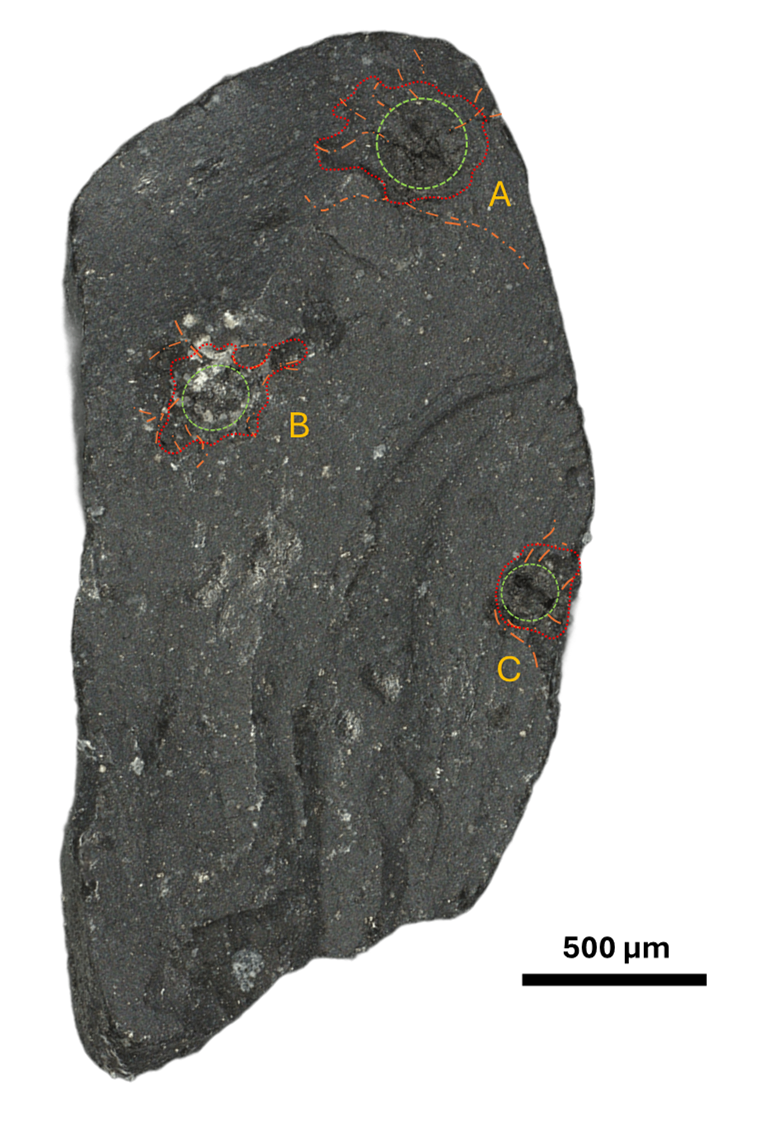
Figure 1: Reflected-light microscope image of sample A0112 showing the three largest microcraters (A, B, and C), with the crater pit high-lighted by green dashed ellipses. The surrounding spallation zones are outlined with red dotted lines, and associated fracture networks are indicated by orange dash-dot lines. the crater pit dimensions are 250 × 230 μm for crater A, 190 × 170 μm for crater B, and 150 × 150 μm for crater C.)
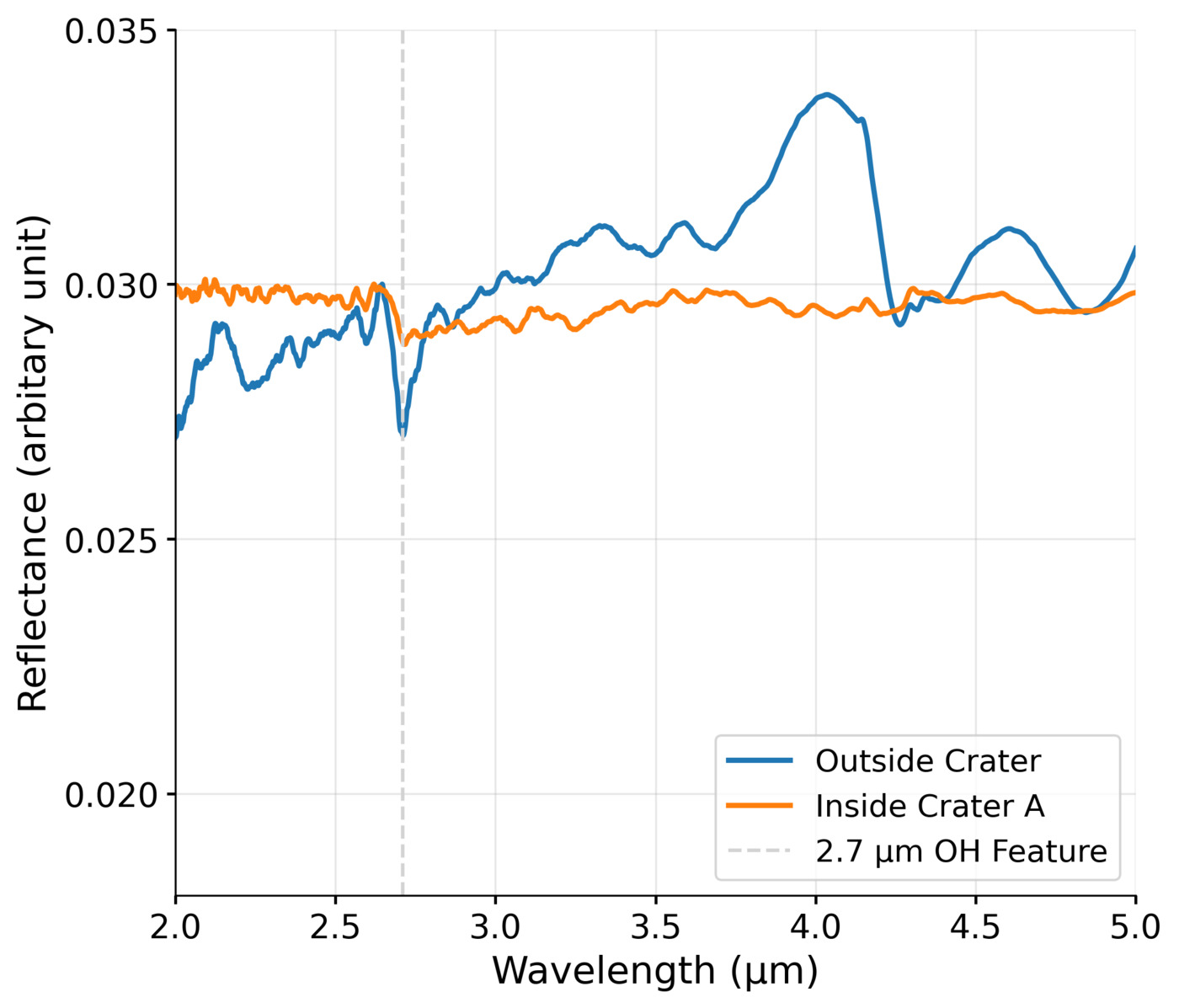
Figure 2: Micro-FTIR measurements acquired inside and outside the microcrater A. The blue spectrum corresponds to a measurement taken outside the microcraters, while the orange spectrum was acquired within the largest microcrater A (see Fig. 1). The 2.72 μm -OH band is represented by a grey vertical line.
How to cite: Van den Neucker, A., Helbert, J., Alemanno, G., Sander, J., Bonato, E., d’Amore, M., Hamann, C., Baque, M., Garland, S., Barraud, O., Greshake, A., Hecht, L., and Maturilli, A.: The Spectroscopic effect of Space Weathering of C-type Asteroid Regolith Documented by Microcraters on Ryugu Sample A0112. Spectral comparison with NIRS3 data., Europlanet Science Congress 2026, The Hague, The Netherlands, 7–11 Sep 2026, EPSC2026-410, https://doi.org/10.5194/epsc2026-410, 2026.


