
 1
1- 1Institute of Geophysics of the Czech Academy of Sciences, Prague, Czechia (petr.broz@ig.cas.cz)
- 2Ajeejee – Illustration and Graphic Design Studio, Brno, Czech Republic
In an era dominated by smartphones, social media, and short-form audiovisual content, printed popular science books may appear increasingly outdated, particularly for younger audiences. Yet our experience from the Czech Republic suggests the opposite: children and parents are still willing to spend substantial time with books if they offer something that digital content often does not — a shared reading experience combining storytelling, humour, illustrations, and curiosity about how the world works.
Here, we present the story of Vesmírníček (“Bedtime, Spacetime”), a trilogy of illustrated popular science books introducing planetary science, astrobiology, and Earth sciences to children and their parents. Rather than functioning as traditional encyclopedias built around isolated scientific facts, the books were intentionally designed as story-driven explorations of scientific questions commonly asked by children. The core concept behind the series is simple: instead of reducing science to disconnected trivia and simplified definitions, the books attempt to explain genuinely complex scientific problems through humour, analogies, storytelling, and richly detailed illustrations.
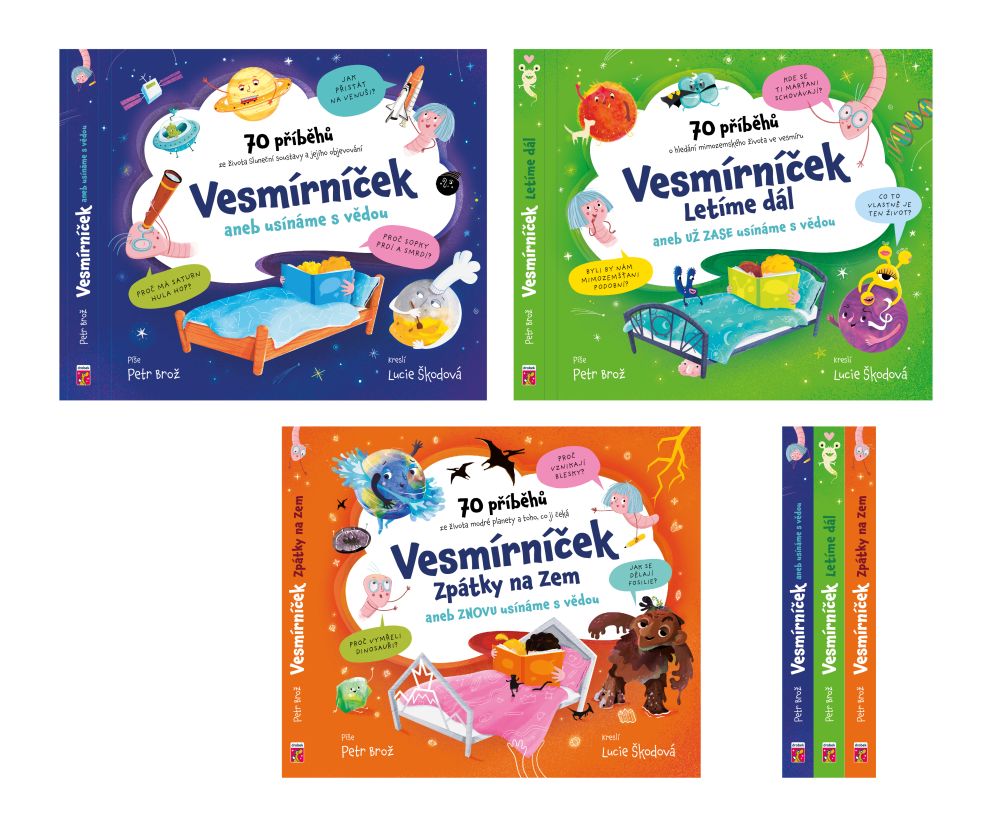
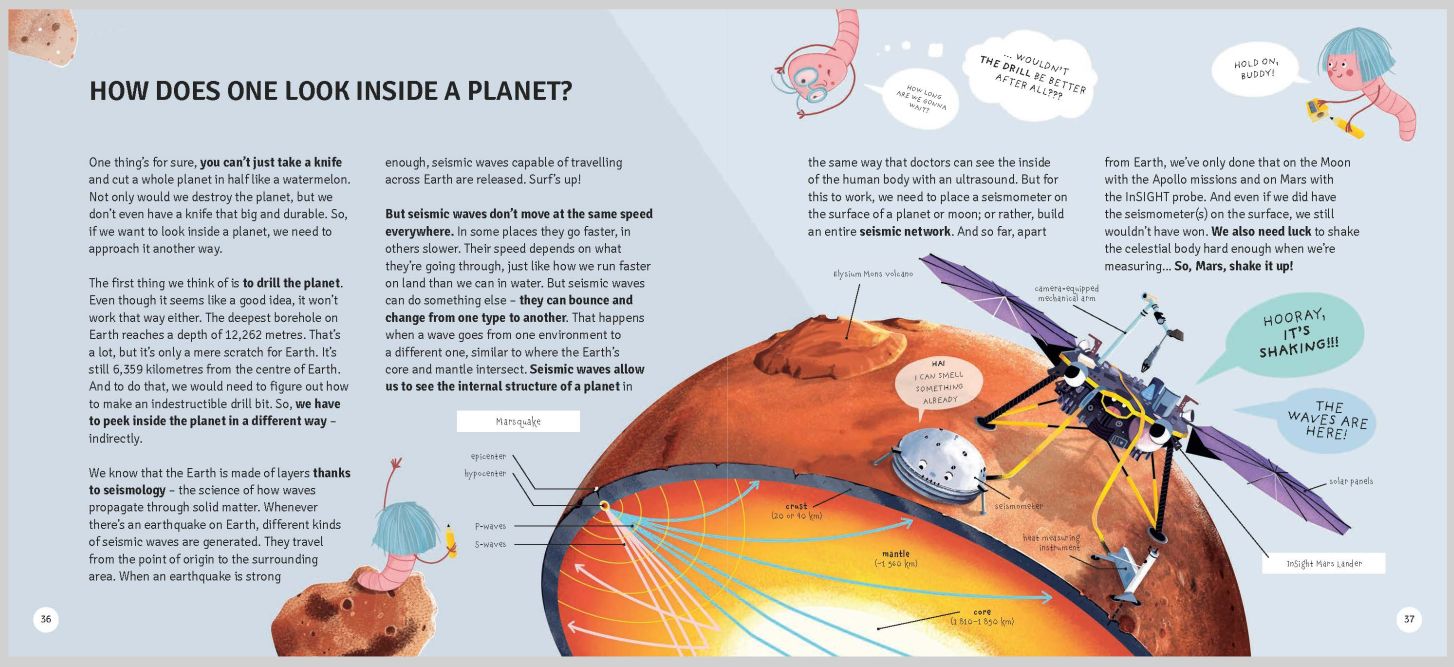
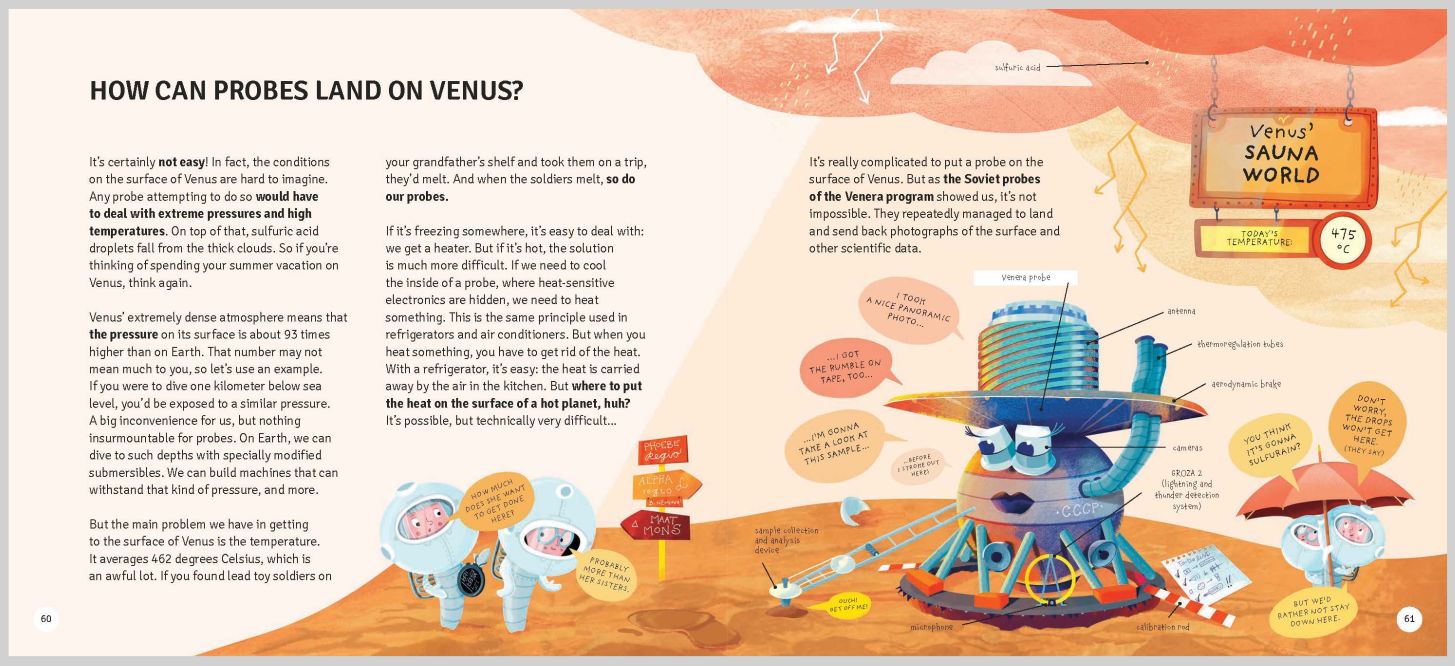
The first volume of the series consists of 70 short chapters focused on the exploration of the Solar System. In practice, the book functions as an introductory textbook of planetary science disguised as a colourful children’s book. Readers encounter topics such as volcanism, impact cratering, planetary interiors, atmospheric evolution, planetary habitability, or space exploration technologies. Children learn why Mars is red, why volcanoes erupt, why some moons may hide underground oceans, or how scientists search for traces of life elsewhere in the Universe. However, these concepts are introduced through humorous illustrations, recurring characters of two “knowledge worms”, playful dialogue, and visual jokes rather than formal educational language. The book deliberately avoids the widespread assumption that young readers require heavily simplified explanations and instead treats children as curious readers capable of understanding surprisingly difficult scientific ideas when they are explained through familiar comparisons and clear visual storytelling.
From the beginning, the book intentionally targeted two audiences simultaneously: children and their parents. While the illustrations, jokes, and large-font humorous comments attract younger readers, the scientific explanations are sufficiently detailed and accurate to engage adults as well. The book was therefore conceived primarily as a shared bedtime-reading experience during which both generations learn together. This approach proved important because it transformed reading from an individual activity into shared time spent together discussing science, jokes, and ideas.
The first volume (published in 2022) became a major bestseller on the Czech book market, eventually reaching sales of approximately 50,000 copies in a country of roughly 10 million inhabitants. Publishing rights were subsequently sold to China, Bulgaria, Estonia, and Saudi Arabia, while Slovak and Latvian editions are currently in preparation. The Bulgarian, Estonian, and Saudi Arabian editions have already been published, and an English translation exists as well, although a publisher for the English-speaking market is still being sought.
The success of the first volume was followed in 2024 by a second book focused on the search for extraterrestrial life within and beyond the Solar System. By the end of 2025, approximately 5,500 copies had been sold in the Czech Republic, and the rights for the Chinese edition were acquired as well. A third volume, planned for publication in September 2026, will complete the trilogy by shifting the focus back to Earth and explaining the origin and evolution of our planet, geological processes shaping its surface, and the future of Earth itself.
Our experience suggests that the extraordinary popularity of the series cannot be explained solely by public interest in astronomy or geology. Instead, much of its success appears to stem from the communication strategy employed throughout the books. Reader reviews repeatedly emphasize the combination of scientific accuracy with humour, playful illustrations, accessible language, and a refusal to underestimate young readers intellectually. Particularly successful proved to be the use of visual jokes and large-font humorous remarks readable even by very young children, recurring fictional characters commenting on scientific concepts, and the inclusion of topics rarely explained in conventional children’s encyclopedias. Many readers also appreciated that the books were clearly designed to be read repeatedly rather than used only once as encyclopedic reference material.
At the same time, the project also demonstrated how difficult it is to create educational content that does not feel overly educational. In our experience, children quickly recognize when scientific explanations become forced, excessively simplified, or disconnected from the story itself. Finding a balance between humour, scientific accuracy, and readable storytelling therefore became one of the main challenges during the development of the series.
We argue that popular science books can still represent a highly effective outreach tool even in the digital era. Rather than competing directly with online content through speed and constant stimulation, books can offer something different: slower, deeper, and longer-lasting engagement with science. Our experience suggests that children are usually not discouraged by difficult scientific topics themselves, but mainly by the way those topics are traditionally presented.
How to cite: Broz, P. and Škodová, L.: From Bedtime Stories to Planetary Science: How a Czech Children’s Book Series Reached Tens of Thousands of Readers, Europlanet Science Congress 2026, The Hague, The Netherlands, 7–11 Sep 2026, EPSC2026-414, https://doi.org/10.5194/epsc2026-414, 2026.


