
 1,2,3
1,2,3- 1Charles University, Faculty of Mathematics and Physics, Department of Geophysics, Prague, Czechia
- 2Charles University, Faculty of Mathematics and Physics, Mathematical Institute, Prague, Czechia
- 3Laboratoire de Planétologie et Géosciences, UMR 6112, CNRS, Nantes Université, Université d’Angers, Le Mans Université, Nantes, France
Introduction
Saturn’s moon Enceladus exhibits a unique pattern of surface deformation associated with ongoing geological activity driven by tidal forcing and internal processes. While features such as the south polar terrain and its eruptive fractures are striking manifestations of this activity, the underlying mechanisms are rooted in the global stress state of the ice shell.
This stress field arises from both external and internal sources. External forcing, induced by Saturn’s gravitational field acting on Enceladus, is represented by diurnal tides and any secular change of the tidal bulge, associated with non-synchronous rotation or any change in the orbital configuration. Internal sources are associated with ice flow driven by departures from hydrostatic equilibrium. Constraining how these processes generate and modulate the stress field is essential for understanding the moon’s mechanical behaviour and long-term evolution.
Model
We investigate the stress state within the viscoelastic ice shell across multiple spatial and temporal scales, with the mechanical response governed by the relationship between the forcing period and the viscous relaxation time. For forcing periods shorter than the relaxation time, deformation is predominantly elastic, allowing stresses to accumulate and potentially promote brittle failure. For longer forcing periods, inelastic deformation becomes increasingly pronounced in terms of viscoelastic Maxwell rheology. At the longest, geological time scales, purely viscous flow dominates.
To account for leading-order structural effects, we consider several models of shell thickness, in particular that of Čadek et al. (2019) derived from the shape model of Tajedinne et al. (2017), as well as recent shape models by Schenk et al. (2024) and Park et al. (2024). For diurnal tides, we also investigate the role of the presence or absence of faults in the south polar region, together with several parameterizations of their geometry, following Porco et al. (2014) and Rhoden et al. (2020). Faults are modelled either as narrow voids or as zones with a specific pseudo-plastic rheology, mimicking frictionless behaviour or Coulomb-type friction, respectively, following Pleiner Sládková et al. (2021).
On geological timescales, the ice shell is treated as a viscous fluid within the Boussinesq approximation, including gravitational effects from internal density variations and boundary topography, following Čadek et al. (2019). For the temperature and viscosity structure, we assume a simplified 1D conductive profile and an Arrhenius-type temperature dependence of viscosity. All numerical simulations are performed using the finite element method, following Alnæs et al. (2015), Souček et al. (2019), and Pleiner Sládková et al. (2021).
Results
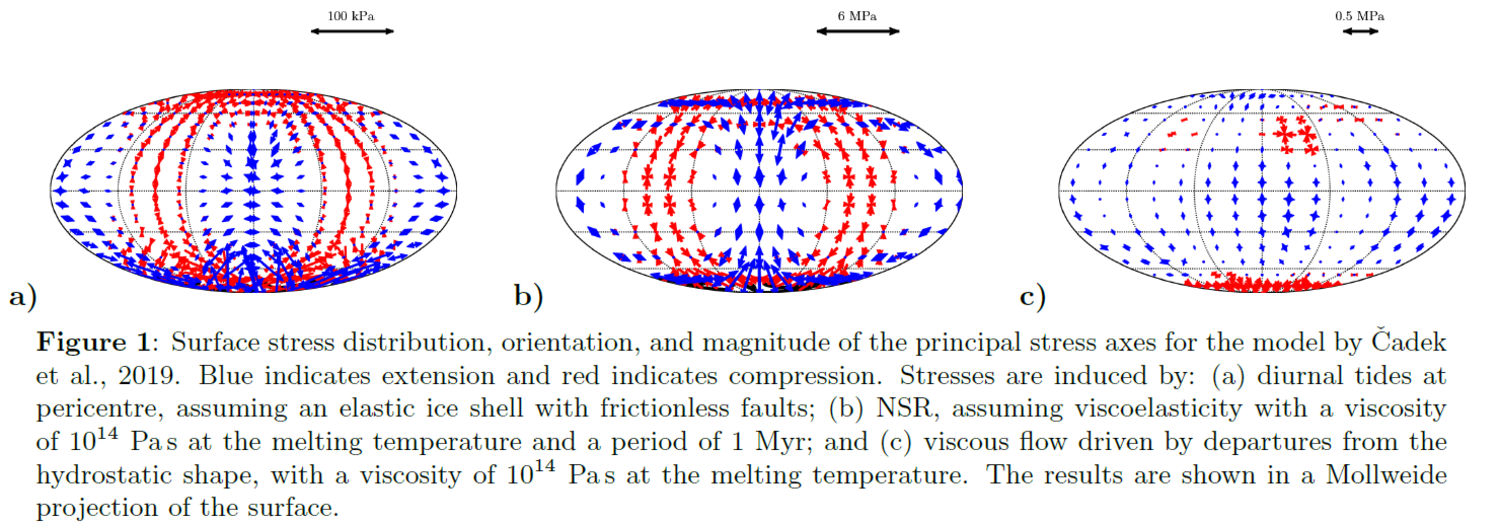
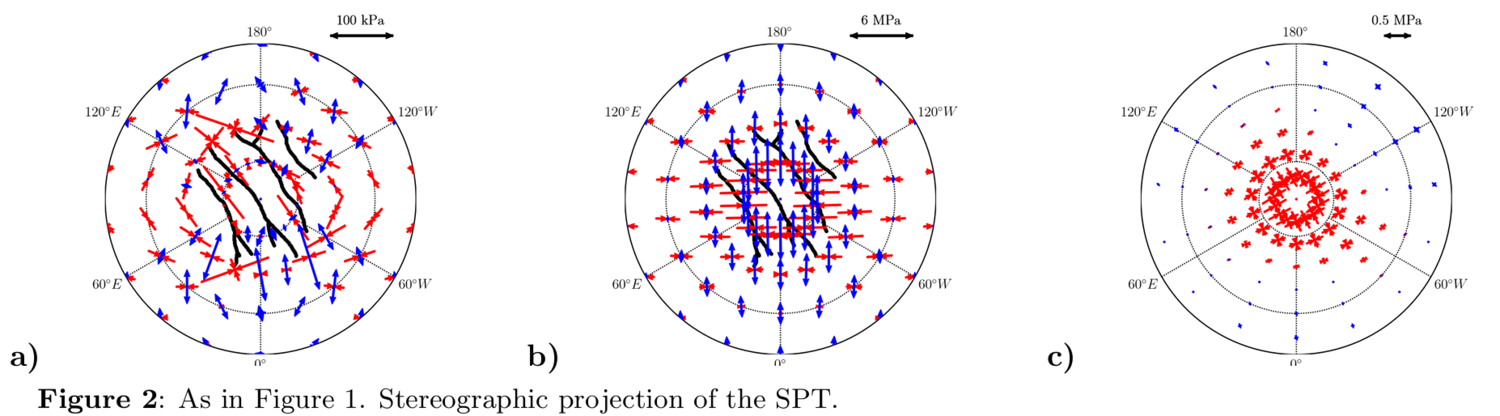
We first analyse the instantaneous elastic response of the shell to tidal forcing over a single orbital period of 1.37 days. This response depends strongly on the shell shape and thickness, as well as on the geometry of the faults and their frictional parameterization. These factors control both the magnitude and orientation of the resulting stresses.
Viscoelastic effects associated with eccentricity-driven tides are relatively limited. They are mainly confined to a thin lowermost region near the ice-ocean interface, where the temperature reaches the melting point, and the viscosity decreases to approximately 1014 Pa s. As the forcing period increases, the contribution of the viscous component to the total response increases. Viscoelastic effects become dominant for slow non-synchronous rotation of the ice shell, particularly in the lowermost, low-viscosity regions. Here, we consider possible non-synchronous rotation periods ranging from 0.01 to 1 Myr, following Patthoff et al. (2019). Viscous weakening at the base of the ice shell effectively reduces its apparent elastic thickness; the induced stresses can reach up to several MPa. In this study, we compare different parameterizations of viscosity in terms of the viscosity value at the ice-ocean interface.
Finally, at geological timescales, we examine viscous flow driven by lateral variations in shell thickness for the aforementioned shell-thickness models. These variations generate density anomalies and associated gravitational imbalances, representing departures from hydrostatic equilibrium. The resulting flow redistributes mass toward a stable hydrostatic configuration, with velocities controlled by the viscosity contrast between the upper and lower shell boundaries. For realistic viscosity contrast across the shell, the flow is predominantly tangential along the ice-ocean interface. This flow pattern cannot be captured by simplified spectral methods that typically assume a shell of uniform thickness.
Conclusions
Our results show that Enceladus’ global stress state is controlled by the interplay between shell geometry, presence of faults and their properties, forcing timescale, and ice rheology. Using advanced three-dimensional finite element modelling, we quantify the relative effects of these processes across elastic, viscoelastic, and viscous deformation regimes.
Short-period tidal forcing produces a mainly elastic response, with stresses strongly affected by shell thickness variations and the mechanical behaviour of south polar faults. Viscoelastic effects are limited for diurnal tides but become important for longer-period forcing, particularly non-synchronous rotation, where basal weakening reduces the apparent elastic thickness of the shell and can generate stresses of several MPa.
On geological timescales, lateral shell-thickness variations drive viscous flow toward a more stable hydrostatic configuration. This flow is strongly influenced by the vertical viscosity contrast and may become localized along the ice-ocean interface, highlighting the need for fully three-dimensional models of Enceladus’ ice shell.
References
Alnaes, et al. (2015). doi: https://doi.org/10.11588/ans.2015.100.20553
Čadek et al. (2019), doi: https://doi.org/10.1016/j.icarus.2018.10.003
Patthoff et al. (2019), doi: https://doi.org/10.1016/j.icarus.2018.11.028
Schenk et al. (2024), doi: 10.1016/j.icarus.2023.115827
Park et al. (2024), doi: https://doi.org/10.1029/2023JE008054
Porco et al. (2014), doi: 10.1088/0004-6256/148/3/45
Rhoden et al. (2020), doi: https://doi.org/10.1016/j.epsl.2020.116389
Pleiner Sládková et al. (2021), doi: http://doi.org/10.1029/2021GL094849 .
Tajeddine et al. (2017), doi: https://doi.org/10.1016/j.icarus.2017.04.019
Souček et al. (2019), doi: https://doi.org/10.1016/j.icarus.2018.10.003
How to cite: Piláriková, B., Bakoč, A., Běhounková, M., Souček, O., Choblet, G., and Tobie, G.: Global stress state of Enceladus’ ice shell: effects of various deformation processes, Europlanet Science Congress 2026, The Hague, The Netherlands, 7–11 Sep 2026, EPSC2026-419, https://doi.org/10.5194/epsc2026-419, 2026.


