
 ,
,- Technische Universität Braunschweig, Institut für Geophysik und Extraterrestrische Physik, Germany (j.pfeifer@tu-braunschweig.de)
Comets are among the most primitive bodies in the Solar System and therefore provide valuable insight into its formation and early evolution. Since they pre-
serve largely unaltered material from the early stages of planetary assembly, the study of their composition and physical properties is essential for understanding the processes that shaped the Solar System. Despite their importance, many aspects of cometary structure and activity remain insufficiently understood. Continued experimental and observational research is therefore necessary to refine existing models of comet formation and evolution.
In this work, we investigate the emission of particles from an illuminated granular water-ice sample, representing a simplified analog of a comet approaching the Sun. The samples consist of micrometer-sized water-ice grains placed inside a thermal vacuum chamber (Kreuzig et al., 2021). They are illuminated by a 24 V halogen lamp while being kept at a pressure of approximately 10-5 mbar. Emitted particles are detected using cameras, and a horizontal line laser mounted on the side of the chamber improves particle counting. The trajectories of the particles are recorded using high-speed cameras. Additionally, a chopper was installed to simulate a periodic day-night cycle. The subsequent analysis includes the determination of particle count, size, mass, velocity, acceleration, and possible rotational motion.
A similar setup was used in a previous experiment to characterize emitted particles (Kreuzig et al., 2025). Figure 1 shows colored particle trajectories obtained with a tracking program over a time span of approximately 1.3 s. The average detected particle was found to have a diameter of about 100 μm, an initial velocity of 0.28 m s-1, and an oscillating acceleration, which is most likely associated with the particle’s rotation. With the additional use of the line laser in the new experimental setup, a relation between mass loss of the sample and emitted particles can be established, allowing the mass of the average particle to be calculated.
One objective of the present study is to reproduce these earlier results and to further investigate the physical properties of the emitted particles.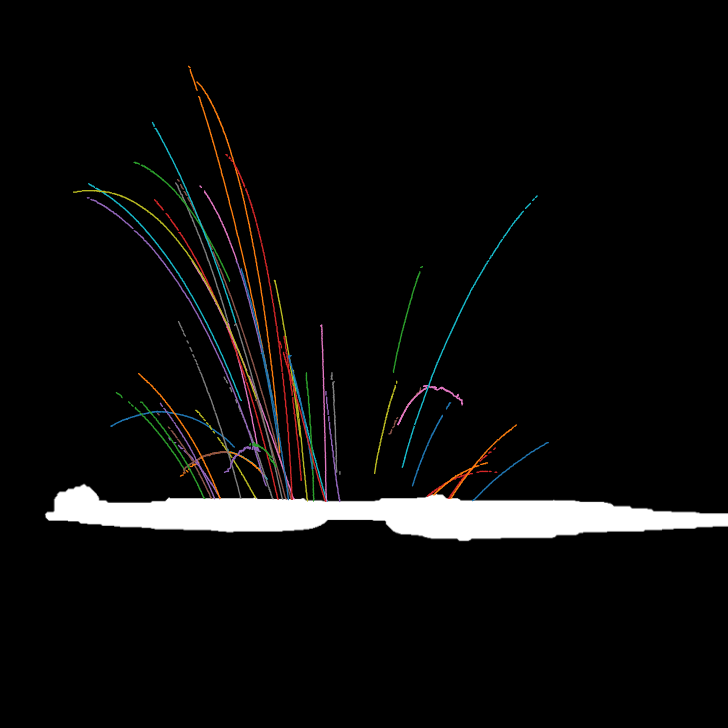
Figure 1: Emitted particles from a granular water-ice sample (white). The displayed trajectories were obtained from approximately 5200 frames, corresponding to a time interval of 1.3 seconds.
How to cite: Pfeifer, J., Kreuzig, C., Timppe, M., Knoop, C., and Blum, J.: Experimental Results from the CoPhyLab - Detection and Analysis of Emitted Particles from an Illuminated Granular Water-Ice Sample, Europlanet Science Congress 2026, The Hague, The Netherlands, 7–11 Sep 2026, EPSC2026-429, https://doi.org/10.5194/epsc2026-429, 2026.


