
 14,
14,- 1RISE Research Institutes of Sweden, Stockholm, Sweden
- 2Dept. of Earth and Atmospheric Sciences, University of Alberta, Edmonton, Canada
- 3Dept. of Earth, Atmospheric and Planetary Sciences, Massachusetts Institute of Technology, Cambridge, MA, USA
- 4Division of Geological and Planetary Sciences, California Institute of Technology, Pasadena, CA, USA
- 5Jet Propulsion Laboratory, California Institute of Technology, Pasedena, CA, USA
- 6Dept. of Geology and Geography, West Virginia University, Morgantown, WA, USA
- 7Dept. of Geosciences, University of Cincinnati, Cincinnati, OH, USA
- 8Laboratoire G-Time, Université libre de Bruxelles, Belgium
- 9Dept. of Geoscience, University of Las Vegas, Las Vegas, NV
- 10Birkbeck, University of London, London, UK
- 11Dept. of Geological Sciences, University of Boulder, Boulder, CO, USA
- 12Imperial College London, London, UK
- 13Dept. Earth and Planetary Science, UC Berkeley, CA, USA
- 14ARES, NASA Johnson Space Center, Houston, TX, USA
- 15Centro de Astrobiologia, INTA, Madrid, Spain
Mars 2020 Perseverance rover is currently exploring Jezero Crater on Mars, which contains an ancient lake-delta fan system. Since its landing in 2021 the rover has investigated different parts of the Jezero crater including the crater floor, the delta fan, the crater margin (Margin unit’) and the Neretva Vallis channel, identifying several different potentially habitable environments. Currently the rover is exploring the crater rim, which contains some of oldest rocks on Mars, when Mars might have been its most habitable.
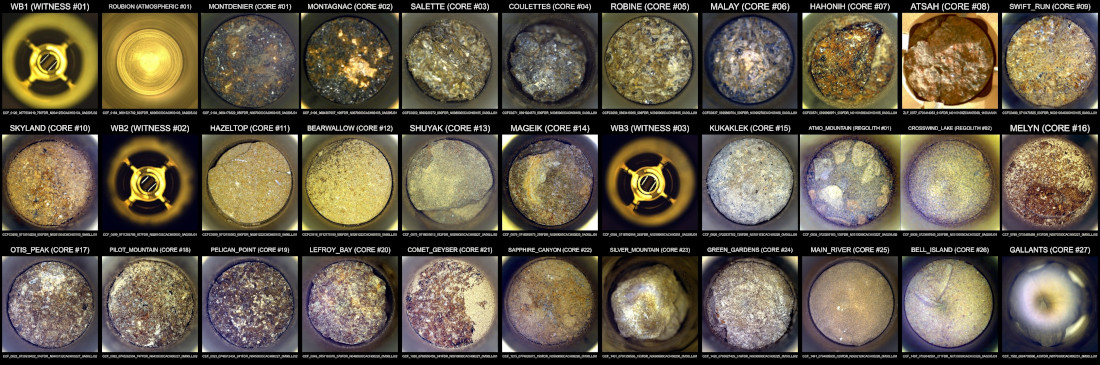
One of Perseverance’s primary science goals is to collect samples for potential return to Earth (Farley et al. 2020). Since February 2021, Perseverance has sealed 33 tubes containing 27 rock cores, 2 regolith samples, one atmosphere sample and three witness tubes (Fig. 1). Of the samples collected, several collected from the fan front, the Margin unit and the Neretva Vallis channel have large potential for answering questions about past climate, habitability and the potential for life on Mars.
The rock cores collected at the fan front and Neretva Vallis are fine-grained clay-rich sedimentary rocks that were likely deposited in a lacustrine/deltaic environment (Bosak et al. 2024; Hurowitz et al. 2025). The fine-grained and phyllosilicate rich nature of these samples are beneficial for the preservation of biosignatures. The Neretva Vallis sample contains tantalizing signatures including organic material and phosphate and sulfide-rich reaction fronts that potentially could have been produced by life (Hurowitz et al. 2025; Murphy et al. accepted). Other more coarse-grained sedimentary samples, such ones collected at the fan top samples, which were likely deposited in a river setting, could inform about a Martian source to sink system, contain lithologies from greater Nilli Fossae area and be used for paleomagnetism studies.
The rock cores collected at the Margin unit contain abundant carbonate and silica which likely were formed by carbonation and serpentinization of ultramafic rocks (Williford et al. 2026). In addition to trapping CO2 and thus providing information about the past atmosphere and climate on Mars, this process could have provided energy and a habitat for potential microbes (Siljeström et al. in prep). Microcrystalline carbonates and silica are also known to preserve biosignatures.
The rock cores have also been collected at the crater rim including a serpentine sample and a phyllosilicate-rich sample will inform about potential habitability during the Noachian. The serpentine rock, collected at a potential megablock, is dominated by minerals formed from serpentinization, informing about Noachian water-rock interaction and providing energy for potential microbes. The phyllosilicate-rich sample was collected from an altered likely Noachian basement and could provide insights into water-rock interactions and a potentially habitable environment in Mars’ most ancient past.
In addition, the rock cores from the crater floor and rim which will be critical for constraining the timing of different events on Mars including aqueous activity in Jezero Crater and when and for how long Mars was habitable (Farley et al. 2022). They will also inform about Mars’ igneous history and potential impact processes on Mars.
Perseverance will continue exploring the crater rim and collecting samples for next couple of years, expanding the number of samples and that can be answered, if returned to Earth.
References:
Bosak, T. et al. (2025) AGU Advances, 5, e2024AV001241.
Farley K.A. et al. (2020) Space Science Reviews 216, 142.
Farley, K.A. et al. (2022) Science 377, eabo2196.
Hurowitz J.A., et al. (2025) Nature 645, 332–340.
Murphy A.E., et al. accepted, Science Advances
Siljeström, S. et al. in prep., JGR-Planets
Williford, K. et al. (2026) Science 391, eadu8264.
How to cite: Siljeström, S., Herd, C., Bosak, T., Farley, K., Stack, K., Benison, K., Czaja, A., Debaille, V., Hausrath, E., Hickman-Lewis, K., Mayhew, L., Sephton, M., Shuster, D., Simon, J., and Zorzano, M.-P.: The returned sample science of the samples collected by NASA Perseverance rover at Jezero Crater, Mars, Europlanet Science Congress 2026, The Hague, The Netherlands, 7–11 Sep 2026, EPSC2026-444, https://doi.org/10.5194/epsc2026-444, 2026.


