
 1,2,4,4,1,
- 1LIRA, Observatoire de Paris, Université PSL, Sorbonne Université, Université Paris Cité, CY Cergy Paris Université, CNRS, 92195 Meudon, France
- 2Université de Reims Champagne-Ardenne, LEATP, Reims, France
- 3Méso-Star, Toulouse, France
- 4Laboratoire de Météorologie Dynamique (LMD/IPSL), Sorbonne Université, ENS, PSL Research University, Ecole Polytechnique, IP Paris, CNRS, 4 Place Jussieu, 75252 Paris Cedex 05, France
Titan’s atmosphere has been extensively studied and modeled over the last twenty years. Global Climate Models (GCMs) successfully reproduce the main features of Titan’s atmosphere, including the detached haze layer and the polar clouds (Lebonnois et al., 2012; Lora et al., 2015; de Batz de Trenquelléon et al., 2025a,b, 2026). However, those models rely on simple plane-parallel radiative transfer algorithms which fail to capture the effects of heterogeneity and sphericity, important for the extended atmosphere of Titan. To address this limitation, we are coupling htrdr-planets (https://www.meso-star.com/projects/htrdr/htrdr.html He et al., 2026), a 3D backward Monte Carlo radiative transfer model, able to account for sphericity and heterogeneity, with the Titan LMDZ Planetary Climate Model (PCM) (de Batz de Trenquelléon et al., 2025a,b, 2026). htrdr-planets incorporates recent developments in computational science (Galtier et al., 2013; Villefranque et al., 2019), and is able to calculate the radiative budget within each PCM cell with minimal approximations and relatively low computational cost.
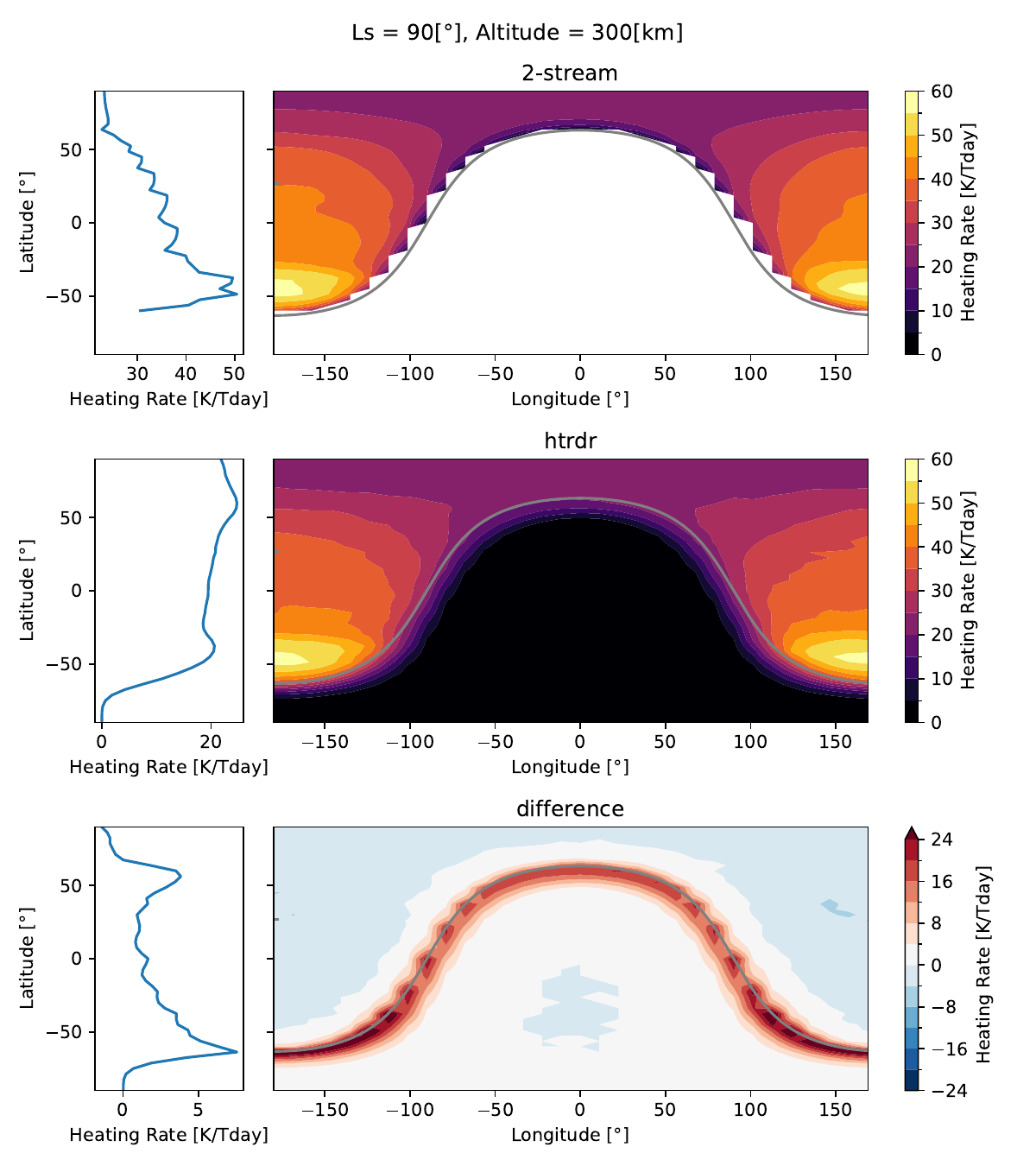
Figure 1: Heating rates at northern summer solstice at 300 km altitude. Upper panels: 2-stream plane-parallel results. Middle panels: htrdr-planets results. Bottom panels: differences htrdr-planets minus plane-parallel. The plots on the left are zonal averages.
Comparisons between the original 2-stream plane-parallel model used in the Titan PCM and htrdr-planets indicates that significant differences are expected at high altitudes in the terminator region (Fig. 1). This behavior is explained by the high incident angles of the stellar radiation near the terminator, which results in larger extinction in a plane-parallel model compared to a spherical scenario. Fig. 1 also demonstrates that, on a zonal average, the main differences are concentrated at the limits of the polar night and polar day, since those regions spend a significant amount of time close to the terminator. In addition, light can directly reach regions beyond the terminator, as a result of sphericity, where plane-parallel calculations cannot be conducted. As a consequence, the spherical model produces additional heating in the regions beyond the terminator in the spherical model relatively to the plane-parallel.
To explore how the observed heterogeneity and sphericity effects impact the thermal structure and dynamic of Titan’s atmosphere, we couple htrdr-planets to the Titan PCM. This is realized by running htrdr-planets every 11 Titan days, with optical properties extracted from the Titan PCM. The calculated heating rates are then used in the Titan PCM with an interpolation in solar longitude and local time. For the sake of computation time, we focus our efforts on the solar heating and keep the original 2-stream model to calculate the thermal cooling.
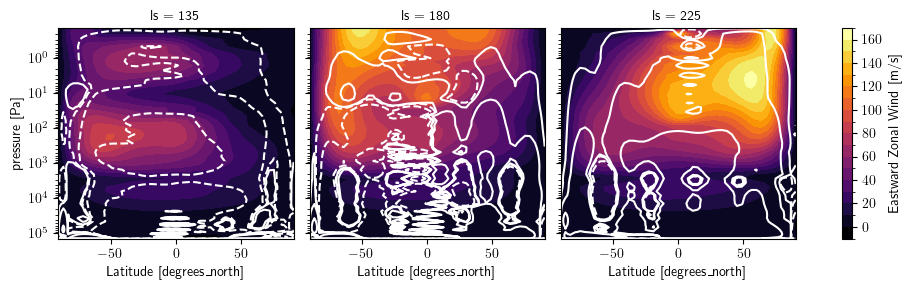
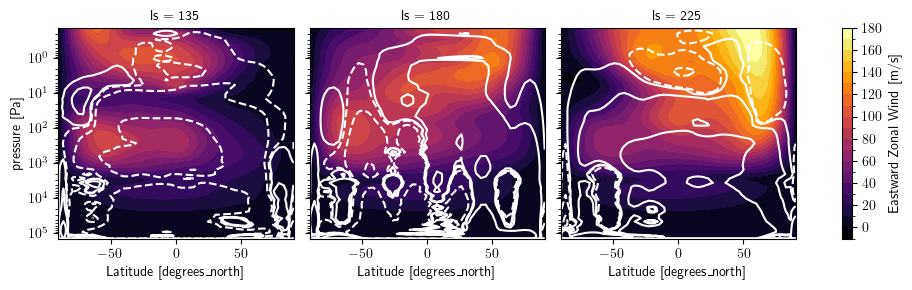
Figure 2: Wind maps around the northern fall equinox. The color scale presents the zonal winds, white lines represent the streamfunction, where dashed lines indicate counter-clockwise circulation and solid lines indicate clockwise circulation. Upper panels: reference PCM calculation. Bottom panels: PCM simualtion coupled to htrdr-planets. Panels on the left are at LS = 135° , middle panels are at LS = 180° and right panels are at LS = 225° .
Preliminary results of this coupling demonstrate that the changes brought by the modified heating rates on the dynamics of Titan’s atmosphere are important. We observe changes in the stability of the Hadley cell as well as modifications in the timing of appearance of this structure (Fig. 2). In addition, smaller yet stable cells appear in the upper stratosphere and are expected to affect the transport of various species, as well as haze particles. Such changes have major ramifications for the thermal structure of the atmosphere.
In this presentation, we detail those initial comparisons between htrdr-planets and a 2-stream plane-parallel model and we explore the preliminary results of the coupling between htrdr-planets and the Titan PCM.
This work has been funded by the French National Research Agency (ANR), project RaD3-net, grant number ANR-21-CE49-0020.
References
de Batz de Trenquelléon, B., et al. (2025a). The New Titan Planetary Climate Model. II. Titan’s Haze and Cloud Cycles. The Planetary Science Journal, 6, 79.
de Batz de Trenquelléon, B., et al. (2026). Origin, evolution, and fate of Titan’s polar clouds. Nature Communications, 17 , 250.
de Batz de Trenquelléon, B., et al. (2025b). The New Titan Planetary Climate Model. I. Seasonal Variations of the Thermal Structure and Circulation in the Stratosphere. The Planetary Science Journal, 6, 78.
Galtier, M., et al. (2013). Integral formulation of null-collision Monte Carlo algorithms. Journal of Quantitative Spectroscopy and Radiative Transfer, 125, 57–68.
He, Z., et al. (2026). Simultaneous estimation of radiance and its sensitivities to radiative properties in a spherical-heterogeneous atmospheric radiative transfer model by Monte Carlo method: Application to Titan. Journal of Quantitative Spectroscopy and Radiative Transfer, 350, 109722.
Lebonnois, S., et al. (2012). Titan global climate model: A new 3-dimensional version of the IPSL Titan GCM. Icarus, 218(1), 707–722.
Lora, J. M., et al. (2015). GCM simulations of Titan’s middle and lower atmosphere and comparison to observations. Icarus, 250, 516–528.
Villefranque, N., et al. (2019). A Path-Tracing Monte Carlo Library for 3-D Radiative Transfer in Highly Resolved Cloudy Atmospheres. Journal of Advances in Modeling Earth Systems, 11(8), 2449–2473.
How to cite: Arfaux, A., Vinatier, S., Rannou, P., Eymet, V., Forest, V., Lebonnois, S., Millour, E., de Batz de Trenquelléon, B., He, Z., and Petetin, C.: htrdr-planets & Titan PCM: coupling Monte Carlo radiative transfer and Planetary Climate Models, Europlanet Science Congress 2026, The Hague, The Netherlands, 7–11 Sep 2026, EPSC2026-448, https://doi.org/10.5194/epsc2026-448, 2026.


