
 1,1,
1,1,- 1Delft University of Technology, Space Exploration, Netherlands (j.jorritsma@tudelft.nl)
- 2University of Munster, Institute of Mineralogy, Germany
Introduction: On Venus, variations in SO2 content in the cloud tops have been suggested as evidence of recent volcanism [1]. The Pioneer orbiter observed a steep decline in SO2 content in the cloud tops between 1978 and 1983 which may have been caused by a recent injection of volcanic SO2 into the mesosphere [2]. [1] found a similar decline in the SO2 content in the Venus Express data between 2006 and 2014, although they suggest that temporal variations are caused by episodic variations in atmospheric mixing of SO2 rich troposphere and SO2 poor mesosphere. [3] found high degrees of temporal and spatial variations in SO, SO2, (SO+SO2) and SO/SO2 ratio across all available datasets. No mechanism was suggested to explain these variations. It is debated whether these variations are caused by either volcanic SO2 influx, by atmospheric processes or by a combination.
Atmospheric SO2 is consumed by weathering of surface rocks, where Ca-bearing minerals react with SO2 to create anhydrite (CaSO4). Atmospheric SO2 may or may not be buffered by interactions with anhydrite and plagioclase [4]. It is therefore unclear whether recent volcanic SO2 degassing is required to maintain the current SO2 abundance in the atmosphere or if it the current SO2 content is in equilibrium with this mineral assemblage [5].
The goal of this study is to experimentally derive SO2 degassing kinematics and their dependence on magma temperature at Venus’ current atmospheric surface pressure (92 bar). This is done by conducting experiments in a gas-mixing furnace at relevant magma temperatures (1250–1400 °C) and two different pressures; a ~0,005 bar vacuum and a 1 bar CO2 atmosphere. From this, the pressure and temperature dependance of degassing kinematics is extrapolated to Venus’s surface conditions.
Methods: SO2-rich starting materials are made in accordance with composition PPG07 from [6]. This a haplobasaltic composition based on the anorthite (CaAl2Si2O8) + diopside (CaMg2Si2O6) eutectic (An36Di64). CaSO4 is added as the volatile component. Boron is added to reduce the system liquidus temperature. The lower temperature at glass synthesis stage mitigates the evaporative loss of SO2 during the synthesis of the starting material, as well as lowering the melting temperature of samples. The mixture is vitrivied in a crucible for a short duration.
This material is ground to a powder. Small amounts of this powder are mixed with polyvinyl alcohol glue to create a viscous slurry. Around 20 mm length of thin (0.1mm) Pt wire is bent around rod for 1–2 rotations to create a loop (r ~ 1.5 mm) with a straight piece of wire extending from the loop. The loop is used to scoop up the slurry. The slurry is dried and hardened with a lighter. The Pt wire attached to a carousel of thicker Pt wire attached to an alumina rod. The rod with samples attached is lowered to the hot spot of the gas-mixing furnace at which point the experiment time starts.
The 1 bar experiments were performed in a CO2 atmosphere by flowing 200 cm3/min CO2 through the furnace with a flow controller in a temperature range of 1250–1400 °C. The vacuum experiments are all done at 1250 °C. Low pressures (~0,005 bar) are achieved by attaching an Alcatel vacuum pump to the furnace.
After the experiment time elapsed, the molten beads are taken out of the furnace and quenched. The dimensions of the resulting glass beads are measured before mounting them in epoxy and analyzing their major oxide composition as well as SO2 content, divided by the original SO2 content (Xt/X0) with an EPMA.
Experiments are done with various experiment times for each combination of P and T. As the loops with starter material reach the hot spot of the furnace, the outside heats up first and starts degassing while the inside is not yet hot enough for diffusion to replenish the outside with SO2. This causes zoning at the beginning of the experiment. As the center of the bead reaches a high enough temperature to start efficient diffusion, the concentration of SO2 throughout the bead equilibrates. From this point, the beads follow a degassing curve (figure 1). This curve is extrapolated to where Xt/X0 = 1. The corresponding time is t0, the apparent lag time, and is subtracted from the experiment time.
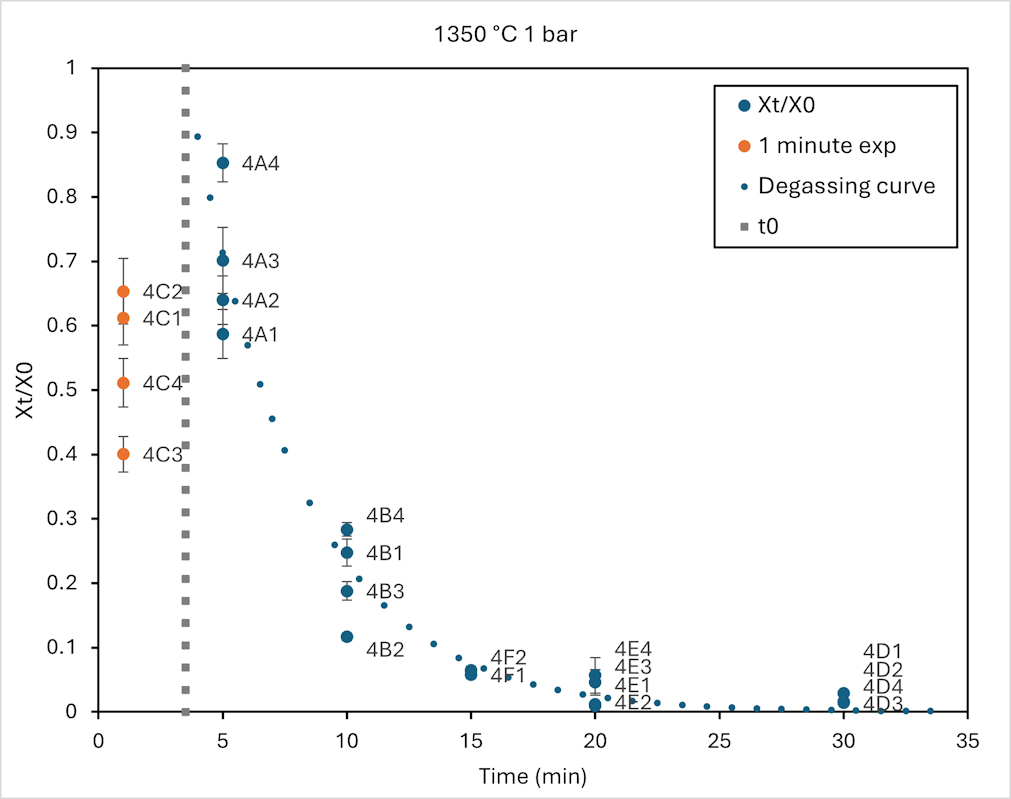
Figure 1: Xt/X0 of all beads from experiments done at 1350 °C under a 1 bar CO2 atmosphere. 1 minute experiments are within the lag time (t0) of 3.5 minutes, constrained from the degassing curve.
From the bead dimensions, the SO2 fraction and the experiment time (minus t0), a reaction rate constant K* is calculated using the thermodynamic framework outlined in [7]. Values for K* from all beads with same P and T are averaged. The effect of temperature on K* is constrained by regression through all data at 1 bar. This effect is assumed to be the same at all pressures. The effect of pressure is constrained at 1250 °C.
These effects are extrapolated to predict the reaction rate constants under Venus surface pressure and relevant magma temperatures. These are used to calculate absolute SO2 fluxes evaporating from silicate lavas in different magmatic settings; a putative global resurfacing event, a collection of large lava lakes and a collection of lava flow channels, in order to see constrain what scale of events can provide a volcanic signature from SO2 degassing.
Results: Experiments have been done and analysis is ongoing, results will be presented at the meeting.
Acknowledgements: This study was supported by ERC StG VenusVolAtmos awarded to ESS. We want to thank Maik Trogisch at Münster University for his diligent preparation of our samples.
References: [1] Marcq et al. (2013), Nature Geoscience [2] Esposito (1984), Science [3] Vandaele et al. (2017), Icarus [4] Zolotov (2018), Reviews in Mineralogy and Geochemistry [5] Wilson et al. (2024), Space Science Reviews [6] Pangritz et al. (2022), ACS Earth and Space Chemistry [7] Sossi et al. (2019), GCA
How to cite: Jorritsma, J., Aerts, G., Berndt, J., Klemme, S., and Steenstra, E.: Experimental quantification of the evaporative loss of SO2 from silicate melt: implications for the Venusian sulfur flux, Europlanet Science Congress 2026, The Hague, The Netherlands, 7–11 Sep 2026, EPSC2026-456, https://doi.org/10.5194/epsc2026-456, 2026.


