
 1,1,1,2,
- 1Institute of Earth and Environmental Sciences, Albert-Ludwigs-Universität Freiburg, Freiburg, Germany (rajit.das@email.uni-freiburg.de)
- 2Institute of Space Research, German Aerospace Center (DLR), Berlin, Germany
Introduction
Ganymede, Jupiter’s largest moon and a primary target of the ESA’s JUICE mission [1], shows a distinct surface dichotomy between older, low-albedo (dark ice) terrains and comparatively younger, high-albedo (light ice) regions [2]. The surface preserves a complex record of impact cratering, resurfacing, and shallow crustal heterogeneity. Ray and halo craters across these terrains display distinct ejecta patterns and crater floor characteristics, providing important constraints on subsurface stratigraphy and material properties; however, the layer thicknesses and mechanical contrasts responsible for these morphologies remain poorly constrained. Here, we use iSALE2D numerical simulations [3, 4, 5] (strength input parameters in Table 1), informed by global photomosaics of Ganymede [6], to investigate how subsurface layering controls the formation of representative ray and halo craters [7].
Results
Our models reproduce the observed ejecta patterns of Antum, Kittu, and Nergal (Fig 1) through distinct near-surface stratigraphies. Antum (Fig 1a) is best explained by a 1.0 km thick dark ice layer overlying a light ice substrate (Fig 2). Kittu (Fig 1b) requires a more complex sequence, with 0.8 km of light ice above a 0.4 km thick dark ice layer and a deeper dark basement (Fig 3). Nergal (Fig 1c) exhibits the most elaborate structure, consisting of alternating layers of light and dark ice above a deeper light ice unit (Fig 4). These configurations indicate that Ganymede’s upper crust is vertically heterogeneous and likely shaped by a combination of tectonic resurfacing, cryovolcanic activity, and the episodic deposition of dust and organic-rich exogenic material.
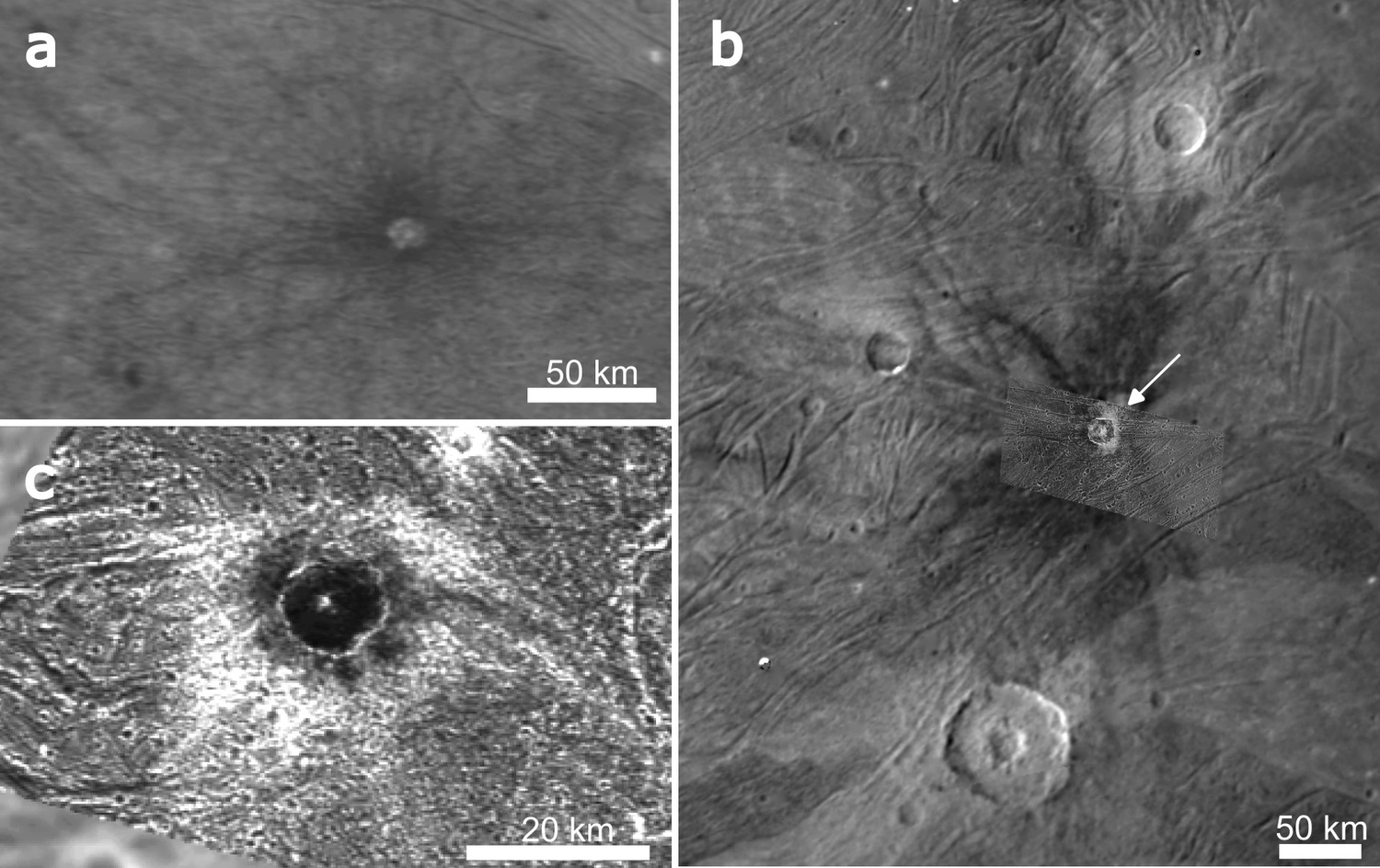
Fig 1. a. Antum, a 15 km crater with dark ejecta on dark terrain with a bright crater floor; b. Kittu (indicated by the white arrow), a 15 km crater with dark ejecta on light terrain with a bright crater floor and c. Nergal, a 9 km crater with dark halo encircled by bright ejecta on light terrain with a dark crater floor.
| Parameter | Light Ice | Dark Ice |
|
Cohesion (yield strength at zero pressure) (Yi0) |
10 MPa |
12.5 MPa |
|
Damaged cohesion (Yd0) |
0.01 MPa |
0.01 MPa |
|
Limiting strength at high pressure for intact material (Yim) |
0.11 GPa |
0.11 GPa |
|
Limiting strength at high pressure for damaged material (Ydm) |
0.11 GPa |
0.11 GPa |
|
Coefficient of internal friction (μi) |
2 |
2 |
|
Damaged coefficient of friction (μd) |
0.6 |
0.6 |
|
Thermal softening parameter (ξ) |
1.2 |
1.2 |
Table 1. Summary of the input parameters for the strength model of target (dark ice and light ice)
Comparisons between the ANEOS [8] and Tillotson [9] equations of state further show that the thermodynamic treatment of ice strongly influences excavation flow and final crater morphology. ANEOS produces nested cavities, double ejecta curtains, and relatively shallow craters with dense (potentially liquefied) crater floor material, whereas Tillotson yields deeper craters and more uniform excavation. The nested cavity formation in ANEOS is associated with vaporization and phase changes in ice, suggesting a more physically realistic representation of impacts into icy targets, albeit at higher computational cost.

Fig 2. Simulation results for Antum using Tillotson (a, c, e) and ANEOS (b, d, f). Dark ice indicated by dark grey and light ice with light grey.

Fig 3. Simulation results for Kittu using Tillotson (a, c, e) and ANEOS (b, d, f).

Fig 4. Simulation results for Nergal using Tillotson (a, c, e) and ANEOS (b, d, f).
Discussion
The results from numerical simulations align well with previous studies [7] which use the Z-model approach [10]. Despite simplifying assumptions (like homogeneous material properties within layers and vertical impact geometry), the simulations provide quantitative constraints on Ganymede’s near-surface stratigraphy and ice rheology. The inferred variations in layer thickness and strength contrast generate testable predictions for JUICE observations and contribute to geophysical models of Ganymede’s thermal and geological evolution. Future three-dimensional simulations incorporating oblique impacts and heterogeneous target properties will further refine these interpretations and improve our understanding of impact processes on icy satellites.
References: [1] Grasset et al., Planet. Space Sci., 78, 1-21, 2013. [2] Pappalardo et al., in Jupiter, 363-396, Cambridge Univ. Press, 2004. [3] Amsden et al., Los Alamos Nat. Lab. Rep., LA-8095, 1980. [4] Collins et al., Meteorit. Planet. Sci., 39, 217-231, 2004. [5] Wünnemann et al., Icarus, 180, 514-527, 2006. [6] Kersten et al., EPSC2022-450, 2022. [7] Baby et al., Earth Space Sci., 11, e2024EA003541, 2024. [8] Thompson & Lauson, Sandia Nat. Lab. Tech. Rep., 1972. [9] Tillotson, Gen. Atomic Rep. GA-3216, 1962. [10] Maxwell, D. E. Impact and explosion cratering, 1003–1008, Pergamon Press, 1977.
How to cite: Das, R., Baby, N. R., Karagoz, O., Kenkmann, T., Stephan, K., and Wagner, R.: Numerical Modeling of Ray and Halo Craters on Ganymede: Insights into Impact Cratering on Icy Targets, Europlanet Science Congress 2026, The Hague, The Netherlands, 7–11 Sep 2026, EPSC2026-457, https://doi.org/10.5194/epsc2026-457, 2026.


