
 1,2,2,2,1,
- 1Laboratoire de Planétologie et Géosciences, Earth Science, Nantes, France (giulia.magnarini@univ-nantes.fr)
- 2Natural History Museum, London, United Kingdom
- *A full list of authors appears at the end of the abstract
Martian rock-avalanches represent some of the most spectacular instances of highly mobile landslides in the Solar System, and their high level of preservation, combined with availability of high-resolution optical satellite imagery, has been exploited to study both their morphology and morphometry (e.g., Magnarini et al., 2019; Magnarini et al., 2024). The current availability of high-resolution colour images from the Colour and Stereo Surface Imaging System (CaSSIS) multi-spectral camera on board ESA ExoMars Trace Gas Orbiter (TGO) allows us to study the surface unit composition of these well-preserved rock-avalanche deposits. Therefore, using CaSSIS imagery represents a unique opportunity to study the transport and distribution of the debris forming martian rock-avalanche deposits, providing insights into their kinematics.
In analogue experiments of rock-avalanches where materials with contrasting colours were used in the source area, Shea and van Wyk de Vries (2008) were able to trace the deposit units back to their source area and infer the kinematics of the simulated rock-avalanches. In this work, we use a similar approach for the study of rock-avalanches on Mars by using high-spatial-resolution (~4 m/px) colour images from the CaSSIS multi-spectral camera.
We chose six giant, well-preserved, martian rock-avalanches, whose deposits and, where available, headwalls expose units with contrasting colours in CaSSIS NIR-PAN-BLU colour composite images. We mapped the distribution of different units as they crop out on the surface of the deposits. Where possible, we tracked the relative transport from the source area to the deposition.
We find different modalities by which the debris is distributed during the emplacement of the rock-avalanches. We describe: 1) a deposit where the stratigraphic order of the lithological units that form the source slope is preserved (Fig. 1); 2) deposits in which specific units are segregated along lateral levees and distinguished from the other units forming the rest of the deposit (Fig. 2 and Fig. 3b); 3) deposits whose distal areas are characterized by transversal banding (Fig. 3d,f,h,i); 4) convolute banding in deposits (Fig. 4); and 5) a lack of relationship between the unit patterns shown in colour and the longitudinal topographic ridges that characterize the surface of several deposits (Fig. 3d,f,i and Fig. 4).
Our investigation of martian rock-avalanche deposits provides novel insights into the kinematics of these catastrophic landslides. Observations demonstrate that rock-avalanches on Mars encompass a diverse suite of kinematics that are reflected by the diverse suite of surface debris distribution patterns and their relationship with morphological features of the deposits. These observations emphasize the complexity of the emplacement of rock-avalanches, suggesting that different mechanisms responsible for their high mobility may exist.
Thanks to the availability of CaSSIS colour imagery, we show that martian rock-avalanches can be approached as field-scale, natural analogue experiments. The critical advantage is that the fundamental property of this type of landslides, which is volume, is not lost because of scale-reduction, which is otherwise inevitable in laboratory experiments. The results from this study can be used to better understand and interpret their terrestrial counterparts.
Figures:
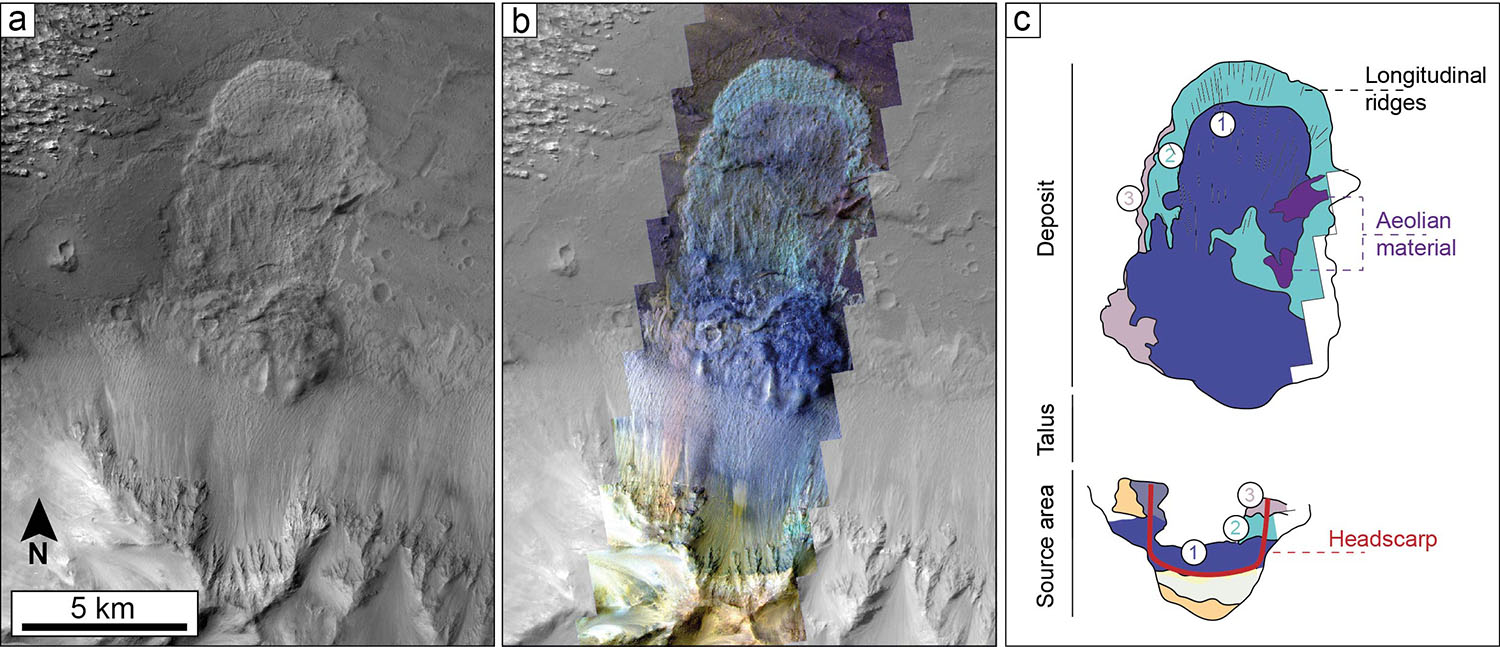
Figure 1 – Rock-avalanche in Central Coprates Chasma, Mars. (a) View of the landslide with CTX imagery. (b) View of the landslide and its headscarp with CaSSIS imagery (image ID MY35_014163_346_0). (c) Map of different rock-avalanche units as they outcrop on the surface of the deposit and at the headwall. The numbers show the three identified units, whose relative stratigraphic order has been maintained from the source area to deposition.
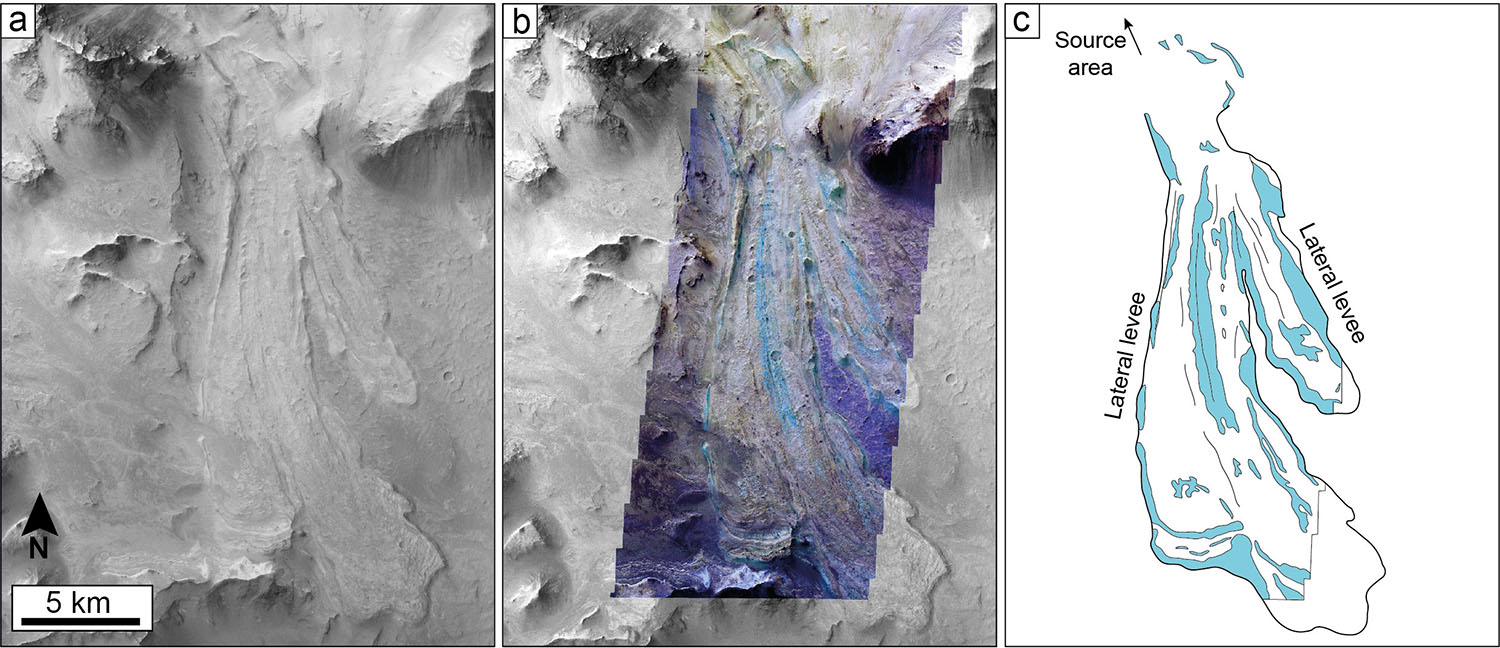
Figure 2 – Rock-avalanche in East Coprates Chasma, Mars. (a) View of the landslide with CTX imagery. (b) view of the landslide with CaSSIS imagery (image ID MY37_029999_344_0); no Cassis image cover the source area. (c) Map of the distinctive turquoise unit consistently found in correspondence of lateral leveed and frontal end of the deposit.
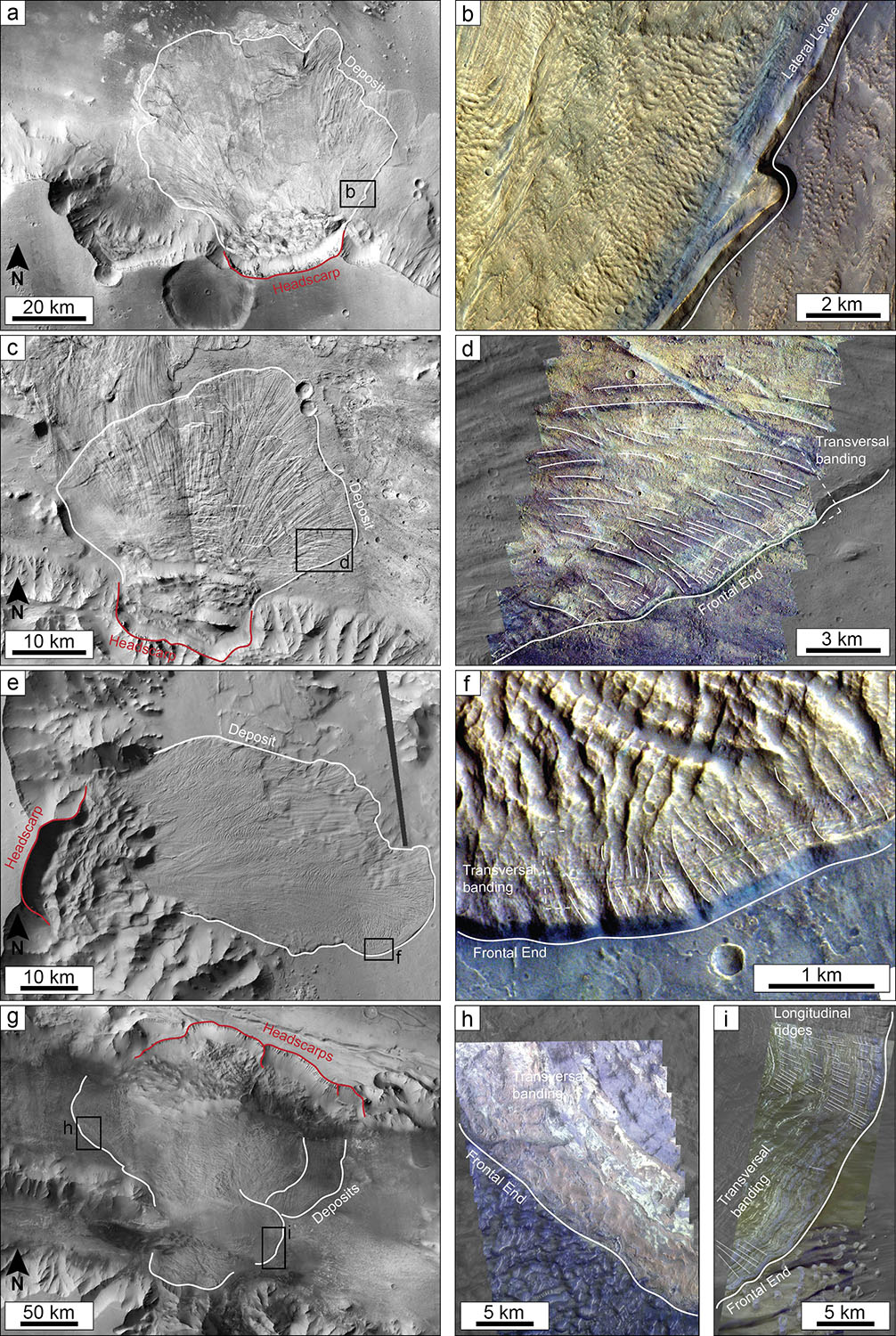
Figure 3 – Examples of segregation of units along lateral levees (b) (CaSSIS image ID MY36_021103_351_0) in a rock avalanche in Ganges Chasma (a). Examples of transversal banding at the terminal part of the deposit in rock-avalanches in West Coprates Chasma (c)(d) ((CaSSIS image ID MY36_014387), in Ganges Chasma (e)(f) (CaSSIS image ID MY36_014436_351_0), and in Ius Chasma (g)(h)(i) (CaSSIS image IDs MY37_026523_188_0 and MY37_022734_349_0). Longitudinal ridges are mapped using thin white lines in (d)(f) and (i), showing a lack of relationship with the unit forming the transversal banding patterns.
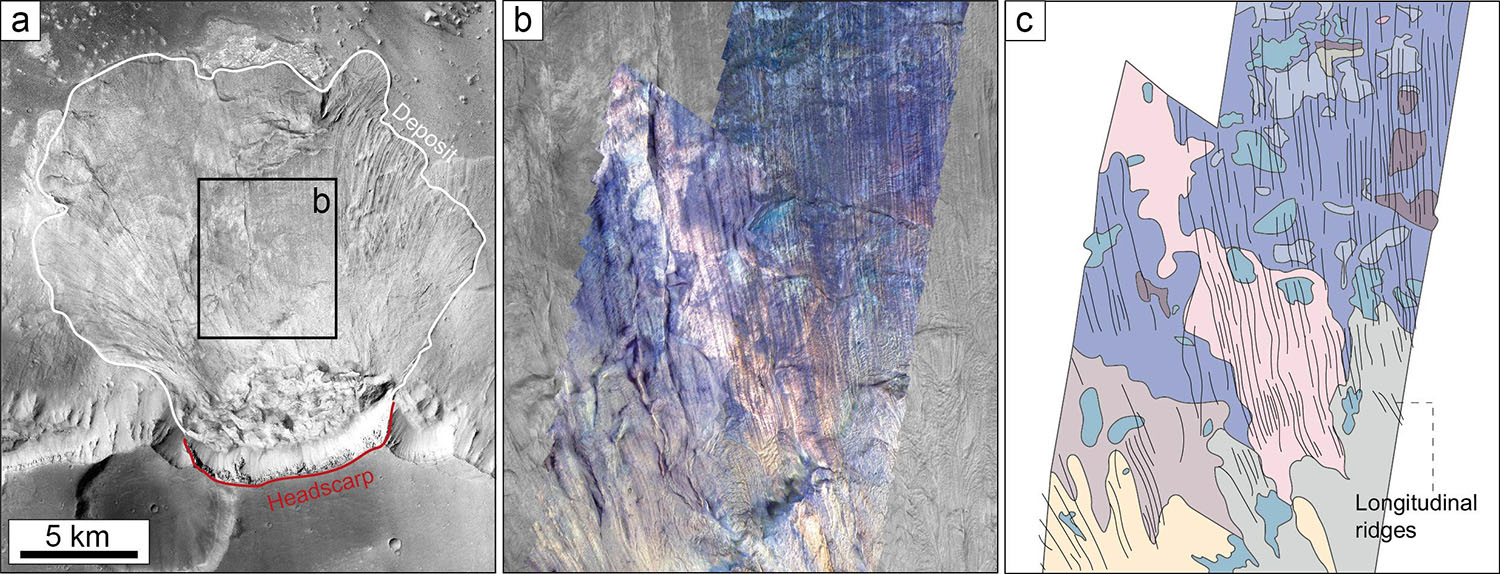
Figure 4 – Rock-avalanche in Ganges Chasma, Mars. (a) View of the landslide with CTX imagery. (b) view of the central section of the landslide deposit characterized by extensive longitudinal ridges with CaSSIS imagery (images ID MY38_031504_349_0 and ID MY36_021215_349_0). (c) Map of the distinctive colorful units showing a lack of relationship with the longitudinal topographic ridges that characterize the surface of the deposit (represented by thin black lines).
References:
Magnarini, G. et al. (2019) Longitudinal ridges imparted by high-speed granular flow mechanisms in martian landslides. Nat Commun 10, 4711. https://doi.org/10.1038/s41467-019-12734-0
Magnarini, G. et al. (2014) Long-runout landslides with associated longitudinal ridges in Iceland as analogues of Martian landslide deposits, Earth Surf. Dynam., 12, 657–678, https://doi.org/10.5194/esurf-12-657-2024
Shea, T. and van Wyk de Vries, B (2008) Structural analysis and analogue modeling of the kinematics and dynamics of rockslide avalanches. Geosphere 4, 657–686. doi: https://doi.org/10.1130/GES00131.1
CaSSIS Science Team
How to cite: Magnarini, G., McNeil, J., Stabbins, R., Grindrod, P., and Conway, S. and the CaSSIS Science Team: Martian Rock-Avalanche Kinematics Revealed by Multi-Spectral Imagery, Europlanet Science Congress 2026, The Hague, The Netherlands, 7–11 Sep 2026, EPSC2026-464, https://doi.org/10.5194/epsc2026-464, 2026.


